

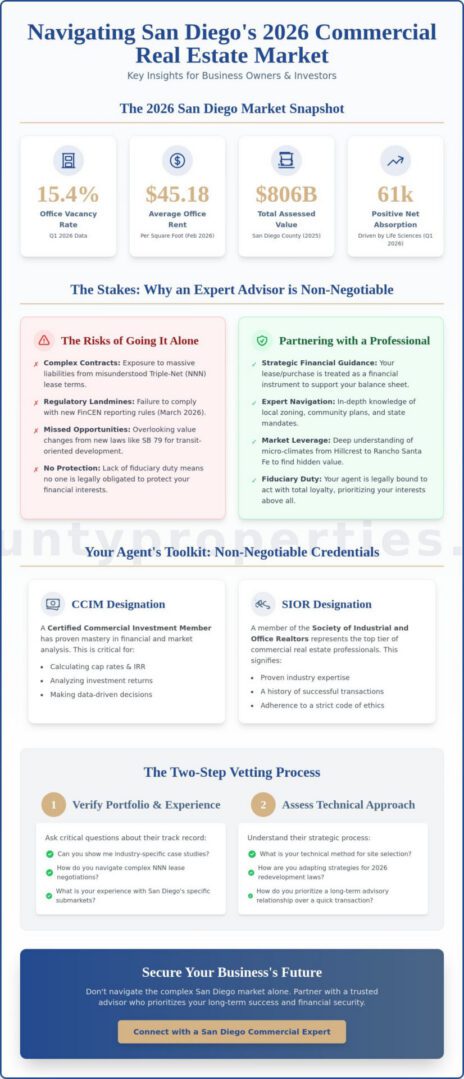
With San Diego’s office vacancy rate climbing to 15.4% in the first quarter of 2026, why does it still feel impossible to find the right space without overpaying? If you are currently finding a commercial real estate agent in San Diego, you likely feel the pressure of a market where average office rents hit $45.18 per square foot in February 2026. You might worry about navigating complex zoning changes like SB 79 or feel like a small fish at a massive global brokerage.
We understand that your business isn’t just a transaction; it’s your legacy. You deserve an advisor who prioritizes your growth over a quick commission check. This guide will show you how to identify and vet a partner who understands the nuances of triple-net (NNN) leases and San Diego’s new 2026 redevelopment laws. We’ll walk through the specific questions to ask and the red flags to watch for so you can secure a space that actually supports your business’s future.
Key Takeaways
- Understand how the 2026 market shifts, including rising office vacancies and new redevelopment laws, change the way you should approach your property search.
- Learn why finding a commercial real estate agent in San Diego who holds specialized designations like CCIM or SIOR is critical for navigating complex NNN lease negotiations.
- Discover the collaborative team advantage and why a boutique, service-centric model often outperforms the high-pressure environment of global corporate brokerages.
- Master a two-step interview process to verify an agent’s industry-specific portfolio and their technical approach to site selection.
- Partner with a seasoned mentor who prioritizes long-term advisory relationships over simple transactions to ensure your business’s financial security.
Navigating the San Diego Commercial Real Estate Landscape in 2026
Finding a commercial real estate agent in San Diego in 2026 requires a shift in perspective. You aren’t just looking for a tour guide; you’re seeking a strategic business consultant. A commercial specialist treats your lease or purchase as a financial instrument that must support your long-term balance sheet. Unlike residential representation, which centers on personal lifestyle, commercial agents facilitate understanding commercial real estate through the lens of utility, traffic counts, and zoning potential. In a market where office rents averaged $45.18 per square foot in February 2026, the margin for error is razor-thin.
Local expertise is the only way to navigate the specific micro-climates of San Diego’s neighborhoods. An agent who knows Hillcrest understands the nuances of urban density and parking challenges, while one focused on Rancho Santa Fe recognizes the premium placed on privacy and professional finishes. With the total gross assessed value of San Diego County reaching $806 billion in 2025, every square foot carries significant financial weight. Your agent must understand how local community plans interact with new state mandates to protect your business’s future.
Key Economic Drivers in San Diego County
The life sciences sector remains the engine of the local economy. In the first quarter of 2026, office space saw a positive net absorption of 61,344 square feet, largely driven by the demand for specialized lab and R&D environments. While the overall office vacancy rate hit 15.4%, biotech hubs continue to see active, price-sensitive development. Simultaneously, walkable urban cores are experiencing a retail resurgence as consumers prioritize experiential shopping. To understand how these trends fit into the broader regional picture, investors should review this guide to commercial real estate southern california for deeper insights into market cycles.
The Risks of Going It Alone in a Competitive Market
Attempting to negotiate a commercial deal without representation exposes your business to massive liabilities. Commercial contracts are far more complex than residential agreements; they often involve intricate triple-net (NNN) expense reconciliations and environmental compliance hurdles. When finding a commercial real estate agent in San Diego, prioritize those who understand the new FinCEN reporting rules for all-cash entity transactions that began March 1, 2026. Furthermore, as of July 1, 2026, SB 79 allows for increased transit-oriented development, which can fundamentally change a property’s value overnight. Fiduciary duty is the legal obligation for a commercial agent to act with total loyalty and care, prioritizing the client’s financial interests above all other parties.
Essential Criteria for Selecting Your San Diego Agent
Finding a commercial real estate agent in San Diego is about vetting for substance over style. Many corporate firms prioritize individual marketing egos, but your business needs a partner committed to a service-centric philosophy. This means choosing someone who acts as a long-term advisor rather than a transactional broker. An agent’s adherence to the REALTOR® Code of Ethics ensures that your financial interests remain protected throughout the entire process. You want a steady hand to guide you, not a flashy salesperson who disappears after the lease is signed.
Professional Designations and What They Mean
Look for a Certified Commercial Investment Member (CCIM) or an SIOR designation. A CCIM proves the agent has mastered financial and market analysis, which is essential when calculating cap rates or internal rates of return. An agent’s background in selling a home in southern california is also surprisingly relevant for modern mixed-use projects. They understand the residential buyer’s mindset, which is crucial for the housing component of commercial developments. Specialized senior real estate knowledge is equally vital if you’re entering the healthcare commercial space, as these properties have distinct regulatory and accessibility requirements.
When finding a commercial real estate agent in San Diego, verify their grasp of local assessments. While Proposition 13 caps the base property tax rate at 1% of the assessed value, voter-approved bonds often push the effective rate between 1.05% and 1.25%. A local expert knows that the first tax installment is due November 1st and becomes delinquent after December 10th. Missing these nuances can result in costly penalties. Your agent should also have an established network of local contractors, lawyers, and inspectors to streamline your due diligence period.
Evaluating Their Negotiation Track Record
Don’t just ask how many deals they’ve closed; ask about the Tenant Improvements (TI) they’ve secured. A skilled negotiator can often win significant build-out credits that save your business capital upfront. In 2026, you also need an agent who understands California’s latest climate-compliance mandates for commercial structures. Access to off-market deals is another hallmark of a top-tier San Diego agent. Many of the best opportunities never hit public listing sites. They’re found through deep-rooted local relationships. If you’re ready to partner with a team that values your long-term success, contact our local experts today for a strategic consultation.
Global Giants vs. Local Boutique Agencies: The Collaborative Advantage
Deciding between a global brokerage and a local boutique firm is one of the most critical steps in finding a commercial real estate agent in San Diego. While the “Big Box” names often boast about their massive headcount, that size can actually work against a small-to-mid-sized business owner. Large firms frequently operate on a model of internal competition where agents guard their listings from their own colleagues. In contrast, a collaborative team concept ensures that every resource within the office is focused on your specific goal. Volume shouldn’t dictate value.
There is a persistent myth that only the largest firms have access to the best San Diego listings. In 2026, technology has leveled the playing field. Boutique firms access the same global databases, such as CoStar and LoopNet, while maintaining deep-rooted local relationships that lead to exclusive off-market opportunities. These smaller, agile teams provide personalized, step-by-step guidance through complex transitions. They treat you like a partner, not a file number.
The Corporate Model: Volume Over Value?
In many large San Diego brokerages, the “junior agent hand-off” is a common practice. You might meet with a high-profile senior partner to sign the representation agreement, only to have the actual site selection and negotiation handled by a junior associate with limited experience. Individual agent quotas in these environments can also conflict with your interests. When an agent is pressured to hit a quarterly volume target, they might encourage you to settle for a space that doesn’t fully support your long-term business strategy. This model lacks the holistic support necessary for businesses navigating the current 15.4% office vacancy rate.
The Boutique Advantage: A Holistic Approach
County Properties operates on a “team concept” where agents work together for the client’s benefit rather than competing for individual glory. This “family of friends” approach ensures that you always have access to seasoned expertise. When you are finding a commercial real estate agent in San Diego, having a professional like Arnie Levine involved in your strategy provides a distinct advantage. With 36 years of experience in the San Diego market, he ensures that every negotiation is backed by decades of local data and historical context. This level of mentorship is rare in high-turnover corporate offices. For more tips on selecting the right partner, see our guide on how to find the best real estate agent near you. Our commitment is to your financial security, ensuring that your commercial space becomes a foundation for growth rather than a liability.
How to Vet and Interview Your Potential San Diego Commercial Agent
Finding a commercial real estate agent in San Diego requires a move away from superficial metrics like online star ratings. Reviews often fail to reveal if an agent’s strategy aligns with your five year business plan. To ensure your financial security, you need a vetting framework that prioritizes technical competence and local market intelligence. Start by requesting a portfolio of transactions from the last 24 months that specifically match your industry. If you are looking for retail space, for instance, you need an agent who successfully navigated the negative net absorption of -251,512 square feet seen in the first quarter of 2026.
Your interview should also uncover their specific process for market analysis. With San Diego’s industrial vacancy rate sitting at 7.3% in early 2026, you can’t afford an advisor who simply waits for listings to appear on public databases. Ask how they identify off-market opportunities and how they use data to project future rent escalations. Most importantly, verify their collaborative approach. You should know exactly who will be handling your lease negotiations. If the senior partner plans to hand you off to a junior associate after the first meeting, it’s a sign that your business isn’t their top priority.
5 Critical Questions to Ask During the Interview
- Question 1: “How do you handle conflicts of interest if you represent both the landlord and the tenant in the same building?”
- Question 2: “What is your specific experience with San Diego’s 2026 zoning updates, such as AB 1050 or the transit-oriented development plans under SB 79?”
- Question 3: “Can you provide a turn-key solution that includes a network of vetted local contractors and inspectors for my transition?”
- Question 4: “How do you factor the 2026 FinCEN reporting rules for all-cash transactions into your closing timeline?”
- Question 5: “What is your primary method of communication, and does it align with my business’s operational rhythm?”
Red Flags to Watch For in Commercial Brokerage
Beware of agents who promise the “lowest price” before they’ve even reviewed a property’s profit and loss statement or your specific space requirements. In commercial real estate, value is driven by income and utility, not just a low sticker price. Avoid agents who don’t ask about your long-term financial security goals or how the space fits into your exit strategy. You should also stay away from lone wolf agents who lack a dedicated support team to manage the intense due diligence required for modern environmental and climate-compliance mandates. If you’re ready to partner with a team that puts your goals first, schedule a strategic vetting session with our experts today.
County Properties: Your Trusted San Diego Commercial Partner
Finding a commercial real estate agent in San Diego shouldn’t feel like a high-pressure sales encounter. At County Properties, we believe the process works best when it’s built on a foundation of trust and seasoned expertise. Arnie Levine brings 36 years of experience to the table, having guided clients through every market cycle since 1995. We’ve seen the San Diego market grow to a gross assessed value of $806 billion in 2025, and we understand that your specific investment or lease is a vital part of that landscape. Our team prioritizes a service-centric philosophy that puts your business’s financial security ahead of our own marketing metrics.
When you are finding a commercial real estate agent in San Diego, you need a partner who can bridge the gap between different real estate needs. Whether you’re a business owner looking for your first storefront or an investor managing a mixed-use property, our holistic approach ensures a seamless transition. We don’t just close deals; we serve as your long-term advisory partner. This is especially critical in 2026 as businesses navigate new transit-oriented zoning and complex climate compliance mandates. Our commitment is not just to close a transaction, but to empower you with the data and guidance needed for success.
A Vision for Collaborative Real Estate
Arnie Levine envisioned a different kind of brokerage when he founded this company. He explicitly rejected traditional real estate office protocols that foster internal competition between agents. Instead, he created a team concept where every agent works collaboratively. This family of friends culture means that when you hire us, you gain the collective wisdom of our entire office. We also bring specialized knowledge in senior real estate needs. This is a crucial asset for healthcare commercial transitions or business owners planning for retirement and legacy transfers. We treat your journey with the empathy and professional care it deserves.
Take the Next Step in Your Business Journey
The 2026 market is competitive, but you don’t have to face it alone. We invite you to a no-obligation consultation to discuss your specific San Diego property goals. Whether you need seller representation, buyer representation, or expert advice on a complex commercial lease, our team is ready to provide personalized, step-by-step guidance. We believe that your success is the only true measure of our own. At County Properties, we say that we help make your dreams come true. It’s not just a slogan; it’s a commitment. Contact Arnie Levine and our dedicated team today to secure a partner who truly understands the San Diego landscape.
Secure Your Business’s Future in the San Diego Market
The 2026 San Diego market demands a partner who acts as a strategic advisor. Finding a commercial real estate agent in San Diego shouldn’t lead you to a junior associate at a massive brokerage. You need a team that prioritizes your financial security through a collaborative, service-centric model. County Properties brings 36 years of deep local market experience to your search. Under the seasoned professional leadership of Arnie Levine, we offer specialized expertise in senior real estate transitions and distressed properties. We focus on securing turn-key solutions that support your long-term growth rather than just closing a quick transaction.
Your business journey deserves the steady hand of a mentor who understands the nuances of 2026 California climate mandates and Proposition 13 tax implications. Partner with a San Diego expert—contact County Properties today for your commercial real estate consultation. We’re here to guide you through every step of this complex landscape with transparency and care. Let’s start building your legacy today.
Frequently Asked Questions
What is the difference between a commercial real estate agent and a broker in San Diego?
Brokers in San Diego hold a higher license level that allows them to own their own firm or employ other agents. While both can facilitate transactions, a broker has completed additional California Department of Real Estate education and experience requirements. When finding a commercial real estate agent in San Diego, it’s beneficial to know if your advisor is a broker-associate or is closely mentored by a broker with decades of local history.
How are commercial real estate agents typically paid in California?
Commercial real estate commissions in California typically range from 4% to 6% of the total rent over the lease term or the final sales price. These fees are usually paid by the landlord or seller, meaning tenant or buyer representation often comes at no direct out of pocket cost to you. Your agent should clearly disclose these arrangements early in your business journey to ensure total transparency and financial security.
Do I need a specialized agent for San Diego life science or biotech properties?
Specialized expertise is vital because life science properties require complex infrastructure like high-power HVAC and lab-grade plumbing. With San Diego’s office market seeing a positive net absorption of 61,344 square feet in Q1 2026 driven by biotech, these spaces are highly competitive. An expert agent understands these technical requirements and can identify properties that meet strict R&D regulatory standards that generalists might miss.
What should I look for in a San Diego commercial lease agreement in 2026?
Look for updated clauses regarding California’s 2026 climate compliance mandates and clear definitions of operating expense pass-throughs. You should also ensure the lease accounts for new transit-oriented development rules under SB 79, which became effective July 1, 2026. A strategic agent will negotiate for tenant improvement allowances that offset the costs of modernizing older Class B office spaces to meet these new standards.
Can a residential agent help me buy commercial property in San Diego?
While a residential agent can legally represent you, it’s risky because they often lack the technical tools to analyze cap rates or complex zoning. Finding a commercial real estate agent in San Diego who understands the 5.16% average cap rate and NNN structures is essential for your financial security. Commercial deals involve different contracts and longer due diligence periods that residential specialists rarely navigate successfully.
How has the 2026 San Diego market changed for commercial buyers?
The market has shifted toward a buyer-friendly environment in the office sector with a 15.4% vacancy rate as of Q1 2026. New FinCEN rules implemented on March 1, 2026, now require reporting for all-cash transactions involving LLCs to prevent money laundering. Additionally, AB 1050 has made it easier to convert commercially zoned properties into mixed-use housing, creating new redevelopment opportunities for investors looking to pivot underutilized assets.
What is a ‘triple net’ (NNN) lease and how does an agent help negotiate it?
A triple net lease requires the tenant to pay base rent plus their share of property taxes, insurance, and common area maintenance (CAM). Agents help by auditing these expenses to ensure you aren’t overcharged for building operations. Given that San Diego property taxes are capped at 1% but often reach 1.25% with voter-approved assessments, having an expert verify these numbers during negotiations is critical to your bottom line.
Why is Arnie Levine’s team approach different from other San Diego firms?
Arnie Levine’s model replaces the high-pressure internal competition found at global firms with a collaborative “family of friends” philosophy. Instead of being handed off to a junior associate, you benefit from Arnie’s 36 years of San Diego market experience. This team concept ensures that every resource in the office is working toward your business goals rather than individual agent quotas, providing a more holistic and supportive experience.