

What if the most effective way to protect your financial legacy isn’t clinging to a mortgage you can’t pay, but rather negotiating a graceful exit on your own terms? If you’re facing a notice of default in 2026, you likely feel the weight of a potential 100 point credit score drop or the fear of a lender suing you for a deficiency balance. It’s a heavy burden to carry alone while trying to distinguish between complex legal options like short sales or foreclosures.
Understanding what is a deed in lieu of foreclosure California homeowners can use to their advantage is the first step toward regaining your peace of mind. Our team at County Properties has spent over 36 years helping families find a path forward through difficult real estate transitions. We’ll show you how this process can secure a clean break from your property and even result in relocation assistance through “cash for keys” programs. This guide breaks down the legal requirements, the impact on your credit, and the specific steps to take to ensure your lender waives their right to pursue you for unpaid debt.
Key Takeaways
- Learn how a deed in lieu of foreclosure serves as a voluntary “graceful exit” by transferring your property title to the lender to satisfy mortgage debt.
- Discover the specific credit benefits of this option, including how to avoid a permanent “Trustee Sale” record that can impact future rental applications.
- Understand exactly what is a deed in lieu of foreclosure California homeowners can use to leverage state anti-deficiency laws and the One Action Rule for financial protection.
- Identify the critical steps to qualify for this program, including how to properly submit a financial package and a persuasive hardship letter to your loan servicer.
- Find out why working with a Senior Real Estate Specialist (SRES®) is essential for navigating complex transitions and ensuring a smooth, professional property transfer.
Understanding the Deed in Lieu of Foreclosure in California
Facing the possibility of losing your home is an overwhelming experience, but you have options beyond a standard bank seizure. When you ask what is a deed in lieu of foreclosure California homeowners often find it’s a strategic way to regain control of their financial future. A deed in lieu is a contractual agreement where the homeowner swaps the property title for a full release of the mortgage debt. Instead of waiting for a bank to seize the home through a trustee sale, you proactively transfer the ownership to the lender.
In the California real estate market of 2026, this is frequently viewed as a graceful exit. It provides a structured departure from a property you can no longer afford without the heavy stigma of a completed foreclosure on your record. This arrangement must be entirely mutual; your lender isn’t legally required to accept your deed. They will typically only agree if the property value is close to the loan balance and the title is clear of other complications. A Deed in lieu of foreclosure serves as a settlement that can save both parties the high costs associated with litigation and property auctions.
The Legal Mechanics of Voluntary Conveyance
The process involves a legal document known as a grant deed, which is recorded at the county level to transfer ownership directly to the mortgage servicer. Lenders often prefer this method because it bypasses the California non-judicial foreclosure process, which can take 120 to 200 days to complete. By accepting a voluntary conveyance, the bank gains control of the asset much faster and in better condition.
There is a strict requirement for this path: the property must be free of secondary liens. If you have a second mortgage, a home equity line of credit (HELOC), or significant tax liens, the lender will likely decline the deed in lieu. They don’t want to inherit your other debts. They need a “clean” title so they can sell the property immediately to recoup their losses.
Why Homeowners Choose This Path in 2026
Privacy is a major factor for California families today. Choosing this route helps you avoid the public embarrassment of a foreclosure notice posted on your front door for neighbors to see. It’s a private transaction between you and the bank that doesn’t involve a public auction on the courthouse steps. Other benefits include:
- Release of Liability: You can negotiate a written “release of liability” to ensure the bank cannot pursue a deficiency judgment against you later.
- Streamlined Transition: It allows you to coordinate a specific move-out date, making the transition to a more affordable living situation much smoother.
- Credit Recovery: While it still impacts your credit score, a deed in lieu is often viewed more favorably by future creditors than a forced foreclosure.
Understanding what is a deed in lieu of foreclosure California requires looking at your specific loan terms and property value. Our team focuses on providing the guidance you need to make these tough decisions with confidence and security. We believe in helping you take the next step in your life’s journey with your dignity intact.
Benefits of a Deed in Lieu vs. Traditional Foreclosure
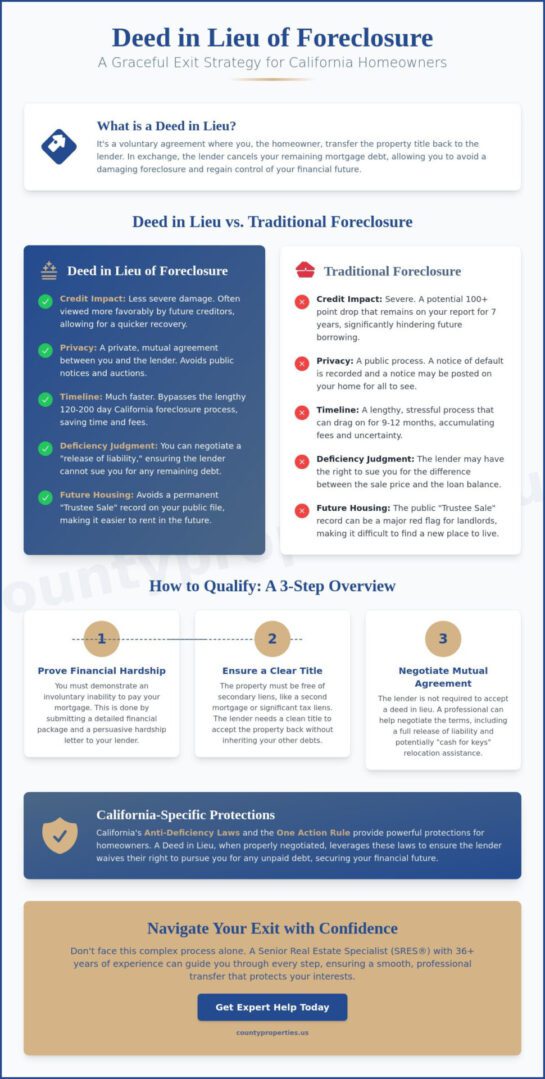
Choosing a deed in lieu over a traditional foreclosure offers several strategic advantages for California homeowners facing 2026’s shifting real estate market. While both options involve surrendering the property, a deed in lieu is generally viewed as a more cooperative resolution. This proactive approach avoids the public “Trustee Sale” record that follows a standard foreclosure. That specific record often acts as a red flag for future landlords and property managers during rental applications. By opting for a deed in lieu, you can move forward with a cleaner public record.
Homeowners often ask what is a deed in lieu of foreclosure California when they realize a standard sale isn’t possible. It’s a private agreement where you voluntarily transfer the title to your lender to satisfy the loan. This process is significantly faster than a foreclosure, which can drag on for nine to twelve months in some counties. A faster resolution means you can stop the accumulation of late fees and legal costs sooner, allowing your financial recovery to begin immediately.
Credit Score and Future Borrowing Impact
A foreclosure typically stays on your credit report for seven years and can drop your score by 100 to 150 points. While a deed in lieu also affects your credit, the long-term impact is often less severe. Understanding what is a deed in lieu of foreclosure California involves looking at the “settled for less than full balance” remark that appears on your report. This is generally viewed more favorably by future creditors than a forced foreclosure judgment.
Future borrowing is another area where this choice pays off. Fannie Mae and Freddie Mac guidelines typically impose a seven-year waiting period after a foreclosure before you can qualify for a new mortgage. In contrast, a deed in lieu may reduce that waiting period to just four years, or even two years if you can prove extenuating circumstances. Before you sign any transfer documents, you need to verify that the agreement releases you from all future liability. California’s legal structure, specifically the one-action rule and anti-deficiency protections, provides a safety net for many borrowers. However, the deed must be drafted carefully to ensure the lender doesn’t pursue a deficiency judgment later.
Financial Incentives and Relocation Assistance
One of the most immediate benefits is the potential for relocation assistance. Programs often called “Cash for Keys” are frequently offered by major lenders like Chase, Wells Fargo, or Bank of America. These payments can range from $3,000 to $10,000 depending on the lender’s current policies and the property’s value. This cash can be the lifeline you need to fund a security deposit on a new rental or pay for moving trucks.
To secure these incentives, lenders require the home to be left in “broom clean” condition. This means all personal belongings are removed, the interior is vacuumed or swept, and no damage has been done to the fixtures. Negotiating these moving expenses should be a core part of your agreement. Finding the right path forward doesn’t have to be a solo journey. You can reach out to our seasoned advisors for personalized guidance on your property’s value and your relocation options.
California Specifics: Anti-Deficiency Laws and the One Action Rule
California provides some of the strongest homeowner protections in the country, but you have to know how to trigger them. The foundation of these protections is the “One Action Rule” found in California Code of Civil Procedure § 726. This law prevents a lender from harassing you with multiple lawsuits. They’re limited to one legal action to recover their debt, which is usually the foreclosure process itself. When you’re researching what is a deed in lieu of foreclosure California, you’ll find that this rule forces the bank to choose between taking the property or suing you personally, they can’t easily do both.
Most California homeowners are protected by anti-deficiency laws under CCP § 580d. This statute prevents lenders from seeking a “deficiency judgment” after a non-judicial foreclosure. However, a deed in lieu is a voluntary transfer, not a foreclosure sale. Because it’s a private contract, the standard protections don’t always apply automatically. You must ensure the deed in lieu documents explicitly state that the transaction fully satisfies the debt. Without this language, a lender holding a “recourse loan” could potentially pursue you for the difference between the home’s value and the total loan balance.
Recourse loans are common for refinanced mortgages or properties that aren’t your primary residence. If your loan falls into this category, the bank has the right to go after your bank accounts or wages. Our team at County Properties focuses on ensuring every agreement is airtight so your financial security remains intact after you hand over the keys.
The Challenge of Second Mortgages and Junior Liens
A deed in lieu is often impossible if you have a HELOC or a second mortgage. The primary lender won’t accept the title if it comes with your other debts attached. To make this work, you’ll need to negotiate directly with junior lienholders to get them to release their claim for a small settlement. If the junior lenders won’t budge, a short sale is usually a better option. It allows for a structured payout to all lenders during the escrow process, which clears the title more effectively than a voluntary conveyance.
Tax Implications for California Homeowners
The IRS generally treats forgiven debt as “Cancellation of Debt” income. If a bank waives $150,000 of your mortgage balance, they’ll likely send you IRS Form 1099-C. This could result in a massive tax bill because that $150,000 is taxed as if you earned it in cash. For the 2026 tax year, California’s treatment of forgiven debt can be complex. While state-level relief often mirrors federal exemptions for primary residences, these rules change frequently. You must consult a qualified tax professional to see if you qualify for insolvency exclusions or other state-specific relief before signing any documents.
The Step-by-Step Process to Qualify for a Deed in Lieu
Securing a deed in lieu of foreclosure is a structured legal negotiation. It requires active cooperation between you and your lender to prove that a voluntary transfer is the most efficient path forward for both parties. Understanding what is a deed in lieu of foreclosure California homeowners must navigate involves following a specific five-step sequence required by most major loan servicers.
- Step 1: Initial Outreach. Contact your loan servicer’s loss mitigation department. This is a specialized team, separate from standard customer service, tasked with preventing foreclosures.
- Step 2: Financial Disclosure. You’ll submit a complete “Loss Mitigation Package.” This includes your last two years of federal tax returns, two months of recent bank statements, and a detailed monthly budget.
- Step 3: The Marketing Period. Most lenders require you to list the home with a licensed agent for at least 90 days. This proves the property cannot be sold at market value for a price that covers the existing loan balance.
- Step 4: Valuation and Title Review. The bank orders an independent appraisal or a Broker Price Opinion (BPO) to confirm the home’s current worth. Simultaneously, they’ll run a title search to check for secondary liens.
- Step 5: Final Execution. If approved, you sign the Grant Deed and a settlement agreement. You must vacate the property by the date specified in the contract, often receiving a “Cash for Keys” relocation incentive.
Proving Financial Hardship
Lenders won’t accept a deed in lieu just because a homeowner is “underwater” on their mortgage. You must demonstrate a legitimate financial crisis that makes future payments impossible. Common qualifying hardships include a documented job loss, a medical crisis with high out-of-pocket costs, or a divorce that eliminates a primary income source. Your hardship letter should be concise. Stick to facts and dates rather than emotional pleas. Banks look for a clear “cause and effect” relationship between your life events and your inability to pay.
The Appraisal and Title Search
The bank’s decision hinges on the numbers. During the appraisal phase, a local San Diego real estate professional provides a BPO to determine if the bank can recoup its investment quickly. Part of what is a deed in lieu of foreclosure California requirements includes a “clean” title. If you have unpaid contractor liens, secondary mortgages, or tax judgments, the bank will likely reject the deed in lieu. These “clouds” on the title must be cleared or settled before the bank will agree to take back the property, as they don’t want to inherit your secondary debts.
If you’re facing a potential foreclosure and need an expert to guide you through the loss mitigation process, we can help. Contact County Properties today for a confidential consultation on your options.
Partnering with a Southern California Expert for a Smooth Exit
Facing the threat of losing your home creates immense pressure. You don’t have to manage this burden by yourself. An agent who specializes in foreclosure prevention in California provides the buffer you need between your family and the lender. At County Properties, we serve as your lead advocate. We negotiate the terms of your exit to ensure the lender waives their right to pursue a deficiency judgment, which protects your future earnings. We prioritize your financial security over simple transaction volume.
Our team features a Senior Real Estate Specialist (SRES®) who understands the unique hurdles faced by long-term homeowners. Financial distress often coincides with other life changes like retirement or health transitions. We provide a holistic approach that respects your history with the property while clearing a path for your next chapter. Understanding exactly what is a deed in lieu of foreclosure California homeowners can use to their advantage is our specialty. We turn a stressful legal process into a managed transition.
Short Sale vs. Deed in Lieu: Which Is Right for You?
Choosing between these two options depends on your timeline. A short sale involves listing the home on the open market, which typically takes 120 to 180 days in the current San Diego climate. Lenders usually prefer this route because it proves the property’s fair market value. However, if your home has been on the market for 90 days without a viable buyer, we can often pivot to a deed in lieu. This option is faster and stops the foreclosure clock immediately. While both impact your credit, a deed in lieu can sometimes allow you to re-enter the housing market sooner if the lender reports the debt as “settled in full.”
Planning Your Next Step with County Properties
Arnie Levine and the team leverage 36 years of San Diego market experience to protect your interests. We don’t just help you leave your current home; we help you find where you’re going next. For seniors downsizing during financial distress, we provide personalized guidance to find affordable, high-quality housing that fits a new budget. We’ve spent decades building a “family of friends” through our service-centric philosophy, and we apply that same care to every client facing foreclosure. You deserve a partner who values your peace of mind as much as the final paperwork.
Don’t wait for the bank to make the first move. Contact Arnie Levine and the team for a confidential consultation on your options. We will help you understand what is a deed in lieu of foreclosure California law allows and how it fits into your specific financial recovery plan.
Take Control of Your Real Estate Transition
Navigating the complexities of distressed property requires more than just luck. You need a strategy that prioritizes your dignity and long term financial health. California anti-deficiency laws and the One Action Rule provide a safety net that many homeowners overlook. Knowing exactly what is a deed in lieu of foreclosure California residents can leverage allows you to bypass the public auction process and potentially walk away without a deficiency judgment. It’s a proactive choice that protects your credit score more effectively than a standard foreclosure.
Our team at County Properties brings 36+ years of Southern California real estate experience to your corner. As Short Sale and Foreclosure Prevention Specialists and Senior Real Estate Specialists (SRES®), we focus on creating dignified transitions for every client. You don’t have to face the bank alone or feel overwhelmed by 2026 market shifts. We’re here to provide the seasoned guidance you deserve for a seamless exit from a difficult situation.
Get a Free, Confidential Foreclosure Consultation with County Properties
Take the first step toward a fresh start today. You have options, and we’re ready to help you find the best path forward.
Frequently Asked Questions
Is a deed in lieu better for my credit than a foreclosure in California?
A deed in lieu of foreclosure typically results in a 50 to 125 point drop in your credit score, which is often similar to the impact of a foreclosure. The primary advantage is how it looks to future lenders during a manual review. It shows you cooperated with the bank rather than abandoning the property, which can be a deciding factor when you apply for credit later.
FHA guidelines allow you to apply for a new mortgage just 3 years after a deed in lieu. In contrast, a standard foreclosure usually requires a 7 year waiting period. Choosing this path helps you start the recovery process sooner and protects your ability to rent or buy in the future.
Can I be sued for a deficiency after a deed in lieu in California?
You won’t be sued for a deficiency if your written agreement specifically includes a “full satisfaction” clause that waives the lender’s right to pursue the balance. While California Code of Civil Procedure Section 580d protects homeowners from deficiency judgments in non-judicial foreclosures, those same protections don’t automatically apply to a voluntary deed transfer.
You must negotiate this waiver directly with your lender. Without this specific language in your contract, a lender could theoretically sell the remaining debt to a collection agency. Our team ensures that any agreement you sign protects your financial security by confirming the debt is fully extinguished.
How long does the deed in lieu process take in San Diego?
The deed in lieu process in San Diego typically takes 90 to 120 days from the moment you submit your initial application package. This timeline is significantly faster than a California foreclosure, which often lasts over 200 days. Understanding what is a deed in lieu of foreclosure California helps homeowners realize it’s an efficient way to resolve debt and move forward.
The speed of the process depends on how quickly you provide the 10 to 15 required financial documents. Lenders usually respond to an initial request within 30 days, followed by a property appraisal and a title search to ensure there are no other liens.
Do I have to pay taxes on the forgiven debt after a deed in lieu?
You might owe taxes on the forgiven amount because the IRS generally treats canceled debt as taxable income. You’ll receive a Form 1099-C from your lender showing the exact amount of debt that was forgiven. However, you may qualify for an exclusion under the California Foreclosure Reduction Act or federal insolvency rules.
If the property was your primary residence, you could potentially avoid these taxes, but it’s not guaranteed. You should consult a tax professional to see if you meet the criteria for the 100% exclusion, as tax laws regarding debt forgiveness change frequently.
Can I get a deed in lieu if I have a second mortgage or HELOC?
You can’t usually obtain a deed in lieu if you have a second mortgage or HELOC unless the junior lienholder agrees to release their claim. Lenders require a clear title before they’ll accept a deed. In 95% of cases involving multiple liens, the primary lender will reject the request because they don’t want to inherit your secondary debts.
To make this work, you’d need to negotiate a settlement with the second lender separately. This often involves a small cash payment to convince them to release the lien, allowing the primary deed in lieu to move forward.
What is “Cash for Keys” and how do I get it?
“Cash for Keys” is a relocation incentive where the lender pays you to vacate the property peacefully and leave it in good condition. In San Diego County, these payments often range from $1,500 to $3,000. It’s a way for the bank to avoid the high costs of a formal eviction process.
To get this incentive, you must request it during your initial negotiations. The bank will inspect the home to ensure it’s “broom clean” and free of damage before they hand over the check. It’s a helpful resource that provides immediate liquidity for your next security deposit.
Do I need a lawyer for a deed in lieu in California, or can a realtor help?
You don’t strictly need a lawyer, but working with an expert realtor who understands what is a deed in lieu of foreclosure California is essential for a smooth transition. Our team manages the complex paperwork and communicates with the bank’s loss mitigation department on your behalf. We provide the seasoned guidance you need to navigate the bank’s strict requirements.
While a lawyer is helpful for specific legal disputes, a realtor handles the practical aspects of the property transfer. We’ve spent 36 years helping homeowners find the best path forward, ensuring all documents are filed correctly to protect your interests.
How long do I have to wait to buy another home after a deed in lieu?
You must wait 2 to 4 years to buy another home after a deed in lieu, depending on the type of loan you seek. Fannie Mae and Freddie Mac typically require a 4 year waiting period for conventional loans. However, if you can prove extenuating circumstances like a job loss or medical emergency, that wait time could drop to 2 years.
This is a major advantage over foreclosure, which carries a mandatory 7 year wait for most conventional financing. By choosing a deed in lieu, you potentially save 3 to 5 years of waiting time, allowing you to return to homeownership much faster.