

Choosing to sell your home for less than you owe might actually be the fastest way to buy your next one. You’re likely feeling the weight of mounting debt and the paralyzing fear that your credit score will never recover. It’s natural to worry that one financial setback will lock you out of the Southern California housing market for a decade. Since 1995, we’ve helped families understand how a short sale affects your credit so they can make a move that protects their long term financial security.
In this 2026 guide, you’ll discover why a short sale remains a superior alternative to foreclosure for your financial health. You’ll learn why a short sale often allows you to apply for a new mortgage in as little as 24 months, while a foreclosure typically requires a seven year wait according to standard Fannie Mae guidelines. We’ll walk you through the specific credit reporting codes to watch for and the steps you must take to avoid a deficiency judgment. You’ll finish this article with a clear, strategic roadmap to minimize damage and reclaim your financial freedom.
Key Takeaways
- Gain clarity on how a short sale functions in the 2026 Southern California market to protect your financial security and take control of your housing transition.
- Understand exactly how a short sale affects your credit score and why the specific reporting notation is significantly less damaging than a foreclosure.
- Compare long-term recovery timelines to see why a short sale offers a much faster path for homeowners aiming to return to the market and regain homeownership.
- Follow a proven, step-by-step roadmap for rebuilding your credit profile immediately after the sale to restore your status as a qualified buyer.
- Learn why partnering with a local San Diego specialist is essential for negotiating “Full Satisfaction” terms that safeguard you from future lender claims.
What is a Short Sale and How Does It Work in 2026?
Understanding your options is the first step toward protecting your financial future. A short sale occurs when you sell your property for a price that is lower than the remaining balance on your mortgage. This process requires your lender to agree to “short” themselves on the payoff. To build a foundation for this discussion, you can review the basic definition of What is a Short Sale? to see how it differs from traditional real estate transactions.
In the 2026 Southern California market, many homeowners in San Diego and Riverside counties are navigating a shifting landscape. While regional home values adjusted by 3.8% in early 2026, some residents remain in “underwater” positions due to the high-interest environment of previous years. It’s important to remember that a short sale is a voluntary, negotiated settlement. Unlike the involuntary and often traumatic nature of a foreclosure, a short sale allows you to remain in the driver’s seat of your financial transition. We act as your seasoned partner to ensure the bank hears your voice.
Success in this process involves a specific team of players working toward a common goal:
- The Homeowner: You, the person taking proactive steps to resolve a debt.
- The Buyer: An independent party who makes a fair market offer on the property.
- The Lender: The financial institution that must approve the discounted payoff.
- The Short Sale Specialist: An expert negotiator who manages the intense documentation and bank communications.
The Short Sale Process Step-by-Step
The journey begins with proving your financial situation through a “Hardship Letter.” This document tells your story and explains why you can’t keep up with payments. Once the lender reviews this, they will order a professional property valuation to justify the lower sales price. Our team focuses on negotiating a “Full Satisfaction of Debt.” This specific clause is vital because it prevents the lender from seeking a deficiency judgment against you later. Understanding how a short sale affects your credit starts with ensuring the bank marks the debt as settled in full rather than simply “paid for less than agreed.”
Common Hardships Recognized by Lenders
Lenders typically approve short sales when a homeowner faces life-altering events. Job loss, significant medical emergencies, or divorce are the most frequent triggers for these negotiations. We also see many Southern California seniors who need to downsize because of health challenges or the constraints of a fixed income. A hardship is the specific financial pivot point that proves to your lender that you genuinely cannot fulfill the original loan terms. Evaluating how a short sale affects your credit against the risk of a foreclosure is a key part of our comprehensive guidance for your family.
Quantifying the Credit Score Impact: What to Expect
Understanding how a short sale affects your credit starts with looking at the raw numbers. Most Southern California homeowners can expect a FICO score drop between 50 and 125 points. This range isn’t a flat rate; it depends heavily on your starting point. If you have a high score of 780, the fall is often more dramatic, sometimes exceeding 125 points. Conversely, a homeowner with a 620 score might see a smaller numerical dip because their credit profile already reflects financial stress. The credit bureaus view a short sale as a significant event, but it’s rarely the sale itself that causes the most damage.
The real impact often stems from the months leading up to the transaction. Each 30, 60, and 90-day delinquency recorded before the sale closes adds its own weight to the decline. A single 30-day late payment can slash a high credit score by 60 to 110 points. By the time the short sale is finalized, these combined delinquencies have already done much of the heavy lifting. Our team focuses on providing the expert guidance needed to manage these timelines effectively and minimize unnecessary damage.
How Lenders Report Short Sales
Lenders don’t use the term “short sale” on your credit report. Instead, they typically use the notation “Settled for less than full balance” or “Account paid for less than full amount.” It’s vital to confirm that your lender doesn’t report the event as a foreclosure, as that carries a much heavier stigma for future borrowing. You can find detailed breakdowns on how a short sale impacts your credit score through official bureau resources. Additionally, be aware of “Charge-off” labels on secondary credit lines, such as HELOCs, which can negatively influence your secondary credit tiers for years.
The Duration of the Negative Mark
Under the Fair Credit Reporting Act, a short sale remains on your credit report for seven years from the date of the first delinquency. While seven years sounds daunting, the “weight” of this mark isn’t permanent. Its negative influence on your ability to secure new loans or competitive interest rates decreases significantly after the first 24 months. Lenders often prioritize your most recent 24 months of payment history over older mistakes. Time heals all credit wounds if no new delinquencies occur during the recovery period. Maintaining perfect payment habits on other accounts during this window is the fastest way to rebuild your financial reputation.
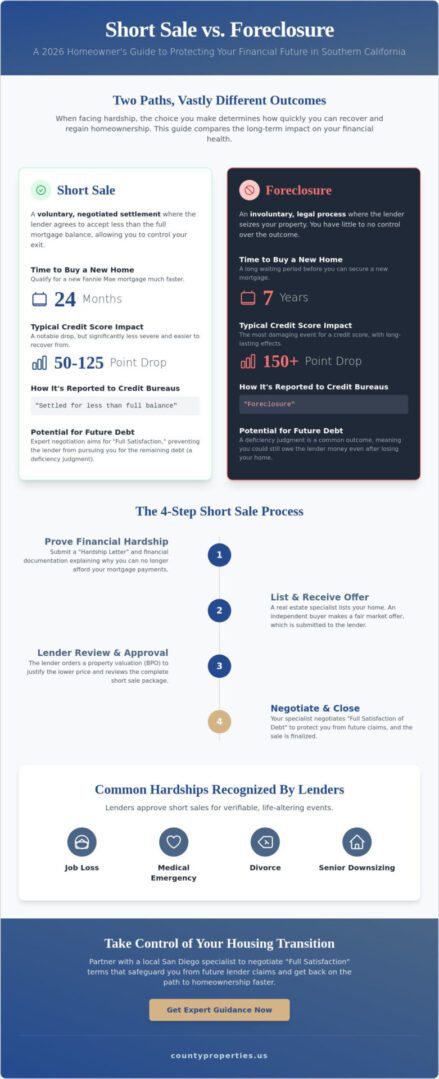
Short Sale vs. Foreclosure: Which is Worse for Your Future?
Choosing between a short sale and a foreclosure isn’t just about your current bank balance; it’s about how quickly you can rebuild your life. While both options result in a property transfer, lenders view them through different lenses. A foreclosure is a forced legal action where the bank seizes the home. In contrast, a short sale is a proactive, negotiated settlement. This distinction is vital when evaluating how a short sale affects your credit compared to the alternative. Data from FICO suggests a foreclosure can drop a score by 100 to 140 points, but the recovery period for a short sale is often significantly shorter because it shows you took responsibility for the debt.
The psychological impact, often called the “moral hazard,” is equally significant. Homeowners who face foreclosure often deal with the trauma of an eviction notice and a total loss of control. A short sale allows you to stay in the driver’s seat, managing the sale of your property and vacating on your own terms. For Southern California professionals in the defense or financial sectors, this choice impacts employment. Many security clearances and high-level background checks flag foreclosures as a failure of fiduciary duty. A short sale, documented as a settled account, is frequently viewed as a responsible mitigation of a financial crisis.
The Ability to Buy a Home Again
The waiting period to return to homeownership is one of the most compelling reasons to avoid foreclosure. If you lose your home to foreclosure, you’re typically barred from obtaining a conventional mortgage for 7 years. However, if you complete a short sale, you could be buying a home in southern california much sooner. FHA and VA guidelines often allow for new loans in as little as 2 to 3 years after a short sale, provided you’ve maintained clean credit in other areas. This 4-year difference represents a massive head start in rebuilding your family’s wealth.
Public Records and Future Liability
Foreclosures are recorded as public judgments, making them easily searchable by landlords, employers, and creditors for years. A short sale is handled as a private real estate transaction. While it appears on your credit report, it doesn’t carry the same weight as a court-ordered judgment. California homeowners have specific protections here. Under California Code of Civil Procedure Section 580e, lenders are generally prohibited from seeking a deficiency judgment after a short sale on a primary residence. This means the bank can’t sue you for the remaining balance, providing a level of legal closure that foreclosure doesn’t always guarantee. Understanding how a short sale affects your credit and your legal standing in 2026 is the first step toward a fresh start.
The Road to Recovery: Rebuilding Your Credit After the Sale
The day after your short sale closes marks the beginning of your financial comeback. While you’ve likely seen a drop in your score, the impact of how a short sale affects your credit begins to diminish the moment the “settled for less than full balance” status is recorded. Your first priority is verifying that your lender reported the mortgage balance as $0. If the report shows a remaining balance after the sale is finalized, it can continue to drag down your score every month as if the debt is still active. Verify this status with all three bureaus within 30 days of closing.
Strategic Credit Rebuilding Steps
Start small to show lenders you’re a responsible borrower again. Open one or two secured credit cards within 90 days of the sale. These cards require a cash deposit that acts as your limit, making them low-risk for banks. Use them for minor expenses and pay them off in full every month. This creates a fresh stream of “on-time” payment data. Keep your credit utilization below 10% on these new accounts to maximize score gains. If you have older credit cards with no balance, don’t close them. The age of your credit history accounts for 15% of your FICO score; those old accounts are vital anchors for your recovery.
2026 Mortgage Eligibility Timelines
The path back to homeownership is shorter than many Southern California residents realize. Lending guidelines for 2026 remain structured around specific waiting periods. You can often apply for a new loan sooner than you think if you maintain a clean record post-sale. These timelines are standard across the industry:
- FHA Loans: 3 years from the date the short sale closed. This can be reduced to 12 months if you prove “Extenuating Circumstances” such as a documented medical crisis or job loss.
- VA Loans: 2 years for eligible veterans and active-duty service members.
- Conventional (Fannie Mae/Freddie Mac): 4 years if you have a 20% down payment; otherwise, the standard wait is 7 years.
Beyond your score, lenders in 2026 look closely at your debt-to-income (DTI) ratio. Aim to keep your total monthly debt payments under 36% of your gross income. This ratio proves you can handle a new mortgage despite the history of how a short sale affects your credit. Check your credit reports from Equifax, Experian, and TransUnion every four months to catch errors early. Consistent monitoring ensures that old, settled debts don’t reappear as active liabilities.
Navigating the Process with a Southern California Specialist
San Diego real estate operates on a different wavelength than the national market. High property values and unique state regulations mean that understanding how a short sale affects your credit requires a localized perspective. At County Properties, we specialize in facilitating “Full Satisfaction” negotiations. This ensures that once the sale closes, the lender agrees to accept the proceeds as payment in full. Without this specific language in your agreement, you could remain vulnerable to debt collectors for years. Our team works to prevent the bank from pursuing a deficiency judgment, protecting your future earnings and assets.
California Anti-Deficiency Protections
Homeowners in the Golden State benefit from some of the strongest legal protections in the country. Under California Code of Civil Procedure § 580e, lenders are generally prohibited from seeking deficiency judgments on short sales of residential properties with one to four units. This law is designed to give you a fresh start, but it requires precise execution and documentation. You need professional representation to ensure the lender acknowledges these protections in writing before the deal closes. For a deeper look at your options, explore our guide on foreclosure prevention california to see how these laws apply to your specific situation.
The Cash Offer Alternative
While a short sale is often a viable path, the timeline can be a significant drawback. Most short sale negotiations take between 120 and 180 days to reach a conclusion. During this window, your credit report might continue to show missed payments, which drags your score down further each month. A quick cash offer serves as a faster alternative. By closing the sale in as little as 10 to 14 days, you stop the cycle of monthly late marks immediately. This speed helps contain the damage, making it easier to begin the credit recovery process sooner than a standard bank negotiation would allow.
Your Trusted Partner in Distressed Sales
Arnie Levine brings over 36 years of experience to the San Diego market, helping families navigate these complex financial hurdles. We use a “Family of Friends” approach because we know that a short sale is often tied to sensitive life changes like divorce or senior transitions. We prioritize your financial security and peace of mind over a quick commission. Our team provides the step by step guidance needed to ensure you understand exactly how a short sale affects your credit and what your life will look like after the keys are handed over. We specialize in helping seniors move into their next phase of life with dignity and financial stability.
Don’t wait for a foreclosure notice to arrive. Take control of your financial future today by speaking with a local expert who understands the San Diego landscape. Contact County Properties for a confidential short sale consultation and let us help you find the best path forward.
Secure Your Credit Recovery and Financial Future
Understanding how a short sale affects your credit is the first step toward regaining your financial footing in the 2026 Southern California market. While a short sale can lower a credit score by 50 to 160 points, it typically allows for a faster recovery period than a foreclosure. Industry data suggests that many homeowners can rebuild their scores and qualify for a new mortgage within two years of a successfully settled sale. This proactive choice keeps you in the driver’s seat of your financial narrative.
The team at County Properties brings 36 years of San Diego real estate experience to your side. Since 1995, our collaborative approach has prioritized client security over individual commissions. We provide specialized expertise to navigate complex bank negotiations and protect your long-term interests. You don’t have to face these lenders alone. Our seasoned professionals ensure every step aligns with your specific path to a fresh start.
Take the proactive step today to safeguard your future. Request a Confidential Short Sale Evaluation with County Properties to explore your options with a trusted local partner. You’ve got the strength to move forward, and we’re here to guide you every step of the way.
Frequently Asked Questions
Is a short sale better for my credit than a foreclosure?
Yes, a short sale is generally less damaging to your financial future than a foreclosure. According to FICO data, a short sale typically results in a credit score drop of 50 to 160 points, while a foreclosure can trigger a drop of 200 points or more. Lenders often view a short sale as a proactive attempt to settle debt, which helps you qualify for a new mortgage in as little as 2 years instead of the 7 years often required after a foreclosure.
How many points does a short sale drop your credit score?
You can expect your score to decrease by 50 to 160 points depending on your starting credit profile. Borrowers with a high score of 780 often see the largest drop of 140 to 160 points, while those starting at 680 might see a smaller 50 to 100 point decrease. Understanding how a short sale affects your credit is vital for planning your recovery. Most homeowners see their scores begin to rebound within 12 to 24 months of consistent on-time payments on other debts.
Can I buy a house 2 years after a short sale?
Yes, you can qualify for a mortgage 2 years after a short sale if you apply for an FHA loan and have maintained clean credit since the sale. Conventional loans usually require a 4 year waiting period, though this can be reduced to 2 years if you prove extenuating circumstances like a job loss or medical emergency. VA loans also offer a 2 year waiting period for eligible veterans. You’ll need to demonstrate a stable income and a 10% to 20% down payment in many Southern California markets.
Do I have to pay taxes on the forgiven debt in a short sale?
You generally don’t have to pay state taxes on forgiven debt in California due to the state’s conformity with federal exclusion rules for primary residences. At the federal level, the Mortgage Forgiveness Debt Relief Act has historically protected homeowners from paying income tax on the forgiven debt amount. You must still report the 1099-C form issued by your lender on your tax return. Always consult a tax professional to confirm your specific eligibility under current 2026 tax codes.
Will a short sale stop a foreclosure that has already started?
A short sale can halt a foreclosure process even after a Notice of Default has been filed. California’s Homeowner Bill of Rights prohibits dual tracking, which means a lender can’t proceed with a foreclosure sale while a complete short sale application is under review. You should submit your application at least 15 to 30 days before the scheduled auction date to ensure the bank has time to pause the legal proceedings. Our team has helped many San Diego families stop auctions this way.
Does a short sale show up on a background check for a job?
A short sale won’t appear on a standard criminal background check, but it will show up if an employer runs a credit report. While many employers in California are restricted from using credit checks for hiring under Labor Code Section 1024.5, exceptions exist for financial positions or jobs with access to large amounts of cash. If you’re applying for a role in the banking or insurance sectors, be prepared to explain how a short sale affects your credit and your steps toward recovery.
Can the bank sue me for the difference after a short sale in California?
No, California Code of Civil Procedure Section 580e protects most homeowners from deficiency judgments following a short sale. This law prohibits a lender from seeking the difference between the sale price and the remaining loan balance for residential properties with one to four units. This protection applies to both first and second mortgages, provided the lender consented to the short sale. It’s a critical safety net that ensures you can walk away from the property with a clean slate.