

On a Tuesday afternoon in November 2025, you open your mailbox to find a formal Notice of Default from your mortgage servicer. Your heart sinks as you realize the 90 day clock has officially started ticking toward a potential public auction. It’s a terrifying moment that leaves many San Diego homeowners feeling paralyzed by confusion and the weight of aggressive phone calls. You aren’t alone. Data from the California Department of Real Estate indicates that thousands of residents face these proceedings each year while struggling to interpret complex state laws. We understand that your home is more than just an asset; it’s your sanctuary.
This guide empowers you with the best options to stop foreclosure in San Diego so you can protect your equity and your credit score. You’ll discover how to successfully negotiate loan modifications, leverage your legal rights under the California Homeowner Bill of Rights, or execute a graceful short sale that preserves your financial future. It’s time to move from fear to a concrete plan of action and reclaim control over your living situation.
Key Takeaways
- Understand the critical timeline of California’s nonjudicial foreclosure process and the vital legal distinctions between a Notice of Default and a Notice of Sale.
- Learn how the California Homeowner Bill of Rights protects you from “dual tracking” to ensure your lender cannot foreclose while a loan modification is pending.
- Discover strategic real estate options to stop foreclosure in San Diego, such as short sales and cash offers that help preserve your credit and financial security.
- Identify the immediate steps you must take to communicate with your lender and access free, unbiased guidance from HUD-approved housing counselors.
- See how 36 years of local experience and a collaborative “team concept” can provide the personalized support you need to navigate distressed property challenges.
Understanding the San Diego Foreclosure Process in 2026
Foreclosure in 2026 remains a daunting prospect for San Diego families, but the law provides specific safeguards that protect your rights. Most California foreclosures are nonjudicial, meaning the lender doesn’t have to go to court to take the property. This process moves faster than judicial states, yet it follows a strict sequence recorded at the San Diego County Recorder’s Office. These public records ensure that every step is documented, providing a paper trail that you can use to challenge errors.
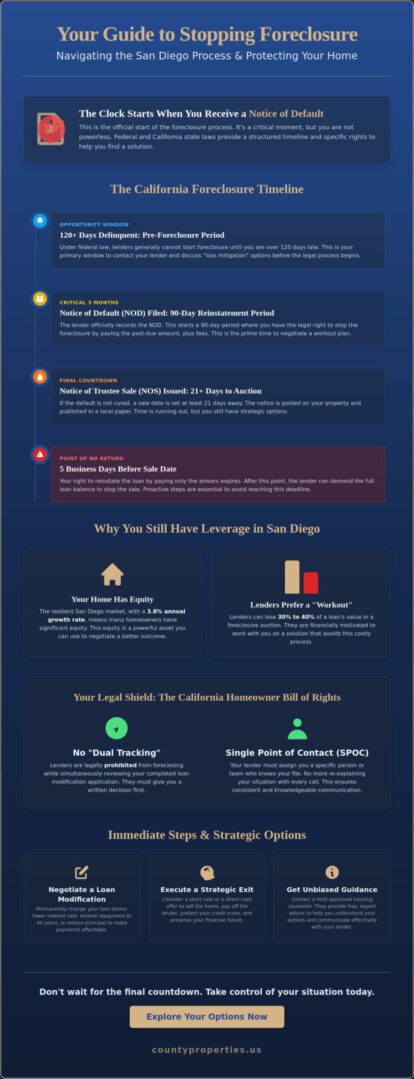
Your first line of defense is the federal 120-day delinquency rule. Under Consumer Financial Protection Bureau regulations, a servicer generally can’t make the first official foreclosure filing until you’re more than 120 days behind on payments. This four-month window is your primary opportunity for Understanding the Foreclosure Process and evaluating your options to stop foreclosure in San Diego before the legal clock starts ticking. During this time, lenders are required to contact you to discuss “loss mitigation” options, such as loan modifications or repayment plans.
The California Nonjudicial Timeline
The formal legal clock begins after that initial 120-day period. The process follows three distinct phases:
- The Notice of Default (NOD): This is the official start. Once recorded, you have a 90-day reinstatement period. This is a critical three-month window where you can catch up on payments or negotiate a workout.
- The Notice of Trustee Sale (NOS): If the default isn’t cured within 90 days, the lender issues this notice. It sets an auction date at least 21 days in the future.
- The Final Countdown: The NOS is posted on your property and published in local San Diego newspapers, marking the final three weeks before a potential auction.
Why San Diego Homeowners Still Have Leverage
San Diego’s real estate market in 2026 continues to show resilience. With median home prices sustaining a 3.8% annual growth rate through the first quarter, many homeowners possess significant equity even when they fall behind. Lenders typically lose between 30% and 40% of a loan’s value through the auction process. They prefer a “workout” over a costly auction because it preserves their bottom line.
You have more power than you might realize, but it’s time-sensitive. You must remember the “Point of No Return.” In California, your legal right to reinstate the loan by paying the arrears expires five business days before the scheduled sale date. After that, the lender isn’t legally required to accept anything less than the full loan balance. Taking proactive steps early is the most effective way to secure the best options to stop foreclosure in San Diego while you still have the legal right to intervene.
Legal Protections: The California Homeowner Bill of Rights
The California Homeowner Bill of Rights (HBOR) acts as a vital shield for residents facing financial distress. These laws, which remain robust in 2026, ensure that lenders treat you fairly during the loss mitigation process. One of the most critical protections is the strict prohibition of dual tracking under Civil Code Section 2923.6. This law prevents a bank from foreclosing on your home while they’re still reviewing your completed application for a loan modification. If you’ve submitted all required documents, the lender must provide a written decision before they can record a Notice of Default or proceed with a foreclosure sale.
Lenders are also required to provide you with a Single Point of Contact (SPOC) under Civil Code Section 2923.7. This individual or specific team must have access to your entire file and the authority to stop the foreclosure process if a solution is reached. You won’t have to explain your situation to a different representative every time you call for an update. If a lender commits material violations of these rules, you have the legal right to sue. A judge can issue an injunction to stop a pending sale or, if the home has already been sold, award you actual damages and attorney fees. Understanding these legal safeguards is one of the most effective options to stop foreclosure in San Diego before the process goes too far.
Loss Mitigation Options to Keep Your Home
- Loan Modification: This involves permanently changing the terms of your mortgage. You might receive a lower interest rate, an extended repayment term of 40 years, or a principal reduction to make monthly payments more affordable.
- Forbearance Agreements: If you’re facing a short-term crisis like a medical emergency, your lender may allow you to pause or reduce payments for a period, typically three to six months, to give you time to recover.
- Repayment Plans: This option allows you to spread out your past-due balance over a set period. You’ll add a portion of the arrears to your regular monthly payment until the loan is current.
The Power of Reinstatement and Redemption
Reinstatement is the act of paying the default amount plus fees to restore the loan to good standing. In California, you generally have the right to reinstate your loan up until five business days before the scheduled trustee sale. This is often the most direct of the options to stop foreclosure in San Diego if you can access the necessary funds through a loan or savings.
While the Right of Redemption allows a homeowner to buy back their property after a sale, it’s extremely rare in California because 95% of foreclosures are nonjudicial. Instead, focusing on your right to cure the default through reinstatement is a more practical strategy for most families. As your trusted real estate partner, we can help you review these timelines to ensure you don’t miss a critical legal deadline that could cost you your equity.
Strategic Exit Options: Short Sales and Cash Offers
While the goal is often to stay put, sometimes the smartest move for your long term financial health is a graceful exit. If your mortgage balance is higher than your home’s current market value, or if your monthly income can’t support a modified payment, exploring specific options to stop foreclosure in San Diego becomes a matter of credit preservation. A forced auction stays on your record for seven years. A strategic sale, however, allows you to rebuild your life and your credit much faster.
The Short Sale Advantage
A short sale occurs when your lender agrees to accept less than the total amount you owe on the mortgage. This isn’t just about walking away; it’s a negotiated settlement that requires a seasoned professional to navigate. Banks often prefer this over the expense of a legal foreclosure process. In many San Diego cases, lenders provide “cash for keys” incentives to help with your relocation costs. For a deeper look at these step by step tactics, you can read our guide on foreclosure prevention in California. Working with a specialist ensures the bank waives their right to a deficiency judgment, so they won’t pursue you for the remaining balance later.
Cash Offers vs. Traditional San Diego Sales
Speed is your greatest asset when an auction date is looming. Traditional sales in San Diego can take 45 to 60 days to close, which might be too slow if the Trustee sale is only weeks away. Rapid cash offers provide a different path for homeowners who need to move quickly. Consider these differences:
- Closing Speed: Cash buyers can often close in 7 to 10 days, effectively stopping the auction process immediately.
- Property Condition: You sell the property “as-is.” You don’t have to worry about expensive repairs, cleaning, or staging that a traditional buyer would demand.
- Credit Recovery: A short sale or cash payoff allows you to apply for a new mortgage in as little as 2 to 3 years. This is a significant improvement over the 7 year wait required after a foreclosure.
If your home has equity, a traditional sale is usually the best way to walk away with a check in hand. However, if time is short or you owe more than the home is worth, a cash offer or short sale provides the certainty you need. These are vital options to stop foreclosure in San Diego for homeowners who want to protect their future financial security and move on with dignity.
The San Diego Action Plan: Immediate Steps to Take
Time is your most valuable asset when you’re facing a potential loss of your home. In California, the non-judicial foreclosure process moves quickly once it starts. Federal law generally prevents lenders from starting the process until you’re more than 120 days delinquent. Use this window wisely. The most damaging mistake you can make is ignoring your mail. Every envelope from your loan servicer contains legal notices and deadlines that dictate which options to stop foreclosure in San Diego remain on the table. Open everything immediately and keep it organized in a dedicated file.
Your next step is to call a HUD-approved housing counselor. Organizations like Home Start Inc. or the San Diego Financial Literacy Center provide free, unbiased guidance. These experts help you understand your rights without charging the predatory fees often seen in the private sector. While you’re talking to professionals, request a “Loss Mitigation Package” from your loan servicer. This is the formal application for help. It’s the only way to officially start the process for a loan modification or a short sale. You can’t get help if you haven’t asked for it through the proper channels.
You also need to know exactly what your home is worth today. San Diego real estate values can shift significantly between neighborhoods like Chula Vista and La Jolla. Consult with a local real estate expert to get a Comparative Market Analysis. Knowing your equity position tells you if you can sell the home traditionally to pay off the debt or if you need to pursue a short sale. Exploring all options to stop foreclosure in San Diego requires a clear-eyed view of your property’s current market value.
Local Resources in San Diego
Low-income homeowners should contact the Legal Aid Society of San Diego. They provide specialized legal assistance for those facing housing instability. To verify your property’s status or check for recorded liens, visit the San Diego County Assessor office at 1600 Pacific Highway. Be extremely careful with “Foreclosure Rescue” companies. Under California Civil Code Section 2945, it’s illegal for foreclosure consultants to collect money before they’ve finished the work they promised. If someone asks for an upfront fee to save your home, walk away.
Documenting Your Hardship
Lenders won’t grant relief based on a verbal request. You must prove your financial situation. This starts with a Hardship Letter. This letter should be a concise, factual account of why you fell behind, such as a job loss, medical emergency, or divorce. You also need to gather the “Big Three” documents: your last two years of federal tax returns, your most recent 30 days of pay stubs, and two months of complete bank statements. A well-documented hardship is the foundation of any successful loan modification or short sale approval.
If you’re feeling overwhelmed by the process, don’t wait until the trustee sale is scheduled. We’re here to help you navigate these difficult choices with 36 years of local experience. Contact our team of San Diego experts today for a personalized consultation on your home’s value and your next steps.
How County Properties Protects San Diego Homeowners
Arnie Levine built County Properties on a foundation of collaboration. He rejected standard office protocols to create a “Team Concept” that puts the homeowner’s needs first. With 36 years of experience in the San Diego market, our team understands the nuances of distressed property sales. We’ve navigated the complexities of local real estate since 1995, helping thousands of families avoid the devastating impact of losing their homes. This isn’t just about a transaction; it’s about our “Family of Friends” approach. We offer empathetic guidance because we know how heavy the weight of debt feels. Our team provides a holistic view of your situation by comparing your home’s current market value against your existing debt. This data-driven analysis ensures you choose the most viable options to stop foreclosure in San Diego.
Personalized Guidance for Distressed Sellers
We provide free, no-obligation consultations to help you understand the legal jargon in your Notice of Default. Our expertise in selling a home in Southern California under high-pressure conditions allows us to move quickly. We don’t just list properties; we negotiate with lenders to protect your financial security. Our goal is to find a path that preserves your credit and keeps as much equity in your pocket as possible. We look at the specific timelines of the California foreclosure process to ensure every move is calculated and effective.
Your Next Step Toward Peace of Mind
Time is your most valuable asset right now. Don’t wait until the Notice of Sale is posted on your door to seek help. By that stage, your window for negotiation shrinks significantly. Our local network of professionals works together to stop the clock and provide breathing room. We’ve spent decades building relationships that help our clients find a fresh start. You deserve a strategy that looks beyond the current crisis toward your long-term stability. Contact Arnie Levine and the team for a confidential strategy session to take control of your situation today. We’ll help you evaluate all available options to stop foreclosure in San Diego with transparency and care.
Take Control of Your San Diego Home’s Future Today
Facing a potential foreclosure feels overwhelming, but you don’t have to navigate the 2026 landscape alone. You’ve learned how the California Homeowner Bill of Rights protects you from dual-tracking and why acting quickly is your best defense. Whether you choose a strategic short sale or a direct cash offer, you have several viable options to stop foreclosure in San Diego that can save your credit and your financial future.
Success depends on having a seasoned guide by your side. County Properties brings 36 years of San Diego real estate experience to your corner. Our specialized team of foreclosure prevention experts operates with an A+ rated “Family of Friends” service-centric philosophy. We prioritize your peace of mind over a simple transaction, ensuring you get the specialized advice you need during this difficult transition.
Don’t wait for the bank to make the next move. Request a Confidential Foreclosure Consultation with County Properties today. It’s time to move forward with confidence and secure the fresh start you deserve.
Frequently Asked Questions
Can I stop a foreclosure in San Diego if the sale is tomorrow?
Yes, you can stop a sale scheduled for tomorrow by filing for bankruptcy to trigger an automatic stay. This federal injunction halts all collection activities immediately, including the auction at the San Diego Courthouse. You might also seek an emergency temporary restraining order if your lender failed to comply with California’s strict notice requirements. You must file these documents before the auctioneer begins the bidding process.
What is the “dual tracking” rule in California?
Dual tracking is an illegal practice where a mortgage servicer moves forward with a foreclosure while your loan modification application is still under review. The California Homeowner Bill of Rights, specifically Civil Code Section 2923.6, forbids lenders from recording a Notice of Default or Notice of Sale if you’ve submitted a complete application. If a lender violates this rule, you can sue to stop the sale and potentially recover legal fees.
Does filing for bankruptcy stop a foreclosure sale in San Diego?
Filing for bankruptcy provides an immediate legal shield called an automatic stay. This protection stops the auction of your property instantly, even if the sale is just hours away. While a Chapter 7 filing typically delays the process by 90 to 120 days, a Chapter 13 filing allows you to catch up on missed payments over a 3 to 5 year period. It’s a powerful tool for homeowners who need more time.
Will a short sale ruin my credit as much as a foreclosure?
A short sale is generally less damaging to your credit score than a foreclosure. According to FICO data, a foreclosure can trigger a drop of 250 to 300 points, while a short sale might result in a 120 to 160 point decrease. Most importantly, you can often qualify for a new Fannie Mae mortgage just 2 years after a short sale, whereas a foreclosure requires a 7 year waiting period.
How much does it cost to hire a foreclosure prevention specialist?
HUD approved housing counselors provide foreclosure prevention assistance at no cost to you. California Senate Bill 94 makes it illegal for any person or entity to charge upfront fees for loan modification or foreclosure relief services. You should never pay a private company for these services before they’ve fully performed the work and provided you with a written agreement from your lender. Professional real estate consultations are also typically free.
What happens if I stay in my house after the foreclosure sale?
You don’t have to leave the property on the day of the auction. You become a holdover tenant, and the new owner must follow a formal eviction process through the San Diego Superior Court. This starts with a 3 day notice to quit, followed by an Unlawful Detainer lawsuit. The entire legal process usually takes 30 to 60 days, giving you a window to arrange your relocation and move your belongings.
Can I sell my house for cash if I am already in default?
Yes, you can sell your home for cash at any point before the final trustee sale occurs. This is one of the most reliable options to stop foreclosure in San Diego because it allows you to pay off the mortgage balance and save your credit from a foreclosure entry. Cash buyers can often close the transaction in 10 to 14 days, which is fast enough to beat the 21 day Notice of Sale period.
Who is the best person to talk to about stopping foreclosure in San Diego?
You should speak with an experienced local real estate professional or a HUD certified counselor who understands the California foreclosure timeline. Arnie Levine and the County Properties team offer 36 years of local experience and can help you evaluate all options to stop foreclosure in San Diego. They provide the steady, expert guidance needed to negotiate with lenders or find a qualified buyer before your home goes to auction.