

What if the reason your home is still on the market has nothing to do with the San Diego economy and everything to do with a single missing piece of the puzzle? You’ve likely spent weeks keeping your property pristine for showings and checking your phone for offers that haven’t arrived. It’s emotionally draining to manage the financial weight of a current mortgage while planning your next move, especially when the median home price in San Diego County reached $1,074,000 this April. You aren’t alone in feeling frustrated when you need to know what to do if your house isn’t selling San Diego while other listings seem to move in the typical 37 days.
We understand that a stale listing feels like a personal setback, but it’s often just a communication gap between your home and the right buyer. This 2026 guide provides a clear, professional roadmap to revive your listing and successfully sell your property in any market condition. You’ll discover how to navigate new transparency laws like AB 723 for digital images, interpret the impact of current 6.375% mortgage rates, and find a more effective agent who acts as a dependable guide. It’s time to replace confusion with a methodical plan that leads to a successful closing and the fulfillment of your next life milestone.
Key Takeaways
- Identify why your property has crossed the critical 30-day market threshold and understand the psychological shift needed to move from a stale listing to a successful contract.
- Master what to do if your house isn’t selling San Diego by using a professional framework to audit your home’s price, condition, and presentation against current 2026 market data.
- Implement a step-by-step re-launch strategy that leverages professional drone footage and high-quality photography to meet the latest digital disclosure requirements.
- Evaluate specialized paths for complex situations, including dedicated support for senior transitions and options for those who need to facilitate a cash offer quickly.
- Learn how a collaborative team can rescue your listing by conducting a deep-dive audit of previous marketing failures to restore your path toward a successful closing.
Why Your San Diego Home Is Still on the Market in 2026
You’ve kept the kitchen spotless, managed dozens of showings, and waited for the phone to ring, yet your San Diego property remains active. It’s a stressful position to be in, especially when you’re managing the financial pressure of a current mortgage while trying to plan your future. In our current 2026 market, a “stale listing” isn’t just a house that hasn’t sold; it’s a property that has lost its initial momentum and failed to capture the urgency of qualified buyers. While it’s natural to feel frustrated, discovering what to do if your house isn’t selling San Diego requires a shift from emotional attachment to objective, data-driven analysis.
The 30-Day Threshold: What the Market is Telling You
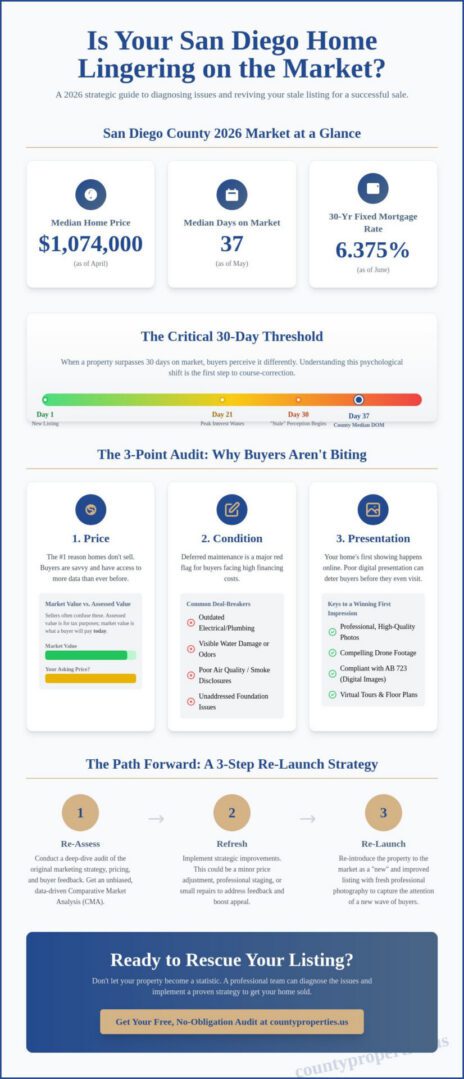
Data from May 2026 indicates that the median days on market in San Diego County is 37 days. This timeframe represents more than just a statistic; it’s a psychological boundary for Southern California buyers. During the first 21 days, your home enjoys a “new listing” premium where interest and visibility are at their peak. When a property sits past the 30-day mark without a pending contract, buyers begin to wonder if there’s a hidden defect or if the price is significantly decoupled from reality. This loss of leverage can be difficult to reclaim without a strategic pivot. Most successful sales in the current climate happen within that initial sweet spot where buyer competition is highest.
Market Shift vs. Listing Flaws
It’s vital to determine if your home is sitting because of macro-economic trends or specific property issues. The Southern California housing market remains resilient, with sales volume jumping 14.8% this past April, but buyer behavior has changed. With the 30-year fixed mortgage rate at 6.375% as of June 2026, every dollar of the $1,074,000 median home price is being scrutinized. Buyers are applying the fundamental principles of real estate economics to their search, balancing limited inventory against the high cost of financing.
Sometimes, the culprit is a neighborhood-specific inventory surge. If your local area suddenly has three months of supply instead of the county-wide 2.8 months, your home faces stiffer competition. Other times, the friction comes from new 2026 regulations. For instance, if your marketing materials don’t clearly follow AB 723 digital image disclosures or if there’s confusion regarding AB 455 thirdhand smoke disclosures, cautious buyers might move on to a “cleaner” listing. Understanding what to do if your house isn’t selling San Diego means evaluating whether you’re fighting a broad market shift or a specific presentation flaw that can be corrected with a seasoned, professional perspective.
The Audit: Evaluating Price, Condition, and Presentation
A successful sale relies on the harmony of the real estate triangle: price, condition, and location. While you can’t move your house, you have total control over the other two pillars. If you’re wondering what to do if your house isn’t selling San Diego, start with an objective audit that separates your emotional investment from the property’s current market utility. Many sellers confuse their “Assessed Value” with “Market Value.” In San Diego, these figures are rarely aligned because assessed values often reflect historical purchase prices protected by tax laws, while market value is strictly what a buyer is willing to pay today.
Modern California buyers are particularly sensitive to deferred maintenance. Common deal-breakers include outdated electrical systems, visible water damage, or poor air quality disclosures. If your home has been sitting for over 37 days, it’s likely the market identified a mismatch between your asking price and the home’s physical reality. Taking proactive steps to generate buyer interest often begins with admitting that your initial strategy hasn’t met the current demand.
Pricing Strategies That Reset Momentum
The debate between “pricing it right” and “pricing it low” to spark a bidding war is more nuanced in 2026. A detailed Comparative Market Analysis (CMA) is your most vital tool. It compares your home to similar properties that recently closed near the $1,074,000 median mark. You should also consider price brackets; for example, pricing a home at $999,000 instead of $1,005,000 ensures you appear in searches for buyers capped at $1 million. If you need a fresh perspective, our team can provide expert seller representation to help realign your expectations with local data.
Condition and Curb Appeal Audit
San Diego’s diverse climate means maintenance expectations vary by zip code. Buyers in coastal areas like La Jolla look for signs of salt air corrosion or moisture issues, while inland buyers in Escondido prioritize energy-efficient cooling systems and drought-tolerant landscaping. High-ROI refreshes often include:
- Professional staging to define multipurpose spaces and improve flow.
- Fresh, neutral paint to maximize natural light in every room.
- Updated light fixtures and hardware for a crisp, modern feel.
- Clear disclosures regarding smoking or vaping history as required by 2026 laws.
By addressing these objections before the next showing, you remove the friction that prevents a buyer from making a confident offer. Understanding what to do if your house isn’t selling San Diego requires looking at your home through the eyes of a buyer who has many other options at their fingertips.
Strategic Refreshes to Revive a Stale Listing
When a listing crosses the 37-day median mark in San Diego, it often falls victim to visual fatigue. Buyers who have been monitoring the market since April 2026 will recognize your photos and likely skip over them, assuming the property is flawed. To break this cycle, you need a coordinated re-entry that treats your property like a brand-new opportunity. This process isn’t about hiding the past; it’s about presenting a more compelling future. If you are struggling with what to do if your house isn’t selling San Diego, a strategic refresh can reset the clock and recapture lost momentum.
A successful re-launch requires a methodical approach. Consider this checklist to ensure your property returns to the market with maximum impact:
- Temporary Withdrawal: Removing the listing for a short period can sometimes allow for a “Coming Soon” reset, creating fresh buzz among local agents.
- Visual Overhaul: Invest in new professional photography that complies with 2026 AB 723 digital disclosure laws. High-definition drone footage is no longer optional; it is essential for showing proximity to San Diego landmarks.
- Narrative Shift: Rewrite your MLS description to focus on the experience of living in the home rather than just listing its dimensions.
- Pocket Listing Strategy: Discuss with your agent whether a period of off-market networking could identify buyers who missed the initial run.
Digital Marketing Overhaul
Your digital footprint is your first showing. In 2026, buyers expect immersive virtual tours that allow them to feel the flow of the home before they ever step inside. We recommend an audit of your current MLS keywords to ensure you’re appearing in searches for “ADU potential” or “solar-ready,” which are high-priority terms for modern California buyers. Beyond the MLS, targeted social media advertising can place your home directly in front of specific demographics, such as families looking to move into the Poway Unified School District or professionals seeking coastal proximity.
Showcase the San Diego Lifestyle
In Southern California, you aren’t just selling walls and a roof; you’re selling a lifestyle. Your marketing should tell a story about Saturday mornings at Balboa Park or sunsets at Sunset Cliffs. Storytelling creates an emotional anchor that data alone cannot provide. By following proven methods for selling a home in Southern California, you can highlight the “vibe” of your neighborhood. Whether it’s the walkability of North Park or the quiet canyons of Scripps Ranch, emphasizing these local amenities helps buyers visualize their daily lives in your home. This emotional connection is often the catalyst that turns a passive browser into a motivated buyer who is ready to sign a contract.
Specialized Solutions: Seniors, Distressed Sales, and Cash Offers
Guidance for Senior Homeowners
Downsizing or moving into a senior living community involves more than just a real estate transaction; it’s a significant emotional and logistical journey. For many long-term San Diego residents, the prospect of clearing out decades of memories can feel overwhelming. This is why partnering with a senior real estate specialist is essential. These professionals are trained to handle the unique needs of older adults, offering turn-key solutions that include estate management and organized moving services. We act as a dependable guide throughout this process, ensuring that the transition is handled with the care and sensitivity it deserves.
Short Sales and Foreclosure Prevention
If financial distress is the reason your home remains on the market, the clock can feel like your biggest enemy. When your mortgage balance exceeds the home’s value, a short sale may be a viable alternative to foreclosure. This path allows you to sell the property with the lender’s approval for less than the amount owed, which often results in less damage to your credit score than a foreclosure would. Homeowners should review our guide on foreclosure prevention in California to understand the legal protections and step-by-step options available to them. Identifying these opportunities early can prevent a difficult situation from becoming a crisis.
Evaluating Cash Offers in San Diego
For those who can’t wait the typical 37 days for a traditional sale, cash offer facilitation provides an immediate exit strategy. The primary benefit is speed; you can often close in a matter of days without the need for repairs, staging, or repeated showings. However, it’s important to weigh this against the potential for a lower sale price compared to a traditional market listing. This option works best for sellers who prioritize certainty and convenience over maximizing every dollar of equity. If you need to explore these non-traditional paths, we invite you to contact our specialized transition team for a confidential consultation.
Partnering for Success: How County Properties Rescues Listings
A stale listing isn’t a permanent failure; it’s a signal that your current strategy has decoupled from the market’s expectations. If you’ve spent months waiting for an offer that never came, you don’t need more of the same tactics. You need a pivot. Arnie Levine and the County Properties team specialize in rescuing listings that have stalled under other agents. We don’t just re-list your home. We perform a deep-dive audit to understand exactly why previous efforts failed, looking at everything from price positioning to the nuances of 2026 buyer psychology. Knowing what to do if your house isn’t selling San Diego starts with choosing a partner who values collaborative success over a quick commission.
The County Properties Advantage
We approach real estate as a service-first profession. Our team-based model ensures that you aren’t just hiring one person; you’re gaining the collective expertise of seasoned veterans who have navigated decades of Southern California market cycles. This collaborative ethos allows us to provide a level of detail that individual agents often overlook. By maintaining deep roots in our local communities, we understand the specific neighborhood trends that drive the $1,074,000 median price point in San Diego County. Whether you’re navigating a complex senior transition or preventing a foreclosure, we act as a dependable guide. Our goal is to position ourselves as the most trustworthy real estate agent near me by providing the reliability and financial safety you deserve during this transition.
Your Next Steps to a Sold Sign
If you’re frustrated by a lack of progress, it’s time to take control of the narrative. The first step is to stop repeating the same mistakes and seek an objective, third-party valuation of your property. We offer a no-obligation consultation to help you identify the specific friction points holding your sale back. During this process, we’ll help you:
- Analyze how your property compares to the 37-day median market average.
- Review your digital marketing to ensure it meets the latest 2026 transparency standards.
- Evaluate whether specialized paths like cash offer facilitation or senior-specific services are right for your timeline.
- Develop a clear, methodical plan to regain buyer urgency and secure a contract.
The 2026 San Diego market offers significant opportunities for sellers who are willing to adapt. Even with 30-year fixed rates at 6.375%, buyers are actively searching for homes that offer quality and clear value. You don’t have to navigate this complex process alone. We’re here to provide the masterly guidance and interpersonal connection needed to reach your long-term goals. Reach out to us today, and let’s work together to turn your stagnant listing into a successful closing.
Take Control of Your San Diego Home Sale Today
You now have a clear roadmap for navigating a stagnant listing. We’ve explored how to audit your property against the 37-day market average and the importance of lifestyle storytelling in your digital marketing. Whether you’re adjusting for the $1,074,000 median price point or navigating a complex senior transition, the right strategy makes all the difference. Knowing what to do if your house isn’t selling San Diego involves looking past the frustration and focusing on objective, data-driven pivots.
Arnie Levine and the County Properties team bring over 25 years of experience to your side. As a Senior Real Estate Specialist with deep expertise in foreclosure prevention and short sales, Arnie provides a collaborative, service-centric approach that traditional agents often miss. We invite you to Get a Professional Home Valuation and Listing Audit to identify exactly why your property hasn’t moved. Your path to a successful closing is still open. With the right guide, you’ll reach your next life milestone with confidence and peace of mind.
Frequently Asked Questions
How long should it take to sell a house in San Diego in 2026?
The median time to sell a home in San Diego County is currently 37 days as of May 2026. While many properties move within the first three weeks, crossing the 30-day threshold typically indicates that the market is pushing back on your price or presentation. If your property hasn’t secured a contract within this window, it is time to conduct a professional audit of your listing’s performance.
Should I fire my real estate agent if my house isn’t selling?
You should consider a change if your current agent isn’t providing data-driven feedback or a proactive plan to revive interest. A successful sale requires a collaborative partner who can explain why a listing has stalled and offer concrete solutions. If communication has stopped or your marketing hasn’t evolved since the first week, finding a seasoned veteran with deep regional expertise can help reset your momentum.
Is a price reduction the only way to sell a stale listing?
A price reduction is a powerful tool, but it isn’t the only way to attract buyers. You can often revive a listing by overhauling your digital presentation or addressing minor physical objections. Updating your photography to meet 2026 AB 723 standards or investing in professional staging can create a fresh “lifestyle” narrative. These changes can sometimes generate enough new urgency to secure a contract without dropping your asking price.
What are the most common reasons homes fail to sell in Southern California?
The most frequent obstacles are overpricing relative to 6.375% mortgage rates and failing to address deferred maintenance. Modern buyers are also sensitive to transparency; listings that don’t follow 2026 disclosure laws regarding smoking history or digital alterations often see less engagement. When homeowners are unsure what to do if your house isn’t selling San Diego, the problem is usually a mismatch between the home’s condition and the market’s current value.
Can I sell my house for cash if it has been on the market too long?
Yes, you can facilitate a cash offer if you need a certain closing date or want to avoid the stress of constant showings. This path is particularly effective for sellers who don’t want to invest in repairs or staging for a stale listing. While a cash sale prioritizes speed and convenience, it provides a reliable exit strategy for those who need to move forward with their lives quickly.
How much does it cost to re-list a home with a new marketing strategy?
The costs for re-listing depend on the specific refreshes your property needs to stand out. You might choose to invest in professional drone footage, high-end staging, or targeted social media advertising to reach specific San Diego demographics. While these updates require an upfront investment, they are designed to protect your equity by preventing a further decline in market interest. You should discuss tailored marketing budget options with your representation.
Does the time of year affect how fast a San Diego home sells?
San Diego typically sees a surge in buyer activity during the spring, but the 2026 market remains active year-round due to limited inventory. April 2026 saw a 14.8% increase in sales volume, proving that demand remains resilient regardless of the season. While summer months often bring more foot traffic, a well-positioned home with expert marketing will attract serious, qualified buyers in any month of the year.
What is the difference between a short sale and a traditional sale?
A traditional sale occurs when you have enough equity to pay off your mortgage and keep the remaining proceeds. A short sale is a specialized process where your lender agrees to accept less than the full mortgage balance to avoid foreclosure. Knowing what to do if your house isn’t selling San Diego when you are facing financial hardship requires an experienced guide who can handle complex lender negotiations and protect your future.