

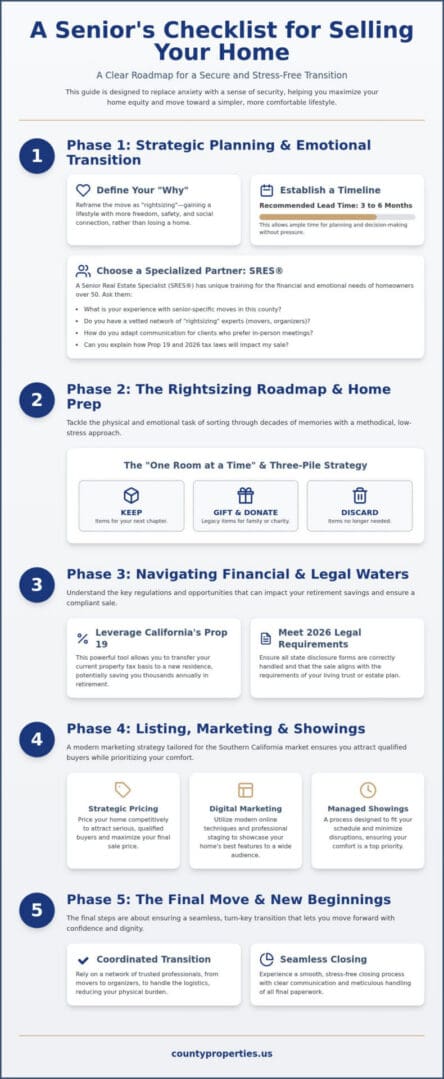
What if the biggest obstacle to your next chapter isn’t the Southern California market, but the emotional weight of the front door key? For many long-time homeowners, the family residence is a living scrapbook of milestones, and the thought of leaving it can feel overwhelming. It’s completely natural to feel a mix of sentimental attachment and physical exhaustion when you think about decluttering decades of memories. This checklist for seniors selling their home is designed to replace that anxiety with a sense of security and professional support.
We understand that you want a transition that respects your past while securing your financial future. You deserve a process that doesn’t involve high-pressure tactics or confusing jargon, especially with 2026 updates to Proposition 19 and new state disclosure requirements. This guide provides a clear, methodical roadmap to help you maximize your home equity for retirement and move toward a simpler lifestyle. We’ll walk through every stage, from the initial physical sort to the final legal signatures, ensuring you feel empowered and heard at every turn.
Key Takeaways
- Learn how to manage the emotional transition and physical demands of downsizing using the “One Room at a Time” decluttering method.
- Discover how to leverage California’s Prop 19 to transfer your current property tax basis to a new residence and maximize your retirement savings.
- Follow our specialized checklist for seniors selling their home to ensure all 2026 legal disclosures and living trust requirements are handled correctly.
- Explore strategic pricing and digital marketing techniques designed to attract qualified buyers in the 2026 Southern California real estate market.
- Understand the value of a Senior Real Estate Specialist (SRES) in coordinating a turn-key transition that prioritizes your comfort and financial security.
Phase 1: Strategic Planning and the Emotional Transition
Selling a home you’ve lived in for decades isn’t a standard transaction. It’s a significant life transition that requires a specialized approach. Before you start packing boxes, you must define your “Why.” Does your current residence still serve your physical and social needs? Perhaps the stairs have become a daily burden, or the maintenance of a large yard is draining your retirement funds. If you’re looking for ways to optimize your property’s exterior systems before the transition, you might check out Sonora Sprinkler Inc.. We encourage a “rightsizing” mindset. This shift reframes the move from losing a family home to gaining a lifestyle that offers more freedom, safety, and social connection.
A critical item on any checklist for seniors selling their home is establishing a realistic timeline. In the 2026 Southern California market, we recommend a 3 to 6 month lead time. This is longer than the average seller requires, but the extra space is vital. It allows you to process the emotional attachment to your belongings and consult with a support team of family members and financial advisors without feeling pressured by an aggressive sales cycle. Taking this time ensures every decision is made with clarity and confidence.
Identifying Your Next Destination
You need a clear vision of your destination before you say goodbye to your current property. Southern California offers a wide array of options, ranging from luxury 55+ communities to assisted living facilities that provide higher levels of care. Evaluate the financial bridge required for this move. You’ll need to determine exactly how much equity you must harvest from your sale to fund your next chapter comfortably. Consider proximity to specialized medical care and your local family network, as these factors are essential for long term stability and peace of mind.
Choosing a Specialized Real Estate Partner
Selecting the right representative is the foundation of a stress-free sale. While understanding the role of a real estate agent provides a baseline for what to expect during a transaction, seniors often require a more nuanced level of service. You should prioritize working with a Senior Real Estate Specialist (SRES). A Senior Real Estate Specialist is a professional who has earned a specific credential for navigating the unique financial and emotional needs of homeowners over the age of 50. When interviewing potential partners, ask specific questions about their experience with senior transitions:
- How many senior-specific moves have you successfully managed in San Diego County?
- Do you have a vetted network of “rightsizing” experts, such as specialized movers or organizers?
- How do you adapt your communication for clients who prefer in-person consultations over digital signatures?
- Can you explain how 2026 tax laws like Prop 19 will impact my specific situation?
By assembling a team that values your legacy as much as the sale price, you ensure that the process remains respectful and supportive from start to finish.
Phase 2: The Rightsizing Roadmap—Decluttering and Property Prep
After decades in a family residence, your home becomes a museum of your life’s journey. The sheer volume of belongings accumulated over 30 or 40 years is often the primary source of stress for homeowners. To combat this, we recommend the “One Room at a Time” method. By breaking the house into specific zones, you can reduce the physical and emotional burden of the transition. This approach is a cornerstone of any effective checklist for seniors selling their home, as it prevents the paralysis that comes from looking at the entire property at once.
Managing “Legacy Items” requires a delicate balance between sentiment and practicality. You don’t have to discard your history; you simply need to curate it. For the 2026 market, buyers in Southern California are heavily prioritizing move-in ready homes. This means your property prep should focus on high-ROI fixes that ensure safety and curb appeal. Professional staging for the “Modern Senior” home involves brightening dark corners and removing heavy drapery while maintaining the cozy, lived-in feel that makes a house a home. While you focus on the physical sort, it’s helpful to keep the broader legal aspects of real estate transactions in mind so you understand how your preparation supports a clean title and a smooth contract process later.
The Three-Pile Strategy for Downsizing
To make progress, you need firm rules. We suggest the Three-Pile Strategy: Keep, Gift or Donate, and Discard. If an item hasn’t been used in over two years, it’s a candidate for gifting to family or a local charity. For those who find the physical labor too demanding, hiring a senior move manager is a wise investment. They act as a neutral party to help you sort through archives. You can also preserve your history by digitizing physical photo albums, allowing you to take your memories to a smaller home without the bulk of heavy boxes. Our Senior Real Estate Transition services often include guidance on finding these specialized resources.
Pre-Listing Inspections and Safety Repairs
A pre-listing inspection is critical for seniors. It identifies issues like aging roofs, outdated HVAC systems, or foundation shifts common in Southern California before a buyer discovers them. Addressing these deferred maintenance items early prevents mid-contract stress and price renegotiations. Beyond major repairs, ensure the home is “Senior Safe” for showings. This includes removing loose rugs, improving lighting in hallways, and ensuring all walkways are clear of trip hazards. These small adjustments project a well-maintained home that buyers can trust.
Phase 3: Navigating the Financial and Legal Landscape
Understanding the financial side of a sale requires a different kind of preparation than the physical sorting we discussed in Phase 2. While decluttering clears the way for buyers, your financial strategy preserves the equity you’ve built over decades. A robust checklist for seniors selling their home must prioritize the specific tax advantages and legal protections available in the Golden State. Missing these details can result in unnecessary tax burdens that eat into your retirement savings.
California Property Tax Benefits for Seniors
The most significant financial advantage for Southern California seniors is the ability to transfer a “Base Year Value.” Under current law, homeowners aged 55 and older can carry their low property tax basis from a long-held home to a new residence. This is a vital tool for those who bought their homes decades ago under Proposition 13 and fear the high taxes associated with today’s market prices. Proposition 19 allows eligible seniors to transfer their existing property tax basis to a replacement residence of any value anywhere in California, provided the new home is purchased within two years of the original sale. This flexibility ensures that moving to a more comfortable or accessible home doesn’t result in a punishing tax increase.
Legal Documentation and Title Issues
Selling a property held in a living trust is common for seniors, but it requires specific documentation to avoid escrow delays. You should gather your full trust agreement and a “Certification of Trust” early in the process. Working with an estate attorney can help ensure your title is clear of any forgotten liens or encumbrances before you go under contract. These legal hurdles are often easier to clear when you aren’t racing against a buyer’s closing deadline. We recommend reviewing these documents at least 90 days before listing to ensure a smooth transition of ownership.
You also need to account for capital gains taxes. While federal law allows an exclusion of $250,000 for individuals or $500,000 for married couples on a primary residence, California taxes capital gains as ordinary income at rates ranging from 1% to 13.3%. Staying informed about the Southern California housing market trends of 2026 will help you time your sale to maximize these exemptions. With the statewide median home price reaching $887,680 in 2026, many long-term owners will find their equity exceeds the federal exclusion limits. Consulting with a tax professional is essential to understand your specific liability before the final settlement statement arrives.
Phase 4: Listing, Marketing, and Managing Showings
Entering the 2026 market requires a strategy that balances your financial goals with your personal comfort. Southern California remains a slight seller’s market due to low inventory, but with only 18% of California households able to afford a median-priced home, pricing accurately from day one is essential to avoid a stagnant listing. Your checklist for seniors selling their home should include a marketing plan that specifically targets the “Adult Child” demographic. These family members often initiate the search for their parents, prioritizing high-impact digital listings and professional photography that prove the home is move-in ready. With the median time on market hovering around 26 days, a well-positioned home attracts qualified buyers quickly, reducing the duration of the sales process.
Managing the “showing stress” is often the most intrusive part of the sale. You have the right to set firm boundaries to protect your energy and peace of mind. We recommend evaluating offers not just on the purchase price, but on the “cleanliness” of the contract. A contract with fewer contingencies and a solid proof of funds is often more desirable than a higher price that carries a high risk of falling through during the appraisal process. If an appraisal does come in low, having a seasoned guide to negotiate a value dispute or a buyer credit can save the transaction without sacrificing your equity.
Safety and Privacy During the Sale
Protecting your personal space is a priority. Before any visitor enters, you must secure all valuables, sensitive legal documents, and medications. We suggest a “By Appointment Only” strategy rather than traditional open houses. This approach limits foot traffic to serious, pre-qualified buyers and protects your privacy. Utilizing high-definition virtual tours acts as a first filter, allowing buyers to “walk” the home digitally. This technology significantly reduces the number of physical visitors, ensuring that only the most interested parties request an in-person tour, which keeps your daily routine as stable as possible.
Negotiating with Confidence
When offers arrive, we look for terms that favor a smooth transition. For senior sellers, “As-Is” clauses are particularly beneficial because they protect you from being forced into minor cosmetic repairs after the home inspection. We also prioritize negotiating a flexible closing date. This ensures you have ample time to coordinate with your move manager and transition to your new residence without the pressure of a rigid deadline. If you’re ready to secure a partner who understands these nuances, explore our specialized seller representation services to ensure your interests are protected at the negotiating table.
Phase 5: The Final Move and Transitioning with Dignity
The day you hand over your keys is the culmination of months of preparation. This final stage is where the physical and emotional threads of the journey come together. To ensure this day remains a positive milestone rather than a source of exhaustion, we advocate for a turn-key approach. Coordinating with a specialized Senior Move Manager provides the physical support many long-term homeowners require. These professionals do more than just pack boxes; they create floor plans for your new residence to ensure your favorite furniture fits perfectly. At County Properties, we facilitate these connections to ensure San Diego seniors don’t have to handle the heavy lifting alone.
A critical item on the checklist for seniors selling their home is managing the final walk-through expectations. You’re generally required to leave the home in “broom-clean” condition, meaning floors are swept and all trash is removed. It’s helpful to remember that built-in fixtures, like chandeliers or custom shelving, must stay behind unless specifically excluded in your contract. Hiring a professional cleaning service for this final step is a worthy investment. It allows you to focus on your new sanctuary while ensuring the buyers receive the home in the respectful condition they expect.
The Logistics of the Final Week
Managing the final week requires a structured approach to paperwork and physical needs. You’ll need to coordinate utility transfers for services like SDG&E and update your address with the Social Security Administration and your healthcare providers. We recommend packing a dedicated “Essentials Box” to keep with you during the move. This box should contain your daily medications, phone chargers, basic toiletries, and copies of your closing documents. Having these items at your fingertips prevents the stress of searching through dozens of sealed boxes during your first 48 hours in your new home.
Post-Sale Financial Management
Once the sale is recorded and the funds are distributed, your focus shifts to long-term security. The equity from your Southern California home is a significant asset that deserves careful management. We suggest working closely with your financial planner to invest these proceeds in a way that generates reliable retirement income. It’s also a vital time to update your estate plan. Your living trust and will should reflect your new residence and any changes in your asset portfolio. Finally, take a moment to celebrate. Moving is a major life achievement. Acknowledging the successful transition of your legacy is the final step in moving forward with confidence and peace of mind.
Embrace Your Next Chapter with Confidence
Selling a long-held family home is a monumental milestone that deserves a specialized approach. By following this checklist for seniors selling their home, you can navigate the emotional hurdles of decluttering and the complex legalities of California’s Prop 19 with total clarity. You’ve worked hard to build your home equity; now is the time to leverage it for a lifestyle that prioritizes your comfort and social connection. Arnie Levine, a specialized Senior Real Estate Specialist (SRES®) with over 30 years of Southern California market experience, acts as your dependable guide throughout this process.
Our team provides turn-key transition solutions tailored specifically for San Diego seniors, ensuring you feel respected and supported during every stage of the sale. Whether you’re just starting to think about rightsizing or you’re ready to list, we invite you to Download Our Free Senior Rightsizing Guide or Schedule a Consultation today. Your future sanctuary is waiting, and we’re committed to helping you reach it with peace of mind. You don’t have to manage this journey alone.
Frequently Asked Questions
Is there a specific real estate agent for seniors in San Diego?
Yes, County Properties is a dedicated firm for seniors in San Diego. Arnie Levine is a specialized Senior Real Estate Specialist (SRES) who focuses on collaborative, service-centric guidance for long-term homeowners. We provide turn-key solutions that manage everything from the initial sorting to the final move. This approach ensures you feel supported through difficult life transitions. Our goal is to make the process as stress-free as possible while maximizing your home equity for retirement.
Can I transfer my low property tax rate to a new home in California?
You certainly can thanks to Proposition 19. Homeowners over 55 can transfer their property tax base to a new home anywhere in California up to three times. The replacement home must be purchased within two years of selling your original residence. This is a vital part of the checklist for seniors selling their home because it protects your financial safety. For transfers between February 2025 and February 2027, specific inflation-adjusted exclusions apply to inherited properties too.
How do I sell my home if it is currently in a Living Trust?
Selling a home in a Living Trust is a straightforward process when you have the right documentation. You’ll need to provide the trust agreement and a Certification of Trust to the title company. The designated trustee must sign all listing and closing documents. We recommend consulting with an estate attorney early to identify potential title issues. This proactive step ensures a smooth transition of ownership and prevents delays during the escrow period.
What is a Senior Real Estate Specialist (SRES) and why is it important?
An SRES is a real estate professional who has completed specialized training through the National Association of Realtors. This designation signifies expertise in the unique financial and emotional challenges faced by homeowners over 50. It’s important because these agents understand complex issues like Prop 19 tax base transfers and estate planning. They act as a dependable guide, focusing on your long-term personal goals rather than just closing a quick transaction.
How much decluttering do I really need to do before listing?
You don’t need to clear out everything, but focus on the “One Room at a Time” method. We suggest prioritizing high-impact areas like the kitchen and living room to help buyers visualize the space. Removing personal items and excess furniture creates a brighter, more inviting environment. If the physical labor is too much, we can connect you with a Senior Move Manager. They provide turn-key sorting services to handle the heavy lifting for you.
What happens if I cannot afford to make repairs before selling?
If repairs are out of reach, selling your home “As-Is” is a viable and common strategy. You should focus on ensuring the property is safe for showings by removing trip hazards. We can facilitate cash offer options that allow you to skip the repair process and the showing schedule entirely. This path provides a sense of security and a faster timeline for those who want to avoid the stress of traditional listing preparations.
How long does the average senior home sale take in 2026?
In the 2026 Southern California market, the median time to sell a single-family home is approximately 26 days. However, the total process for seniors often takes 3 to 6 months when you include the initial planning and decluttering phases. This extended timeline is a standard part of a checklist for seniors selling their home. It allows you to move at a pace that feels comfortable and ensures every legal and financial detail is handled with care.
Are there cash offer options for seniors who want to skip showings?
Yes, we offer cash offer facilitation for seniors who prioritize privacy and speed. This option allows you to bypass the traditional listing process, including open houses and repeated showings. It’s an excellent solution if you want to skip the exhaustion of property repairs and staging. A cash sale provides a certain closing date, which makes it much easier to coordinate your transition to a smaller home or a senior living community with dignity.