

The world of commercial real estate can often feel like an exclusive club with its own complex language-Cap Rate, NOI, Triple Net Leases. If you’re standing on the outside looking in, it’s easy to feel overwhelmed, unsure where to start, and fearful of making a massive, costly mistake. But what if you had a trusted partner to translate the jargon and guide you through the process, step by step?
Securing financing and managing the asset are two critical pillars of your investment journey. A commercial lender specializes in financing investment properties and understands the unique metrics involved, from debt service coverage ratios to net operating income. Building a strong relationship with a reliable lender is crucial for scaling your portfolio; as you grow, you may want to explore Refinance / Cash-Out Loans options to fund future acquisitions. Once you own the property, a professional property manager can handle the day-to-day operations-from tenant relations to maintenance-allowing you to focus on strategy rather than logistics.
That’s precisely our commitment to you. We believe that investing in commercial real estate for beginners should be an empowering journey, not an intimidating one. This comprehensive guide is designed to be your roadmap, providing the expert guidance you need to move forward with confidence. We’ll help you understand the fundamental metrics for evaluating a deal, explore different property types, and show you how to build a team of trusted professionals. Let’s take the first step toward your investment success together.
Key Takeaways
- Master the key differences between commercial and residential investing, such as tenant types and lease structures, to build a solid foundation for your portfolio.
- The first step in investing in commercial real estate for beginners is creating a clear investment strategy and educating yourself on the market-before you ever look at a listing.
- Assembling your “A-Team” of trusted professionals, including a specialized broker, attorney, and lender, is a critical move to guide you and minimize risk.
- Learn the essential process for finding, analyzing, and financing a property to confidently move forward and close on your first commercial investment.
What Is Commercial Real Estate (and How Is It Different from Residential)?
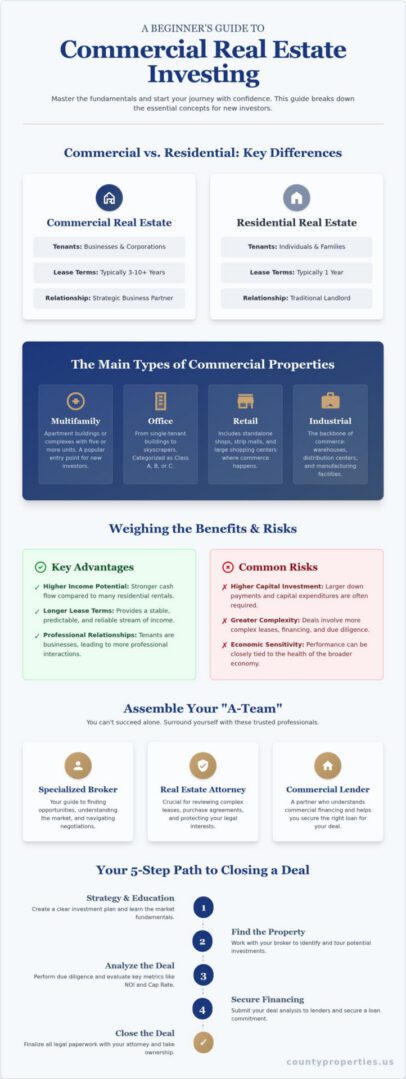
At its core, commercial real estate (CRE) is property used exclusively for business-related purposes or to provide workspace rather than a living space. Unlike residential properties where you rent to individuals and families on short-term agreements, in CRE your tenants are businesses, and the leases are typically much longer. This fundamental difference is what makes investing in commercial real estate for beginners such a unique journey. It requires a shift in mindset from simply being a landlord to becoming a strategic business partner.
Investors generate returns in two primary ways: through consistent rental income paid by tenants and through property appreciation, which is the increase in the property’s value over time. More than just owning a building, you are investing in your tenant’s business. Their success directly fuels your return, creating a powerful partnership. This is true whether you own a small retail storefront or a large office building.
The Main Types of Commercial Properties
While the world of Commercial property is vast, most opportunities fall into four main categories. As a newcomer, understanding these types will help you focus your search:
- Multifamily: Apartment buildings or complexes with five or more units. This is a popular entry point as it blends familiar residential concepts with commercial-scale operations.
- Office: These range from single-tenant buildings to large skyscrapers. They are often categorized as Class A, B, or C based on age, location, and amenities.
- Retail: This includes everything from standalone shops and local restaurants to large strip malls and regional shopping centers where people spend money.
- Industrial: The backbone of modern commerce, this category includes warehouses, distribution centers, and manufacturing facilities.
Understanding Leases: The Engine of Your Investment
The lease agreement is the engine that drives your investment’s profitability. A key lesson when investing in commercial real estate for beginners is understanding the difference between a Gross Lease, where the landlord pays most operating expenses, and a Net Lease, where the tenant is responsible for some or all of those costs (like taxes, insurance, and maintenance).
CRE leases are typically long-term, often spanning 3 to 10 years. This structure is designed to provide you with a stable, predictable, and reliable stream of income, which is a major appeal of this asset class. Because of this, the financial health and creditworthiness of your tenant are paramount to your success. A strong, reliable tenant means a secure, high-performing investment.
The Core Benefits and Risks of Investing in CRE
Venturing into commercial real estate (CRE) can be an incredibly rewarding part of your financial journey, but it’s crucial to approach it with a clear-eyed perspective. Unlike more volatile assets, CRE is a long-term commitment, not a get-rich-quick scheme. Success in investing in commercial real estate for beginners starts with understanding the complete picture-both the powerful advantages and the significant challenges. Before making any decisions, it’s wise to absorb foundational knowledge from trusted sources, such as this comprehensive Beginner’s Guide to CRE Investing from Forbes. The key is to align the unique characteristics of this asset class with your personal financial goals and risk tolerance.
To help you weigh your options, we’ve broken down the core pros and cons in a straightforward comparison.
| Key Advantages (The “Pros”) | Common Risks (The “Cons”) |
|---|---|
|
|
Understanding this balance of risk and reward is the foundational first step. While the challenges are real, they can be managed with careful planning, thorough due diligence, and expert guidance-which we will explore in the sections to come.
Your First 5 Steps: Building a Foundation Before You Buy
The allure of a tangible asset can make it tempting to jump straight into property listings. However, the most successful investors know that the real work happens long before the first tour. Building a strong foundation is the most critical part of investing in commercial real estate for beginners. This strategic roadmap will guide you through the essential planning stages, ensuring you enter the market with clarity and confidence, backed by a trusted real estate partner.
Steps 1 & 2: Clarify Your Strategy and Commit to Learning
First, define what success looks like for you. Is your primary goal steady monthly income (cash flow), long-term growth in the property’s value (appreciation), or a balanced mix? Next, determine your ideal involvement. Do you want to be a hands-on landlord or a passive investor? Answering these questions shapes every decision that follows. Immerse yourself in educational resources like books and podcasts. Before focusing solely on commercial assets, it helps to understand the broader principles of how to invest in real estate, as many fundamental concepts overlap and provide a solid base of knowledge.
Step 3: Master the Core Financial Metrics
Numbers tell the story of a property’s potential. Understanding these three key metrics is non-negotiable:
- Net Operating Income (NOI): This is the property’s annual income after all operating expenses are paid, but before mortgage payments. For example, if a property generates $100,000 in rent and has $35,000 in expenses (taxes, insurance, maintenance), its NOI is $65,000.
- Capitalization (Cap) Rate: This metric helps you quickly compare opportunities. It’s the NOI divided by the property price. Using the example above, if the property is selling for $1,000,000, its Cap Rate is 6.5% ($65,000 ÷ $1,000,000).
- Cash-on-Cash Return: This shows the return on the actual cash you invested (your down payment). If your annual pre-tax cash flow is $20,000 and your down payment was $250,000, your cash-on-cash return is 8%.
Steps 4 & 5: Arrange Financing and Select Your Market
Begin conversations with lenders early to understand your borrowing power. Common financing options include conventional bank loans, SBA loans (for owner-occupied properties), or even seller financing. Lenders will scrutinize your personal financial statement, so have it prepared and polished. Simultaneously, research potential markets. Look for indicators of a healthy economy, such as population growth, diverse job markets, and new developments. A trusted local expert can provide invaluable guidance on whether to invest in your backyard or explore other promising regions.
Assembling Your A-Team: The Experts You Can’t Succeed Without
Unlike buying a home, commercial real estate is rarely a solo endeavor. Successful investing in commercial real estate for beginners is a team sport, and the quality of your team directly impacts your bottom line. Attempting to navigate this complex world alone exposes you to unnecessary risks and missed opportunities. By partnering with seasoned professionals, you gain the guidance and expertise needed to make confident, informed decisions and protect your capital.
Your Commercial Real Estate Agent
Think of your commercial agent as your strategic guide and team captain. They provide more than just property listings; they offer deep local market knowledge, access to off-market deals, and expert analysis to help you identify the right opportunities. A great agent is also a skilled negotiator, working to secure the most favorable terms on your behalf. More importantly, they serve as a hub, connecting you to their network of other trusted professionals. Our team has the expertise to guide your first investment.
Your Real Estate Attorney and CPA
Your legal and financial advisors are the defensive line of your team, protecting you from costly errors. A real estate attorney meticulously reviews all contracts, lease agreements, and title work to ensure your legal interests are secure. Meanwhile, a Certified Public Accountant (CPA) advises on the most advantageous ownership structure (like an LLC) and develops tax strategies to maximize your returns, both during the purchase and for years to come.
Your Lender and Property Manager
Securing financing and managing the asset are two critical pillars of your investment journey. A commercial lender specializes in financing investment properties and understands the unique metrics involved, from debt service coverage ratios to net operating income. Building a strong relationship with a reliable lender is crucial for scaling your portfolio. Once you own the property, a professional property manager can handle the day-to-day operations-from tenant relations to maintenance-allowing you to focus on strategy rather than logistics.
Finding, Analyzing, and Closing Your First Deal
With a solid foundation of knowledge, you’re ready to transition from learning to doing. This is where the rewarding journey of investing in commercial real estate for beginners truly begins. The process involves three critical phases: finding the right opportunity, conducting thorough analysis, and successfully closing the deal. We are here to provide the guidance you need to navigate this path with confidence.
Where to Find Potential Investment Properties
Your search for the ideal property can start in several places. Partnering with an experienced commercial real estate broker is often the most effective route, as they provide access to off-market deals and expert local knowledge. Additionally, online platforms like LoopNet and Crexi are valuable resources for browsing available listings. Don’t underestimate the power of networking; connecting with local investors, attorneys, and business owners can uncover unique opportunities.
The Due Diligence Checklist for Beginners
Once you’ve identified a property, the due diligence period is your opportunity to verify every detail. This critical phase protects your investment and ensures there are no surprises. Your checklist should include:
- Financial Due Diligence: Scrutinize the property’s financial health by reviewing at least two years of profit and loss statements, rent rolls, and all existing tenant leases to verify income streams.
- Physical Due Diligence: Hire licensed professionals to conduct a thorough property condition assessment, including inspections of the structure, roof, HVAC systems, and a Phase I Environmental Site Assessment.
- Legal Due Diligence: Engage an attorney to review the title report for any liens or encumbrances, confirm the property’s zoning classification aligns with your intended use, and verify all necessary permits are in place.
Common Mistakes to Avoid
New investors can easily fall into common traps that jeopardize their success. Being aware of these pitfalls is the first step to avoiding them. Watch out for:
- Underestimating ongoing expenses, especially capital expenditures (CapEx) like future roof or HVAC replacements.
- Failing to properly vet tenants and fully understand the terms of their leases. A bad tenant can negate a good deal.
- Becoming emotionally attached to a property, which can lead to overpaying and ignoring red flags.
- Lacking a clear exit strategy-know how you plan to profit from the investment before you buy.
The path of investing in commercial real estate for beginners is detailed, but it doesn’t have to be intimidating. Each step, from analysis to closing, is manageable with the right support system. Having a seasoned professional guide you through the complexities is the key to making a sound investment. Our team at County Properties is committed to being your trusted partner on this exciting journey.
Your Journey into Commercial Real Estate Starts Now
Embarking on your investment journey can feel daunting, but as you’ve learned, success is built on a solid foundation. Remember that understanding the unique risks and rewards of commercial properties and assembling a team of trusted experts are non-negotiable first steps. While the path of investing in commercial real estate for beginners has its complexities, meticulous preparation and expert guidance can transform it from an intimidating challenge into a tangible, wealth-building opportunity.
You don’t have to navigate this journey alone. When you’re ready to move forward, lean on a team that prioritizes your success. With over 36+ years of real estate experience and deep expertise in the Southern California market, our service-centric, collaborative approach is designed to empower you. Ready to take the next step? Partner with our experienced team to navigate the Southern California commercial real estate market.
Your first successful commercial real estate deal is within reach. Take that next step with confidence.
Frequently Asked Questions About Commercial Real Estate Investing
How much money do you realistically need to start investing in commercial real estate?
While there’s no single magic number, a direct property purchase typically requires a significant down payment of 20-30% of the property value, plus an additional 3-5% for closing costs and reserves. For a $500,000 property, this means having $115,000 to $175,000 in liquid capital. For a lower entry barrier, options like Real Estate Investment Trusts (REITs) or real estate crowdfunding platforms allow you to start with just a few thousand dollars.
Can you invest in commercial real estate with no experience?
Yes, you can, but it is crucial to approach it with guidance and a commitment to learning. We strongly advise partnering with a team of seasoned professionals, including a commercial real estate broker, a real estate attorney, and a knowledgeable lender. These experts act as your trusted partners, helping you navigate complex contracts, conduct thorough due diligence, and avoid common pitfalls. Starting with a smaller, simpler property or a passive investment can also be a wise first step.
What is a REIT, and how is it different from owning a property directly?
A REIT, or Real Estate Investment Trust, is a company that owns and often operates income-producing real estate. Think of it like a mutual fund for property. Investing in a REIT means buying shares in a portfolio of properties, which is highly liquid and requires less capital. Direct ownership gives you full control over a single asset and all its potential profits, but it also means you bear all the management responsibilities, risks, and require a much larger initial investment.
How long does it typically take to find and close on a commercial property deal?
The timeline can vary, but a typical transaction takes between 60 to 120 days from the time your offer is accepted. This period includes a comprehensive due diligence phase (30-60 days) where you inspect the property and its financials, followed by the financing and legal process to secure a loan and finalize the closing. The initial search for the right property can take several months before this process even begins, so patience is a key part of your journey.
Is commercial real estate a good investment in the current economic climate?
While economic shifts can create uncertainty, they also uncover unique opportunities for savvy investors. Certain sectors, like industrial warehouses and multifamily housing, have shown strong resilience. The key to success is not timing the market perfectly but conducting meticulous market analysis and due diligence. A well-located property with strong tenants can provide a stable income stream and long-term appreciation regardless of broader economic trends, making it a solid component of a diversified portfolio.
What is the hardest part of commercial real estate investing for a beginner?
For most newcomers, the two biggest challenges are securing financing and performing adequate due diligence. Lenders have stricter requirements for commercial loans than for residential mortgages, demanding detailed financial projections and a solid business plan. The due diligence process is also far more complex. Successfully navigating these hurdles is often the most difficult part of investing in commercial real estate for beginners, which is why having an expert team to guide you is not just a benefit; it’s a necessity.