

By 2026, the traditional lone wolf approach to property investment is officially a liability. You’re likely looking for a way to break into the market, but learning how to invest in commercial real estate for beginners can feel like learning a foreign language while your capital is on the line. It’s natural to worry about the 12.9% office vacancy rates seen in recent urban reports or the confusing structure of triple-net leases. You want the steady cash flow of a retail center without the stress of managing it alone.
Commercial real estate is a team sport. Unlike residential deals where you might manage the entire process alone, commercial success requires a collaborative approach. Since 1995, our “Family of Friends” philosophy has prioritized this team concept because individual guesswork often leads to expensive mistakes. When you’re learning how to invest in commercial real estate for beginners, your first goal shouldn’t be finding a building; it should be finding the right advisors. A seasoned collective, such as the professionals at Real Estate Services, provides the steady hand you need to secure your financial future in the 2026 market.
We’ve spent 36 years since 1995 proving that the right team makes all the difference in your financial security. This guide will show you how to master commercial fundamentals and build a professional network that replaces guesswork with expert guidance. You’ll discover the exact steps to secure long-term wealth through appreciation and diversify away from the volatile residential market. We’ll provide the roadmap you need to turn these complex assets into a reliable engine for your financial future.
Key Takeaways
- Identify the unique 2026 market opportunities in Southern California that allow new investors to secure income-generating assets.
- Master the “Big Four” property types and learn how to choose between Class A, B, and C assets based on your specific risk tolerance.
- Gain financial clarity by mastering Net Operating Income (NOI) and Cap Rates, which are essential metrics when learning how to invest in commercial real estate for beginners.
- Build a collaborative professional success team to replace individual guesswork with expert guidance and seasoned industry connections.
- Define your personal “Buy Box” and look beyond public listing sites to uncover high-value off-market deals through professional networks.
The Beginner’s Entry into Commercial Real Estate (CRE) in 2026
Commercial real estate is any property designed to generate income through business operations or multi-unit housing. While residential investing focuses on single-family homes, commercial assets include everything from a local coffee shop to a 50-unit apartment complex. Learning how to invest in commercial real estate for beginners starts with shifting your mindset from being a simple landlord to becoming a strategic business partner. You aren’t just providing a roof; you’re providing the infrastructure that allows a business to thrive. This partnership approach is what creates the stability and high returns that seasoned investors have relied on since we began our journey in 1995.
Entering this market in 2026 requires a realistic view of your resources. Unlike residential deals that might require 3% down, commercial lenders typically look for 20% to 35% in equity. You should also prepare for a longer time horizon. Commercial assets aren’t meant for quick flips; they are built for 5-year to 10-year cycles where appreciation and debt paydown work together. Understanding Commercial Property classifications will help you see that while the entry bar is higher, the professional nature of the tenants often leads to a more predictable lifestyle for the owner.
Commercial vs. Residential: What Beginners Need to Know
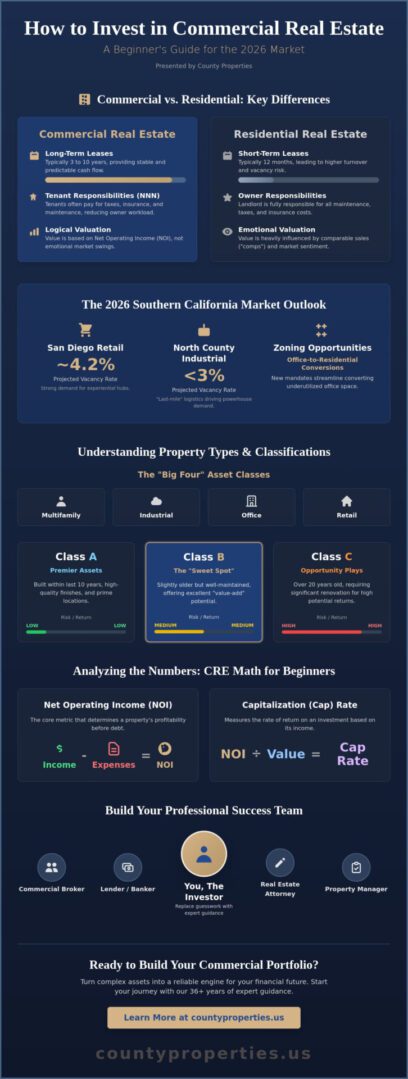
Stability is the primary draw for commercial investors. Most residential leases expire after 12 months, creating constant turnover stress. In contrast, commercial leases frequently span 3 to 10 years. This longevity provides a reliable cash flow that helps you sleep better at night. Maintenance is another major differentiator. Under a Triple Net (NNN) lease, the tenant often pays for property taxes, insurance, and even roof repairs. This shifts the operational burden away from you. Finally, valuation is based on logic rather than emotion. While a house is valued by what the neighbor’s home sold for, a commercial building’s value is tied directly to its Net Operating Income (NOI). If you increase the income, you increase the property value instantly.
The 2026 Southern California CRE Outlook
The Southern California market in 2026 is defined by a “flight to quality.” In San Diego, retail spaces are evolving into experiential hubs, with vacancy rates projected to stay near 4.2% for well-located centers. Industrial space remains the region’s powerhouse, with sub-3% vacancies in North County as logistics firms scramble for “last-mile” delivery spots. Local zoning changes are also creating massive opportunities for those who know where to look. New state-level mandates have streamlined the process for converting underutilized office space into mixed-use residential units. For a broader look at how these shifts fit into the regional economy, you can check our Southern California housing market forecast to see the full picture of the 2026 landscape.
Understanding Property Types and Classifications
Success in commercial real estate depends on choosing an asset class that aligns with your lifestyle and financial goals. The industry typically focuses on the “Big Four”: Multifamily, Retail, Office, and Industrial. While each offers unique benefits, understanding how to invest in commercial real estate for beginners often starts with recognizing property “classes.” These categories (A, B, and C) define the age, quality, and risk profile of a building. Class A properties are premier assets built within the last 10 years, offering the lowest risk but also the lowest immediate returns. Class B buildings are slightly older but well-maintained; Class C properties are often over 20 years old and require significant renovation. Many of our clients find Class B to be the “sweet spot” because it allows for “value-add” improvements that increase income without the high price tag of a brand-new tower.
Beyond the primary four, niche sectors like self-storage, medical clinics, and hospitality offer specialized opportunities. Medical offices are particularly resilient because healthcare providers rarely move once they’ve established a local patient base. If you’re feeling overwhelmed by these choices, Building Your Commercial Real Estate Team is your next logical step to help filter these opportunities based on current market data. Multifamily properties, such as apartment complexes with five or more units, often serve as the “gateway” for those transitioning from residential investing because the management style feels familiar, even if the scale is larger.
Multifamily and Industrial: The 2026 Safe Havens
In Southern California, the persistent housing shortage ensures that multifamily demand remains incredibly high. San Diego’s rental market continues to see occupancy rates above 95% in most submarkets. This makes Class B multifamily assets prime candidates for value-add strategies; simple upgrades to kitchens or landscaping can justify higher rents. Industrial real estate is also booming due to the “last-mile” delivery needs of e-commerce. Small warehouses near major highways are in high demand, often fetching premium rents from logistics companies that need to reach customers quickly. You can search for local commercial listings to see which asset types are currently available in your preferred zip code.
Retail and Office: Navigating the New Normal
The retail and office sectors have undergone a massive transformation leading into 2026. Traditional storefronts are being replaced by “experiential retail,” where tenants offer services or entertainment that can’t be found online. Think of boutique gyms, high-end salons, or grocery stores. These “recession-proof” tenants provide a stable foundation for a shopping center. Similarly, the office market has shifted away from massive skyscrapers. Today’s tenants want flexible, boutique spaces with modern amenities. Smaller buildings that cater to local professional services like law firms or accounting practices are outperforming large corporate campuses, providing a more accessible entry point for new investors.
Analyzing the Numbers: CRE Math for Beginners
Numbers are the universal language of business. When you are learning how to invest in commercial real estate for beginners, your ability to read a profit and loss statement is more important than the paint color on the walls. The most critical metric is Net Operating Income (NOI). This figure represents your total income minus all operating expenses, excluding debt service. It’s the raw profit a property generates before you consider your mortgage. To verify this, you’ll need a Rent Roll, which lists every tenant’s lease terms and payment history, and a certified Expense Statement. These documents provide the ground truth for your due diligence process, ensuring you aren’t buying a property with hidden costs.
Mastering the Cap Rate
The Capitalization Rate, or Cap Rate, is the ratio of NOI to property purchase price. Across San Diego County, these rates vary based on location and risk. For instance, a premier retail center in Del Mar might trade at a 4.5% cap rate, while an industrial warehouse in Escondido might offer a 6.2% return. It’s a common mistake to assume a higher cap rate is always better. A low cap rate often signals a high-quality asset in a prime location where demand is guaranteed. This makes it a safer long-term bet for your financial security because the property is less likely to face extended vacancies.
While the cap rate looks at the property, Cash-on-Cash Return looks at your wallet. This is your annual pre-tax cash flow divided by the total amount of cash you actually invested. Since 1995, we’ve seen that this number is the most accurate way to measure how hard your money is working for you compared to the volatile stock market. Understanding these metrics is the first step in how to invest in commercial real estate for beginners with confidence and professional clarity.
Financing Your First Commercial Deal
Financing a commercial deal is significantly different from a residential mortgage. Most lenders require a Loan-to-Value (LTV) ratio between 60% and 75%, which means you’ll need more cash up front than a typical home purchase. Banks also focus heavily on the Debt Service Coverage Ratio (DSCR). This metric compares the property’s NOI to its annual debt payments. Lenders typically look for a DSCR of 1.25 or higher to ensure the property can comfortably pay its own mortgage even if expenses rise slightly. If traditional bank financing feels out of reach, don’t be discouraged. Many beginners explore creative options like seller carry-backs, where the owner acts as the lender for a portion of the price, or private money partnerships to help bridge the gap for their first acquisition.
Building Your Professional Success Team
Commercial real estate is a team sport. Unlike residential deals where you might manage the entire process alone, commercial success requires a collaborative approach. Since 1995, our “Family of Friends” philosophy has prioritized this team concept because individual guesswork often leads to expensive mistakes. When you’re learning how to invest in commercial real estate for beginners, your first goal shouldn’t be finding a building; it should be finding the right advisors. A seasoned collective provides the steady hand you need to secure your financial future in the 2026 market.
The Essential Roles on Your CRE Team
A Commercial Real Estate Broker is your most valuable player. Public listing sites often show “stale” inventory that has already been passed over by institutional investors. A broker with deep local roots provides access to off-market deals and “pocket listings” that never hit the public internet. You also need a Real Estate Attorney who specializes in commercial contracts. These documents differ significantly from residential ones, often including complex clauses for environmental liability, tenant improvement (TI) allowances, and specific lease structures. Finally, a CPA or tax strategist is vital. They help you maximize depreciation benefits and navigate the rules of 1031 exchanges, which allow you to defer capital gains taxes when you eventually sell and trade up to a larger asset.
Why Local Expertise Matters in Southern California
The Southern California regulatory environment is notoriously complex. Navigating California-specific environmental disclosures or local zoning changes requires a team that understands the San Diego County landscape. For instance, the value of a Senior Real Estate Specialist is unmatched if you’re purchasing assisted living or senior housing assets. These properties involve intricate licensing and operational requirements that standard residential agents don’t encounter. Our collaborative model ensures you have access to this specialized knowledge, protecting you from regulatory surprises that could impact your cash flow.
The 2026 market demands a holistic approach to every deal. We believe that your success is a direct result of the guidance you receive, which is why we reject the traditional “lone wolf” brokerage model. This service-centric philosophy is a core part of how to invest in commercial real estate for beginners with confidence. You aren’t just hiring a service provider; you’re building a network that will support your journey toward long-term wealth through appreciation. If you’re ready to start assembling your advisors, you can connect with our expert team to discuss your specific investment goals.
Taking Action: Your First Commercial Investment Strategy
Taking the final step in how to invest in commercial real estate for beginners requires a disciplined transition from analysis to execution. You must first define your “Buy Box.” This is a specific set of parameters that includes your target geography, such as North County or the South Bay, your preferred property type, and your maximum budget. Without this filter, you’ll waste time on deals that don’t fit your long-term wealth goals. Once your criteria are set, move your search beyond public portals like LoopNet or Crexi. While these sites are useful for market research, the highest-quality assets in San Diego often trade within professional networks before they ever reach a public screen.
When you find a property that fits your box, you’ll start with a Letter of Intent (LOI). This document outlines your price and key terms but is generally non-binding. It allows you to negotiate the broad strokes before you pay an attorney to draft a formal Purchase and Sale Agreement (PSA). Once the PSA is signed and your earnest money is in escrow, your due diligence clock begins ticking. This is your critical window to verify every claim the seller has made. You are looking for the “ground truth” behind the marketing brochure to ensure your financial security.
Finding and Vetting the Opportunity
Analyzing a neighborhood’s “path of progress” is essential in a dynamic market like San Diego. Look for areas with planned infrastructure improvements or new transit-oriented development (TOD) zones that will drive future demand. During this phase, you must request a “T-12” statement, which shows the trailing 12 months of actual income and expenses. This document is much harder to manipulate than a simple pro forma estimate. Pair this financial audit with a rigorous physical inspection. You’re looking for deferred maintenance, such as leaky roofs or outdated HVAC systems, that could instantly kill your projected ROI. Learning how to invest in commercial real estate for beginners means knowing that a deal isn’t final until every inspection report is cleared.
Closing the Deal and Beyond
As you move toward the finish line, you’ll need to secure specialized insurance and a Phase I Environmental Site Assessment (ESA). Lenders require this report to ensure the land isn’t burdened by historical contamination from previous business use. Closing the deal is a major milestone, but it’s actually the beginning of your management journey. You’ll need to formally notify tenants of the ownership change and implement your management systems to ensure a seamless transition. For those looking to move beyond their first deal, our Commercial Real Estate Southern California guide provides the advanced scaling strategies you’ll need to build a true portfolio. We’ve helped investors navigate these complex transitions since 1995, and we’re ready to guide you through your first successful close.
Securing Your Financial Future in the 2026 Commercial Market
The 2026 market offers a clear path for those ready to move beyond the volatility of residential properties. You now understand that commercial success is built on precise math like NOI and Cap Rates, paired with a disciplined search for high-value asset classes. Mastering how to invest in commercial real estate for beginners is about more than just reading data; it’s about shifting your mindset toward a collaborative, team-based strategy. Since 1995, our 36 years of Southern California experience have shown that the right network is the ultimate hedge against risk.
We’ve spent decades building a “Family of Friends” approach to help our partners navigate complex transitions, including senior housing and distressed assets. You don’t have to face these complexities alone. To start your journey with professional clarity, Download our Exclusive Southern California Commercial Investor’s Checklist today. Your goals for steady cash flow and long-term appreciation are within reach. We are here to provide the expert guidance you need to turn your investment dreams into a secure financial reality.
Frequently Asked Questions
How much money do I need to start investing in commercial real estate?
You generally need a down payment between 20% and 35% of the property’s purchase price to secure a commercial loan. Unlike residential loans that might allow for 3.5% down, commercial lenders require higher equity to mitigate their risk. You’ll also need to budget for closing costs, which often range from 2% to 5% of the total deal size. Having a cash reserve for immediate maintenance or unexpected tenant improvements is essential for your long-term financial security.
Is commercial real estate more risky than residential real estate?
Commercial real estate involves different risks, specifically regarding vacancy duration and specialized build-out costs. While residential tenants might leave every 12 months, commercial leases often last 5 years or longer. However, if a commercial space goes dark, it can take 6 to 12 months to find a suitable new business tenant. This is why we emphasize building a collaborative team to vet tenant creditworthiness before you sign any lease agreement or commit your capital.
What is a Triple Net (NNN) lease and how does it work?
A Triple Net lease is a structure where the tenant is responsible for property taxes, building insurance, and maintenance costs in addition to rent. This is a common strategy when learning how to invest in commercial real estate for beginners because it significantly reduces your management responsibilities. You receive a “net” rent check while the business tenant handles the operational headaches. It’s an ideal setup for investors seeking a more passive, hands-off income stream from retail or industrial assets.
Do I need a special license to buy commercial property?
You don’t need a special license or certification to buy or own commercial property. Any individual or legal entity, such as an LLC or S-Corp, can acquire these assets. Licenses are only required for professionals who represent other parties in a transaction or manage properties for a fee. Most new investors choose to work with a licensed broker to access market data and navigate complex 2026 California disclosures that are often difficult for individuals to source alone.
What happens if a commercial tenant goes out of business?
If a tenant fails, you typically rely on the security deposit and any personal guarantees signed during the lease execution. A personal guarantee allows you to pursue the tenant’s personal assets for the remaining lease balance. Our team suggests requiring at least 3 to 6 months of rent as a deposit for new businesses. Recovering the space quickly is vital so you can begin marketing to the 4.2% of retail seekers currently active in the San Diego market.
Can I use a 1031 exchange to move from residential to commercial property?
You can absolutely use a 1031 exchange to transition from residential rentals into commercial assets. The IRS considers all investment real estate “like-kind,” regardless of whether it’s a single-family house or a warehouse. This is a powerful tool for how to invest in commercial real estate for beginners because it defers capital gains taxes. You must identify a replacement property within 45 days and close the transaction within 180 days to qualify for this tax benefit.
How do I find commercial real estate deals that aren’t on the market?
Finding off-market deals requires building relationships with local brokers and property managers who know which owners are ready to sell. Many high-quality assets never reach public listing sites because they are sold through “pocket listings” within a broker’s private network. Since 1995, we’ve found that being an active part of the local community leads to more opportunities than refreshing a public website. Direct mail campaigns to specific property owners can also yield results if you have a defined “Buy Box.”
What is a good Cap Rate for a beginner’s first investment?
A sustainable cap rate for a first-time investment usually falls between 5% and 7% in today’s Southern California market. While you might see distressed properties offering 10% or higher, these often come with significant structural or tenant risks. We recommend prioritizing a stable 6% return from a well-located Class B property over a higher-risk asset. Your goal as a beginner is to secure a reliable “win” that builds your confidence and creates a steady foundation for your future portfolio.