

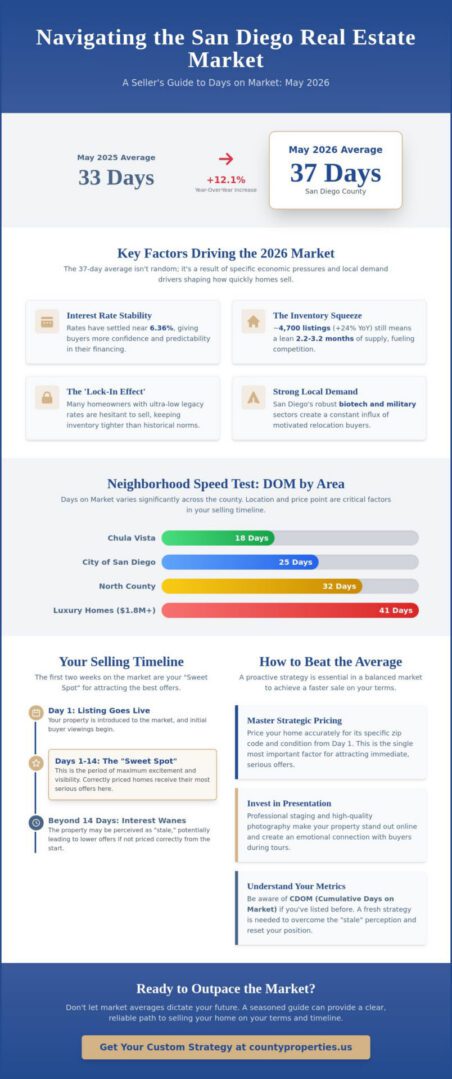
In May 2026, the average days on market San Diego county sellers face has climbed to 37 days, a 12.1% increase from last year. You might see one headline claiming the market is cooling while another says homes are flying off the shelves in 25 days. It’s natural to feel a sense of unease when you’re trying to time a major life change, especially if you’re coordinating a sensitive senior transition or need a specific timeline to secure your next move.
We agree that these conflicting numbers can make you worry about your property sitting stagnant while your future remains on hold. You deserve a clear, reliable path forward that cuts through the noise of national apps and local rumors. We’ll show you exactly how to navigate the current 2026 trends and share the professional strategies we use to help our clients beat the local averages. You’ll discover how to leverage current buyer selectivity and the 6.36% mortgage rate environment to ensure your home sells on your terms and provides the financial security you’ve worked hard to build.
Key Takeaways
- Learn why the average days on market San Diego county sellers face has increased to 37 days and how to interpret these figures for your specific neighborhood.
- Identify the core 2026 market drivers, such as current inventory levels and interest rate stability, that dictate how quickly buyers are moving.
- Master strategic pricing and staging techniques designed to help your property stand out and attract serious offers faster than the local average.
- Gain clarity on the “Coastal vs. Inland” DOM gap to set realistic expectations for your sale and coordinate your next move with confidence.
- Discover how specialized guidance in senior transitions and foreclosure prevention can provide a secure, methodical path through complex real estate challenges.
Understanding the 2026 Average Days on Market in San Diego
When you’re preparing to sell your home, the most common question is how long the process will take. The What ‘Days on Market’ Means is a calculation of the total time from when a property is first listed until it goes under contract. In May 2026, the average days on market San Diego county reports is 37 days, though this number varies by property type and specific neighborhood. It’s helpful to distinguish between the average and the median; while the average can be skewed by a few luxury estates that sit for months, the median often gives you a more realistic view of what the “middle” of the market is experiencing.
Your timeline is also heavily influenced by the transition from “Active” to “Pending” status. Once a home moves to pending, the DOM clock stops, but your actual move date is still weeks away. Understanding this gap is vital for anyone coordinating a senior real estate transition or trying to time a purchase. In 2026, San Diego remains faster than many other California regions, but buyers are taking more time to conduct inspections and secure financing compared to previous years. We’ve seen a shift where accuracy in your initial listing matters more than ever.
DOM vs. CDOM: Which Metric Should You Trust?
If you’ve previously listed your home and it didn’t sell, the Cumulative Days on Market (CDOM) becomes your most important metric. CDOM is the total time a property has been listed across multiple attempts without a successful closing. Buyers and their agents watch this number closely because a high CDOM can signal that a home is overpriced or has hidden issues. This “stale” perception often leads to lower than average offers. We focus on helping you reset your market position to ensure your property feels fresh and desirable to new buyers entering the search.
San Diego Market Speed: 2026 vs. Historical Norms
The 2026 market feels different than the “frenzy” years of 2021 and 2022. Back then, homes often went pending in under 10 days. Today, the average days on market San Diego offers reflects a more balanced environment. This shift requires a change in seller psychology. You shouldn’t panic if your home doesn’t sell in 48 hours. However, the “Sweet Spot” for receiving your best offers is still within the first 14 days. Properties that are priced correctly for their specific zip code tend to see the most engagement during this initial window.
- City of San Diego: 25 days average.
- North County: 32 days average.
- Chula Vista: 18 days average.
- Luxury Homes ($1.8M+): 41 days average.
Data tells a story, but it doesn’t have to be your destiny. By understanding these benchmarks, you can choose a strategy that prioritizes your financial safety and long-term goals. We’re here to act as your dependable guide through every step of this transition.
Key Factors Driving San Diego Real Estate Speed in 2026
The 37-day average days on market San Diego currently experiences is not a random figure. It’s the result of specific economic pressures and local lifestyle drivers. While macroeconomic shifts influence every city, our region operates on a unique set of rules. Interest rates have stabilized near 6.36% as of May 2026, which has brought a sense of predictability back to the market. This stability allows buyers to plan their long-term financial safety with more confidence, even if they’re more selective about the properties they choose to tour.
San Diego’s economy provides a sturdy foundation that many other regions lack. Our massive biotech sector and deep military roots create a constant stream of relocation buyers. These professionals often move on strict schedules, which keeps the market moving at a steady clip. When a biotech firm expands in Sorrento Valley or a naval officer receives new orders, they need housing quickly. This consistent demand helps buffer our local market against the broader cooling trends seen in other parts of the country.
The Inventory Squeeze and Buyer Competition
Active listings in San Diego County hover around 4,700 homes. While this is a 24% increase compared to last year, the supply remains lean at roughly 2.2 to 3.2 months. Many homeowners are currently experiencing the “Lock-in Effect,” where they’re hesitant to trade their existing low interest rates for a new mortgage. This keeps inventory levels below what we would see in a truly balanced market. You can explore these dynamics further in our guide to the Southern California Housing Market: Forecast & Trends for 2026. If you’re feeling overwhelmed by these numbers, a personalized market analysis can help clarify your specific position.
Seasonal Trends: When Does San Diego Move Fastest?
Data from National Real Estate Market Trends shows how median days on market typically fluctuate across the United States. San Diego follows a similar seasonal rhythm, but our coastal climate softens the impact. The “Spring Surge” typically begins in late February, as buyers aim to close before summer. During this window, the average days on market San Diego sellers see often dips as competition intensifies. In contrast, the fourth quarter usually brings a “Holiday Slowdown.” Families often pause their search to focus on personal milestones, which can lead to a slight increase in the time it takes to secure a contract. Coastal properties tend to defy these national trends, as the allure of the Pacific Ocean maintains high demand throughout the entire year.
Neighborhood Deep Dive: Where Homes Sell Fastest in San Diego
San Diego is a patchwork of micro-climates, and its real estate market is no different. While the 37-day average days on market San Diego reports provides a helpful benchmark, it doesn’t tell the whole story for every zip code. Real estate speed is hyper-local. According to the latest San Diego Association of REALTORS® market statistics, properties in Chula Vista often find buyers in just 18 days. Meanwhile, inland suburban areas with highly rated school districts, like Scripps Ranch or Carmel Valley, consistently outperform the county average because of the steady influx of families.
Urban neighborhoods like Hillcrest benefit from what we call the “walkability factor.” Buyers here are often looking for lifestyle proximity to dining and employment hubs, which keeps demand high and listing times short. In contrast, East County markets might see a slightly slower pace as buyers weigh the commute against larger lot sizes. Understanding these nuances helps you set a realistic timeline for your specific move. It’s about matching your property’s unique strengths with the specific buyer pool looking in your neighborhood.
Coastal Luxury vs. Suburban Stability
There’s a significant gap between the high-end coastal market and inland suburban stability. Luxury homes, particularly those priced over $1.8 million in areas like Rancho Santa Fe, saw their time on market increase to 41 days this April. These properties require a smaller, more selective group of buyers, which naturally extends the timeline. Suburban entry-level homes move much faster. In these neighborhoods, the sale-to-list price ratio remains near 98.5%, proving that while buyers are selective, they’re ready to act when they find a home that offers long-term value and financial safety.
Specialized Markets: Seniors and Transitions
Selling a home that’s been in the family for decades requires a different approach than a standard suburban sale. Senior real estate transitions often involve complex emotional and logistical layers that can impact the selling speed. It’s not just about the house; it’s about the life transition attached to it. We focus on a methodical, empathetic process to ensure these moves are handled with care and precision. If you’re navigating this path, understanding What is a Senior Real Estate Specialist (SRES®) and Why Do You Need One? can be a vital first step. Our goal is to reduce the stress of the sale while protecting your equity, acting as a dependable guide through every phase of the transition.
Strategic Moves to Reduce Your Days on Market
While the 37-day average days on market San Diego currently maintains serves as a baseline, your personal timeline doesn’t have to follow the crowd. Selling your home faster requires a proactive approach that prioritizes financial safety and professional mastery. One of the most effective ways to prevent delays is a pre-listing inspection. By identifying and addressing potential repair issues before your home hits the market, you eliminate the mid-escrow surprises that often cause buyers to back out or demand price concessions. This methodical preparation ensures a smoother, more predictable path toward a successful closing.
High-impact marketing also plays a pivotal role in compressing your timeline. We utilize professional video and social media targeting to put your property in front of qualified buyers who are actively searching for their next milestone. In a market where the sale-to-list price ratio is a healthy 98.5%, reaching the right audience quickly is the difference between a fast contract and a stagnant listing. If you’re ready to see how these strategies apply to your property, you can request a professional equity assessment to get started.
Pricing for the 2026 Market
The first 10 days of your listing are the most critical window for capturing “hot” buyers. These are the individuals who have already been outbid or have been waiting for a home that fits their specific criteria. Setting an accurate price is the single most important factor in beating the average days on market San Diego reports for your specific zip code. If you overprice your home initially, you risk missing this surge of activity. Chasing the market with incremental price drops later on often leads to a higher CDOM and lower perceived value. For a deeper look at navigating these complexities, explore our Selling a Home in Southern California: The Ultimate Guide. Pricing correctly from day one protects your equity and keeps your momentum strong.
Presentation and Digital Reach
To further boost your home’s visibility and professional appeal, you can check out Plain Insane Graphix for high-quality custom signage and promotional materials that provide a polished, professional look for any property listing.
Why a Seasoned Guide is Your Best Asset in San Diego
Navigating the 2026 real estate landscape requires more than just access to a database. While the current 37-day average days on market San Diego reports provides a useful benchmark, your success depends on how you interpret and react to shifting buyer behaviors. Arnie Levine and the County Properties team bring a deep background in the local market, having steered clients through multiple economic cycles with a focus on reliability and financial safety. We don’t believe in high-pressure sales tactics. Instead, we position ourselves as your steadfast partner, ensuring you have the professional mastery needed to make informed decisions during significant life transitions.
Our collaborative team approach differentiates us from the traditional industry model of individual competition. By working as a close-knit group, we ensure that every listing benefits from a collective pool of knowledge and specialized marketing resources. This method allows us to remain agile and responsive, which is essential when the market action index is fluctuating as it is in 2026. Whether you are selling a family home or looking for your next milestone property, we focus on methodical, client-first outcomes that protect your equity and your peace of mind.
Expertise Beyond the Transaction
A property sale is often the centerpiece of a larger personal journey. We specialize in senior real estate transitions, where empathy and sensitivity are just as important as market data. Moving from a long-term family residence into a more manageable situation is a high-stakes personal event that deserves a supportive guide. If you’re currently researching your options, our resource on How to Find the Best Real Estate Agent Near You: A Complete Guide can help you identify the qualities that matter most in a professional ally. Our commitment to your long-term goals remains our primary anchor through every step of the process.
Short Sales and Foreclosure Prevention
We understand that some sellers face complex legal or situational challenges that require a different set of tools. If you are navigating financial hardship, our specialized expertise in short sales and foreclosure prevention can help you find a secure path forward. We provide clear, actionable steps as outlined in our Foreclosure Prevention in California: A Homeowner’s Step-by-Step Guide. For those who need to move immediately and cannot wait for the average days on market San Diego typically requires, we also offer cash offer facilitation. This flexibility ensures that you can achieve a successful outcome even in difficult circumstances, allowing you to move toward your next chapter with optimism and achievement.
Securing Your Success in the San Diego Market
You’ve seen how the average days on market San Diego currently reports is a benchmark rather than a fixed destiny. Success in 2026 depends on your ability to align your property with hyper-local neighborhood trends and the specific needs of today’s selective buyers. By focusing on strategic pricing, professional presentation, and pre-listing preparation, you can move forward with a realistic timeline that protects your equity and your peace of mind.
Our collaborative team provides the professional mastery needed to navigate these complexities with ease. We offer specialized support through an expert Senior Real Estate Specialist (SRES®) on staff and maintain deep expertise in short sale and foreclosure prevention. With decades of experience in the Southern California market, we act as your dependable guide to ensure your move is handled with the care and precision you deserve. Ready to sell? Get your personalized market analysis from County Properties today. We’re here to help you turn your next life milestone into a rewarding achievement.
Frequently Asked Questions
What is the current average days on market for San Diego in 2026?
The current average days on market San Diego county reports is 37 days as of May 2026. This reflects a 12.1% increase over the previous year. While the county average is climbing, specific areas move much faster. For instance, the City of San Diego maintains a 25-day average, while Chula Vista homes often go pending in just 18 days. Your specific timeline depends heavily on your neighborhood and property type.
Does a higher average DOM mean it is a buyer’s market?
A higher average DOM does not automatically signal a transition to a buyer’s market. In 2026, San Diego still maintains a lean inventory of 2.2 to 3.2 months of supply, which favors sellers. The increase in listing time is largely driven by buyer selectivity and the 6.36% mortgage rate environment. Buyers are simply taking more time to ensure their financial safety before committing to a long-term purchase.
How can I sell my house faster than the San Diego average?
You can beat the average days on market San Diego benchmark by focusing on the “Sweet Spot” of the first 14 days. This involves setting a precise, data-driven price and investing in professional staging. Addressing repairs through a pre-listing inspection also prevents mid-escrow delays. Our collaborative team approach ensures your home receives maximum digital reach, which is the most effective way to attract motivated offers early in the listing period.
Why has my home been on the market longer than the neighborhood average?
Homes typically sit on the market longer than their neighbors due to pricing misalignment or deferred maintenance. If your price doesn’t match the current 2026 value for your specific zip code, buyers will overlook your property for fresher listings. High Cumulative Days on Market (CDOM) can also create a stale perception. We recommend a professional equity assessment to identify if presentation issues or pricing strategy are hindering your progress.
Does the time of year affect how many days it takes to sell a house in San Diego?
Yes, seasonal shifts influence selling speed, though San Diego’s coastal climate keeps demand relatively steady year-round. The Spring Surge in late February often sees the lowest DOM as families try to settle before summer. Conversely, the fourth quarter typically brings a Holiday Slowdown where buyers pause their search for personal milestones. Timing your listing to coincide with these high-activity windows can significantly reduce your total time on market.
Is there a difference between “Days on Market” and “Days to Close”?
Days on Market (DOM) measures the time from the initial listing until a contract is signed and the status changes to pending. Days to Close includes the entire escrow period, which involves inspections, appraisals, and financing. While your home might go pending in 25 days, the actual closing and transfer of funds typically take an additional 30 to 45 days. Understanding this distinction is vital for timing your move.
How does overpricing impact a home’s total days on market?
Overpricing is the most common cause of a high DOM and often leads to a lower final sale price. When a home is priced above its 2026 market value, it misses the initial surge of hot buyers during the first two weeks. This forced chasing the market with incremental price drops creates a stale listing. Buyers often perceive these properties as having hidden issues, which can lead to offers well below the original average.
Can a real estate agent accurately predict my home’s DOM?
A seasoned real estate agent can provide a highly accurate estimate of your DOM by analyzing current comps and market velocity. While no one can guarantee a specific date, our historical background and localized knowledge allow us to project a realistic timeline. We use a methodical approach to evaluate inventory levels and buyer demand in your specific neighborhood. This ensures you can plan your transition with confidence and financial security.