

Seller’s remorse isn’t actually caused by the sale of your home; it’s caused by a lack of alignment between your financial goals and your next life chapter. You might worry about leaving money on the table in a market where 11,000 homes sell every day, or perhaps you feel the emotional weight of leaving a property filled with decades of memories. Understanding how to avoid seller’s remorse starts with recognizing that a successful move requires more than just a high offer. It requires a strategic framework that balances your equity with your future lifestyle needs.
We know it’s daunting to consider a move when 30-year mortgage rates sit near 6.65% and the San Diego inventory remains tight. You deserve to feel certain that your hard-earned equity, including potential tax exclusions of up to $500,000 for married couples, is being utilized to its fullest potential. We’ll show you how to manage these complexities so you can move forward with total confidence and zero regret. This guide provides a clear decision-making framework to ensure your next transition is both financially rewarding and personally fulfilling. Our commitment isn’t just to facilitate a sale; it’s to act as your dependable guide through one of life’s most significant milestones.
Key Takeaways
- Learn why seller’s remorse is fundamentally different from buyer’s remorse and how to protect your sense of security during a major life transition.
- Discover how to accurately calculate the “Replacement Cost” in the current Southern California market to ensure your financial outcome justifies the move.
- Master a strategic five-step framework on how to avoid seller’s remorse by defining your lifestyle goals and securing future housing before you list.
- Understand how to use a professional Comparative Market Analysis as an emotional anchor to balance logical financial gains against personal property attachments.
- Explore the benefits of a collaborative, service-centric approach to senior real estate transitions that prioritizes your long-term peace of mind and confidence.
What is Seller’s Remorse in Real Estate?
Seller’s remorse is a deep sense of regret or persistent second-guessing that occurs after you’ve committed to a home sale. While the industry often focuses on the anxiety of buying, the emotional toll of selling a long-term family residence is often far more complex. It’s the heavy feeling that you’ve made a permanent mistake you can’t reverse. You might worry about the timing of the market or feel a sudden, intense grief over leaving the neighborhood where your children grew up.
This feeling often stems from cognitive dissonance in real estate, where your logical financial goals and your emotional attachments are at odds. Buyer’s remorse usually centers on the fear of a bad investment; however, seller’s remorse is about the loss of a “safe haven.” In 2026, this sentiment is more prevalent because over 80% of homeowners are still holding mortgages with rates below 6%. Giving up a low interest rate for the current average of 6.65% creates a psychological “T-account” where you must weigh cherished memories against the potential of your next chapter. Understanding how to avoid seller’s remorse begins with recognizing that these feelings are a natural part of a high-stakes transition.
The Emotional Weight of the Family Home
Selling a home often feels like the end of an era. You might experience a sharp pang of regret during the very first showing when you see strangers walking through your private spaces. It’s easy for sentimental value to cloud your expectations, making it difficult to see the property as a financial asset. You can begin separating your identity from the physical structure by focusing on the fact that your “home” is composed of the people and experiences you take with you, not the four walls themselves.
Financial Anxiety vs. Market Reality
Many Southern California homeowners fall into the “Peak Performance” trap. You might fear that you listed your home just weeks before a price jump, especially with 11,000 homes selling daily across the country. To combat this, you must define what “enough” profit looks like before you ever sign a listing agreement. Knowing your specific numbers helps anchor your decisions in facts rather than fear. When you have a clear plan for how to avoid seller’s remorse, you can view the 1% to 3% in closing costs as a necessary step toward your future goals. Seller’s remorse is the gap between a closed real estate deal and an unfulfilled life transition.
Why Homeowners Regret Selling: The 4 Core Triggers
Regret rarely stems from the act of selling itself. Instead, it arises from a lack of preparation regarding the financial and logistical realities of the 2026 market. You can learn how to avoid seller’s remorse by identifying these four common triggers before you list your property:
- Underestimating Replacement Costs: The price of your next home in Southern California may be significantly higher than anticipated, especially with 30-year mortgage rates averaging 6.65%.
- Lack of a Concrete “Next Step” Plan: This is particularly common in senior real estate transitions where the emotional move happens before the logistical one.
- Selling Under Duress: External pressures from family or sudden life changes can force a sale before you are personally ready to let go.
- Misinterpreting Market Data: Relying on automated online estimates can lead to unrealistic expectations that the current market cannot meet.
The ‘Where Do I Go?’ Dilemma
San Diego inventory remains a significant challenge for many homeowners. While April 2026 saw a 4.6% increase in homes on the market compared to the previous year, the selection is still tight. Selling your home without a secured purchase or lease elsewhere often leads to “seller paralysis.” You don’t want to find yourself in a position where you’ve sold your primary asset but have no place to call home. Utilizing a comprehensive guide for buying a home in Southern California allows you to coordinate your exit strategy with precision and safety.
The Misaligned Valuation Trap
Online estimates often create a “Zestimate trap” where homeowners expect a certain price based on an algorithm that ignores local neighborhood nuances. This leads to disappointment at the closing table when the actual net proceeds are calculated. You must account for the 1% to 3% in seller closing costs and potential capital gains taxes. For 2026, married couples filing jointly can exclude up to $500,000 of capital gains, but income thresholds for the 15% and 20% tax rates still apply to the remaining profit.
Distinguishing between your home’s sentimental value and its actual market value is essential for a smooth transition. Understanding the role of a specialized seller’s agent is critical here, as an expert provides the data-driven perspective needed to set realistic goals. If you need a partner to help navigate these complex valuations, our team at County Properties is ready to provide a detailed analysis of your home’s true worth. Selling under duress almost always results in second-guessing, but by building a collaborative team around your move, you ensure every decision is made with clarity rather than anxiety.
Financial Valuation vs. Emotional Value: Balancing the Scales
Logic and emotion often pull in opposite directions during a home sale. You might know that your equity is at an all-time high, yet the thought of leaving your neighborhood creates a sense of hesitation. Understanding how to avoid seller’s remorse requires a shift from viewing your home solely as a collection of memories to seeing it as a strategic financial vehicle. A professional Comparative Market Analysis (CMA) serves as your best emotional anchor in this process. It provides a data-driven reality check that silences the “what if” inner critic by grounding your expectations in current market truths rather than past peaks or sentimental attachments.
You must also quantify the “Cost of Staying” to get a full picture of your decision. This includes more than just your monthly mortgage payment. Consider the rising costs of property taxes, insurance, and ongoing maintenance. According to the National Association of Realtors in March 2026, two-thirds of sellers are making significant repairs before listing. If you stay, those aging systems and cosmetic updates remain your financial responsibility. There is also an opportunity cost to consider; equity locked in an underutilized property could be working for you elsewhere, perhaps in a more manageable home or a more liquid investment. Evaluating the “Lifestyle ROI” of a move helps you see that relocating isn’t just about a check at closing. It is about gaining a home that actually fits your current life stage.
Objective Data as an Emotional Buffer
A neutral perspective is vital when you are too close to the situation. Finding a qualified real estate agent near me ensures you have a partner who views your property through the lens of a buyer. They compare your home to recent local sales rather than the unsustainable 2021 peaks. This distinction is crucial because the Southern California housing market in 2026 has normalized. Buyers are more selective and analytical now; having objective data helps you meet them with confidence instead of overpricing based on emotion.
The Senior Transition: A Special Case for Value
Seniors often experience the highest levels of remorse because the move represents a significant life shift. For this demographic, the value of “peace of mind” and proximity to family often outweighs the desire for maximum equity. When the stairs become a challenge or the yard feels like a burden, the emotional cost of staying begins to exceed the financial benefit. A certified senior real estate specialist understands these unique pressures. They act as a dependable guide, focusing on a methodical transition that prioritizes your comfort and future security over a high-pressure sales tactic. This specialized support is a key component in how to avoid seller’s remorse during a legacy move.
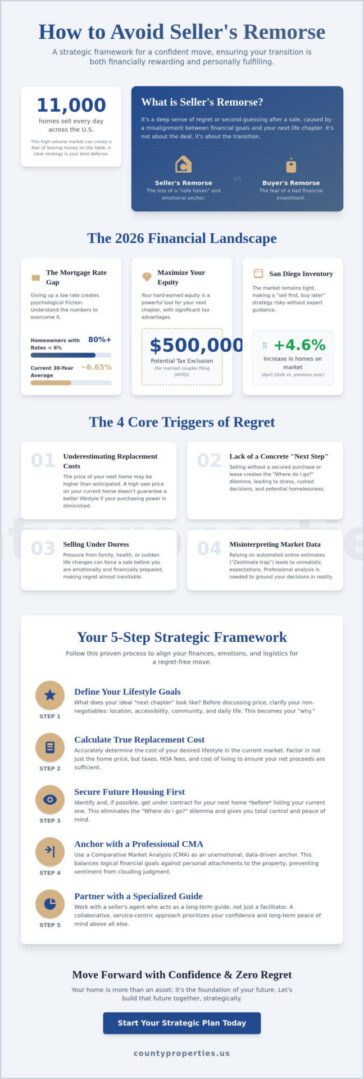
How to Avoid Seller’s Remorse: A Strategic 5-Step Framework
A successful sale is measured by your peace of mind, not just the balance in your bank account. Seller’s remorse often occurs when the logistical speed of a transaction outpaces your emotional readiness. To ensure you remain in control, follow this structured framework designed for the 2026 market.
- Step 1: Define your ‘Why’ beyond the dollar sign. Identify the lifestyle improvement that justifies the move, such as better health, proximity to family, or financial freedom.
- Step 2: Secure your future housing BEFORE you list. Eliminating the fear of being “displaced” is the most effective way to maintain confidence during negotiations.
- Step 3: Get a professional, unbiased valuation. Relying on a veteran’s analysis rather than a generic online estimate prevents the “valuation trap” discussed earlier.
- Step 4: Screen buyers for more than just the highest offer. Terms, timelines, and the buyer’s financial strength are often more important than the top-line price.
- Step 5: Partner with a collaborative agent. You need a seasoned mentor who understands your specific situation, especially if you are navigating a complex senior transition.
By following these steps, you create a buffer against the second-guessing that often follows a major decision. Knowing how to avoid seller’s remorse is about building a foundation of certainty before the first “For Sale” sign hits the lawn.
Defining Your Non-Financial Goals
While the financial outcome is important, your non-financial goals are what will make you feel successful six months after the move. Are you seeking a home that is easier to maintain as you age? Do you want to be closer to your grandchildren? One powerful tool is writing a “Letter to Your Future Self.” In this letter, clearly state the reasons you decided to sell in 2026. When the inevitable stress of escrow hits, you can read this letter to remind yourself of the positive life chapter you are working toward. Additionally, identify your “Deal Breakers” early. Knowing exactly what terms would make you walk away from a sale provides a sense of agency and protection.
Screening for the Right Buyer
The highest offer isn’t always the best offer for your mental health. A financed bid at a higher price might come with strict appraisal contingencies or lengthy inspection periods that increase your anxiety. In contrast, a cash offer often provides a smooth, predictable closing process with fewer hurdles. Understanding how contingencies impact your stress levels is vital. A buyer who asks for fewer repairs or offers a flexible move-out date may be worth more to you than an extra few thousand dollars on the purchase price. If you are ready to build a custom plan for your move, our team at County Properties can help you evaluate your options with total transparency and care.
Moving Forward with Confidence: The Role of a Specialized Seller’s Agent
The journey of selling a home is often paved with emotional hurdles and complex financial crossroads. While market data and frameworks provide a solid foundation, the ultimate tool in how to avoid seller’s remorse is the guidance of a seasoned professional. A specialized agent acts as a steady guide, providing the historical perspective and emotional distance necessary to make clear-headed decisions. In a landscape where mortgage rates are expected to remain above 6% through the end of 2026, having an ally who has navigated multiple market cycles is invaluable. We ensure your transition is not just a transaction, but a well-planned step toward your next life milestone.
At County Properties, our approach is built on a foundation of reliability and empathetic service. We understand that every homeowner’s situation is unique, whether you are managing a legacy family estate or navigating a high-stakes distressed sale. Our team prioritizes your long-term security over quick results. By utilizing comprehensive professional selling a home in Southern California expertise, we provide the localized knowledge needed to anchor your expectations in reality. This specialized support is the most effective antidote to the second-guessing that often plagues unassisted sellers.
The Collaborative Advantage
Success in the 2026 market requires moving from a transactional mindset to a true partnership. We handle the heavy lifting of the sale, from coordinating pre-sale repairs to managing complex negotiations with selective buyers. This collaborative model is designed to reduce your decision fatigue, allowing you to focus on your upcoming move rather than the minutiae of the escrow process. We verify that every step of the sale aligns with the non-financial goals you defined earlier in your journey. Our role is to facilitate your progress, ensuring you feel empowered and informed at every milestone.
Taking the First Step
Testing your readiness to sell shouldn’t come with high-pressure tactics or immediate obligations. A no-obligation consultation is the best way to explore your options and gain clarity on your home’s true market position. We help you navigate current inventory trends and buyer selectivity with a focus on your specific neighborhood. By looking at the historical context of San Diego real estate, we provide a realistic forecast of what your transition will look like. This methodical, care-based approach ensures that when you do decide to list, you do so with total confidence. How to avoid seller’s remorse starts with having the right information and a dependable partner by your side. Ready to explore your options without the pressure? Contact County Properties today to begin your next chapter with peace of mind.
Take Command of Your Real Estate Future
Moving from a long-term family home is a significant life milestone that deserves a methodical and empathetic approach. By prioritizing your non-financial goals and anchoring your expectations in verified market data, you can navigate the 2026 landscape with clarity. Remember that securing your next residence before you list and working with a specialized advocate are the most effective ways to protect your peace of mind. Understanding how to avoid seller’s remorse is ultimately about ensuring your financial outcome supports the aspirational life chapter you’ve envisioned.
Our team brings decades of experience in the San Diego market and specialized Senior Real Estate (SRES®) expertise to every transaction. We employ a collaborative, client-first philosophy to act as your dependable guide through even the most complex situational challenges. You deserve a partner who values your personal journey as much as the final sale price. To begin your transition with a professional ally by your side, Request a Personalized Consultation to Sell Your Home with Confidence. Your future is bright, and with the right strategic support, you can move forward with total certainty and zero regret.
Frequently Asked Questions
Is it normal to feel sad after selling a house you’ve lived in for years?
Yes, feeling a sense of loss is a standard emotional response to leaving a long-term property. This often manifests as grief during the first showing or when packing. It’s a natural reaction to closing a significant life chapter. You can manage this by focusing on the lifestyle goals you defined in your decision-making framework earlier in this guide.
How can I tell if my seller’s remorse is emotional or financial?
You can distinguish between the two by looking at your specific triggers. Financial remorse usually centers on the “lock-in effect” of giving up a sub-6% mortgage rate for the current 6.65% average. Emotional remorse is tied to the property’s history and your personal identity. Understanding these roots is key to how to avoid seller’s remorse before you sign the final papers.
What should I do if I get an offer but don’t have a new place to live yet?
You should consider negotiating a “seller rent-back” agreement to provide a buffer for your transition. This allows you to remain in the home for a set period after closing while you finalize your next purchase. Never rush into a sale without a secured exit strategy. This lack of a plan is a primary driver of post-sale anxiety and regret.
Can I back out of a home sale if I start feeling regret?
Backing out of a signed purchase agreement is legally difficult and can carry significant financial penalties. Once you’ve accepted an offer, the contract is legally binding unless a specific contingency isn’t met. You should consult with a professional regarding the specific language in your contract before attempting to cancel a deal once escrow has opened.
How do I know if I’m selling at the ‘right’ time in San Diego?
Determining the right time involves looking at market normalization rather than trying to time the 2021 peaks. In 2026, San Diego is seeing more balanced inventory and mortgage rates settling in the low 6% range. If your current equity allows for a comfortable transition to a home that fits your needs, it’s likely the right time for your specific situation.
Does a higher sale price always prevent seller’s remorse?
A higher price does not guarantee a regret-free sale. While a top-line number is attractive, the terms of the offer often dictate your overall satisfaction. A lower cash offer might provide a smoother, more predictable closing than a higher financed bid with strict appraisal requirements. Balance the financial gain against your need for a seamless transition, and to see how professional brokerages like Arrowhead Realty Company showcase properties to help sellers reach their goals, learn more.
How does working with a Senior Real Estate Specialist help avoid regret?
Working with a Senior Real Estate Specialist provides a methodical framework tailored to legacy moves. These professionals focus on the “Lifestyle ROI,” such as proximity to family or reduced maintenance burdens. They act as a dependable guide to ensure the logistical move doesn’t overwhelm your emotional readiness. This specialized support is essential for how to avoid seller’s remorse.
What are the tax implications of selling my home in California in 2026?
In 2026, you can exclude up to $250,000 of capital gains as a single filer or $500,000 as a married couple filing jointly. To qualify, you must have lived in the home for two of the last five years. Any profit above these amounts is subject to long-term capital gains tax rates of 15% or 20% depending on your income thresholds.