

California’s home-sale exclusion can shelter up to $250,000 of gain for a qualifying single filer or $500,000 for qualifying married taxpayers filing jointly, according to the Internal Revenue Service. To qualify, you generally must meet the ownership and use tests by owning and living in the home as your main residence for at least two of the five years before the sale. California generally follows the federal exclusion, but qualifying gain above the applicable limit may still be taxed as ordinary income.
If you’re wondering how to avoid capital gains tax on a home sale in California, start by identifying which part of your gain may qualify for the home-sale exclusion and how the gain is calculated. The sale price is only one part of the picture: your adjusted cost basis and eligible selling costs can also affect the taxable gain.
This guide explains the exclusion and its eligibility tests, how to account for your basis and selling costs, and how California treats taxable gains. Use it to organize the facts relevant to your sale and understand where real estate support can help with the transaction.
Key Takeaways
- Identify whether the home-sale exclusion applies to your situation, and understand how other taxes may affect the final bill.
- Gather records of qualifying home improvements and sale expenses to see how they may affect your adjusted cost basis and taxable gain.
- Review your ownership and residence history, since both tests matter when determining eligibility for the exclusion.
- Account for California’s treatment of real estate gains when planning your sale, especially if some of your gain remains taxable.
1. What Is the Primary Residence Capital Gains Exclusion?
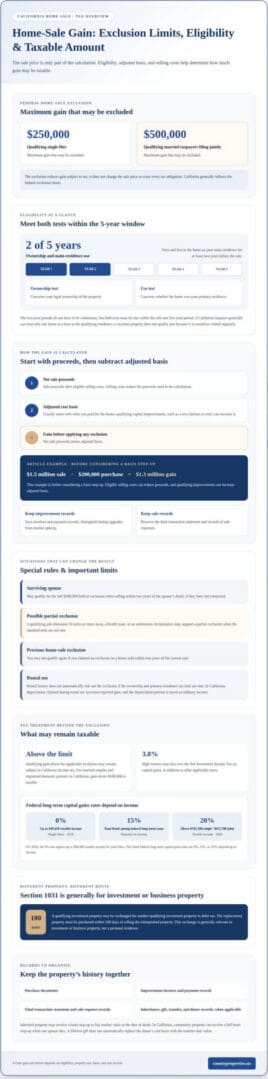
IRC §121 lets eligible homeowners exclude some gain from a primary residence sale. The Internal Revenue Service says qualifying single filers can exclude up to $250,000 of gain. Qualifying married taxpayers filing jointly can exclude up to $500,000. The exclusion reduces the gain subject to tax; it does not change the sale price or erase every tax obligation. The Internal Revenue Service describes the usual ownership and use test as living in and owning the home for two of the five years before the sale.
Divorce, death, and a work-related move can change how eligibility applies to a transaction. After divorce, review each seller’s ownership and residence history because those details affect whether the exclusion applies. A surviving spouse may qualify for the full $500,000 federal exclusion when selling within two years of the spouse’s death, if they haven’t remarried. A qualifying job relocation 50 miles or more away, health issue, or unforeseen circumstance may support a partial exclusion when the standard tests aren’t met.
California generally follows the federal $250,000 and $500,000 primary-residence exclusion limits. For married couples and registered domestic partners in California, gain above $500,000 is taxable. Gain above the applicable exclusion may therefore remain subject to California income tax. High earners may also owe a 3.8% Net Investment Income Tax on capital gains, in addition to other applicable taxes, according to the Internal Revenue Service.
For homeowners asking how to avoid capital gains tax on a home sale in California, a Section 1031 exchange is generally relevant to investment or business property, not a personal residence. It can defer tax when one qualifying investment property is exchanged for another. The Internal Revenue Service requires the replacement property to be purchased within 180 days of selling the relinquished property. Federal long-term capital gains rates are 0%, 15%, or 20%, depending on income. For 2026, the 0% rate applies up to $49,450 taxable income for single filers and $98,900 for joint filers. The 20% rate applies above $545,500 for single filers and $613,700 for joint filers.
2. Adjusting cost basis and deducting selling costs
Your cost basis usually starts with what you paid for the home. Add qualifying capital improvements, such as a new kitchen or roof, to calculate your adjusted basis. Keep purchase documents, improvement invoices, and payment records together. These help distinguish lasting upgrades from routine upkeep when calculating basis. For a primary residence, a higher adjusted basis can reduce the gain subject to tax.
Calculate the gain by subtracting adjusted basis from net sale proceeds after selling costs. For example, a home bought for $200,000 and later sold for $1.5 million has a $1.3 million gain before considering a basis step-up. Selling costs reduce the proceeds used in that calculation, so preserve the final transaction statement and records of sale expenses. The resulting taxable gain, rather than the sale price alone, is the figure relevant to income tax and taxable income.
Inherited property follows a different basis rule from a lifetime gift. Internal Revenue Code §1014 provides for the basis of inherited assets to be stepped up to fair market value at the date of death. In California, community property can receive a full basis step-up when one spouse dies. A lifetime gift should not be treated as though its transfer-date value automatically replaces the donor’s cost basis. Keep the donor’s purchase and improvement records, along with transfer documents, so the basis calculation reflects the property’s history.
For filing, organize purchase records, improvement receipts, closing statements, and documents showing any inheritance or gift. IRS Publication 523, Selling Your Home, can help determine whether you have a gain or loss, calculate taxable gain, and report the transaction. Charitable transfers involve a different set of tax considerations, so don’t combine them with ordinary selling-cost calculations. If you’re preparing for a sale, planning your home sale alongside a complete record of the property’s costs can help keep the transaction details organized.
3. Ownership and use tests
Meeting the ownership and use tests is central to qualifying for the federal home-sale exclusion. The usual rule looks at whether you owned and used the property as your main residence for at least two years during the five-year period before the sale. The ownership test concerns your legal ownership; the use test concerns whether the home was your primary residence. Track each separately, especially after a move, separation, or change in title.
The two-year periods don’t have to be continuous, but both tests must be met within the relevant five-year window. For example, if you lived in a property, moved away, and later returned, count your qualifying ownership and residence periods against the sale date. A California taxpayer generally can treat only one home at a time as the qualifying residence. A vacation property doesn’t qualify simply because you own it or visit regularly.
Using the property as a rental before selling doesn’t automatically rule out the exclusion. You may qualify if the home meets the ownership and primary-residence use tests, but rental history can affect the taxable gain. In California, depreciation claimed during rental use increases the reported gain, and the depreciation portion is taxed as ordinary income. Keep rental and residence dates distinct so the calculation reflects how you used the property.
A previous home-sale exclusion can also affect eligibility: you may not qualify again if you claimed an exclusion on a home sold within two years of the current sale. Compare the earlier sale date with your current ownership and use timeline. The tests focus on your home’s use and ownership, not simply how long you held title. A clear timeline helps show whether you qualify, what portion of the gain may be excluded, and whether rental depreciation remains relevant.
4. California taxation of real estate gains
California’s key difference is how it treats capital gains: the state taxes them as ordinary income, rather than applying a separate capital-gains rate. For 2026, California income tax rates range from 1% to 13.3%. Your taxable gain is generally considered alongside other income, so the amount subject to tax and your income level both matter.
The federal exclusion doesn’t mean every California sale is tax-free. For an individual taxpayer, home-sale gain over $250,000 is taxable; for married couples and registered domestic partners, gain over $500,000 is taxable. If you don’t qualify for the exclusion, or choose not to claim it, California may tax the gain. A seller who receives Form 1099-S must report the sale, even when the gain is excluded.
Investment property follows a different path. A Section 1031 exchange applies to qualifying investment or business property, while personal residences generally don’t qualify. An exchange can defer tax, but California may tax an originally deferred gain when an out-of-state replacement property is later sold in a taxable transaction. Keep the exchange history with the property’s sale records so the deferred amount isn’t overlooked.
Rental property also requires attention to depreciation. California taxes the depreciation portion as ordinary income, and depreciation claimed during ownership increases the reported gain. Nonresidents selling California real estate generally face 3.33% withholding. That withholding rule is separate from determining the final taxable gain and applicable income tax.
The practical takeaway: calculate the California result separately from the federal capital gains calculation. Identify the property’s use, any exclusion claimed, rental depreciation, and any deferred exchange gain before estimating state tax. If you’re preparing to sell California real estate, plan your property sale with these tax factors in view, so transaction timing and sale proceeds are considered together.
County Properties: Short Sale and Foreclosure Prevention
County Properties can guide you through the real estate decisions involved in a sale, from preparing the property for market to managing the transaction through seller representation. This support can help as you weigh timing, sale proceeds, and the practical steps involved. Your tax records remain essential for establishing the gain calculation.
If financial pressure or foreclosure risk is affecting your plans, County Properties offers Short Sale and Foreclosure Prevention to help you consider your real estate options. For a move connected to later-life changes, Senior Real Estate Transition can support the property transition. These services focus on the real estate transaction, not on calculating or filing taxes.
Contact County Properties to discuss your property sale and the real estate support that fits your situation.
Move Forward With a Clear Sale Plan
Planning how to avoid capital gains tax on a home sale in California starts with understanding the tax picture, then making real estate decisions that fit your wider transition. Your next step may be preparing to sell, moving into another home, or addressing financial pressure affecting the property. Keep your transaction plan and tax records organized so each decision has a clear purpose.
County Properties offers Seller Representation when you’re preparing to sell, Buyer Representation if you plan to purchase another home, and Short Sale and Foreclosure Prevention when financial strain affects your housing options. These services guide the property transaction, while tax reporting remains a separate part of your planning.
Choose a next step that reflects your circumstances and goals. Contact County Properties for help planning your real estate move, and move ahead with a steadier plan for what comes next.
Frequently Asked Questions
REAL PROPERTY SALES: HOW DO I AVOID CAPITAL GAINS TAX IN CALIFORNIA?
You may reduce taxable gain by applying an eligible home-sale exclusion and accurately calculating adjusted basis and net sale proceeds. Start by separating federal and California calculations, then account for documented improvements, selling costs, and any rental depreciation. California generally taxes taxable gains as ordinary income, so an exclusion may reduce the amount subject to tax without necessarily eliminating every tax liability.
Can you still qualify if you didn’t live there for the full two years?
You may qualify for a partial exclusion if a qualifying life change prevented you from meeting the usual residence test. Job relocation, health issues, and unforeseen circumstances can matter under federal rules. For example, a job move 50 miles or more away may support a reduced exclusion in qualifying circumstances. The reason for the move and the period you lived in the home affect eligibility.
What Is the Primary Residence Capital Gains Exclusion?
It’s a tax provision that can exclude qualifying gain from the sale of a main home, rather than exempting the entire sale proceeds. Eligibility depends on the home’s use and ownership history, and the exclusion has limits. If you receive Form 1099-S, you must report the sale even when the gain is excluded. Reporting the transaction and qualifying for the exclusion are separate considerations.
What is the federal home sale capital gains tax exclusion for a primary residence?
According to the Internal Revenue Service, the federal IRC §121 exclusion can cover up to $250,000 of gain for a qualifying single filer and up to $500,000 for qualifying married taxpayers filing jointly. These limits apply to gain, not the home’s total sale price. Eligibility depends on meeting the applicable requirements, so calculate your gain before determining how much may be excluded.
What are the ownership and use tests for the Section 121 home sale exclusion?
The tests examine whether you owned the home and used it as your main residence for at least two years during the five years before the sale. Treat ownership and residence as separate questions: title history helps establish ownership, while your actual living arrangements help establish use. A vacation home you visit occasionally doesn’t qualify solely because you own it; its use as a primary residence matters.
How does the home sale exclusion work for married couples filing jointly?
Qualifying married taxpayers filing jointly may exclude up to $500,000 of gain under the federal rule, according to the Internal Revenue Service. California also treats gain above $500,000 as taxable for married couples and registered domestic partners. For a joint sale, distinguish the federal filing status from California’s treatment, then calculate the gain and determine whether it falls within the applicable exclusion.