

Yes, some closing costs when selling a home in San Diego County are negotiable, while others are customary or calculated under local rules. Selling costs can add up to about 6% to 10% of the sale price, so understanding the hidden costs of selling a home in San Diego County can help you plan for your net proceeds.
It’s easy to focus on the sale price and overlook expenses that arise during escrow or before your home is ready to list. The details matter: some closing costs can be negotiated, but the seller pays San Diego County’s documentary transfer tax.
This guide explains the costs that may affect your budget, including agent compensation, negotiable closing expenses, repairs and home preparation, and transfer taxes. You’ll learn which costs buyers and sellers can negotiate, which depend on the property or transaction, and why estimating them early can make your next move easier to plan.
Key Takeaways
- Separate listing-agent compensation from any buyer-agent concession, then account for each through your sale negotiations.
- Review escrow, title, HOA, and prorated property-tax charges to see which closing costs may be negotiated and how they affect your proceeds.
- Prioritize home preparation based on its condition and presentation needs, so repairs, staging, cleaning, and landscaping support a focused selling plan.
- Include the county documentary transfer tax in your estimate, and distinguish it from other possible transaction expenses.
1. Agent commissions and buyer-agent concessions
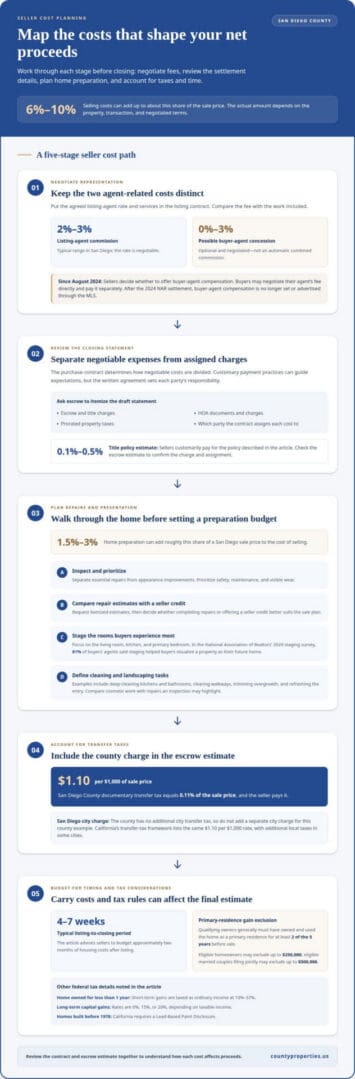
Commission is a major selling expense, but the rate is negotiable. San Diego listing-agent commissions typically range from 2 to 3 percent of the sale price. Put the agreed rate and services in the listing contract, then compare the fee with the work included.
That listing fee is separate from any amount you offer toward a buyer’s agent. Since August 2024, San Diego sellers decide whether to offer buyer-agent compensation, and any amount is negotiated rather than set at a standard rate. A seller may negotiate a concession of 0 to 3 percent. Buyers can also negotiate their agent’s fee directly and pay it separately. After the 2024 NAR settlement, buyer-agent compensation is no longer set or advertised through the MLS.
For a practical estimate, calculate the listing commission first, then compare different buyer-agent concessions. For example, weigh your expected proceeds with no concession against a negotiated offer in the purchase contract. The median sale price can provide local context, but your sale price and negotiated terms determine the actual commission. Don’t assume a traditional combined commission applies automatically.
If a buyer approaches the listing agent directly, clarify the agent’s role and any compensation terms before proceeding. This helps you understand whether the buyer has separate representation and what the contract proposes. Make sure the arrangement and any concession are clear in the transaction documents.
Other sale-related obligations can affect your net proceeds. The U.S. Environmental Protection Agency says California requires a Lead-Based Paint Disclosure for homes built before 1978. For federal taxes, the Internal Revenue Service generally requires owners to have owned and used a home as their primary residence for at least 2 of the 5 years before sale to qualify for the exclusion. Eligible homeowners may exclude up to $250,000 in capital gains; eligible married couples filing jointly may exclude up to $500,000, according to the Internal Revenue Service.
The Internal Revenue Service states short-term gains on a home owned for less than 1 year are taxed as ordinary income at 10-37%. Long-term capital gains rates are 0%, 15%, or 20%, depending on taxable income. Include these tax considerations when estimating the hidden costs of selling a home in San Diego County.
2. Are closing costs negotiable when selling a home in San Diego?
Yes. Buyers and sellers can negotiate how some closing costs are divided in the purchase contract. Customary payment practices can guide initial expectations, but the written agreement determines each party’s responsibility. Separate negotiable expenses from charges tied to the transaction, then review the escrow estimate before accepting the final terms.
Sellers customarily pay for that policy, estimated at 0.1% to 0.5% of the sale price. Ask the escrow officer to itemize both categories, so you can see what the draft closing statement assigns to you.
Budget for other line items, too. Review the HOA documents and tax proration on the settlement statement.
Capital gains are calculated under federal tax rules, and qualifying primary-residence sellers may exclude eligible gains. According to the Internal Revenue Service, the exclusion can reach $250,000 for eligible homeowners or $500,000 for eligible married couples filing jointly; qualification generally requires owning and using the home as a primary residence for at least 2 of the 5 years before sale.
Timing affects carrying costs. A San Diego sale typically takes 4 to 7 weeks from listing to closing, and sellers should budget approximately two months of housing costs after listing. If a major transition shapes your sale, cash offer facilitation may help you consider another route alongside a traditional listing.
3. Repairs, staging, cleaning, and landscaping
Home preparation can add roughly 1.5% to 3% of a San Diego sale price to your cost to sell. Start with a property walkthrough and separate essential repairs from appearance improvements. Use its findings to prioritize safety, maintenance, and visible wear.
Repair costs depend on the home’s condition and the work required. Request itemized estimates, then decide whether completing repairs or offering a seller credit better suits your sale plan.
Staging is another line to consider. The National Association of Realtors’ 2024 staging survey found 81% of buyers’ agents said staging helped buyers visualize a property as their future home. Focus first on rooms buyers experience most, such as the living room, kitchen, and primary bedroom.
Cleaning and landscaping costs depend on the property’s needs, so define the work before scheduling it. List specific tasks, such as deep-cleaning kitchens and bathrooms, clearing walkways, trimming overgrowth, and refreshing the entry. Compare these tasks with repair priorities and staging needs. This helps keep cosmetic work from crowding out fixes an inspection may highlight.
For a clear plan, group preparation into inspection findings, essential repairs, presentation, and final cleaning. Compare each estimate with the expected benefit to your listing. A realtor can help you weigh which updates fit the property and local buyer expectations. Include property taxes and ongoing carrying expenses in your full budget, since preparation may happen before closing and those obligations continue during the sale.
4. Transfer taxes, including California taxes
Transfer taxes are calculated from the sale price and appear in the escrow statement. San Diego County’s documentary transfer tax is $1.10 per $1,000, equal to 0.11% of the sale price, and the seller pays it. San Diego County has no additional city transfer tax, so don’t add a separate city charge to this county example.
California’s transfer-tax framework also lists a rate of $1.10 per $1,000 of sale price, with additional local taxes in some cities. For your transaction, review the escrow statement’s transfer-tax calculation and confirm which applicable charge it records. This helps you distinguish transfer tax from escrow fees and other real estate transaction costs, rather than treating every closing line as one fee.
A home with solar may involve another transfer expense. Review the solar contract early, identify its transfer or buyout terms, and include the relevant amount in your financial estimate.
HOA transfer fees are separate from the county transfer tax. Ask escrow to list HOA charges separately in the draft statement so you can distinguish association costs from government taxes. Attorney fees may also arise if legal work is needed for a transaction; the scope of that work determines the charge.
Before closing, compare the draft statement with your sale contract and solar documents. Check the sale price used for the transfer-tax calculation, the responsible party, and any HOA or solar charge. These steps make it easier to spot distinct expenses and estimate your proceeds. Discuss your home-selling options as you prepare for the next step.
County Properties: Seller Representation
County Properties provides Seller Representation to help you plan a sale and consider decisions that affect your proceeds. Turn to the team as you prepare a home for market, review an offer, or compare proposed contract terms, including responsibility for negotiable costs. A clear estimate of expected expenses can help you assess offers against your financial priorities.
If a sale is part of a major life transition, County Properties’ Senior Real Estate Transition service offers focused real estate guidance. For homeowners facing mortgage-related difficulty, Short Sale and Foreclosure Prevention may be relevant. The right next step depends on your circumstances and the transaction you’re considering.
To discuss your selling plans, contact County Properties or visit countyproperties.us.
Make your next move with a clear plan
The next step is turning your estimate into a decision you can act on. Consider your timing, the home’s condition, and the proceeds you need for what comes next. A grounded plan can help you weigh an offer, decide whether to prepare the property, and keep the hidden costs of selling a home in San Diego County in perspective without letting uncertainty stall your plans.
County Properties provides Seller Representation for homeowners planning a sale and Buyer Representation for those preparing to purchase their next home. If financial pressure affects your options, Short Sale and Foreclosure Prevention may also be relevant. Start by discussing what you need from this transition and which path fits your circumstances.
Contact County Properties to discuss selling and take a considered next step toward your move.
Frequently Asked Questions
Are closing costs negotiable when selling a home in San Diego?
Yes. The purchase contract can assign some closing expenses differently from customary practice, and buyers and sellers can negotiate seller credits. For example, you might agree to cover a specified expense in exchange for other terms that suit your sale. Review the proposed allocation before signing, then compare it with the escrow statement to confirm the agreed responsibility appears correctly at closing.
How Much Does It Cost to Sell a House in San Diego?
Total selling costs are often estimated at 6% to 10% of the sale price, but your actual total depends on the transaction. Agent compensation, preparation work, closing charges, transfer tax, and any solar agreement can all affect proceeds. A practical estimate starts with your expected sale price, subtracts the costs that apply to your property, and accounts separately for any mortgage payoff.
What are typical seller closing costs in San Diego County?
Typical charges can include escrow, title, recording, disclosure, HOA transfer fees, and prorated property taxes. HOA fees vary by association, while tax prorations depend on the closing date. Review each item separately in the draft settlement statement.
How much is the San Diego County documentary transfer tax when selling a home?
The county documentary transfer tax is $1.10 per $1,000 of the sale price, equal to 0.11%. To estimate it, divide the sale price by $1,000 and multiply by $1.10. Check that the escrow statement uses the agreed sale price in its calculation.
Do San Diego cities charge additional real estate transfer taxes?
No additional city transfer tax applies in San Diego County, according to the current local-cost information for this sale. Keep the county documentary transfer tax separate from other transaction charges shown in escrow. If a listed tax raises questions based on your property’s location or transaction details, review the charge description and property address on the closing statement before approving it.
What real estate agent commissions do home sellers in San Diego typically pay?
San Diego listing-agent commissions typically range from 2% to 3% of the sale price, and the rate is negotiable. Your listing agreement should state the agreed commission and the services covered. Buyer-agent compensation is separate: buyers negotiate that fee with their agents, and sellers may negotiate whether to offer a concession. Consider each amount independently when estimating proceeds.