

California HOA transfer fees commonly range from $100 to $500, but the amount alone doesn’t determine whether a charge is allowed. Knowing what an HOA transfer fee in California is can help you distinguish a one-time ownership-record or document charge from regular HOA dues. California associations generally can’t impose a fee just because title transfers, subject to exceptions for qualifying entities under Civil Code Section 4575, according to the California State Legislature.
If you’re concerned about an unexpected closing cost, that’s understandable: a fee’s purpose and supporting costs matter as much as its label. This guide explains what an HOA transfer fee in California may cover, what state restrictions mean, and how to assess a charge or discuss it during a sale. You’ll also learn who commonly pays and how the fee differs from disclosure-document costs and other association charges.
Key Takeaways
- HOA transfer fees commonly range from $100 to $500, but the charge’s purpose and cost basis matter as much as the amount.
- Learn which documents and record updates a fee may cover, and how to distinguish it from dues or other closing charges.
- California restrictions can limit transfer-related charges, so understanding the applicable rule can help you assess a fee that seems excessive.
- Find out what to review when discussing a charge and how seller and buyer responsibilities may be addressed during a transaction.
How much are HOA transfer fees?
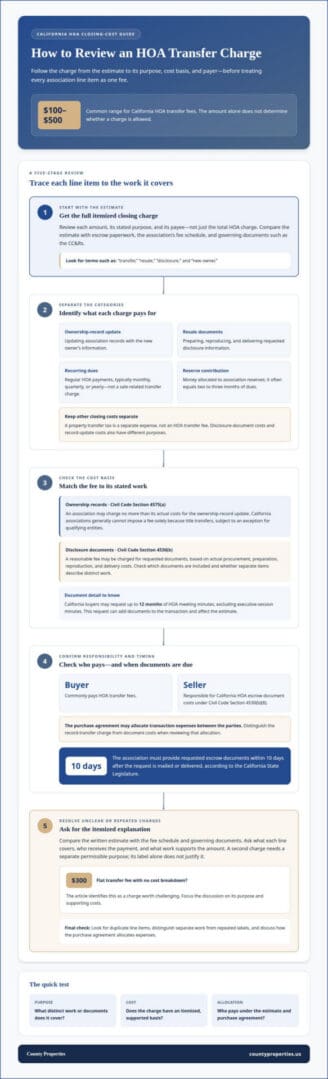
HOA transfer fees commonly range from $100 to $500, but the total depends on what the association charges for records and documents. Separate the ownership-record charge from resale paperwork, then compare each item with its stated purpose.
Administrative and Document-Transfer Costs
An administrative transfer charge covers work such as updating the association’s ownership records after a sale. Document charges cover preparing, reproducing, and delivering resale information. California buyers may request up to 12 months of HOA meeting minutes, excluding executive-session minutes, according to the California State Legislature. That request can add documents to the transaction and affect the estimate.
California associations may charge a reasonable fee for requested disclosure documents, based on actual procurement, preparation, reproduction, and delivery costs under Civil Code Section 4530(b). Review the itemized estimate to see which documents are included and whether separate charges identify different work.
Finding Fees in Governing Documents
Governing documents, including the association’s CC&Rs, may identify the transfer fee or explain how it is assessed. Look for terms such as “transfer,” “resale,” “disclosure,” or “new owner,” then compare those provisions with the estimate. This can help distinguish an established charge from document costs listed separately.
Some management companies also list transfer charges in their fee schedules. Compare the schedule, governing documents, and escrow paperwork to identify the payee, purpose, and amount of each line item.
Who pays? Buyers commonly pay HOA transfer fees, while sellers are responsible for California HOA escrow document costs under Civil Code Section 4530(b)(8). The purchase agreement may allocate transaction expenses between the parties, so distinguish the record-transfer charge from document costs.
Can the association charge separate fees to both parties? Separate charges need separate permissible purposes, such as changing ownership records and preparing requested documents. A second charge isn’t justified by its label alone; compare its stated work with the itemized estimate.
How can you verify or dispute a fee? Compare the written estimate with the governing documents and fee schedule, then request an itemized explanation of each charge. A flat $300 transfer fee without a cost breakdown is worth challenging; focus your discussion on the charge’s purpose and supporting costs.
Negotiating or reducing transfer fees
Start with the itemized closing estimate, not just the total HOA charge. Separate ownership-record work, resale documents, recurring dues, and any contribution to association reserves. Each amount serves a different purpose, so asking for a breakdown gives you a clearer basis for discussing the charge with the seller or homeowners association.
HOA transfer fees aren’t government-imposed property transfer taxes. A property transfer tax is a separate closing expense, while an association transfer charge relates to an ownership change or association paperwork. Disclosure fees pay for requested documents, such as a resale certificate, and are distinct from record-update costs. California’s rules limit disclosure charges to reasonable costs for the work involved.
That example shows why a written breakdown can matter. Compare the stated work with the fee schedule and governing documents, then identify any duplicate line items. You can also discuss how the purchase agreement allocates expenses between buyer and seller.
Recurring HOA dues are different: homeowners typically pay them monthly, quarterly, or yearly, while a transfer fee is tied to a sale. A capital contribution is different again because it goes into association reserves and often equals two to three months of dues.
How do transfer fees compare with other closing costs? They’re one part of the closing total, alongside document charges, dues adjustments, and possible reserve contributions. Review each line separately rather than treating every association charge as one fee.
If a home sale accompanies a major life transition, senior real estate transition support can help you consider the sale alongside its closing costs.
What is a homeowners’ association transfer fee?
A homeowners’ association transfer fee is a charge associated with a property sale or ownership transfer. In a community association, it may cover updating ownership records or preparing requested disclosure documents. The purpose matters: separate charges should correspond to distinct work, not simply repeat one another under different labels.
For an ownership-record update, the association may charge no more than its actual costs under Civil Code Section 4575(a). That work can include recording the new owner’s information in association records. Disclosure-document charges follow a separate rule: Civil Code Section 4530(b) ties a reasonable fee to actual procurement, preparation, reproduction, and delivery costs. A resale certificate, for example, should be distinguished from the record update itself.
An association may use a management company under a service contract to prepare transfer paperwork and disclosures. The contract or fee schedule can show which party performs each task and how charges are itemized. Paying for a management service doesn’t change the stated purpose of a charge; compare each line with the work and documents provided. California associations also can’t charge a member to email records that already exist electronically.
Timing matters in escrow. The California State Legislature says an association must provide requested escrow documents within 10 days after the request is mailed or delivered. A California HOA may make delivery of required disclosure documents conditional on paying permissible fees. If those charges remain unpaid, the association may withhold the documents, which can disrupt buyers’ review within escrow.
When are California HOA transfer fees due, and what happens if they are not paid? Transfer and document charges are commonly handled during escrow, with payment timing reflected in the transaction estimate. If permissible document fees aren’t paid, the association may condition delivery of required disclosures on payment, delaying access to those materials.
California HOA transfer-fee restrictions
California’s restrictions make the fee’s purpose and legal basis central, not merely its label. In California, an association generally may not impose or collect a fee in connection with a property-title transfer within its development, except for certain entities that qualify under Civil Code Section 4580, according to the California State Legislature under Section 4575.
That rule makes it important to distinguish a charge for the title transfer itself from permitted charges for specific services. For example, Civil Code Section 4530 allows reasonable charges for requested disclosure documents, based on actual costs to procure, prepare, reproduce, and deliver them. Updating association records and providing resale documents are separate tasks, so an estimate should identify each service and its cost basis.
Some entities may qualify for exceptions under Section 4580. The criteria include an entity’s purpose and when it was established. One exception concerns qualifying environmental mitigation or habitat organizations established before February 20, 2003. Another applies to an entity established and receiving a transfer fee before January 1, 2004; beginning January 1, 2006, it must offer purchasers payment at transfer or installments lasting at least seven years.
Other restrictions affect developer-imposed fees. Civil Code Section 1098.6 bans developer transfer fees created in 2019 or later, while some older deed-based fees may remain enforceable if statutory requirements are met. A fee recorded in a deed at a development’s inception therefore raises a different question from a new administrative charge in a management company’s schedule.
For a disputed amount, compare the purchase agreement, deed, association documents, and itemized estimate. Identify who receives the money, what work it covers, and whether the association claims a statutory exception. A charge that appears to exceed actual costs or lacks a clear basis deserves careful review; a real estate professional can help you understand how the issue fits the sale, though legal interpretation belongs with an attorney.
If a fee issue affects a move tied to aging or changing housing needs, explore senior real estate transition support as you plan the sale.
County Properties: Seller Representation
County Properties helps homeowners approach a sale with informed Seller Representation, including decisions that affect the transaction and its closing costs. If an HOA transfer charge appears in your escrow paperwork, your real estate representative can help you understand its place among the sale details and coordinate the transaction. For buyers, Buyer Representation offers guidance through purchase decisions and closing considerations.
A sale connected to a major life change may call for Senior Real Estate Transition support. If foreclosure risk or a difficult sale is involved, Short Sale and Foreclosure Prevention may be relevant. These services support real estate decisions, while questions about the legality of a specific HOA charge belong with a qualified attorney.
For steady guidance as you plan your next real estate step, contact County Properties or visit countyproperties.us.
Move Forward With a Clear Real Estate Plan
Understanding what an HOA transfer fee in California means is one part of making a confident property decision. Your next step is to connect the association paperwork with the broader goals of your sale or purchase. A clear transaction plan can help you keep important decisions, deadlines, and responsibilities in view as the process moves ahead.
If an association charge raises a legal question, an attorney can assess its legal basis. For the real estate decisions around a sale or purchase, County Properties offers representation tailored to the transaction, including support for homeowners facing a short sale or foreclosure concern. Having the right professional involved in each part helps you focus on the decisions that belong to you and move forward with greater clarity.
Choose the next step that fits your situation, and let experienced guidance support the transition ahead. Contact County Properties for help with your real estate plans.
Frequently Asked Questions
What is an HOA transfer fee, and who pays for it?
If you’re asking, “What is an HOA transfer fee in California?”, it’s a one-time charge connected with an ownership change, often covering record updates or sale-related association documents. The buyer commonly pays it, but the purchase agreement can assign it to the seller or divide it between both parties. Check the settlement statement for the charge’s description and payee, especially when escrow lists document costs separately.
Can an HOA transfer fee affect my financing?
Understanding the answer to “What is an HOA transfer fee in California?” can help you budget for closing. The fee may affect the cash you need, but it’s a transaction expense, not a mortgage product or recurring dues. For example, if escrow lists it separately from prepaid taxes and insurance, account for it as its own closing line. Review the purchase agreement’s allocation to see which party pays.
How much are hidden HOA costs at closing?
The total may combine document charges, dues adjustments, key or gate fees, fines, and assessments due as part of the transaction. Separate refundable deposits from permanent charges.
Is an HOA transfer fee the same as an HOA resale certificate?
No. A transfer fee is a charge, while a resale certificate is a document summarizing the property’s status with the association, its finances, lawsuits against it, and other information required by state law. The certificate helps you understand the association’s position; the related charge concerns document preparation or delivery. Read the certificate itself, rather than relying only on the fee description.
What is the difference between a transfer fee and a capital contribution?
A transfer fee is associated with processing an ownership change or transfer documents. A capital contribution goes into the association’s reserves and often equals two to three months of HOA dues. On your closing statement, compare each charge’s description and recipient. A reserve contribution funds the association’s reserves, so it serves a different purpose from administrative transfer work.
What’s the average HOA transfer fee?
The amount depends on the association’s charge and the transaction services involved. Compare the itemized fee with the governing documents and estimate, and distinguish a transfer charge from a larger total that includes separate document or move-in costs.