

What if convincing family to move to a 55+ community starts with listening, not persuading? If you’re worried about a loved one’s safety, isolation, or the demands of home upkeep, it’s natural to want a solution. It’s also understandable to worry that raising the subject could damage trust, especially when relatives disagree about timing or priorities.
A productive conversation doesn’t require you to have every answer or reach a decision right away. It starts by making room for your loved one’s preferences, concerns, and sense of independence. Their priorities should guide the discussion, not pressure from family members.
This guide will help you start the conversation with care, learn what matters most to your loved one, and compare 55+ community living with their current home and needs. You’ll also find practical next steps for exploring community options and discussing a possible home sale if your loved one chooses to move. The aim is a shared plan, even if the first step is simply learning more together.
Key Takeaways
- Understand how age-qualified housing differs from independent and assisted living before comparing options.
- Make convincing family to move to a 55+ community a collaborative conversation by asking permission, listening, and agreeing on one next step.
- Compare your loved one’s current routines with the lifestyle they want, keeping independence at the center of the discussion.
- Explore communities gradually and let your loved one shape the criteria, questions, and visit.
- If your family member chooses to move, plan the home transition together. Real estate guidance can support a home sale without replacing the family’s decision.
What Does Moving to a 55+ Community Mean for Your Family?
A move to a 55+ community is first a housing decision. These communities generally have age-related eligibility rules, but the label alone doesn’t tell you what daily life includes. Some are age-qualified neighborhoods of homes or apartments, while others offer independent living with services such as meals or housekeeping. Your loved one’s preferences, routines, and support needs matter more than the label.
A 55+ community is age-qualified housing, not automatically a care service. The housing rules, amenities, and support provided depend on the individual community. In the U.S., some age-restricted communities follow criteria associated with the Housing for Older Persons Act, including that at least 80% of occupied units have a resident aged 55 or older. You can read a general overview of an age-restricted community, then review the specific community’s written eligibility policies with your loved one.
Keep these three terms distinct as you compare options:
- Age-qualified housing describes housing with age-related eligibility rules. It may be owned or rented, and services and amenities vary.
- Independent living generally refers to housing for people who manage their daily lives independently, sometimes with services such as meals or housekeeping.
- Assisted living is a different type of setting, intended for people who need help with daily activities or personal care. Don’t assume it’s part of a 55+ housing community.
How is a 55+ community different from assisted living?
Age-qualified housing sets expectations about who may live there. It doesn’t, by itself, promise personal care. Services, amenities, visitor policies, and resident rules can vary by community. Read the written information together and note what is included, what is optional, and what the resident would arrange separately. This helps your family compare actual living arrangements rather than relying on broad assumptions about “senior living.”
Why can a move feel difficult even when it may help?
A long-time home can hold familiar routines, neighborly connections, treasured belongings, and memories that aren’t easy to replace. Even a well-intended suggestion can sound like criticism if your loved one feels the family has already decided what should happen. Treat the first discussion as an invitation to explore, not an announcement. Ask what they value about home and what, if anything, they’d like to change.
When discussing convincing family to move to a 55+ community, separating housing from care can make the conversation more precise and less alarming. Start with your loved one’s priorities, then compare them with what each option actually provides. These questions can give everyone a shared starting point:
- Which routines and relationships should a move preserve?
- Which home responsibilities feel manageable, and which feel burdensome?
- What services or support, if any, would improve daily life?
The answers don’t commit your loved one to moving. They help your family identify which options are worth exploring together.
How to Talk About a 55+ Community Without Taking Away Their Choice
A respectful conversation isn’t a pitch you need to win. It’s a chance to understand what your loved one wants and share what you’ve noticed without deciding the outcome for them. Before raising the subject, consider what you hope to learn, not only what you hope they’ll agree to. That shift can lower the pressure and help protect trust.
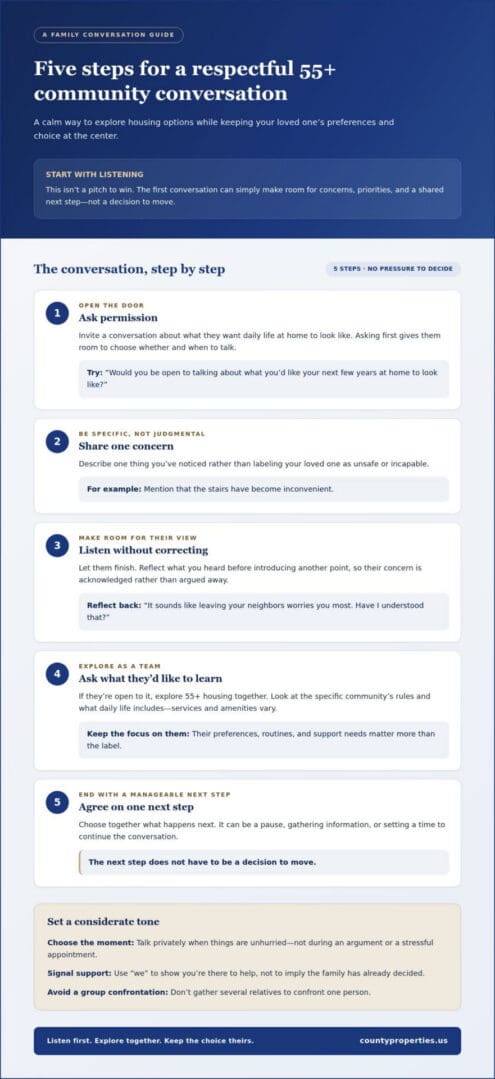
An invitation to explore preserves choice better than an ultimatum because it lets your loved one consider options without being asked to commit. Use this five-step sequence to keep the conversation calm and collaborative:
- Ask permission. “Would you be open to talking about what you’d like your next few years at home to look like?”
- Share one specific concern. Describe an observation, such as noticing that the stairs have become inconvenient, rather than labeling your loved one as unsafe or incapable.
- Listen without correcting. Give them time to respond, then reflect back what you heard before adding another point.
- Explore together. Ask whether they’d like to learn more about housing options, including the rules and daily life of a 55+ community.
- Agree on one next step. You might pause, gather information, or choose a time to continue the discussion. The next step doesn’t have to be a decision to move.
What should you say when you first raise the idea?
Choose a private, unhurried moment, not the middle of an argument or a stressful appointment. Start with care and curiosity: “I care about how comfortable you feel at home. Would you be open to talking sometime about what you want daily life to look like in the years ahead?” Use “we” to signal support, not to suggest that the family has already decided. Avoid gathering several relatives to confront one person.
Then ask open questions and give the answer room to emerge. “What parts of your routine would you most want to keep?” or “What would make a new place feel like home to you?” can reveal priorities the family may not have considered. These questions keep the conversation focused on your loved one’s preferences instead of turning it into a debate about whether they should move.
How can you listen when your family member is hesitant?
Let them finish before responding. Try reflecting their concern: “It sounds like leaving your neighbors worries you most. Have I understood that?” Then ask whether their hesitation is mainly about cost, location, community fit, belongings, or independence. Don’t rush to rebut the concern. If they want to stop, respect the pause and agree together on whether and when to revisit the topic.
Family members can prepare by agreeing to keep the conversation curious, not coercive. One person might ask questions while another listens, rather than having several relatives present concerns at once. If opinions differ, don’t make your loved one referee a family disagreement. Focus on what they want and what information would help them assess their options. The goal isn’t convincing family to move to a 55+ community at any cost. It’s making space for an informed choice.
If your loved one later chooses to move, personalized senior real estate transition guidance from County Properties can help with the housing decisions involved, while the choice remains theirs.
How to Address the Fear of Losing Independence
Fear of losing independence deserves a direct answer: moving to a 55+ community doesn’t automatically mean giving up control over daily life. Age-qualified housing may simply change where someone lives, while the resident continues to manage their own routines. But independence means different things to different people, and a community’s rules or location may affect some choices. Look at the actual trade-offs rather than promising that a move will solve loneliness, safety concerns, or family disagreements.
Which parts of independence matter most to your loved one?
Ask about the details that make a day feel like their own. Does privacy matter most, or the ability to welcome visitors without planning ahead? Do they want to keep a pet, set their own schedule, drive or use familiar transportation, and arrange their personal space as they like? These questions turn a general fear into specific criteria your family can use.
Sort the answers into non-negotiables and preferences. For example, keeping a pet might be essential, while having a larger garden might be something they’d reconsider if outdoor space is available nearby. Don’t decide for them which concerns are flexible. Ask, then use their answers to identify which communities, if any, are worth considering. If a written rule conflicts with a non-negotiable, that option may not be a good fit.
How can families compare staying home with moving?
Make a balanced comparison together. A simple page with “staying” and “moving” columns can help separate what you know from what you’re assuming. Keep the resident’s priorities at the center, and compare the ordinary details of a week, not just the best-case version of either choice.
- Daily convenience: Note what errands, appointments, and household tasks require now, then consider how each housing option might affect them.
- Upkeep: List the home responsibilities your loved one handles and which ones they’d prefer to keep or reduce.
- Social connection: Identify existing relationships and activities, then consider whether a new location would make them easier, harder, or simply different to maintain.
- Personal priorities: Record what matters most, such as familiar surroundings, privacy, a particular location, or fewer home responsibilities.
Mark each point as an observed fact, a question to investigate, or an assumption. “The yard takes time to maintain” may be observable; “they’ll be lonely if they stay” is a prediction, not a certainty. Likewise, don’t assume a community will create friendships or remove every practical concern. A visit and a review of written rules can help answer questions, but the choice remains personal.
If evaluating the current home is part of the discussion, senior-focused real estate guidance can help clarify property considerations without deciding whether a move is right. The separate overview “What is a Senior Real Estate Specialist (SRES®) and Why Do You Need One?” can provide context as your family considers those housing questions. Any real estate decision should follow the resident’s wishes and fit into the broader conversation, not replace it.
How to Explore 55+ Communities Together, Step by Step
Once your family agrees to learn more, keep the process gradual. Exploring isn’t a commitment to move. It lets your loved one see whether a community fits the life they want, using written information and firsthand impressions rather than assumptions.
- Agree on criteria. Ask the prospective resident to name their priorities, such as location, home layout, activities, pet policies, or access to familiar places. Separate must-haves from features they’re simply curious about.
- Review written information. Compare eligibility requirements, costs, services, rules, and location for each option. Communities differ, so don’t assume one community’s policies or offerings apply to another.
- Choose a visit together. Let your loved one select the questions they want answered and decide which parts of the visit they’d like to lead.
- Reflect before discussing next steps. Give everyone time to consider what they saw. Ask the prospective resident for their impressions before relatives weigh in.
- Decide whether to continue. The next step might be visiting another community, looking into a detail, or taking a break from the search.
What should your family look for during a visit?
Notice whether the setting and daily activities connect with your loved one’s actual interests, not just what looks appealing to the family. If they value quiet, for instance, ask how residents can spend time privately. If they enjoy social activities, find out what’s available and how people participate. Review the written rules and ask what services are offered, what they involve, and what residents manage on their own. Leave room for an honest reaction. A visit is for learning, not persuading someone to like a place.
How can relatives handle different opinions?
Give each relative a chance to share a concern, but keep the prospective resident’s preferences at the center. Sort questions into two groups: practical matters that need clarification, such as eligibility or costs, and preferences the family can consider over time, such as which neighborhood feels most appealing. If relatives disagree, don’t turn a visit into a vote. Agree on one manageable next step that respects the resident’s pace.
Keep later-stage planning separate from community exploration. If your loved one eventually chooses to move, Senior Real Estate: A Guide to Downsizing with Dignity can help your family think through belongings and the home transition. That planning belongs after the resident has had a meaningful say in whether to move and which option feels right.
When a move becomes your loved one’s choice, personalized senior real estate transition guidance can help with the residential decisions involved. Explore real estate transition guidance as one practical part of the plan, while keeping your family member’s priorities in the lead.
When a Move Is Chosen: Plan the Home Transition With Support
Exploring housing and deciding what to do with the current home are separate steps. First, make sure your loved one wants to move and is ready to discuss the home. A community visit or family concern doesn’t automatically mean the home must be sold. Keeping these decisions distinct gives the resident space to consider each choice on its own terms.
Once they’re ready, map out the transition together. The plan doesn’t need to settle every detail at once. It should clarify who will help, which decisions belong to the homeowner, and what questions still need answers. The goal isn’t convincing family to move to a 55+ community and then rushing into a sale. It’s supporting the move the loved one has chosen.
What decisions come after your loved one chooses to move?
Begin with the homeowner’s wishes, then identify the decisions that affect their home and belongings. A shared planning list can clarify responsibilities without taking control away from them:
- Timing: Discuss the preferred move sequence and which dates or commitments need to be coordinated.
- Belongings: Ask what they want to keep, give to family, donate, or consider later. Avoid sorting or removing possessions without their involvement.
- Family responsibilities: Agree who will help with tasks the homeowner wants support with, such as organizing documents or coordinating moving-related decisions.
- The property’s future: Talk through whether selling the home is the preferred option and what information would help the owner decide how to proceed.
- Communication: Decide who should be kept informed and how updates will be shared, especially if relatives live in different places.
Some decisions may need coordination, but that doesn’t mean the family should make them on the resident’s behalf. Check in as the plan develops. Their preferences may become clearer once they understand what the move involves.
How can real estate guidance support the transition?
A home sale can bring questions about the property, the process, and how the decision fits into the larger transition. County Properties provides personalized senior real estate transition guidance in Southern California, helping clients consider residential property decisions as one practical part of a move. The collaborative team can help organize the real estate side of the plan while the homeowner and family make decisions together. This support focuses on real estate, not care at a 55+ community.
Thoughtful guidance can make housing decisions easier to organize, but it shouldn’t replace your loved one’s voice or settle choices the family hasn’t made. If your family member has chosen to move and would like support thinking through the home’s real estate transition, County Properties can help with the next steps.
Let Their Next Step Begin With Their Priorities
A family conversation doesn’t need to end with a move date or a final answer. A meaningful next step might be giving your loved one time to think, identifying a question to explore, or agreeing to revisit the subject when they’re ready. What matters is that the pace and direction continue to reflect the person whose home and daily life are at stake.
That principle applies to the home, too. If your loved one chooses to move, real estate planning can become one part of a broader transition, shaped around their wishes rather than treated as an automatic consequence. Convincing family to move to a 55+ community isn’t the goal; supporting an informed choice is. Personalized senior real estate transition guidance can help clarify residential decisions, with collaborative support that keeps the homeowner’s priorities in focus.
If a move has been chosen and you’re ready to discuss the home’s real estate transition, talk with County Properties about next steps. A thoughtful plan can begin with one conversation, then move forward one decision at a time.
Frequently Asked Questions
How do I convince a parent to move to a 55+ community?
Start by asking whether they’re open to a conversation about future housing. If they agree, ask what they’d want a typical week to include and what they hope to avoid. Share one concrete observation, such as repeated difficulty managing a household task, then ask how they see it. The goal isn’t convincing family to move to a 55+ community. It’s understanding their priorities and agreeing on whether to explore further.
What if my family member refuses to consider a 55+ community?
Respect their answer and avoid trying to overcome it in the moment. You might say, “I hear that you don’t want to move. Would you be willing to tell me what concerns you most?” If they’d rather not discuss it, change the subject and keep your relationship bigger than this decision. You can ask whether they’d like you to bring it up again later, but let them help set the timing.
Are 55+ communities the same as assisted living?
No. A 55+ community generally refers to housing with age-related eligibility rules, while assisted living is a separate living arrangement that may include support services. Before comparing options, identify what your family member expects help with and what they prefer to manage independently. Then review each community’s written description to understand its services and resident responsibilities, rather than assuming that an age-qualified home includes personal care.
How can I explain the benefits of a 55+ community without pressuring my parent?
Connect an option to a goal your parent has named, then present it as something to investigate. For example, if they want fewer home responsibilities, ask whether they’d like to compare the upkeep involved at home with the responsibilities in a particular community. Don’t promise they’ll make friends or feel safer. Invite them to decide what information would help, and accept that learning more may confirm they’d rather stay where they are.
Should the whole family be involved in the decision to move?
Involve the relatives your family member wants included, while ensuring the prospective resident can speak without being outnumbered. Before a family discussion, agree on a simple structure: let the person considering a move speak first, give each relative a chance to raise one concern, and finish by recording questions rather than forcing agreement. If relatives disagree, discuss those differences separately so the older adult doesn’t have to manage family conflict as well as a housing decision.
When should we start discussing a move to a 55+ community?
Raise the subject when there’s room to consider it thoughtfully, rather than waiting until a move feels like an emergency. A natural opening might be a conversation about future plans, a change in household routines, or what the person would like to spend less time managing. Age alone doesn’t determine whether a move makes sense. Ask what they want their next stage of daily life to look like, then follow their lead.
How can we plan a home sale if my loved one decides to move?
Start by asking the homeowner whether they want to consider selling, then note what they’d like to understand before making a decision. They may want to gather information about the property, discuss how belongings will be handled, or identify which relatives can help coordinate tasks. County Properties provides personalized senior real estate guidance in Southern California, helping families work through residential property decisions as one part of a transition chosen by the homeowner.