

Most homeowners believe a history of mold is a permanent deal-breaker that will tank their property value, but in the current California market, transparency is actually a value-driver. You might feel that a past leak or a remediated attic is a secret that could trigger a future lawsuit, and that anxiety is understandable. Selling a house with a history of mold California involves navigating some of the strictest disclosure laws in the country, but it doesn’t have to be a source of stress or a reason to lose equity.
We understand the pressure of wanting a clean, profitable sale while staying on the right side of the law. You deserve the peace of mind that comes from knowing your paperwork is airtight and your home’s history is presented as a testament to diligent maintenance rather than a liability. This guide will show you how to handle 2026 disclosure requirements with confidence. We’ll walk through the essential steps of documenting remediation, fulfilling your Transfer Disclosure Statement (TDS) obligations, and positioning your property to attract serious buyers who value honesty over perfection. By the end, you’ll have a clear path to move from fixing to listing with total certainty.
Key Takeaways
- Identify what constitutes a “material fact” under 2026 California law to ensure your Transfer Disclosure Statement is legally compliant and protects you from future lawsuits.
- Learn why professional remediation and official “Clearance Letters” are essential for turning past mold issues into a compelling selling point for discerning buyers.
- Evaluate the financial impact of selling “as-is” versus remediating before listing to determine the most profitable strategy for your specific neighborhood.
- Follow a methodical step-by-step checklist to navigate the complexities of selling a house with a history of mold California while maintaining your home’s market value.
- Discover how expert seller representation can guide you through complex physical property disclosures and ensure a seamless transition to your next life milestone.
California Disclosure Laws: What Sellers Must Reveal About Past Mold
California law operates on a principle of full transparency. A “material fact” is any information that might affect a buyer’s decision or the price they are willing to pay for a property. When you’re selling a house with a history of mold California, you must treat past microbial growth as a material fact, even if the visible signs were removed years ago. Buyers are often highly sensitive to the health risks associated with mold, which makes a history of moisture an essential detail for your records. If you hide a past issue, you aren’t just being strategic; you’re opening yourself up to significant legal liability. In the Southern California market, where property values remain high, the cost of a post-sale lawsuit for non-disclosure often far exceeds the cost of an initial professional remediation.
Fixing the problem doesn’t exempt you from the duty to disclose. Many sellers mistakenly believe that if the mold is gone, the problem no longer exists. However, California’s disclosure requirements are designed to give buyers a complete history of the structure. Failing to mention a major leak or a previous mold outbreak can be seen as fraudulent concealment. This could lead to a judge awarding the buyer damages for repairs, medical bills, or even rescinding the sale entirely. Transparency is your strongest shield against these outcomes.
The Transfer Disclosure Statement (TDS) Requirement
The Transfer Disclosure Statement, or TDS, is the primary document where you’ll record the home’s history. As we move through 2026, California’s focus on environmental health remains a top priority for regulators. You’ll specifically look at Section II, Part C, where the form asks about environmental hazards, including mold. Don’t just check a box and move on. Provide a brief, factual description of what happened, when it occurred, and exactly how it was resolved. Honesty at this stage acts as your best defense against future litigation. It’s much better to have a buyer ask questions during the contingency period than to have them discover a covered-up patch in the drywall six months after closing.
Known vs. Suspected Mold Issues
You might wonder if a small leak from several years ago requires a formal note. Under California Department of Public Health (CDPH) standards, any significant moisture intrusion that could support microbial growth should be evaluated. If you knew mold was present, you must disclose it. If you suspect it was there because of a major flood or recurring pipe failure, it’s safer to mention the event. You can work with a real estate agent near me to review your disclosures for accuracy. A seasoned professional ensures your language is clear without being unnecessarily alarming, protecting both your legal standing and your home’s marketability.
Professional Remediation: Turning a Red Flag into a Selling Point
While a history of mold might initially seem like a stain on your property’s record, professional remediation transforms that history into a powerful selling point. When selling a home in Southern California, buyers are looking for reasons to trust the seller. Hand-scrubbing a patch with bleach might solve the visual problem, but it creates a massive liability. DIY attempts lack the certification required to satisfy home inspectors or mortgage underwriters. By hiring a licensed professional, you effectively shift the liability from yourself to the contractor. This documentation proves you didn’t just hide a problem; you invested in a permanent, verified solution.
Successfully selling a house with a history of mold California requires more than just a clean surface; it requires a documented narrative of care. When you treat remediation as a home improvement project rather than a secret to be kept, you signal to buyers that you are a diligent steward of the property. This transparency builds the rapport necessary to maintain your asking price even when the home’s history is complex. It positions you as a transparent partner in the transaction, which is invaluable in high-stakes markets.
The Importance of Professional Mold Testing
A credible paper trail starts with professional testing. Surface sampling can identify a specific growth, but air quality testing is what truly reassures a buyer that the entire environment is safe. It’s a best practice to use separate companies for testing and remediation. This prevents a conflict of interest and provides an unbiased verification that the work was necessary and, later, that it was successful. Air quality reports provide numerical data that subjective visual inspections simply cannot match. Keeping every invoice and report allows you to present a comprehensive history that leaves no room for buyer speculation or fear.
Securing a Clearance Letter for Potential Buyers
The ultimate tool in your disclosure kit is the Clearance Letter, also known as a Certificate of Completion. To be legally effective, this document should state the scope of work, the methods used, and the results of post-remediation testing. This letter acts as a psychological reset for the buyer. During the inspection period, when anxiety is highest, handing over a professional clearance report neutralizes fears before they can derail the deal. It simplifies the escrow process by providing the buyer’s lender with the necessary proof of habitability. You can even highlight this status in your marketing materials to attract health-conscious buyers. If you are preparing to list a home with a complex history, seeking professional seller representation can ensure your documentation is presented in the most favorable light.
Strategic Options: Selling “As-Is” vs. Remediating Before Listing
Deciding whether to remediate or list your property “as-is” is one of the most critical financial choices you’ll make. Your decision should be guided by a clear understanding of the Southern California housing market trends for your specific neighborhood. In a high-demand market, you might think you can skip the repairs, but active mold is a significant hurdle for traditional buyers. When you’re selling a house with a history of mold California, you aren’t just selling a structure; you’re selling the confidence that the home is a safe investment.
The financial trade-off involves more than just the repair bill. You have to weigh the cost of professional work against the likely reduction in your final sale price. Buyers who see a mold disclosure without a corresponding clearance letter will naturally assume the worst. They’ll often over-calculate the risk, leading to offers that are far below market value. You’re essentially paying for the buyer’s peace of mind, which usually yields a much higher return than leaving the problem for the next owner to solve.
The Risks and Rewards of Selling “As-Is”
Selling “as-is” typically means you’re targeting cash investors rather than retail families. This path avoids the upfront time and logistical effort of remediation, but it comes at a steep price. Investors expect a “mold discount” that often exceeds the actual cost of repairs because they’re taking on the risk and the labor. They’re looking for a bargain, and a history of moisture provides them with the perfect leverage.
Active mold can also disqualify your home from traditional mortgage financing. FHA and VA loans have strict habitability requirements. If an appraiser notes microbial growth, the lender will likely require remediation before they fund the loan. This narrows your buyer pool significantly. You’re left with only cash offers or specialized financing, which naturally drives down your net proceeds. For those in distressed situations, this speed might be worth the equity loss, but it’s a trade-off that requires careful calculation.
When Pre-Listing Remediation Maximizes ROI
For most sellers, pre-listing remediation is the most effective way to protect equity. Retail buyers in California are looking for move-in ready homes where they don’t have to worry about immediate health hazards. By fixing the issue and providing the documentation we discussed earlier, you remove the “fear factor” that causes buyers to walk away or submit lowball offers. It keeps your property competitive with other listings that don’t have a history of issues.
The psychological benefit of a “clean bill of health” can’t be overstated. When a buyer sees a professional clearance report, they feel secure paying a premium for the property. You’re effectively shifting the property from the “distressed” category back to “prime” real estate. This proactive approach ensures you maximize your return on investment while selling a house with a history of mold California. It’s about turning a potential liability into a verified asset, ensuring your transition to your next home is as profitable as possible.
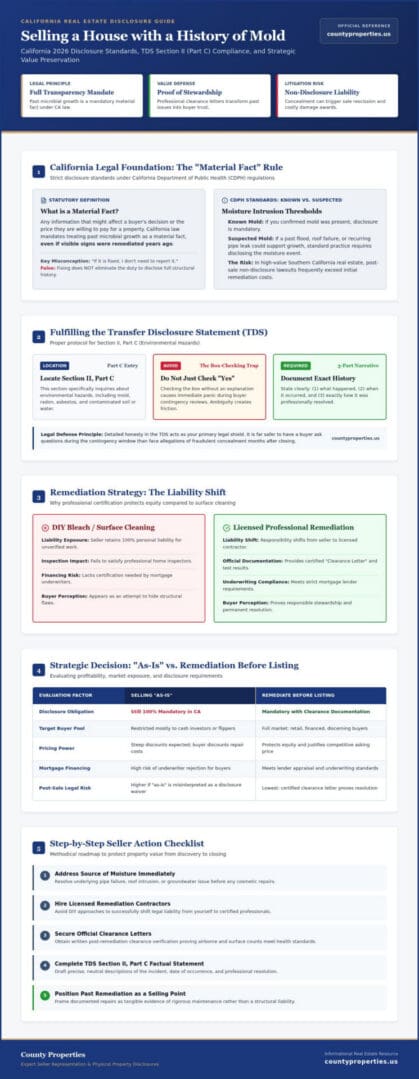
Your Step-by-Step Checklist for Selling a Mold-Affected Property
Selling a house with a history of mold California requires a methodical approach that accounts for our unique regional climate. In Southern California, the combination of coastal marine layers and seasonal humidity can create persistent moisture challenges that buyers are trained to look for. You need a strategy that moves beyond simple repairs and focuses on building a bulletproof case for your home’s value. Following a structured checklist ensures you don’t miss the legal nuances that often trip up sellers in our strict regulatory environment.
- Step 1: Conduct a professional pre-listing inspection. Don’t wait for the buyer’s inspector to find a problem. Identify every potential moisture issue early so you can control the narrative from day one.
- Step 2: Execute remediation and obtain all necessary permits. Use licensed specialists who understand California’s building codes. If your remediation involves structural changes or extensive plumbing, ensuring the work is permitted is vital for a clean title transfer.
- Step 3: Gather all invoices, warranties, and clearance reports. Your paper trail is your most valuable asset during escrow. It proves that the work was done to professional standards.
- Step 4: Draft your disclosure statement with professional guidance. Use factual, clear language on your Transfer Disclosure Statement (TDS) to describe the past issue and the resolution.
- Step 5: Set a strategic price based on the home’s current condition. A remediated home with a “clean bill of health” should be priced competitively with move-in ready properties, not as a distressed sale.
Documenting the Remediation Process
You should create a “Buyer Discovery Packet” to proactively address your property’s history. This packet should include the initial air quality tests, the remediation plan, and the final clearance letter. Including transferable warranties for the remediation work is a significant advantage; it tells the buyer that if a problem returns, they are protected at no cost. This level of detail ensures all work meets local building codes and demonstrates that you have been a responsible steward of the property. When you provide this information upfront, you eliminate the “discovery shock” that often causes deals to fall through during the inspection period.
Marketing the Home with Transparency and Confidence
Transparency in your marketing doesn’t have to be a deterrent. Instead of hiding the home’s history, you can highlight the upgrades made during the remediation process, such as improved ventilation or moisture-resistant materials. You should train your agent to answer tough questions from buyer’s agents with data rather than defensive posturing. When you lead with facts, you maintain control over the property’s perceived value. If you need a partner who understands how to position complex properties, our team offers expert seller representation to help you navigate every disclosure with total confidence.
How County Properties Protects Your Interests During Complex Sales
Arnie Levine leads County Properties with a philosophy that prioritizes your financial safety and emotional well-being above all else. Selling a house with a history of mold California requires a steady hand and a deep understanding of the local regulatory fabric. We don’t just list properties; we act as your professional ally through every phase of the transaction. Our team specializes in navigating the 2026 disclosure requirements, ensuring that your property’s history is presented as a testament to your integrity rather than a hurdle to be cleared. We’ve spent decades building a reputation for reliability in the San Diego market, and we bring that seasoned perspective to every complex sale.
Personalized Guidance for Distressed or Damaged Properties
Navigating the emotional and financial stress of a mold-affected sale can feel overwhelming, especially if you’re dealing with a property that requires significant attention. We provide tailored solutions for sellers who may not have the liquid capital for upfront remediation. By leveraging our established network of trusted San Diego contractors, we help you find methodical ways to address physical property issues without draining your resources before the sale. Whether you are facing a distressed situation or need help with short sales and foreclosure prevention, we offer a collaborative path forward that protects your equity. We believe that every homeowner deserves a way to exit a difficult property situation with their financial future intact.
We also provide specialized support for seniors transitioning out of long-term family homes through our senior real estate transition services. These sales often involve decades of history and complex emotional ties. Our team approaches these transitions with the empathy and patience they deserve, ensuring that every disclosure is handled correctly while honoring the legacy of the home. We take the burden of technical details off your shoulders, allowing you to focus on your next life milestone with total peace of mind. Our goal is to act as a dependable guide during these high-stakes personal transitions.
Leveraging Expert Marketing for San Diego Homeowners
Our marketing programs are never one-size-fits-all. For homes with unique histories, we develop customized strategies that target the right buyer profiles, specifically those who value transparency and professional verification. We position your home’s remediation history as a proactive maintenance success story. This approach ensures you find a buyer at the right price who isn’t deterred by the past but is instead reassured by your honesty. Our commitment to financial safety means we oversee every document to ensure a legally sound and transparent transaction from start to finish.
Your journey toward a successful sale begins with a clear understanding of your property’s current market position. We invite you to take the first step toward a secure and profitable transition by requesting a professional home valuation today. Let our experience be your guide as you move from listing to a successful close. You can reach out to our team at County Properties to begin your personalized consultation and see how our collaborative approach can work for you.
Secure Your Equity with Professional Disclosure Guidance
Navigating the complexities of the 2026 real estate market doesn’t have to be a source of anxiety. By prioritizing professional remediation and maintaining a meticulous paper trail, you transform a potential red flag into a clear demonstration of your home’s integrity. Remember that transparency is your greatest asset; fulfilling your legal obligations today prevents costly litigation tomorrow. Selling a house with a history of mold California is a manageable process when you have the right documentation and an expert strategy in place.
At County Properties, we specialize in helping homeowners navigate these exact challenges. Led by Senior Real Estate Specialist Arnie Levine, our team brings decades of experience in Southern California real estate to every transaction. Whether you are dealing with a distressed property or a complex short sale, we provide the steady guidance you need to maximize your profit and protect your interests. It’s time to move forward with confidence and clarity.
Take the first step toward a successful sale: Request a Professional Home Valuation and Disclosure Consultation
You’ve worked hard to build equity in your home, and we’re here to help you protect it. With a collaborative approach and local expertise, your next life milestone is well within reach.
Frequently Asked Questions
Do I have to disclose mold if it was professionally remediated years ago?
Yes, you must disclose past mold issues even if they were professionally remediated years ago. California law requires sellers to reveal all material facts that could affect the property’s value or desirability. Selling a house with a history of mold California necessitates transparency on the Transfer Disclosure Statement (TDS). By noting the past issue and providing proof of professional repair, you protect yourself from future legal claims and build trust with potential buyers.
Can a buyer sue me after the sale if they find mold I didn’t know about?
A buyer can attempt to sue after the sale, but they generally must prove that you intentionally withheld information or committed fraud. If the mold was truly unknown and not reasonably discoverable, your liability is significantly lower. However, California’s strict disclosure environment means that any red flags, such as past water damage, should be disclosed to show you acted in good faith. Consulting with an experienced real estate professional helps ensure your disclosures are airtight.
Will mold history prevent a buyer from getting a mortgage in California?
A history of mold will not prevent a buyer from obtaining a mortgage, provided the issue has been fully remediated and documented. Lenders, especially for FHA and VA loans, require the home to be safe and habitable. If an appraiser identifies active microbial growth, the lender will likely pause the funding until repairs are complete. Selling a house with a history of mold California is much easier when you have a professional clearance letter ready to satisfy the underwriting requirements.
How much does mold remediation typically affect a home’s resale value?
The impact on resale value depends entirely on how you handle the disclosure and documentation. Unresolved mold can trigger a distressed property discount of 10% or more as buyers over-calculate the risk. Conversely, a home with a history of mold that has been professionally remediated and carries a transferable warranty often sells at full market value. Transparency and proof of quality work turn a potential liability into a sign of diligent home maintenance for the next owner.
Should I get a mold inspection before listing my San Diego home?
Yes, obtaining a pre-listing mold inspection is a strategic move for any San Diego homeowner. Our coastal climate and humidity can lead to hidden moisture issues in attics or crawlspaces. Identifying these problems before a buyer’s inspector finds them allows you to control the remediation process and the narrative. It prevents escrow shock and keeps you in a stronger negotiating position when you eventually bring the property to the competitive local market.
What is the difference between toxic black mold and common household mold in disclosures?
From a disclosure standpoint, California law does not distinguish between different species of mold; all known microbial growth must be reported. While toxic black mold carries a higher psychological stigma for buyers, even common household mold resulting from a leak is considered a material fact. Your disclosure should focus on the source of the moisture and the professional steps taken to resolve the issue rather than the specific biological classification of the growth.
Can I sell my house for cash if it currently has active mold?
You can absolutely sell your house for cash if it has active mold. Cash buyers and investors often look for properties with physical issues that disqualify them from traditional financing. At County Properties, we specialize in cash offer facilitation for distressed or damaged homes. This path allows you to skip the remediation process entirely and close quickly, which is often the best solution for sellers who cannot afford the upfront costs of professional repairs.
What documents should I provide to a buyer to prove the mold is gone?
You should provide a comprehensive clearance packet to any prospective buyer. This includes the final post-remediation air quality test results, the invoice from the licensed remediation contractor, and a formal Clearance Letter or Certificate of Completion. These documents prove that the environment has returned to normal fungal ecology. Providing these records upfront during the disclosure process significantly reduces buyer anxiety and ensures a smoother path toward a successful closing and a clean title transfer.