

Walking away from your home might feel like a defeat, but in the current market, a deed in lieu of foreclosure california can actually be your most powerful financial move. With California foreclosure starts ranking third in the nation as of mid-2026, many homeowners feel trapped by the ticking clock of a 90-day Notice of Default. You’re likely worried that losing your home means a decade of credit ruin or a lingering deficiency judgment. We understand the anxiety this pressure creates; it’s a heavy burden to carry when you’re simply trying to protect your family’s future.
This guide explains how a deed in lieu works as a strategic settlement rather than a simple surrender. You’ll learn how to negotiate a clean break that saves your credit score from the massive 400-point drop often seen with a public auction. We’ll also preview the steps to secure relocation assistance through “Cash for Keys” programs and explain why this path offers more certainty than a traditional short sale. By the end of this article, you’ll have a clear roadmap to move forward with confidence and dignity.
Key Takeaways
- Understand the mechanics of a deed in lieu of foreclosure california as a voluntary, negotiated settlement that protects your financial future more effectively than a forced sale.
- Compare the significant credit score advantages of a deed in lieu, which typically results in a much smaller point drop than the 200 to 400 points lost in a traditional foreclosure.
- Learn how the California Homeowner Bill of Rights provides essential safeguards, including the “dual tracking” ban that prevents lenders from foreclosing while your application is under review.
- Discover the strategic differences between a deed in lieu and a short sale to determine which path offers the fastest exit and the best opportunity for “Cash for Keys” relocation assistance.
- Follow a professional roadmap to negotiate with your lender, ensuring you secure a written deficiency waiver to protect yourself from future financial claims.
What is a Deed in Lieu of Foreclosure in California?
Facing a potential loss of your home is an incredibly stressful experience, but you have options that allow you to maintain control. A Deed in Lieu of Foreclosure is a formal, written agreement where you voluntarily transfer the title of your property to the mortgage lender. In exchange, the lender releases you from the mortgage obligation and cancels the scheduled public auction. This process is often called a “friendly foreclosure” because it bypasses the adversarial nature of a forced sale, allowing both parties to reach a collaborative resolution.
The primary goal is a clean financial break. By utilizing a deed in lieu of foreclosure california, you satisfy the debt without the public stigma of a trustee sale. This is especially relevant given California’s non-judicial foreclosure timeline. When a lender files a Notice of Default, a clock starts ticking. A deed in lieu offers a way to stop that clock before the property reaches a public auction, providing a sense of certainty that a forced sale simply can’t offer.
The “Voluntary” Nature of the Transfer
It’s vital to remember that this process is entirely consensual. A lender can’t force you into this agreement, and you can’t force the lender to accept it. Both parties must engage in good faith negotiations to ensure the transfer makes sense for everyone involved. A Deed in Lieu is a consensual alternative to a Trustee Sale in California. This voluntary approach allows you to move out on your own terms rather than being evicted after a surprise sale on the courthouse steps.
Why Lenders Might Accept a Deed in Lieu
While it may seem counterintuitive for a bank to take back a property, it often serves their financial interests. The standard California non-judicial foreclosure process typically takes a minimum of 111 days. This includes a 90-day period after the Notice of Default and a 21-day period following the Notice of Sale. By accepting a deed in lieu, the lender avoids the legal risks associated with a contested foreclosure and saves significant administrative costs.
Lenders generally require the property to be in “broom-clean” condition. This means you remove all personal belongings and leave the home undamaged. Because the bank wants to sell the property quickly to recover their investment, showing them that you’ve maintained the home can be a strong negotiating point for your deed in lieu of foreclosure california request.
The Benefits and Financial Risks for California Homeowners
Choosing a deed in lieu of foreclosure california isn’t just about leaving a property; it’s about making a strategic decision to protect your financial recovery. Unlike a forced sale, this process allows you to keep your situation private. You avoid the embarrassment of a public Notice of Sale posted on your front door or published in local newspapers. This discretion preserves your standing in the community while you transition to your next chapter with your dignity intact.
Many homeowners are pleasantly surprised to learn about “Cash for Keys” opportunities. Lenders often provide relocation assistance to ensure the property is left in “broom-clean” condition, which can provide several thousand dollars to help with your moving costs. However, you must also consider potential tax consequences. The IRS may view forgiven debt as taxable income, resulting in a 1099-C form. It’s vital to consult a tax professional to see if you qualify for insolvency exclusions that might mitigate this liability.
Protecting Your Credit and Future Housing
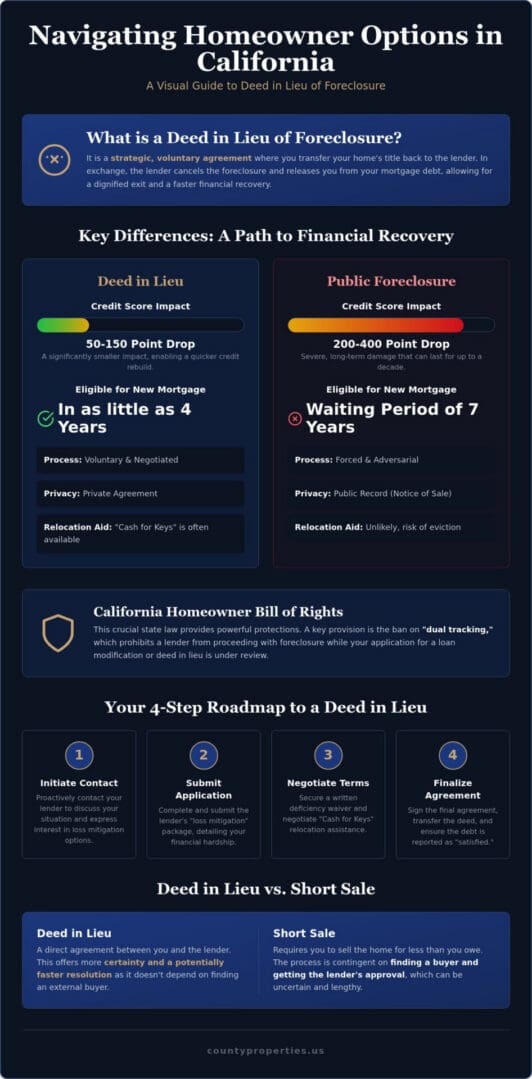
One of the most compelling reasons to pursue this path is the reduced impact on your credit score. A standard foreclosure can slash your score by 200 to 400 points, whereas a Deed in lieu of foreclosure typically results in a drop of only 50 to 150 points. This difference is critical for your future. Under current lending guidelines, you might be eligible to purchase another home in just four years, compared to the seven year waiting period required after a foreclosure. Securing a “Satisfaction of Debt” letter from your lender ensures that the account is reported correctly, which looks significantly better to future creditors.
The Risk of Deficiency Judgments
While California law generally prohibits deficiency judgments after a nonjudicial foreclosure, these protections aren’t always automatic in a voluntary transfer. A deficiency occurs when the bank seeks to recover the difference between your home’s current market value and your total loan balance. You must ensure your agreement explicitly states that the lender waives their right to pursue you for this balance. Working with experienced foreclosure prevention specialists can help you review the lender’s offer to confirm these protections are in writing. Without this explicit waiver, you could remain financially vulnerable even after moving out. Our team focuses on securing these specific terms to ensure your exit is truly a clean break from the mortgage debt.
California Protections: The Homeowner Bill of Rights
California homeowners possess some of the most robust legal safeguards in the United States. The California Homeowner Bill of Rights (HBOR) was specifically enacted to level the playing field between individual families and massive financial institutions. One of the most significant provisions is the absolute ban on “Dual Tracking” under California Civil Code § 2923.6. This law mandates that a mortgage servicer cannot proceed with a foreclosure sale while your application for a deed in lieu of foreclosure california is officially under review. If you’ve submitted a complete package, the lender is legally required to halt the auction process until they’ve reached a final decision. This protection provides the essential breathing room you need to negotiate a strategic exit without the constant threat of a looming sale date.
The HBOR doesn’t just stop at halting sales; it fundamentally changes how you interact with your bank. By providing clear procedural requirements, these laws give you significant leverage. If a lender violates these protections, they can face substantial legal penalties, which often makes them much more cooperative during negotiations. We’ve seen that when homeowners understand their rights, they can transform a high-pressure situation into a structured, professional settlement that preserves their financial future.
Leveraging the Single Point of Contact
The days of being lost in a maze of automated phone trees and anonymous departments are over. Under the HBOR, lenders are required to assign a Single Point of Contact (SPOC) to any homeowner seeking a foreclosure alternative. California law requires lenders to provide a consistent contact person for foreclosure alternatives. This dedicated representative must have access to your full file and the authority to explain the specific requirements for your deed in lieu of foreclosure california application. Having a direct line to a specific individual ensures that your documents aren’t “lost” and that you receive timely updates on your status.
Anti-Deficiency Laws in the Golden State
Beyond the procedural rights of the HBOR, California offers powerful financial shields. California Code of Civil Procedure § 580e is a cornerstone of these protections. This statute generally prohibits lenders from pursuing a deficiency judgment on “purchase money” loans for owner-occupied residential properties after a short sale or deed in lieu. Southern California homeowners benefit from these unique protections which are often far more comprehensive than those found in other states. These laws are designed to ensure that once you hand over the keys, the debt is truly gone. For a deeper dive into these specific statutes and how they apply to your property, refer to our Foreclosure Prevention in California guide. Understanding these legal nuances is the first step toward a successful, stress-free transition.
Deed in Lieu vs. Short Sale: Which is Right for You?
Deciding between these two paths depends heavily on your specific timeline and the current state of your property. While both options effectively prevent a forced auction, a deed in lieu of foreclosure california is often a faster exit strategy because it doesn’t require finding a third-party buyer on the open market. If your property has sat on the market for 90 days with no realistic offers, the bank may be more inclined to accept a deed transfer to resolve the case quickly. This path provides a definite end date, allowing you to plan your move with certainty.
Short sales often offer a higher potential for relocation funds, but they require more patience. Lenders frequently prefer this route because the home sells for actual market value through a traditional transaction, which reduces the bank’s ultimate loss. However, if the local market is stagnant, waiting for a buyer can be risky. As the foreclosure clock continues to tick, you don’t want to be caught in a situation where a short sale fails at the last minute, leaving you with no time to negotiate a deed transfer.
The Short Sale Alternative
A short sale involves listing your home with a professional agent and negotiating with the lender to accept less than the full mortgage balance. This method is often viewed more favorably by future creditors because it shows you made an active effort to sell the property at market value. For many families, this is the preferred way of selling a home in Southern California during a financial crisis. It allows you to maintain more control over the showing process and the final sales terms compared to a voluntary deed transfer.
The Impact of Multiple Liens
Junior liens create a significant hurdle for a successful deed in lieu of foreclosure california. Lenders generally require a “clear title” before they’ll accept a deed transfer. This means if you have a Home Equity Line of Credit (HELOC), a second mortgage, or even a tax lien, that secondary creditor must also agree to release their claim. Since a deed in lieu usually only benefits the primary lender, secondary creditors often refuse to cooperate unless they receive a specific payout.
In cases with multiple creditors, a short sale is often the only viable path. During a short sale closing, the primary lender may allocate a portion of the proceeds to satisfy the junior lienholders. This collaborative approach is rarely possible with a deed in lieu. If you’re struggling to navigate these complex creditor relationships, you should speak with our foreclosure prevention specialists to review your title report and determine which strategy protects your financial future most effectively.
How to Negotiate a Deed in Lieu: A Step-by-Step Roadmap
Negotiating a deed in lieu of foreclosure california is a structured process that requires precision and proactive communication. You aren’t just handing over keys; you’re presenting a professional proposal to a financial institution. Lenders view this as a business decision to mitigate their losses, so your goal is to prove that a voluntary transfer is the most efficient path for everyone involved. Following a specific roadmap ensures you meet the bank’s strict criteria while protecting your legal interests.
- Step 1: Documenting Your Financial Hardship. You must provide a “Hardship Letter” that clearly explains why you can no longer afford the mortgage. This narrative should be supported by evidence of life changes, such as medical emergencies, job loss, or divorce.
- Step 2: The Good Faith Listing Period. Most lenders require you to list the property for sale with a licensed broker for at least 90 days. This proves that you’ve attempted to sell the home at market value before asking the bank to take it back.
- Step 3: Submission to Loss Mitigation. You’ll submit a complete “Deed in Lieu” package to the bank’s loss mitigation department. This is the team responsible for finding alternatives to foreclosure.
- Step 4: Property Inspection and Title Search. The lender will conduct a professional appraisal and a title search. As discussed in previous sections, a clear title is essential; any junior liens or secondary mortgages must be resolved before the bank moves forward.
- Step 5: Finalizing the Transfer. If approved, you’ll sign an Estoppel Affidavit and a Grant Deed. These documents formally transfer the property title and confirm that you’re acting voluntarily and in good faith.
Working with a Southern California Specialist
Navigating these steps alone can be overwhelming, especially when you’re facing the pressure of a 90-day Notice of Default. Arnie Levine and the County Properties team serve as your “Dependable Guides” throughout this transition. We use localized San Diego market data to show the bank why a deed transfer is their best financial option. If you’re an older homeowner downsizing due to financial stress, it’s particularly helpful to work with a Senior Real Estate Specialist who understands the unique emotional and logistical challenges of your situation.
Your First Action Steps
The key to a successful negotiation is preparation. You should begin gathering your financial records immediately, including your last two years of tax returns, recent pay stubs, and at least three months of bank statements. Most importantly, don’t stop communicating with your lender. Silence is often interpreted as a lack of interest in resolving the debt, which can accelerate the foreclosure process. Taking the first step toward a settlement can provide the peace of mind you’ve been looking for. Contact County Properties today for a confidential consultation to explore your options and secure your financial future.
Secure Your Financial Future and Personal Dignity
Navigating the complexities of a deed in lieu of foreclosure california is a strategic move to preserve your credit and personal dignity. By understanding your rights under the Homeowner Bill of Rights, you can secure a clean break from mortgage debt. Whether you choose a voluntary deed transfer or a short sale, the goal is to protect your long term financial health and avoid a public auction.
As San Diego local market experts and short sale specialists, County Properties provides the compassionate, senior focused guidance you need during this transition. We act as your dependable guide, handling the bank negotiations so you can focus on your family’s next chapter. You don’t have to face this uncertainty alone. Our team ensures every detail is handled with professional mastery and your best interests in mind.
Ready to explore your options? Request a Confidential Foreclosure Prevention Consultation today to achieve a fresh start. You have the power to turn this challenge into a successful milestone, and we’re here to facilitate your progress.
Frequently Asked Questions
Can I stop a foreclosure the day before the sale in California?
Yes, but your options are limited at that late stage. Under the Homeowner Bill of Rights, lenders must stop a sale if a complete application for a deed in lieu of foreclosure california is under review. Additionally, the 2025 law AB 2424 allows for a 45-day postponement if you list your property with a licensed broker. However, waiting until the final 24 hours often requires a bankruptcy filing or an emergency court injunction to halt the auction.
What is the California Homeowner Bill of Rights?
The California Homeowner Bill of Rights is a set of laws designed to protect borrowers from unfair or deceptive foreclosure practices. It mandates that lenders provide a single point of contact for homeowners and strictly prohibits “dual tracking.” These protections ensure you have a fair opportunity to explore alternatives like a short sale or a deed in lieu. The law was recently updated in 2026 to strengthen these essential consumer safeguards.
How many missed payments before foreclosure starts in California?
Federal law generally prohibits lenders from starting the foreclosure process until you are at least 120 days delinquent. This gives you a four-month window to seek professional guidance and explore exit strategies. In California, your servicer must also contact you to discuss foreclosure alternatives at least 30 days before they can file a Notice of Default. Using this time wisely is the best way to protect your financial future.
Is a short sale better for my credit than a deed in lieu?
Both options typically result in a credit score drop of 50 to 150 points, which is far less damaging than the 200 to 400 point drop caused by a foreclosure. A short sale may be viewed more favorably by future lenders because it shows you actively marketed the home to find a buyer. However, a deed in lieu is often faster and provides a more certain timeline for your family’s transition.
What is “Dual Tracking” and is it illegal in California?
Dual tracking occurs when a mortgage servicer continues the foreclosure process while simultaneously evaluating your application for a loan modification or a deed in lieu. This practice is illegal in California under the Homeowner Bill of Rights. If you’ve submitted a complete application, the lender cannot record a Notice of Default or Notice of Sale until they have formally denied your request and provided you with a window to appeal the decision.
Can I get a deed in lieu if I have a second mortgage?
It is challenging but not impossible. A deed in lieu of foreclosure california typically requires a clear title, meaning any junior liens or second mortgages must be released by those creditors. Most primary lenders won’t accept a deed if they have to assume responsibility for your other debts. In these cases, a short sale is often a more viable path because sale proceeds can sometimes satisfy secondary creditors during the closing process.
Do I have to pay taxes on the debt forgiven in a deed in lieu?
Forgiven mortgage debt is generally considered taxable income by the IRS; you will likely receive a 1099-C form after the transaction closes. While certain past federal and state laws provided relief for primary residences, you should consult a tax professional to discuss current insolvency exclusions. Understanding these potential liabilities is a crucial part of planning your financial recovery after transferring your property back to the lender.
What happens to my equity if my home is foreclosed on?
If your home sells at a foreclosure auction for more than what you owe, you are legally entitled to the surplus funds. However, properties sold at public auction often go for significantly less than market value, which frequently wipes out any existing equity. By negotiating a deed in lieu or a short sale, you maintain more control over the outcome and may even secure relocation assistance through programs like “Cash for Keys.”