

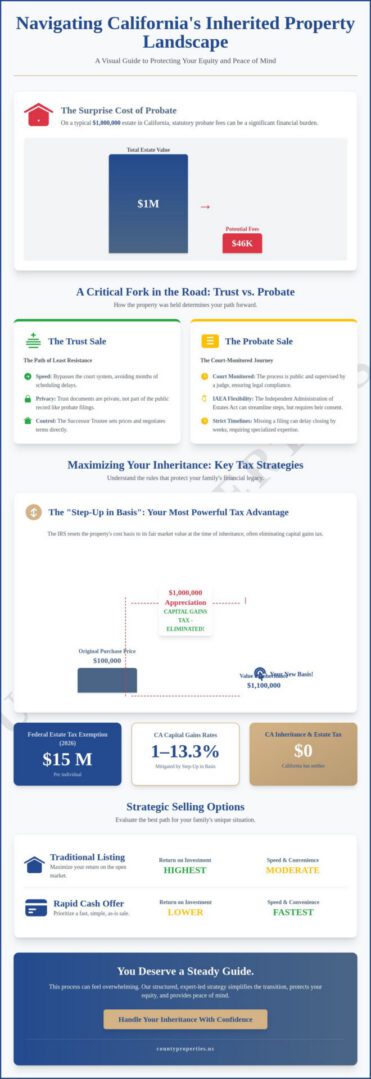
Did you know that on a $1 million estate in California, statutory probate fees for the attorney and executor can reach approximately $46,000? It’s a staggering figure that often catches families by surprise during an already emotional time. When you’re selling an inherited property in California, the weight of legal deadlines and tax complexities like Proposition 19 can feel overwhelming. You want to honor your loved one’s legacy, yet the fear of making a costly financial mistake often leads to exhaustion and doubt.
We believe you deserve a steady guide who prioritizes your peace of mind over a quick transaction. You’re likely looking for a way to manage this transition without the typical probate stress or the fear of high capital gains taxes. This guide provides a structured, expert led strategy to help you protect your equity and handle the legal landscape with confidence. We’ll explore the 2026 federal estate tax exemption of $15 million, the impact of the current 1% to 13.3% capital gains rates, and the specific steps required for a smooth, compassionate title transfer.
Key Takeaways
- Distinguish between Trust and Probate processes to ensure a smooth legal title transfer and avoid common procedural delays.
- Leverage the “Step-Up in Basis” rule to potentially eliminate capital gains taxes when selling an inherited property in California.
- Navigate the 2026 property tax landscape by identifying how Proposition 19 affects inherited homes not established as a primary residence.
- Evaluate strategic selling options, comparing the convenience of cash offer facilitation with the higher ROI potential of a traditional listing.
- Follow a structured, expert led roadmap that simplifies the transition from gathering documentation to achieving a successful closing.
Understanding the Legal Landscape of California Inheritances
Being named an executor or a successor trustee is a significant responsibility that often arrives during a period of deep personal grief. You aren’t just managing a transaction; you’re stewarding a family legacy. The first step toward finding peace of mind is what we call the Legal Clearance phase. This involves identifying exactly who has the legal authority to sign documents and make decisions. Without this clarity, any attempt at selling a home in Southern California will likely face frustrating delays or legal challenges.
Legal authority depends entirely on how the deceased held the title. Understanding Real Property law is essential here, specifically how estates and ownership are structured. This legal framework determines whether you follow the private instructions of a trust or wait for a judge’s order in probate court. This distinction is the most critical fork in the road when you’re selling an inherited property in California.
The Trust Sale: The Path of Least Resistance
A Living Trust is designed to be the most streamlined way to handle an inheritance. If the property was properly funded into a trust, you can typically bypass the California probate courts entirely. As the Successor Trustee, you act as the manager of the sale. This path offers several distinct advantages for families:
- Speed: You don’t have to wait for court dates, which can often take months to schedule.
- Privacy: Unlike probate filings, trust documents are not part of the public record.
- Direct Control: You have the authority to set the listing price and negotiate terms with less outside oversight.
Navigating Probate in Southern California
If there is no trust, the home must go through the probate process. In 2026, California probate remains a structured, court-monitored journey. However, you can often gain more flexibility through the Independent Administration of Estates Act (IAEA). This act allows an executor to sell the property without seeking court permission for every single step, provided the heirs don’t object. Even with these powers, court-supervised sales involve specific timelines that must be followed strictly. You’ll want a real estate agent near me who understands these specific court requirements. Having a seasoned professional by your side ensures you don’t miss a filing that could delay your closing by weeks. When selling an inherited property in California through probate, this specialized expertise acts as your financial and legal safety net.
Maximizing Your Inheritance: Taxes, Step-Up Basis, and Prop 19
Financial anxiety often peaks when heirs consider the potential tax bill associated with a family estate. You’ll be relieved to know that California does not have a state-level inheritance tax or estate tax. This removes a significant layer of complexity that exists in other parts of the country. However, understanding how federal taxes and local property assessments interact is vital when you’re selling an inherited property in California. By mastering a few key rules, you can protect the financial legacy your loved one intended to leave behind.
Success in this transition requires looking at the gap between the original purchase price and current value. In the current Southern California housing market, where median prices in San Diego reached $1,074,000 in April 2026, that gap is often substantial. Without the right strategy, taxes could eat into your equity. Thankfully, the tax code provides a powerful mechanism to prevent this.
The Step-Up Basis: Protecting Your Equity
The “Step-Up in Basis” rule is arguably the most significant tax advantage available to heirs. When you inherit real estate, the IRS “resets” the property’s cost basis from the original purchase price to the fair market value on the date of the owner’s death. If your parents bought a home decades ago for $100,000 and it’s worth $1.1 million today, your new tax basis is $1.1 million. This reset virtually eliminates capital gains tax on the appreciation that occurred during their lifetime. A professional appraisal is required to establish this new basis and provide documented proof of the value at the time of transfer.
Proposition 19 and the Parent-to-Child Transfer
While federal capital gains are often mitigated, property taxes follow a different set of rules under Proposition 19. For transfers occurring through February 2027, heirs only keep a parent’s low property tax base if they move into the home and establish it as their primary residence within one year. There’s also an exclusion limit of $1,044,586 over the factored base year value. If the home’s market value exceeds this combined amount, a partial reassessment occurs.
For many, selling makes more financial sense than keeping an inherited property as a rental. If the home isn’t your primary residence, it will be reassessed at full market value, potentially leading to a massive spike in annual taxes that erodes your rental income. If the tax implications of keeping the property feel too burdensome, exploring the process of selling a home in Southern California might be your most financially sound path. Selling an inherited property in California shortly after the transfer allows you to capture the full market value while the tax basis is still at its peak “stepped-up” level.
Strategic Options: Traditional Sale vs. Rapid Cash Offers
Every family’s situation is unique, and the right path depends on your capacity to manage a project versus your need for a swift resolution. When selling an inherited property in California, you’ll generally find yourself at a crossroads between the Convenience Path and the Maximum ROI Path. Our collaborative approach at County Properties ensures you evaluate both options side by side. We don’t believe in high pressure tactics; instead, we provide the data you need to make a choice that honors your loved one’s legacy while protecting your own interests.
Before committing to a strategy, it’s vital to assess the home’s financial health. If you discover the property has an underwater mortgage or is nearing a default, specialized strategies like foreclosure prevention california may be necessary to protect the estate’s remaining equity. You should also review the IRS guidance on inherited property to understand how your chosen sale method might impact federal reporting. Having a clear picture of both the physical and financial state of the home allows you to proceed with certainty.
When to Consider a Rapid Cash Offer
Distressed properties in San Diego often justify a rapid cash facilitation. If the home requires significant structural repairs, has been vacant, or if the heirs live out of state, the “as-is” nature of a cash offer provides immense emotional relief. You gain peace of mind from a 7 to 14 day closing period without the stress of inspections or buyer financing contingencies. To ensure a cash offer is fair, we always compare it against a professional home valuation. This transparency helps you understand the exact “convenience cost” of choosing speed over a traditional market listing.
The Traditional Market: Honoring the Home’s Full Value
For homes in well-maintained condition, the traditional market remains the most effective way to maximize your financial inheritance. In 2026, we utilize advanced marketing technology to find buyers who value the specific history and neighborhood character of your family home. Professional staging and minor “refresh” repairs can significantly boost the final sale price, ensuring heirs receive the highest possible return. A collaborative agent handles the logistical burden of showings and complex negotiations, acting as a steady guide so you don’t have to manage the details alone while selling an inherited property in California.
A Step-by-Step Roadmap to a Stress-Free Sale
Success in an estate transition doesn’t happen by accident; it’s the result of a deliberate, step-by-step roadmap. We divide this journey into four logical phases designed to protect your interests and your time. Phase 1 is Discovery and Documentation, where we gather the death certificate and title documents to establish a clear legal path forward. Phase 2 involves Valuation and Strategy. By determining the 2026 market value, we help you choose the sale path that fits your timeline. In Phase 3, we address Property Preparation by deciding which items to keep and what needs a refresh. Finally, Phase 4 covers the Market Launch and Negotiation. This is where we act as your shield, managing aggressive buyers so you can remain focused on your family’s needs while selling an inherited property in California.
The “Clean Out” Challenge: Senior Specialist Support
Sorting through a lifetime of possessions is often the most emotionally draining part of selling an inherited property in California. A senior real estate specialist acts as a project manager for this transition. They coordinate estate sales, haul-away services, and charitable donations, allowing you to focus on your family. If the burden feels too heavy, we offer turn-key solutions where you can leave the house exactly as it is. We handle the heavy lifting so you don’t have to spend your weekends clearing out a basement or attic. This supportive approach turns an overwhelming chore into a manageable transition.
Managing Sibling Dynamics and Multiple Heirs
Managing multiple heirs often requires a neutral perspective to keep everyone aligned. When siblings disagree on price or timing, a seasoned expert acts as a buffer to maintain family harmony. We provide transparent, third-party communication so every beneficiary feels heard and respected. This collaborative mindset helps avoid legal complications like partition actions, which only serve to drain the estate’s equity through court costs. By keeping the process objective and data-driven, we ensure the transaction remains a smooth experience for everyone involved. We believe that professional mastery combined with empathy is the only way to navigate these high-stakes personal situations.
To begin your transition with a steady, compassionate ally, view our seller representation services.
Why a Compassionate San Diego Expert is Your Best Ally
Choosing the right partner transforms the process of selling an inherited property in California from a daunting legal obligation into a structured success. At County Properties, we operate under a “Steady Guide” philosophy. This means you receive high level expertise without the high pressure tactics common in the industry. Arnie Levine’s decades of experience in Southern California serve as a financial safety net for heirs. He has navigated various market cycles over the years, providing a level of seasoned wisdom that helps prevent costly errors during sensitive transitions.
Local Expertise in the 2026 San Diego Market
The San Diego real estate landscape is intricate and requires a localized perspective to navigate effectively. With the median sold price for existing single family homes reaching $1,074,000 in April 2026, the financial stakes for heirs are incredibly high. Local knowledge prevents underpricing in diverse neighborhoods ranging from the luxury estates of Rancho Santa Fe to the vibrant streets of Hillcrest. We’ve observed a 5.8% year over year appreciation in San Diego County, a trend that requires a nuanced strategy to capture maximum value. Our commitment to “Relational Professionalism” means we treat your transaction as a shared mission rather than a simple data point.
Your Next Chapter: Moving Forward with Confidence
We invite you to reframe this sale as a celebration of your loved one’s legacy. It isn’t just about closing a legal file; it’s about honoring the life lived in the home while securing the future of those left behind. The right partnership provides the clarity you need to move forward with absolute confidence. We handle the complexities of the 2026 market so you can focus on your family and your next chapter. When selling an inherited property in California, having a mentor who understands both the numbers and the emotions involved makes all the difference.
If you’re ready to explore your options with a dependable mentor, request a confidential consultation on your inherited property today.
Moving Forward with Clarity and Financial Security
You’ve explored the critical tax advantages of the step up in basis and the nuances of Proposition 19. You now understand that the right strategy depends on your unique goals, whether you choose the convenience of a rapid cash facilitation or the maximum return of a traditional market listing. Selling an inherited property in California is a significant life transition, but it doesn’t have to be an overwhelming one.
At County Properties, we provide a collaborative, service first approach rooted in over 30 years of Southern California market expertise. As an SRES® Certified Senior Real Estate Specialist, Arnie Levine offers the seasoned mentorship required to protect your equity while honoring your family’s legacy. We act as your steady guide, ensuring every detail is managed with professional mastery and genuine empathy. Connect with County Properties for a Compassionate Estate Sale Experience and take the first step toward your next chapter with confidence. You’ve done the hard work of caring for your loved one; now let us care for the details of their estate.
Frequently Asked Questions
Do I have to go through probate to sell my parents’ house in California?
You can avoid probate if the property was held in a Living Trust or if the total estate value is below the $208,850 small estate threshold for 2026. If the home was owned individually without a trust, formal probate is typically required to transfer the title. This process ensures all debts are paid before the heirs receive their inheritance. We recommend checking the title early to determine which legal path you must follow.
How much is the capital gains tax on inherited property in California?
California taxes capital gains as ordinary income at rates ranging from 1% to 13.3%. However, most heirs pay little to no capital gains tax because of the “Step-Up in Basis” rule. If you sell the property shortly after inheriting it, the sale price will likely be very close to your new tax basis. This results in minimal taxable gain, even if the property appreciated significantly during your parents’ lifetime.
What is the “Step-Up in Basis” and how does it help me as an heir?
The “Step-Up in Basis” resets the property’s value to its fair market value on the date of the owner’s death. This is the most vital tax benefit when selling an inherited property in California. It eliminates the tax burden on all the appreciation that occurred during the previous owner’s life. This reset can save your family tens of thousands of dollars in federal and state taxes when you close the sale.
Can one sibling force the sale of an inherited house in California?
Yes, a sibling can legally force a sale through a court procedure known as a Partition Action. While this legal mechanism exists, it is often expensive and emotionally draining for the family. We recommend using a neutral third party to facilitate a collaborative agreement. This preserves more of the estate’s equity for all beneficiaries and avoids the high legal fees associated with court mandated sales.
How long does it typically take to sell an inherited property in San Diego?
A traditional sale in San Diego typically takes 30 to 60 days from listing to closing. In April 2026, San Diego saw a 14.8% increase in sales volume, reflecting a healthy, balanced market. If you need a faster resolution because of travel or financial needs, our cash offer facilitation can close in as little as 7 to 14 days. The right timeline depends on the home’s condition and your specific goals.
Does Proposition 19 mean I will pay higher taxes on my inherited home?
Proposition 19 will likely lead to higher property taxes unless you move into the home and establish it as your primary residence within one year. For properties not used as a primary residence, the home is reassessed at its current 2026 market value. This change is a significant financial burden for those who intended to keep the property as a rental. Selling often becomes the most practical path to avoid this tax spike.
What documents do I need to start the sale of an inherited property?
You will need the original death certificate, the most recent deed, and either the Living Trust documents or Letters of Testamentary from the probate court. Additionally, obtaining a professional appraisal as of the date of death is crucial for establishing your tax basis. Having these documents ready early in the process of selling an inherited property in California prevents unnecessary delays and ensures a smoother legal transfer of the title.
Should I make repairs to an inherited home before listing it in 2026?
In 2026, “refresh” repairs like interior painting or flooring updates often provide a strong return on investment in the San Diego market. However, major structural repairs should be evaluated carefully. If the home requires extensive work, the convenience of an as-is sale through cash offer facilitation might be more beneficial. This choice allows you to avoid the stress and cost of a long renovation project during a difficult transition.