

Last week, a San Diego landlord discovered that their tenant’s refusal to allow a single showing could jeopardize the sale of their property in a market where median prices sit at $830,370. It’s a nightmare scenario that leaves you feeling powerless against strict “Just Cause” eviction laws and mandatory relocation fees. You’ve likely realized that knowing how to sell a house with uncooperative tenants California is less about force and more about a strategic negotiation of value versus friction.
We understand the anxiety of facing a 120 day notice period or the fear of legal retaliation when you just want a clean exit. You deserve to secure your financial future without being held hostage by a difficult rental situation. This guide provides the legal strategies and negotiation tactics you need to regain control of your property. We’ll break down the “Cash for Keys” process, where buyouts in cities like Los Angeles have recently averaged $25,068.87, and show you how to partner with professionals who handle the difficult conversations so you don’t have to.
Key Takeaways
- Navigate the latest 2026 updates to AB 1482, including specific relocation assistance requirements for no-fault evictions.
- Evaluate the advantages of selling your property tenant-occupied to long-term investors versus pursuing a vacant possession sale.
- Master the “Cash for Keys” negotiation strategy to resolve disputes faster and more affordably than traditional court proceedings.
- Learn the exact legal notice timelines and documentation needed for how to sell a house with uncooperative tenants California while minimizing liability.
- Discover how a professional real estate partner serves as a vital buffer to manage difficult tenant communications and ensure successful property showings.
Navigating California Tenant Rights and AB 1482 in 2026
When you’re trying to figure out how to sell a house with uncooperative tenants California, the first hurdle is defining what “uncooperative” actually means in a legal sense. In 2026, this usually involves a tenant who ignores the 120 day notice of intent to sell, refuses to clean for photos, or repeatedly denies entry for appraisals. California’s Tenant Protection Act, known as AB 1482, has significantly changed the power dynamic between owners and renters. Under the 2026 updates, landlords must provide a “just cause” to terminate a lease for any tenant who has lived in the property for at least 12 months. This creates a complex environment where simply wanting to cash out on your investment isn’t enough to clear the property for a vacant sale.
Understanding the broader context of U.S. Landlord-Tenant Law is helpful, but California’s specific protections are among the strictest in the country. You must distinguish between “At-Fault” and “No-Fault” causes. At-fault causes include clear lease violations like non-payment or criminal activity. No-fault causes, which require you to pay one month of relocation assistance as of May 2026, include owner move-ins or withdrawing the property from the rental market. In San Diego, local ordinances like the Residential Tenant Protection Ordinance add even more layers of protection. These local rules often require additional notices that must be served perfectly to avoid a dismissed eviction case.
The “Right of Entry” vs. Tenant Privacy
California law requires you to provide a written 120 day notice to tenants before any showings can begin. Once that window opens, you still must provide a 24 hour notice before each individual entry. If a tenant repeatedly denies entry for inspections or appraisals despite proper notice, they are technically in breach of the lease. However, forcing entry is never advised; it often leads to harassment claims that stall your sale. Civil Code Section 1954 is the specific statute that governs exactly when and how a landlord can legally enter a tenant occupied unit.
Exemptions You Might Not Know About
If your property is a single-family home or a condo, you might be exempt from state rent caps and just-cause requirements. This exemption isn’t automatic. You must have provided your tenant with a specific written disclosure in the lease agreement stating the property is exempt. Without this document, you’re bound by the same rules as large apartment complexes, including the 6.3% rent increase cap for 2026. This is why selling a home in Southern California requires a thorough audit of your lease documents before you ever plant a “For Sale” sign in the yard. Verifying your status early prevents a tenant from using AB 1482 as a shield against your right to sell the property.
Evaluating Your Best Path: 4 Strategies for Difficult Tenancies
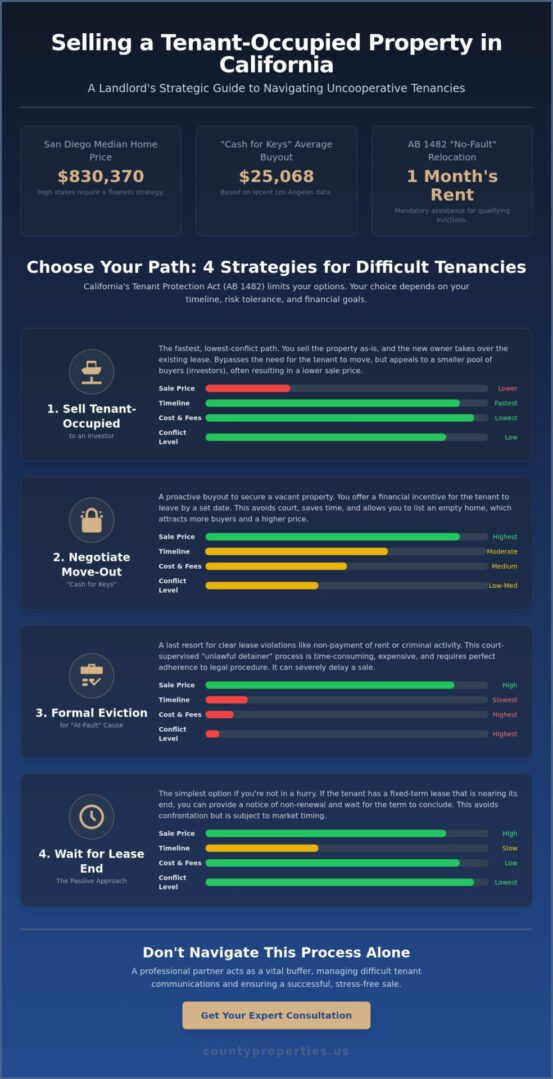
Every landlord faces a unique crossroads when deciding how to sell a house with uncooperative tenants California. You aren’t just selling real estate; you’re managing a delicate human situation with high financial stakes. According to the California Attorney General’s Office, both parties have specific protections that dictate what you can and cannot do during a property transition. Your choice depends on your timeline, your risk tolerance, and your current equity position.
- Option 1: Selling Tenant-Occupied to an Investor. This is the fastest route. You sell the home as-is, and the new owner takes over the existing lease. It bypasses the need for the tenant to move out before closing, though it typically results in a lower sale price.
- Option 2: Negotiating a Voluntary Move-Out (Cash for Keys). You offer a financial incentive for the tenant to leave by a specific date. It’s often cheaper than a legal battle and ensures the home is vacant for traditional buyers who pay top dollar.
- Option 3: Formal Eviction for Lease Violations. This is the “hard” path. If the tenant has stopped paying rent or is damaging the property, you can file an unlawful detainer. It’s time-consuming and requires strict adherence to court procedures.
- Option 4: Waiting for Lease Expiration. If the lease is ending soon, you might choose to wait. You’ll continue managing the relationship while preparing for a post-tenancy listing once the term naturally concludes.
The Impact on Buyer Financing and Appraisals
An uncooperative tenant doesn’t just make showings difficult; they can kill a deal by blocking buyer financing. Most traditional buyers use FHA or VA loans, which require the purchaser to occupy the home as their primary residence within 60 days of closing. If a tenant refuses to leave or holds a long-term lease, these buyers are effectively locked out. Additionally, appraisers need full access to the property. If a tenant denies entry, the lender won’t approve the loan. This refusal to show often leads to a stagnant listing and a final sale price well below market value.
Selling to an Investor vs. Traditional Market
Selling to an investor usually means accepting a “tenant discount.” You’re essentially trading equity for the convenience of not handling the “dirty work” of tenant removal. However, if your tenant has stopped paying rent entirely, this might be your best move to avoid a total financial loss. In cases where non-payment is leading toward a crisis, exploring foreclosure prevention strategies can protect your credit while you exit the property. If you’re feeling overwhelmed by these choices, partnering with a local expert can help you navigate the negotiation process with minimal stress.
Mastering the “Cash for Keys” Negotiation in Southern California
A legal battle in the California court system during 2026 can drag on for six months or longer. Between filing fees, process servers, and attorney costs, many landlords find themselves spending thousands before a judge even hears the case. This is why a voluntary buyout, commonly known as “Cash for Keys,” has become the preferred method for owners learning how to sell a house with uncooperative tenants California. It transforms a hostile legal confrontation into a business transaction, providing the tenant with the liquidity they need to move while protecting your property’s market value.
Determining the right offer requires a cold calculation of your potential losses. If an uncooperative tenant prevents you from selling to a traditional buyer, you might lose 10% to 20% of your home’s $830,370 median value. In this context, paying a tenant a significant sum is often the more profitable choice. While the California Tenant Protection Act (AB 1482) mandates one month of rent for relocation assistance in no-fault evictions, voluntary buyouts in cities like Los Angeles have recently averaged $25,068.87. You aren’t just paying for their move; you’re buying back your right to a friction-free sale.
Always use a third party to handle these discussions. When a landlord negotiates directly, emotions often flare and past grievances surface. Having a Realtor act as a buffer keeps the conversation focused on the future. Once you reach an agreement, it must be memorialized in a “Surrender of Possession” document. This legal paperwork ensures the tenant waives their rights to the property in exchange for the payment, preventing them from claiming they were illegally locked out later.
The “Empathy First” Approach for Uncooperative Tenants
Most uncooperative behavior stems from fear. With the San Francisco-Oakland-Hayward CPI region seeing a 6.3% rent cap increase for 2026, tenants are terrified they won’t find another home they can afford. Try using a soft icebreaker: “I know this sale is a big change for everyone, and I want to see how we can work together to make your next move as smooth and affordable as possible.” Sometimes, non-monetary perks like hiring a professional moving company or providing a glowing landlord reference are more persuasive than cash alone.
Protecting Yourself from “Holdover” Risks
Never pay the full buyout amount until the tenant has completely vacated and handed over the keys. A common mistake is providing funds upfront, only for the tenant to remain in the unit as a “holdover” after the money is spent. Schedule a final walkthrough to verify the property is in “broom-clean” condition before issuing the check. If you are dealing with an elderly tenant or an owner-occupant in a complex family situation, it’s wise to consult a senior real estate specialist. They possess the specific training to handle sensitive transitions with the patience and care required for older residents.
The Legal Process: Notice Requirements and Eviction Timelines
If negotiation fails and a voluntary buyout isn’t an option, you must transition to the formal legal process. While previous sections highlighted why “Cash for Keys” is often faster, some situations leave you with no choice but to pursue a court-ordered eviction. In 2026, the California court system remains backlogged, meaning a standard Unlawful Detainer case typically takes between three and five months from filing to lockout. Understanding how to sell a house with uncooperative tenants California requires a strict adherence to a four-step legal timeline that leaves zero room for error.
- Step 1: Serving the Appropriate Notice. For tenants who have lived in the property for more than one year, a 60-day written notice is required. If they’ve been there less than a year, a 30-day notice suffices. If the eviction is based on a specific lease violation, a 3-Day Notice to Cure or Quit is the starting point.
- Step 2: Filing the Unlawful Detainer. Once the notice period expires and the tenant remains, you file an Unlawful Detainer in the local Superior Court. In San Diego, these cases are handled by specific courtrooms that specialize in landlord-tenant disputes.
- Step 3: The Tenant’s Response and Trial. After being served, the tenant has exactly five days to file a response. If they contest the eviction, a trial date is usually set within 20 days of the request.
- Step 4: Writ of Possession and Lockout. If the judge rules in your favor, the court issues a Writ of Possession. You then deliver this to the San Diego County Sheriff, who performs the physical lockout five days after posting a notice on the tenant’s door.
Common Pitfalls in the California Eviction Process
A single clerical error on your initial notice can reset your entire timeline. If you miscalculate the expiration date by even 24 hours, a tenant’s attorney can have the case dismissed, forcing you to start the 60-day clock all over again. Avoid “Self-Help” evictions at all costs. Changing locks or cutting off utilities is illegal under California law and can result in statutory penalties of $100 per day per violation. When performing a real estate agent near me search, prioritize partners who have established networks of legal resources to ensure every document is bulletproof.
Documentation: Your Best Defense
Your success in court depends on your paper trail. Keep a detailed log of every denied showing, including the date, time, and the specific reason the tenant gave for refusal. Photo evidence of the property’s condition is vital if the tenant claims the unit is “uninhabitable” as a defense to non-payment. Uncooperative tenants often use “Retaliatory Eviction” claims, arguing you’re only evicting them because they complained about repairs. Having time-stamped communication that proves your intent to sell existed before their complaint is your strongest shield. If you’re ready to move forward with a professional team that understands these legal nuances, contact County Properties today for a consultation.
Why Partnering with a Local San Diego Expert Simplifies the Sale
County Properties isn’t just a real estate firm; we’re your steadfast partner in a complex life event. If you’re struggling with how to sell a house with uncooperative tenants California, the emotional toll can be just as heavy as the financial one. Our team acts as a professional buffer. We step between you and the tenant to handle every difficult conversation, showing request, and negotiation. This service-centric philosophy ensures your journey stays focused on your financial security rather than daily conflict.
Our “Team Concept” was envisioned by our founder, Arnie Levine, to revolutionize how real estate is practiced. Instead of the traditional model where agents compete against each other, our family of friends works collaboratively. We use over 36 years of experience, dating back to 1995, to navigate the evolving Southern California legal landscape. This collective wisdom allows us to create tailored marketing strategies that respect tenant privacy while still generating maximum buyer interest. We don’t just close deals; we provide a seamless transition that protects your equity.
Specialized Expertise for Complex Sales
Complex sales often involve more than just a tenant. If you’re managing a property through probate, a divorce, or a senior transition, the presence of an uncooperative tenant adds a significant layer of stress. We provide access to a trusted network of legal and specialized maintenance professionals who understand these specific challenges. Local knowledge is also vital for your success. Pricing a tenant-occupied home in City Heights requires a different approach than a similar property in Hillcrest. We understand the micro-market dynamics of San Diego neighborhoods. This ensures your property is positioned correctly to attract investors or traditional buyers despite the occupancy status.
Your Next Step: A Stress-Free Property Evaluation
We take a holistic approach to your property sale. Our goal is to empower you with the information needed to make the best decision for your future. Whether you need help with a voluntary buyout or a strategic market listing, we guide you through every step of the process. Knowing how to sell a house with uncooperative tenants California is much easier when you have a seasoned professional handling the “dirty work” of tenant communication.
We invite you to a confidential consultation to discuss your specific tenant situation. Every property is different, and your strategy should be too. Count on us to provide the expert guidance and personalized care you deserve. We are in the business of helping you take the next step in your life’s journey.
Take the Next Step Toward a Successful Sale
Selling a property with difficult residents doesn’t have to stall your financial journey. You now have a roadmap for navigating the 2026 AB 1482 updates and the practical “Cash for Keys” strategies that keep your equity intact. By removing the emotional friction from the process, you can secure a top-dollar sale even in California’s complex regulatory environment.
Mastering how to sell a house with uncooperative tenants California is simpler when you have a seasoned mentor by your side. At County Properties, our team leverages 36 years of Southern California experience to act as your professional buffer. We combine specialized Senior Real Estate and Short Sale expertise with a collaborative approach that puts your needs above individual agent ego. Since 1995, we’ve focused on providing the steady guidance required to turn high-stress tenancies into successful closings.
You deserve a transition that is both profitable and peaceful. Reach out to our family of experts to discuss your property today. Get Expert Guidance on Selling Your Tenant-Occupied Home
Frequently Asked Questions
Can I show my house to buyers if the tenant says no in California?
Yes, you can legally show the property if you have provided a written 120-day notice of intent to sell. After this initial period, you only need to give a 24-hour notice before each individual showing. If a tenant still refuses access, they are violating the lease terms. We recommend having your agent negotiate access to prevent the situation from escalating into a harassment claim or a legal dispute.
What happens if a tenant refuses to leave after the house is sold?
If a tenant remains after the sale closes, the new owner inherits the tenancy and any existing lease terms. This is a significant hurdle because most buyer financing, including FHA and VA loans, requires the owner to occupy the home within 60 days. The new owner would then have to pursue a formal eviction. This risk is why most traditional buyers insist on the property being vacant before the close of escrow.
How much notice must I give a tenant to move out if I am selling the house in 2026?
You must provide a 60-day written notice to vacate if the tenant has lived in the property for one year or more. For tenancies under 12 months, a 30-day notice is sufficient. As of May 2026, you must also provide relocation assistance equal to one month’s rent for no-fault evictions. This payment or rent waiver must be finalized within 15 days of serving the notice to ensure legal compliance.
Is “Cash for Keys” legal in California?
Yes, “Cash for Keys” is a legal, voluntary agreement that is often the fastest way for how to sell a house with uncooperative tenants California. You are essentially paying the tenant to surrender their possession of the property. While amounts vary, verified data from January 2019 to July 2025 shows the average buyout in Los Angeles was $25,068.87. It’s a common business decision to avoid the 3-5 month timeline of a court eviction.
Can I sell my house to an owner-occupant if a tenant has a fixed-term lease?
You can sell the property, but the tenant has the right to remain until the fixed-term lease expires. The new owner inherits the lease and cannot force the tenant out simply because they bought the home. If the buyer needs to move in for loan compliance, you must negotiate a voluntary move-out with the tenant. Otherwise, the buyer must wait until the lease naturally ends to take possession.
What are the penalties for “Self-Help” evictions in San Diego?
San Diego landlords face statutory penalties of $100 per day for each day they maintain a “Self-Help” eviction. This includes illegal acts like changing locks, removing windows, or shutting off essential utilities. California courts don’t tolerate these actions and often award tenants additional damages and attorney fees. It’s always more cost-effective to use legal notice requirements or professional negotiation than to risk a lawsuit through improper eviction methods.
Does a tenant have the right of first refusal when I sell my California rental?
Generally, California tenants don’t have a legal “Right of First Refusal” unless it is explicitly written into their lease agreement. You aren’t required by state law to offer the tenant the chance to buy the home before listing it on the open market. However, if you have a cooperative tenant, offering them the first opportunity to purchase can sometimes lead to a quicker sale without the need for public showings.
How does AB 1482 affect my ability to sell a single-family home?
AB 1482 requires “just cause” for eviction unless your property is specifically exempt, which is common for single-family homes not owned by corporations. However, you only maintain this exemption if you provided the tenant with a mandatory written disclosure at the start of their tenancy. If you didn’t provide this notice, you must follow state-mandated relocation assistance rules and just-cause requirements, even for a single-family residence or condo.