
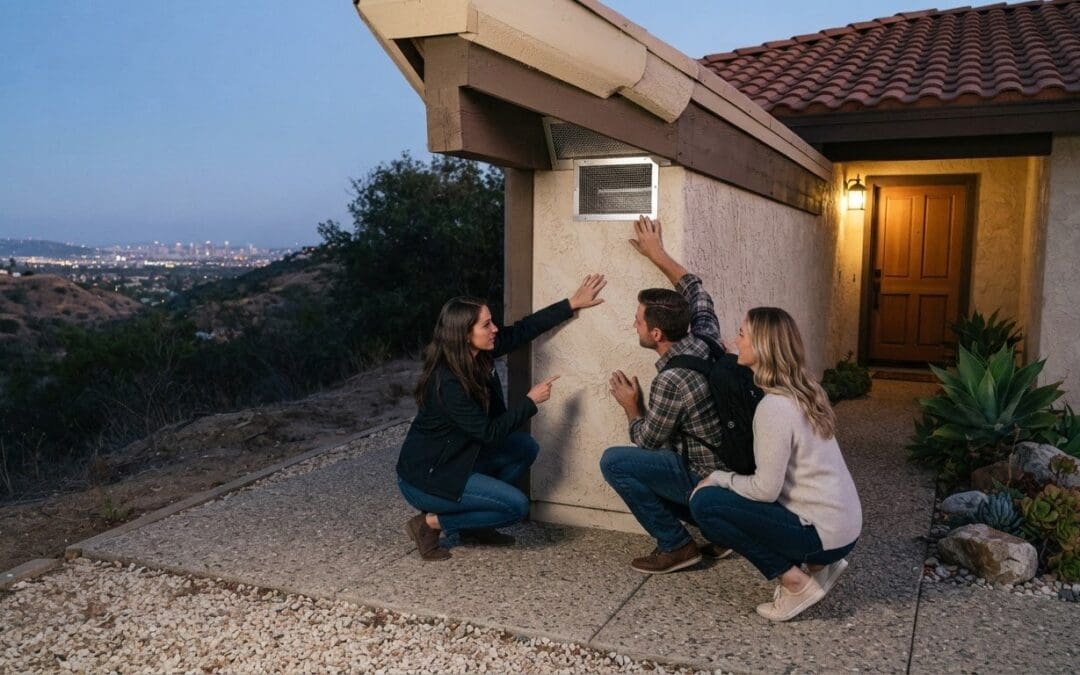
The seller’s homeowners policy is not a reliable guide to your coverage or premium. When buying a home in a high fire risk area in San Diego, the property’s hazard designation, condition, fire-protection features, and insurers’ underwriting decisions can all affect your options. The seller’s current policy does not determine what coverage you can obtain.
It’s reasonable to want a clear picture before committing to a home, especially when insurance costs and availability can affect your budget. This guide explains how fire hazard maps relate to insurance, how home-hardening improvements may affect discounts, and how wildfire risk assessments and property disclosures can inform your decision. You’ll also learn how buyer representation can help you weigh these factors during the purchase and better understand the property’s risks and requirements.
Key Takeaways
- Use the 2025 Local Responsibility Area Fire Hazard Severity Zone map as one part of your property review; a hazard designation alone doesn’t decide whether insurance is available.
- Look beyond possible mitigation discounts: insurers may weigh a home’s fire-resistant features and defensible space differently, and discounts can vary.
- Include the ember-resistant area around the home in your assessment. The City of San Diego defines Zone Zero as the area within five feet of a structure.
- Review wildfire-related disclosures alongside property and neighborhood conditions to build a clearer picture of risk before moving forward with a purchase.
Does a Fire Hazard Severity Zone map determine whether a buyer can obtain insurance?
When buying a home in a high fire risk area in San Diego, use the hazard map to understand area-level exposure, not to predict whether insurance will be approved. Insurers also assess individual property features and apply their own underwriting criteria.
Local Fire Hazard Zone Identification
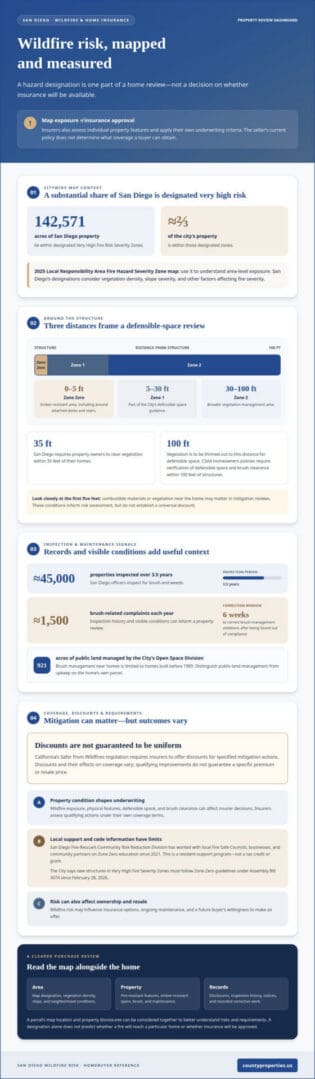
The Office of the State Fire Marshal released the updated 2025 Local Responsibility Area Fire Hazard Severity Zone map. California law requires local jurisdictions to identify very high fire hazard severity zones within their areas of responsibility. The City of San Diego bases its designations on vegetation density, slope severity, and other factors that affect fire severity. Its map helps public officials plan vegetation management and building standards to reduce fire spread and intensity. Approximately 142,571 acres of San Diego property lie within designated Very High Fire Risk Severity Zones, roughly two-thirds of the city’s property.
Reading Fire Hazard Severity Maps
A real estate professional can locate a parcel on the map and explain its designation as one part of your purchase review. Buying a home in a high fire risk area in San Diego also means considering the property’s location and physical characteristics. The map identifies area-level hazard, not whether a fire will reach a particular home. San Diego’s listed factors include vegetation density and slope severity, along with other factors that contribute to fire severity.
Wildfire Underwriting and Building Codes
A zone designation alone doesn’t determine whether homeowners can obtain insurance. CSAA homeowners policies require verification of defensible space and brush clearance within 100 feet of structures, illustrating how property conditions can also affect underwriting.
For building codes, the City of San Diego says new structures in Very High Fire Severity Zones must follow Zone Zero guidelines under Assembly Bill 3074 since February 28, 2026. Zone Zero is the area within five feet of a structure. A real estate professional can consider the designation and property disclosures together, giving you a clearer basis for evaluating the purchase.
Do home-hardening or defensible-space improvements guarantee an insurance discount?
No. California’s Safer from Wildfires regulation requires insurers to offer discounts for specified mitigation actions, but the discounts and their effects on coverage vary.
Homeowners insurance costs depend on wildfire exposure, the property’s physical features, and the insurer’s underwriting. Wildfire risk can also affect resale by influencing buyers’ insurance options, ongoing maintenance, and willingness to make an offer.
Ember-Resistant Space
When reviewing a property, examine the ember-resistant area immediately around the structure, including attached decks and stairs. The City of San Diego defines Zone Zero as the area within five feet of a structure. Combustible materials or vegetation close to the home may matter in mitigation reviews, so note how this area is maintained and whether improvements may be needed. These conditions can inform your risk assessment, but they do not determine a universal discount.
Defensible-Space Inspections
Inspections can assess brush, weeds, and vegetation near a home. San Diego officers inspect roughly 45,000 properties over 3.5 years for brush and weeds, and the city receives roughly 1,500 brush-related complaints each year. A property’s inspection history and visible conditions can therefore provide useful context during a purchase review. San Diego property owners have six weeks to correct brush-management violations after they are found out of compliance.
San Diego requires property owners to clear vegetation within 35 feet of their homes and thin vegetation out to 100 feet for defensible space. The City’s guidance places Zone 1 from 5-30 feet and Zone 2 from 30-100 feet from a structure. These areas help frame what an inspection may consider beyond the immediate five-foot zone. For buyers, the distinction matters: ember-resistant space and broader vegetation management address different distances around a home.
Improvements may help meet eligibility requirements for a mitigation discount, but they do not guarantee a specific premium or resale price. Insurers assess qualifying actions under their own coverage terms, while buyers weigh insurance availability and property upkeep as part of the purchase. Consider both the home’s condition and its defensible-space context.
Home wildfire risk assessments and resident support
San Diego Fire-Rescue’s Community Risk Reduction Division has worked with local Fire Safe Councils, businesses, and community partners on Zone Zero education since 2021. This is a resident-support program, not a tax credit or grant.
The City of San Diego’s Open Space Division manages 921 acres of public land for brush management near homes. Its brush-clearing responsibility near homes extends only to homes built before 1989. That boundary matters when assessing nearby public land and the property’s surroundings. A purchase review can distinguish public-land management from upkeep on the home’s parcel, helping clarify which conditions relate to the property itself.
Compliance records add another layer to a wildfire risk assessment. San Diego property owners have six weeks to correct brush-management violations after they are found out of compliance. Notices and related documents can show whether a concern was identified and whether corrective work was recorded. For buyers, this history provides context about maintenance and any unresolved issues that could affect plans for the property.
Disclosures also provide useful information. California Civil Code section 1102.6f addresses specified wildfire-vulnerability and retrofit disclosures for certain homes built before 2010 in high or very high fire-hazard zones. California Civil Code section 1102.19 addresses defensible-space compliance documentation or, in defined circumstances, a written buyer-seller agreement concerning later documentation. Reviewing these records helps connect a home’s stated condition with its wildfire-related requirements.
Existing home and property owners in San Diego Very High Fire Severity Zones are encouraged to meet Zone Zero guidelines by February 2027. The education work led by San Diego Fire-Rescue can help residents understand those guidelines. For a purchase, consider the intended use of the property, its disclosure documents, and any documented brush-management concerns together. This creates a clearer picture of ongoing responsibilities before you decide whether the home fits your plans.
What wildfire risks should homebuyers assess in San Diego neighborhoods?
A real estate professional should consider risks beyond a home’s mapped designation, including nearby vegetation, terrain, and property condition. San Diego’s 2007 wildfires burned 9,250 acres and 365 homes in the city, a reminder that neighborhood context deserves careful review.
For a specific purchase, assess how the parcel relates to its surroundings. A real estate professional can organize your review around features that may affect exposure and ownership decisions:
- Nearby vegetation and open space: Consider whether brush or unmanaged vegetation lies close to the property or connects it to surrounding areas.
- Terrain: Note slopes and hillsides near the home, since the City of San Diego identifies slope severity as a factor in fire severity.
- Home condition: Review visible features and property records for information relevant to wildfire vulnerability and planned improvements.
- Neighborhood context: Consider how adjacent parcels and nearby development relate to the home, rather than evaluating the structure in isolation.
These factors help distinguish area-wide hazards from property-specific concerns. For example, two homes in the same San Diego neighborhood may have different surroundings, vegetation, and maintenance histories. A real estate professional can connect available property information with your intended use and identify questions that may affect your decision. This review complements, but does not replace, an insurer’s underwriting assessment or a specialist property inspection.
San Diego’s wildfire history also makes it useful to understand a neighborhood’s relationship to open space and nearby hillsides. A real estate professional can help you consider those surroundings alongside the property’s disclosures and purchase documents, focusing on the home and its immediate context. This gives you a clearer basis for weighing wildfire exposure against other priorities, such as location and long-term plans.
Discuss your San Diego home purchase with a real estate professional who can help you evaluate the property’s neighborhood context.
County Properties
County Properties provides Buyer Representation to help you weigh wildfire-related property information during a home purchase. The team can support your review of a home’s disclosures, neighborhood context, and purchase considerations so you can make an informed decision aligned with your plans. This guidance can be especially useful when a hazard designation, insurance concern, or property condition raises questions about whether a home fits your priorities.
Bring your questions about a specific property and the factors shaping your decision. County Properties can guide you through the real estate transaction while keeping your goals central. Insurance underwriting and technical property assessments remain separate considerations.
Contact County Properties to discuss your home purchase.
Make Your Next Move With a Clear Plan
Buying a home in a high fire risk area in San Diego calls for a decision that fits both the property and your long-term plans. Before moving forward, consider how wildfire-related information affects your priorities, which questions remain, and how the home fits the way you intend to live. A thoughtful purchase is not about eliminating every uncertainty. It’s about understanding the trade-offs and choosing your next step carefully.
County Properties supports clients through changing real estate decisions with Buyer Representation, Seller Representation, and Short Sale and Foreclosure Prevention. If your home search includes a fire-risk property, the team can guide you through the transaction while you assess your options and keep your goals in view.
Contact County Properties about your home search, and take the next step with a clearer plan.
Frequently Asked Questions
Can a buyer rely on the seller’s existing homeowners policy or premium?
No. The seller’s policy and premium reflect the seller’s circumstances and do not establish what an insurer will offer a new owner. Underwriting may consider the home’s condition, brush clearance, roof, and fire exposure. Treat the existing policy as background information, not as a substitute for coverage terms and pricing based on you and the specific property.
Does a Natural Hazard Disclosure Statement replace a property inspection or insurance quote?
No. A Natural Hazard Disclosure Statement and a property inspection serve different purposes. The disclosure provides hazard-related information, while an inspection evaluates the home’s physical condition. Neither document establishes what coverage an insurer will offer or the premium. For example, a disclosure may inform your questions about a property, while an inspection can identify conditions that affect repair planning.
Does a property outside a mapped high or very high zone have guaranteed insurance availability?
No. A location outside a mapped high or very high fire zone does not guarantee that an insurer will offer coverage. A map is one part of assessing area-level hazard; underwriting may also consider the structure, nearby vegetation, and property condition. The home’s precise surroundings and the insurer’s criteria still matter, so a lower mapped designation does not guarantee coverage availability.
Is a California FAIR Plan policy the same as a traditional homeowners policy?
No. Don’t assume a California FAIR Plan policy provides the same coverage as a traditional homeowners policy. Compare the policy’s covered risks, limits, exclusions, and any separate coverage your situation may require. Review how the limit relates to the home’s value and your coverage needs.
When should a San Diego buyer begin the insurance review?
Begin early in the home-purchase process, as soon as you have a specific property in mind. An early review gives you time to understand potential coverage terms and how the property’s characteristics may affect underwriting before the decision becomes urgent. For example, a roof condition or vegetation concern may need further consideration alongside the purchase timeline.
How can a real estate professional check whether a San Diego home is in a high fire hazard severity zone?
A real estate professional can locate the property on the 2025 Local Responsibility Area Fire Hazard Severity Zone map and review its mapped designation. The City of San Diego identifies very high zones using factors including vegetation density and slope severity. For a purchase, the professional can connect the parcel’s map information with the property’s disclosures and neighborhood context.