

You’ve likely typed it into a dozen different websites: how much is my home worth? Each time, you get a different, often confusing number. Relying on these instant estimators can feel like a gamble, leaving you worried about undervaluing your most significant asset or overpricing it and watching it sit on the market for months. It’s a frustrating position for any homeowner preparing for the next step in their life’s journey, and you deserve clarity you can count on.
Finding the right professional is a critical step in this process. A dedicated Real Estate Brokerage for Sellers will have the necessary access to data, tools, and local expertise to provide an accurate and strategic valuation that goes beyond any automated estimate.
For a decision this important, you need more than an algorithm’s guess-you need an expert’s guidance. As your trusted real estate partner, we’re here to pull back the curtain on the valuation process. This guide is our commitment to empowering you with the same proven methods professionals use to determine a home’s true market value. We will walk you through the crucial factors that define your property’s price, from location to recent sales, so you can gain a realistic estimate and the confidence to make informed decisions for a successful future.
Key Takeaways
- Learn why instant online home value estimators are a helpful starting point but can’t provide the complete, nuanced picture of your home’s true worth.
- Discover the professional’s method-the Comparative Market Analysis (CMA)-and understand how experts use it to pinpoint a competitive and accurate listing price.
- Go beyond the basics to see how location, condition, recent upgrades, and current market dynamics all factor into the final answer of “how much is my home worth.”
- Gain clarity on the crucial differences between market value, assessed value, and appraised value to avoid common and costly misunderstandings.
The Starting Point: Understanding Online Home Value Estimators
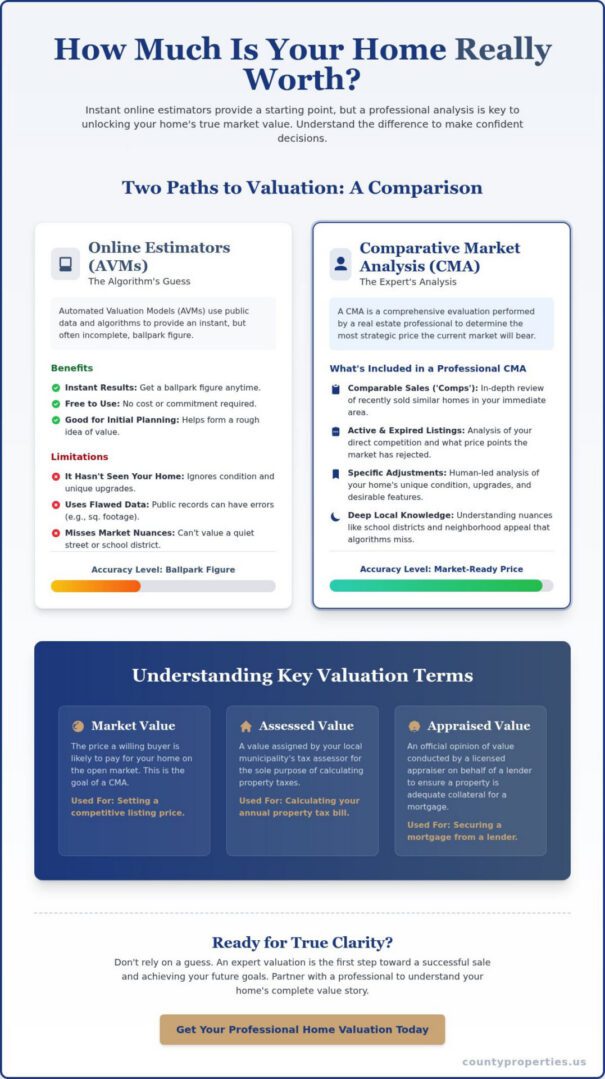
For most homeowners, the journey to understanding their property’s value begins with a simple online search for “how much is my home worth?” Instantly, you’re presented with free, immediate estimates from various popular real estate websites. These platforms use powerful tools known as Automated Valuation Models (AVMs), which are complex algorithms that analyze public records, tax data, and recent sales in your area to generate a value estimate in seconds.
While incredibly convenient, it’s vital to view these numbers for what they are: a preliminary, computer-generated ballpark figure. They serve as an excellent first step to gauge the market, but they are not a substitute for a comprehensive, expert valuation. Think of an AVM as a helpful starting point, not the definitive price tag for your most significant asset.
The Benefits of a Quick Online Estimate
There’s a reason AVMs are so popular; they offer clear advantages for homeowners at the beginning of their selling journey:
- Instant Results: Get a ballpark figure anytime, day or night, without having to speak with anyone.
- Completely Free to Use: There is no cost or commitment required to satisfy your initial curiosity about your home’s potential value.
- Helpful for Initial Planning: These estimates can provide a rough idea that helps you begin thinking about your financial future and potential next steps.
- Tracking General Market Trends: Watching your online estimate fluctuate over months or years can give you a general sense of your local market’s trajectory.
Why AVMs Fall Short: Common Inaccuracies
The convenience of AVMs comes at the cost of accuracy. An algorithm, no matter how sophisticated, cannot grasp the full picture of your property. Here are the most significant limitations:
- They Haven’t Seen Your Home: An AVM is blind to your home’s actual condition. It doesn’t know about your brand-new kitchen, the pristine hardwood floors you installed, or the fact that your roof needs replacing.
- Data Can Be Flawed: These systems pull from public records, which can contain errors. Incorrect square footage, an outdated bedroom count, or a misclassified property type can drastically skew the final estimate.
- Algorithms Miss Market Nuances: A computer can’t understand why homes on one side of the street sell for more, the value of a quiet cul-de-sac, or the premium associated with a specific school district.
- An Estimate Is Not an Appraisal: This is the most critical distinction. An online estimate or any other AVM value is an opinion, not a professional valuation. Lenders will never use an online estimate for a mortgage; they require a formal real estate appraisal conducted by a licensed human expert.
The Professional Standard: The Comparative Market Analysis (CMA)
While online calculators offer a convenient starting point, the professional standard for determining your home’s value is the Comparative Market Analysis, or CMA. This isn’t just a number generated by an algorithm; it’s an in-depth evaluation performed by a seasoned real estate professional. It is the primary tool agents use to provide expert guidance on a listing price. The goal of a CMA is not just to answer the question, “how much is my home worth?” but to find the highest, most strategic price the current market will bear. Think of it as a comprehensive service designed to position your home for success.
What Goes Into a Professional CMA?
A thorough CMA synthesizes multiple data streams to create a complete picture of your home’s market position. A trusted agent doesn’t just look at one factor; they conduct a holistic analysis that includes:
- Comparable Sales (‘Comps’): An in-depth review of similar homes in your immediate area that have recently sold. This forms the baseline for your home’s value.
- Active Listings: An evaluation of homes currently for sale in your neighborhood. This is your direct competition, and their pricing influences your strategy.
- Expired Listings: An analysis of homes that failed to sell. This provides crucial insight into pricing thresholds the local market has rejected.
- Specific Adjustments: Factoring in your home’s unique condition, recent upgrades (like a new kitchen or roof), and desirable features that set it apart.
Why a CMA is More Accurate Than an Online Estimate
An algorithm can’t walk through your front door. The key advantage of a CMA lies in its human-led analysis. An experienced agent conducts a physical or visual inspection, leveraging deep local market knowledge to see what a computer can’t. They understand the subtle nuances-like the value of a specific school district, the appeal of a quiet cul-de-sac, or the impact of a dated floor plan. An agent considers the unique factors that determine a home’s value with a level of detail that automated tools miss. The result is a strategic pricing recommendation, not just a raw data point.
Who Can Prepare a CMA for You?
A CMA must be prepared by a licensed real estate agent or broker who has access to the Multiple Listing Service (MLS) and the expertise to interpret its data correctly. For the most insightful analysis, seek out a local agent with a proven track record in your community. Their firsthand experience with neighborhood trends provides an invaluable layer of accuracy. If you’re ready to take the next step in your home-selling journey, our team provides complimentary, no-obligation market analyses for homeowners.
Key Factors That Determine Your Home’s Worth
Determining your home’s value is a comprehensive process, not a simple calculation. A property’s final worth is a dynamic blend of tangible features and intangible market forces. When you ask, “how much is my home worth?”, it’s essential to understand that appraisers and savvy buyers look at a holistic picture. Understanding the methods experts use to determine your home’s value involves weighing these key components together, as each one plays a crucial role in the final number.
Location, Location, Location
The oldest saying in real estate remains the most important truth. A home’s value is fundamentally tied to its location. This includes the reputation of the neighborhood and the quality of the local school district-a major driver for many families in Southern California. Proximity to desirable amenities like parks, beaches, shopping centers, and major transportation routes also adds significant value. Even the specific placement of the lot, such as a quiet cul-de-sac versus a corner on a busy street, can have a substantial impact.
Property Characteristics
The physical attributes of your home form the foundation of its value. Appraisers and buyers will analyze these core features to compare your property to others in the area:
- Size and Layout: This includes the total square footage, the number of bedrooms and bathrooms, and the functionality of the floor plan (e.g., an open-concept living area is often more desirable).
- Lot and Outdoor Features: The usable size of your lot, the quality of landscaping, and the presence of features like a swimming pool, patio, or outdoor kitchen are especially valuable in the Southern California climate.
- Age and Condition: A well-maintained newer home will typically command a higher price than an older home in need of significant repairs. The overall condition is a direct reflection of its value.
Recent Upgrades and Updates
Thoughtful improvements can significantly boost your home’s worth. High-return-on-investment (ROI) projects include renovated kitchens and bathrooms, which are focal points for most buyers. Newer systems, such as an updated HVAC, a recent roof replacement, or energy-efficient windows, provide peace of mind and add measurable value. It’s important to distinguish these upgrades from personal cosmetic choices, which may not offer the same financial return.
Current Market Conditions
Your home’s value is also subject to the economic environment. In a “seller’s market,” where buyer demand is high and inventory is low, prices tend to rise. Conversely, in a “buyer’s market,” with more homes for sale than active buyers, prices can soften. Broader economic trends, such as prevailing mortgage interest rates, directly affect a buyer’s purchasing power and, consequently, the price they are willing to pay for your home.
Market Value vs. Assessed Value vs. Appraised Value
When you start asking, “how much is my home worth?“, you’ll quickly discover that the word “value” can mean different things in different contexts. This is a common point of confusion for homeowners, but understanding the distinction is crucial for making informed financial decisions. The number on your property tax bill is rarely the same as the price a buyer would offer. Let’s clarify the three primary types of home value.
Market Value: What a Buyer is Willing to Pay
This is the number that matters most when you’re selling. Market Value is the estimated price your property would likely sell for on the open market in a competitive transaction. It’s not a fixed number but a dynamic figure influenced by current supply and demand, the condition of your home, and-most importantly-the recent sale prices of similar, nearby properties (known as “comps”). This is the value we focus on to price your home correctly for a successful sale.
Assessed Value: For Tax Purposes Only
Your local municipality’s tax assessor determines your home’s Assessed Value solely for calculating property taxes. This figure is often a percentage of the market value and is calculated using a mass appraisal formula that may not be updated annually. Because its purpose is taxation, not sale, the assessed value on your tax statement is almost never an accurate reflection of what your home would sell for today.
Appraised Value: A Lender’s Perspective
An Appraised Value is a professional opinion of value provided by a licensed appraiser, typically on behalf of a mortgage lender. When a buyer needs a loan, the lender requires an appraisal to ensure their investment is protected-they won’t lend more money than the home is worth. While an appraiser uses methods similar to a real estate agent’s market analysis, their final report is a formal, legally defensible valuation for the lending institution.
| Type of Value | Primary Purpose | Determined By |
|---|---|---|
| Market Value | To determine a likely sale price | Real estate agents, buyers, and sellers using market data & comps |
| Assessed Value | To calculate property taxes | Local government tax assessor using a mass appraisal formula |
| Appraised Value | To secure a mortgage for a buyer | A state-licensed appraiser hired by a lender |
Understanding these key differences empowers you on your real estate journey. While each value serves a purpose, only the market value truly answers the question of how much your home is worth to potential buyers. For a comprehensive market analysis from a trusted partner, contact the experts at County Properties.
How to Get the Most Accurate Home Valuation
You’ve explored online estimators and reviewed market trends, but the ultimate answer to the question, “how much is my home worth?” requires a blend of technology, data, and irreplaceable human expertise. This final stage of your valuation journey is about moving from a general estimate to a confident, market-ready price. Following this clear, three-step path will provide the guidance and clarity you need to understand your home’s true market value.
Step 1: Start with Online Research
Automated Valuation Models (AVMs) and online estimators are an excellent starting point for a ballpark figure. To add context, use real estate portals to look up homes that have recently sold in your immediate neighborhood. As you review these “comps,” make a list of any significant differences between them and your property, such as:
- Major renovations (e.g., an updated kitchen or a finished basement)
- Lot size, landscaping, or exterior features like a pool
- The overall condition and curb appeal
Step 2: Objectively Assess Your Home’s Condition
Now, take an honest look at your own property through the eyes of a potential buyer. Create a simple list of recent upgrades that add value (like a new roof or energy-efficient windows) alongside any necessary repairs (like a leaky faucet or scuffed walls). A home’s first impression is powerful, so don’t forget to consider its curb appeal. This objective assessment helps you understand the factors an expert will consider during a professional evaluation.
Step 3: Partner with a Local Real Estate Expert
This is the final and most crucial step. While data provides a foundation, only a seasoned real estate professional can interpret it within the unique context of your local market. A trusted expert understands the nuances of your specific neighborhood, knows what today’s buyers are looking for, and can accurately price your home’s unique features. They will provide a detailed Comparative Market Analysis (CMA) that goes far beyond any online estimate, forming the basis of a strategic pricing plan to help you achieve your goals.
This professional guidance is the key to transforming your research into a successful sale. Ready for a true expert valuation? Contact County Properties today.
From Estimate to Certainty: Your Home’s True Value
Understanding your home’s value is a journey that begins with online tools but finds its true destination in expert analysis. As we’ve explored, while instant estimators offer a helpful baseline, a professional Comparative Market Analysis (CMA) provides the nuanced, accurate picture you need. Ultimately, answering the question ‘how much is my home worth‘ requires a deep understanding of local market dynamics, your property’s unique features, and the crucial differences between market, assessed, and appraised values.
Ready to move beyond the guesswork and get a clear, actionable number? The best way forward is to partner with a trusted expert. At County Properties, our service-centric team is committed to your success. With over 36 years of specialized experience in the Southern California and San Diego markets, we provide the guidance you can count on. Request Your Free, Personalized Home Valuation from a Local Expert and get the clarity you deserve.
Take this important next step on your real estate journey with confidence.
Frequently Asked Questions About Home Valuation
What is the difference between a home value estimate and a home appraisal?
A home value estimate, like a Zestimate, is an automated calculation using public data and algorithms. It serves as a helpful starting point. A home appraisal, however, is a formal, in-depth valuation conducted in person by a licensed appraiser. Lenders require appraisals to secure a mortgage because they provide a legally defensible and highly detailed assessment of your property’s true condition, features, and location, ensuring the loan amount is justified by the home’s actual worth.
How often does my home’s value change?
Your home’s value is dynamic and can change daily with the real estate market. Factors like shifts in mortgage interest rates, recent sales of similar homes in your neighborhood (known as “comps”), local housing inventory, and even the time of year can all influence its current value. Because the market is constantly in flux, the value you see today might be different next week, which is why receiving up-to-date guidance from a professional is so important.
Do all home improvements and renovations increase my property value?
Not all renovations provide a dollar-for-dollar return on your investment. Projects with broad appeal, such as a modern kitchen or an updated primary bathroom, typically add significant value. However, highly personalized upgrades like a swimming pool or a high-end home theater may not appeal to all buyers and often recoup a smaller percentage of their cost. For the best return, it’s wise to focus on improvements that enhance functionality, curb appeal, and align with current market desires.
Why is my Zestimate different from the price my real estate agent recommended?
A Zestimate is a computer-generated figure that cannot see your recent kitchen remodel, the condition of your roof, or the unique charm of your property. A trusted real estate agent provides a Comparative Market Analysis (CMA) based on an in-person assessment, deep local market knowledge, and an understanding of what current buyers are willing to pay. An agent’s recommendation reflects the real-world, nuanced value of your specific home, not just an algorithm.
Can I determine my home’s value without a real estate agent?
You can get a preliminary idea by using online valuation tools and researching recent sales of comparable homes. This is a useful first step when asking, “how much is my home worth?” However, this approach lacks the expert analysis of a seasoned professional. An agent provides a comprehensive market analysis, interprets the data in the context of current trends, and offers strategic pricing guidance that automated tools and individual research simply cannot replicate for maximum accuracy.
How long does a professional home valuation (CMA) take?
The process for a professional Comparative Market Analysis (CMA) is quite efficient. The initial in-person walkthrough of your home with one of our expert agents usually takes only 30 to 60 minutes. Following the visit, your agent will conduct in-depth research on comparable properties and analyze current market data. You can typically expect to receive the complete, detailed CMA report and our pricing recommendation within 24 to 48 hours, giving you a clear, expert-backed valuation.