
A few extra weeks in your San Diego home can create more than a moving cushion. The risks of a seller rent-back agreement in San Diego often come from unclear costs, responsibilities, or move-out terms. In California, a seller-in-possession arrangement can cover stays of 29 days or less; a stay of 30 days or more is treated as a landlord-tenant relationship.
It makes sense to want time to coordinate your next move after closing, especially when a new home isn’t ready. A written agreement can set expectations, but the length of the stay may also affect the buyer’s loan terms: an owner-occupied mortgage may expect the buyer to move in within 60 days. This guide explains how rent-backs work, which costs and duties to spell out, and how clear terms can help reduce surprises for both sides.
Key Takeaways
- Understand how a seller’s post-closing stay can change the relationship between buyer and seller.
- Identify the occupancy costs and property responsibilities that deserve clear written terms.
- See how move-out dates, repairs, and access rules can prevent avoidable disputes.
- Learn how County Properties’ Seller Representation can help you navigate the sale and coordinate terms around your transition.
What is a rent-back agreement?
A seller rent-back agreement lets you stay in your home after closing under written occupancy terms. The length of the stay can affect both parties’ responsibilities and the buyer’s mortgage conditions.
Post-Closing Seller Occupancy
Post-closing occupancy gives a seller a defined period to stay after ownership transfers. It can help when construction on a new home is delayed, a move spans states, or the next housing arrangement is not ready. Unlike delaying closing, a rent-back transfers ownership on schedule; unlike a short-term rental, it lets you remain in your former home. The contract should state the move-out date and occupancy terms. A separate tax point may also matter: according to the Internal Revenue Service, the IRC §121 capital-gains exclusion for a primary residence is $250,000 for a single filer and $500,000 for married taxpayers filing jointly. A homeowner generally must have lived there as a primary residence for at least 2 years of the last 5 years to qualify.
Occupancy Duration and Lender Rules
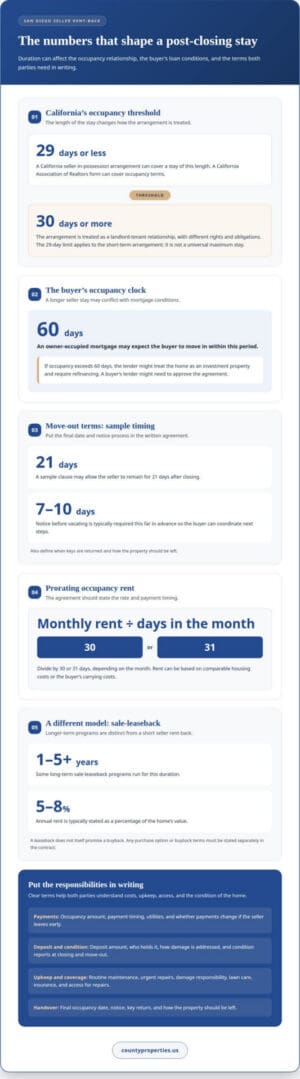
Occupancy duration is the agreed period the seller stays after closing, often 30-60 days. The 60-day issue matters because an owner-occupied mortgage may expect the buyer to move into the home within 60 days. A buyer’s lender might need to approve the contract, and a longer stay could conflict with loan conditions. If occupancy exceeds 60 days, the lender might treat the home as an investment property and require refinancing. That can affect financing, so the parties should settle the duration before closing.
California Occupancy Obligations
California occupancy agreements define whether the seller remains under a short-term seller-in-possession arrangement or a landlord-tenant relationship. For 29 days or less, a California Association of Realtors form can cover occupancy terms. At 30 days or more, the arrangement is treated as a landlord-tenant relationship, with different rights and obligations. That is the California 29-day limit: it applies to the short-term occupancy arrangement, not as a universal maximum stay. The contract should clearly set the period, payment, and move-out terms; an informal understanding leaves the parties without clear written expectations.
Rent, deposits, utilities, maintenance, and insurance
Rent-back costs go beyond the occupancy payment. Buyers and sellers should put responsibility for property expenses, upkeep, and insurance in writing.
Security Deposits and Escrow
A security deposit gives the buyer recourse if the home is damaged or left in materially worse condition. California seller-in-possession paperwork provides for a deposit, typically held by the title company. Deposits may also be held in escrow or by the new owner. The agreement should state the amount, who holds it, and how damage will be addressed. Clear terms help both parties understand how the deposit relates to the home’s condition.
Property Condition and Maintenance
Maintenance terms assign responsibility for caring for the home during the seller’s occupancy. The buyer owns the property but may have limited control, creating risks such as damage, deferred maintenance, neglected landscaping, or move-out damage. The agreement can specify who handles routine upkeep and who pays for damage beyond ordinary use. A condition report at closing and move-out gives both parties a shared reference point, especially if the deposit may be used to address damage.
Rent can be based on comparable housing costs or the buyer’s carrying costs. Prorate monthly rent by dividing it by 30 or 31 days, depending on the month. Put the rate and payment timing in the contract.
Specify who pays utilities, handles routine maintenance, and maintains insurance during the occupancy period. A seller’s homeowners insurance might not cover the seller during a rent-back, so renters insurance may be needed. Set expectations for lawn care and repairs, too. School schedules or a delayed move can shape the seller’s housing needs, but they don’t clarify who pays each bill. For support coordinating the sale and occupancy terms, explore seller representation guidance.
Agreement terms for rent, utilities, repairs, and move-out
A written addendum turns an occupancy understanding into defined contract terms. It should cover payments, upkeep, access, and the seller’s final move-out obligations.
Rent and Utility Terms
Rent and utility terms specify what the seller pays while continuing to occupy the home. State the rental amount, payment schedule, and which utilities remain in the seller’s name. For a financed purchase, sellers customarily pay the buyer’s daily principal, interest, taxes, and insurance during occupancy. The agreement should also clarify whether payments change if the seller leaves early. These details help both parties plan costs without relying on verbal assumptions.
A sale-leaseback is a different arrangement: the owner sells the property, then leases it back. Some long-term programs run 1-5+ years, with annual rent typically equal to 5-8% of the home’s value. A leaseback does not itself promise a buyback. Any purchase option or buyback terms must be clearly stated as separate contract provisions.
Repair Responsibilities
Repair terms assign responsibility for damage and upkeep during the seller’s stay. Specify who handles routine maintenance, urgent repairs, and damage caused by occupants. Documenting the home’s condition at closing can help distinguish existing issues from new damage. The agreement should also explain how to report repairs and arrange access. Without these details, buyers may face deferred maintenance, while sellers may be unsure which work they are responsible for.
Move-Out Timelines and Terms
Move-out terms establish the final occupancy date and the process for returning possession. A sample clause may allow the seller to remain for 21 days after closing. The agreement can also require notice, typically 7 to 10 days before vacating, so the buyer can coordinate next steps. Define when keys are returned and how the property should be left. This precision matters if moving plans shift or the seller’s next housing arrangement changes.
Tie the proposed stay to the seller’s actual transition needs rather than relying on an open-ended extension. If a new home is delayed, the parties can agree to a defined period and document any permitted change in writing. Buyers can plan for possession, and sellers know the deadline and their responsibilities.
Reducing rent-back agreement risks
To reduce the risks of a seller rent back agreement in San Diego, connect the occupancy plan to financing, possession, and the seller’s moving timeline. Put responsibilities in writing before closing instead of leaving important details to later conversations.
Use a focused review to identify gaps before signing:
- Set the move-out date and require written agreement for any extension.
- Record rent, payment timing, utilities, maintenance, and responsibility for damage.
- Describe the deposit, who holds it, and how property-condition concerns are handled.
- Clarify access, notice, and insurance responsibilities during occupancy.
- Align the proposed stay with the buyer’s lender and mortgage conditions.
Consider how a delayed move could affect the transaction. An owner-occupied mortgage may expect the buyer to move in within 60 days, while a stay longer than 90 days may trigger tax implications or mortgage complications. If the seller’s next home is not ready, negotiate a defined end date and a written process for changes. That gives both parties a clear basis for planning instead of relying on an open-ended expectation.
Paperwork matters, too. California rent-back forms can differ on whether the new owner may show the home to prospective buyers or tenants. California Association of Realtors rent-back paperwork includes that access right, unlike the PRDS form. Before signing, understand how the agreement addresses access, privacy, and future plans. Resolving these terms alongside escrow and possession planning helps manage the risks of a seller rent back agreement in San Diego.
Clear terms help prevent avoidable disputes, though they cannot remove every uncertainty. If you’re preparing for a sale involving post-closing occupancy, plan your seller transition with the timeline and agreement terms in view.
County Properties: Seller Representation
County Properties helps sellers plan a home sale through Seller Representation, including post-closing occupancy decisions and transition timing. Raise rent-back terms early so the proposed stay, move-out plan, and sale timeline can be considered together.
If you’re buying instead, County Properties’ Buyer Representation can help you assess how a seller’s requested stay fits your purchase. The team also supports Short Sale and Foreclosure Prevention and Senior Real Estate Transition, which may be relevant when financial pressure or a major life change shapes your next move. The right real estate path depends on your circumstances and goals.
Contact County Properties to discuss your sale and transition plans.
Plan Your Sale Around the Transition Ahead
A home sale also changes where and how you’ll live next. Before choosing a closing date, consider how the move fits your next housing arrangement, family commitments, and financial priorities. This broader view can help you decide whether staying after closing supports your plans or adds complexity. Managing the risks of a seller rent-back agreement in San Diego starts with treating occupancy as part of your overall transition, not as an isolated contract detail.
County Properties can help you consider your real estate options in light of your goals, whether you’re selling, buying, or facing financial pressure around a sale. Bring your priorities and timeline to the conversation to shape a manageable path forward.
Contact County Properties to discuss your options, and take the next step with a clearer view of your transition.
Frequently Asked Questions
Seller rent back after close of escrow: what do you need to know?
A seller rent-back allows you to remain in the home after escrow closes under agreed occupancy terms. Treat it as a distinct part of the transaction, not an informal extension of the sale. Before closing, align the possession date, payment start, insurance arrangements, and key return with the written agreement. This helps prevent conflicting assumptions during the handoff.
What are the key issues for the rent back?
The key issues are the seller’s move-out date, payment terms, property care, insurance, and the buyer’s loan conditions. Ask whether both parties can explain who handles an unexpected leak, who pays utilities, and how the home’s condition will be assessed at move-out. If their answers differ, clarify the agreement before closing.
How long can a seller stay after closing in California?
There is no single maximum stay that applies to every California rent-back. A seller-in-possession arrangement can cover 29 days or less, while stays of 30 days or more are treated as a landlord-tenant relationship. Many rent-backs run 30-60 days, but the buyer’s mortgage conditions matter: an owner-occupied loan may expect the buyer to move in within 60 days.
What are the California rules for seller occupancy after a home sale?
California’s occupancy paperwork and the length of the stay shape the parties’ relationship. For a stay of 29 days or less, a seller-in-possession form can set occupancy terms; at 30 days or more, the arrangement is treated as a landlord-tenant relationship. The agreement should reflect the actual stay and clarify obligations. The paperwork does not replace lender requirements.
What insurance coverage is needed during a seller rent-back in San Diego?
The seller’s existing homeowners insurance might not cover them during the rent-back, so renters insurance may be needed. Buyers and sellers should address coverage for the occupancy period in writing, including who is responsible for maintaining applicable property coverage. For example, a seller who assumes their existing policy automatically protects them after closing could face a coverage gap.
Who is responsible for repairs, utilities, and property damage during a rent-back?
The written agreement should assign responsibilities because ownership transfers to the buyer while the seller remains in possession. Specify who pays utilities, handles routine upkeep, reports urgent repairs, and addresses damage during occupancy. A condition record at move-in and a comparable review at move-out can help distinguish pre-existing wear from new damage and clarify how the security deposit applies.