

Yes, you can apply for a mortgage without your spouse in California, and the lender may evaluate your income and credit on their own. But buying a house as a married couple in California involves more than choosing whose name goes on the loan: property acquired during marriage is generally community property under Family Code section 760, and some loans require a spouse to sign certain documents even when they aren’t on the title.
It’s understandable to assume that one spouse’s mortgage application, the names on the deed, and the couple’s ownership rights all line up. They may not. Applying together can bring both incomes into a lender’s assessment, but the spouse with the lower credit score may affect eligibility. The title you choose also shapes how ownership is shared and what happens to each spouse’s interest.
This guide explains when an individual mortgage may work, how a joint application can affect qualification, and how California ownership options differ, including community property and tenancy in common. You’ll have a clearer picture of the decisions to discuss as you plan your purchase.
Key Takeaways
- You may qualify for a mortgage on your own, but California’s community-property rules can affect the application and ownership decisions.
- Compare individual and joint applications to understand how income, debt, and credit scores may shape mortgage eligibility.
- Choose how to hold title deliberately: tenancy in common can allow unequal ownership shares, while other forms of ownership handle inheritance differently.
- Review both spouses’ finances and future plans before deciding what mortgage and ownership arrangement fits your household.
Can spouses buy property separately?
Yes. A spouse may seek a mortgage individually and take title as sole and separate property, but California’s community-property rules still matter. When buying a house as a married couple in California, the loan, deed, and source of funds can affect different rights.
Community Property and Separate Vesting
Property acquired during marriage is generally community property under California Family Code section 760, while sole-and-separate vesting places ownership in one spouse. Community property with right of survivorship transfers the deceased spouse’s interest to the surviving spouse and gives the entire property a basis step-up at the first spouse’s death. It avoids probate and reassessment only when purchase funds are truly community property. A spouse buying as sole and separate may have the other spouse sign a quitclaim deed at closing. Proposition 13 matters because joint tenancy may trigger property-tax reassessment. Budget for property taxes and possible supplemental assessments when weighing title choices.
Separating Mortgage Borrowers from Title Owners
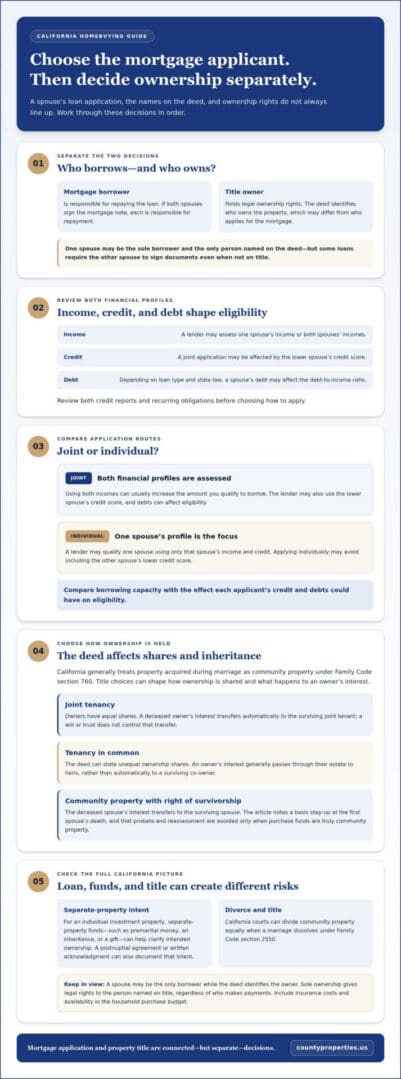
A mortgage borrower is responsible for repaying the loan; a title owner holds legal ownership rights. One spouse may be the sole borrower and the only person named on the deed, but some loans require the other spouse to sign documents even when not on title. With sole ownership, the person named on the title holds the property’s legal rights, regardless of who makes payments. Insurance costs and availability also affect affordability, so include coverage in your household purchase budget. Depending on the loan type and state law, a lender may consider a spouse’s income or debt.
Legal and Financial Risks for Married Buyers
Title, funds, and loan responsibility can create different risks during ownership, a sale, or divorce. California courts can divide community property equally when a marriage dissolves under Family Code section 2550. For an individual investment property, using separate-property funds, such as premarital money, an inheritance, or a gift, helps clarify the intended ownership. A postnuptial agreement or written acknowledgment can also document that intent. California first-time homebuyer programs may offer assistance to eligible buyers, with eligibility shaped by each program’s rules and household finances.
Investment-property financing also differs from a primary-home mortgage. As of August 2026, a conventional single-unit investment-property purchase may require at least a 15% down payment; 20% to 25% is more common. Rates are higher than for primary residences, so include both the down payment and borrowing cost when assessing whether the property fits your plans. For buyers exploring structured financing options, specialized advisory firms like Mortgage Suite Ltd illustrate how professional guidance can assist with residential investment property loans and home loan solutions.
How joint applications affect credit and mortgage eligibility
When buying a house as a married couple in California, choosing who applies can affect borrowing capacity. A joint application combines both financial profiles, while an individual application focuses on one spouse. The mortgage decision and the choice of how to hold title are separate decisions.
Joint and Individual Mortgage Applications
A joint application asks the lender to assess both spouses as mortgage applicants; an individual application focuses on one. Using both incomes can usually increase the amount you qualify to borrow, but the lender may use the lower spouse’s credit score. Applying individually may avoid including the other spouse’s lower score. Compare potential borrowing capacity with the effect each applicant’s credit and debts could have on eligibility. This can help you choose an approach that fits your household’s financial profile.
Income, Credit, and Debt Evaluation
California mortgage lenders evaluate applicants’ income, credit, and debts to assess eligibility and repayment capacity. A lender may qualify one spouse using only that spouse’s income and credit, while a joint application brings both financial profiles into consideration. Depending on loan type and state law, a spouse’s debt can affect the couple’s debt-to-income ratio. Review both credit reports and recurring obligations before applying. These details help you understand how buying a house as a married couple in California may fit your finances.
Mortgage borrowers and real estate owners can be different people. One spouse may be the only borrower, while the deed identifies who holds ownership. If both spouses sign the mortgage note, each is responsible for repayment. Keep this distinction in mind as you consider the loan and deed together.
Title also determines how assets transfer. Joint tenancy gives owners equal shares and transfers a deceased owner’s interest automatically to the surviving joint tenant. A will or trust doesn’t control that transfer. Tenancy in common can allow unequal shares stated in the deed, with an owner’s interest passing through their estate. If your plans shift toward buying without financing, cash offer facilitation may fit that path.
Tenancy in common and unequal ownership shares
Tenancy in common lets co-owners hold separate interests in the same property, including unequal shares. The deed and any co-ownership agreement shape how those interests work during ownership and afterward.
Tenancy-in-Common Ownership Interests
California generally presumes people who purchase property together are tenants in common unless they state otherwise, under Civil Code section 686. Each owner holds an individual interest in the property, rather than an automatic right to inherit another owner’s share. When a tenant in common dies, that interest generally passes through probate to the owner’s heirs, not automatically to a surviving co-owner. This distinction matters for estate planning.
Unequal Ownership Shares
Tenants in common can hold unequal ownership shares, and the deed can specify each owner’s interest. For example, spouses may document different shares if one contributes separate funds or takes on different agreed responsibilities. Shares don’t necessarily determine who can use each room: California tenants in common generally have equal possession rights unless they agree otherwise. An owner may also encumber their individual interest without the other co-owner’s consent, so discuss that possibility before taking title.
Co-Ownership Agreements and Marvin Agreements
A co-ownership agreement records how owners will manage expenses, mortgage payments, utilities, changes in value, and a sale or separation. For unmarried cohabiting partners, California courts recognize express or implied agreements under Marvin v. Marvin; cohabitation is required for a Marvin agreement’s enforcement under Bergen v. Wood. Put the ownership arrangement and expectations in writing, and include estate-planning intentions in the discussion.
Marriage adds another consideration: California courts can divide community property equally when a marriage dissolves under Family Code section 2550. A deed showing unequal tenancy-in-common shares doesn’t by itself explain how separate contributions or community funds should be treated in a divorce. Keep records of contributions and payments, and discuss how the borrower’s obligations relate to each owner’s interest before signing.
Mortgage readiness and homebuying considerations
Mortgage readiness means understanding what your household can borrow and sustain. A lender weighs income, credit, debts, work history, and the property’s intended use.
Financial Readiness and Mortgage Qualification
Before applying, review both spouses’ credit scores, income, debts, and financial history. A lender assesses applicants’ ability to repay, and an applicant with less than two years of work history could affect a joint application’s chances of preferred terms and rates. Mortgage preapproval helps estimate affordability and show sellers you’re serious. Keep income and debt records organized for the application.
Debt-to-Income Ratio and Affordability
Debt-to-income ratio compares debt payments with income to help a lender evaluate monthly repayment capacity. Depending on loan type and state law, a spouse’s substantial debt can lower mortgage eligibility even if that spouse isn’t applying. Consider the full household budget, including existing payments and future plans. Moving, changing careers, or relying on one income can affect how comfortably you manage the mortgage.
Down Payments, Closing Costs, and Purchase Documents
Down payments and closing costs depend on the loan and transaction. For a conventional single-unit investment property, the down payment may be at least 15%; 20% to 25% is more common, as of August 2026. A lender can outline the funds needed for your specific purchase. For a typical purchase, the process includes preapproval, an offer and purchase agreement, lender underwriting, and closing documents. Organize records supporting income, debts, and funds for the purchase. Additionally, buyers aiming to keep financing requirements manageable can track regional opportunities with agencies like Mountain View Realty that highlight price-reduced properties.
Compare fixed-rate and adjustable-rate mortgages against your expected time in the home and plans for income. A 30-year fixed mortgage is a standard option; its average rate was 6.69% in early August 2026. Mortgage-interest tax treatment is separate from approval, so don’t assume interest is deductible simply because both spouses make payments. Keep loan and ownership records for tax preparation. To prepare your property search around your budget and priorities, plan your home search.
County Properties: Seller Representation
County Properties provides Buyer Representation when you’re ready to search, compare homes, and move toward an offer. A real estate professional can help you keep your priorities in view as you weigh location, property features, and the terms of a potential purchase.
If buying means selling your current home, Seller Representation can support that part of the transition. For older homeowners coordinating a move, Senior Real Estate Transition may also be relevant. These services address real estate decisions and transactions, while your lender handles mortgage qualification and an attorney can advise on legal and estate-planning questions.
Contact County Properties to discuss Buyer Representation or the real estate transition that fits your plans.
Make Your Next Move With a Clear Plan
Before moving forward, align your household’s real estate goals: what you want from the next home, what role it should play in your future, and how the purchase fits your plans together. A shared direction can keep decisions focused as you turn the idea of buying a house as a married couple in California into a practical next step.
County Properties offers Buyer Representation for your purchase, Seller Representation if your plans involve selling a home, and Short Sale and Foreclosure Prevention for homeowners facing financial hardship. Choose support that matches your situation, and focus your next conversation on the real estate decisions ahead.
Contact County Properties for help as you plan your next move. A thoughtful plan can make room for a confident start.
Frequently Asked Questions
Can a married person get a mortgage without their spouse?
Yes, a married person may apply using their own income and credit. Depending on loan type and state law, the lender’s review may still consider the other spouse’s income or debt. Some loans also require a spouse to sign certain documents, even if they won’t be a borrower or appear on title. Clarify which signatures and financial details the application requires.
What Happens When the Relationship Breaks Down?
During divorce, California courts can divide community property equally under Family Code section 2550. That makes it important to understand how the home is classified and who holds title, rather than relying only on who made payments. Keep records of mortgage contributions and agreements about the property. Ownership, loan responsibility, and the court’s division of assets are related, but they aren’t identical.
What is Title Vesting?
Title vesting is the way a deed records who owns property and how those owners hold their interests. Vesting can affect whether ownership passes automatically to a surviving co-owner or through an estate. It can also influence tax treatment when the property is sold. Before closing, compare the deed’s stated ownership with your intended shares and inheritance plans.
How does California community property law affect married couples buying a house?
Property acquired during marriage is generally community property under California Family Code section 760. Filing taxes jointly doesn’t determine ownership. The source of purchase funds and how the deed is written can matter, especially if one spouse uses premarital money, an inheritance, or a gift. Keep clear records of those funds so the intended treatment of the property is easier to establish.
Should married couples in California take title as community property with right of survivorship or joint tenants?
Compare how each form handles inheritance and basis when a spouse dies. Community property with right of survivorship transfers the deceased spouse’s interest to the survivor and provides a basis step-up for the entire property. Joint tenancy generally provides a basis adjustment for the deceased owner’s half. The right choice depends on your ownership funds, estate plan, and intended transfer.
Can a married couple in California buy a house using only one spouse’s name or credit?
Yes, one spouse may apply for the mortgage individually and may be the only person named on the deed. However, some loans require the other spouse’s signature, and depending on the loan and state law, a lender may consider that spouse’s income or debt. If only one spouse holds title, that person has the legal ownership rights, regardless of who makes payments.