

What if the right home is listed as having a guest house or ADU, not a casita? When searching for homes for sale with a casita in San Diego, treat the label as a starting point. The space’s layout, privacy, access, and documented use matter more than the wording in the listing.
It’s understandable if the search feels broad. Photos may leave key details unclear, and a separate unit may not suit your household just because it looks appealing online. Start with how you want the second space to function, whether for family, guests, or another intended use. Then compare each property against that need.
This guide will help you search beyond listing labels, assess the main home and casita together, and identify records and condition details to review. You’ll also learn how to focus your neighborhood search and organize showings, due diligence, and offer steps. County Properties Team has represented buyers across San Diego County since 1995, helping clients navigate showings, paperwork, and escrow with experienced, collaborative support.
Key Takeaways
- Start with how you want the second living space to function, then look beyond listing terms like “casita” to find suitable homes for sale with a casita in San Diego.
- Build a focused search across North County Coastal, Central Coastal, East County, and South Bay using varied search terms.
- Compare each home’s access, privacy, layout, condition, and fit for your intended use. Note which details need records or follow-up.
- Use a showing checklist to assess both living spaces in person, keeping direct observations separate from questions that need further review.
- Buyer representation can help coordinate showings, offer paperwork, and escrow as you work toward a considered decision.
San Diego Casita Homes: What Buyers Should Look For
You may be looking for more room for relatives, a comfortable place for guests, a dedicated workspace, or flexibility as your household changes. Let that purpose guide your search for homes for sale with a casita in San Diego. “Casita” is a commonly used real estate listing term for a secondary living space, but the word alone doesn’t tell you how the space is configured or how it may be used.
Casita, guest house, or ADU: how listing language varies
Similar spaces may appear in listings as guest houses, detached suites, or accessory dwelling units (ADUs). These terms can help you find potential options, but sellers and listing agents may use them differently. A label doesn’t establish the property’s formal classification or permitted use. For broader background on related terminology, Understanding Secondary Suites and ADUs can provide useful context.
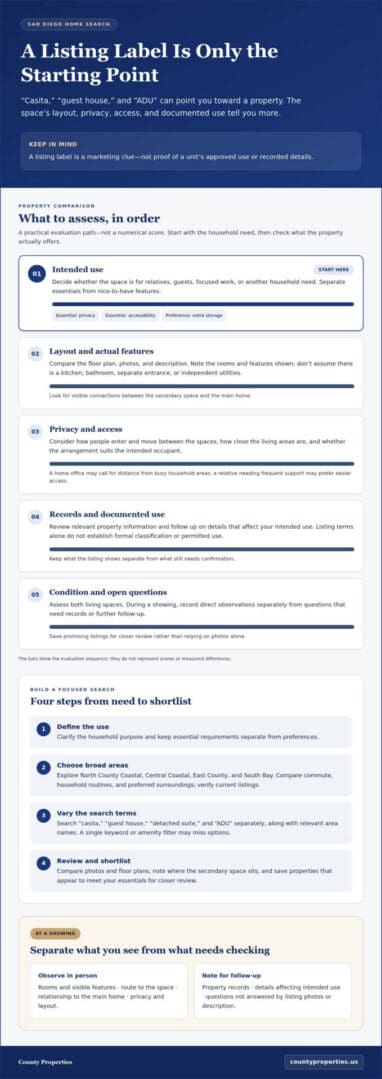
“A listing label is a marketing clue, not proof of a unit’s approved use or recorded details.”
Look beyond the name and assess the specific property. Listing photos and descriptions may show some features, while other details call for a scheduled visit or review of available property records. Don’t assume every casita has a kitchen, bathroom, separate entrance, or independent utilities.
- Layout: Note the rooms and features actually shown or described.
- Access: Look for a visible route to the space and consider how it relates to the main home.
- Records and use: Review relevant property information and follow up on details that affect your intended use.
This approach helps you distinguish what a listing presents from what still needs confirmation through records, a showing, or transaction follow-up.
Start with the household need the second space must meet
Before saving listings, picture how you expect the space to work. Will it give relatives more day-to-day independence, make overnight visits more comfortable, provide a quiet home office, or serve another household purpose? A clear answer gives you a practical standard for comparing options instead of relying on an appealing label or a few attractive photos.
Write down your essential needs separately from features you’d simply enjoy. For example:
- Essentials: Privacy for a family member, a manageable route between spaces, or accessibility features that suit the intended occupant.
- Preferences: A particular view, extra storage, or a layout that could accommodate more than one use.
Use those priorities to assess the main home and secondary space as one property. If privacy is essential, consider the distance between the living areas and how people enter and move through them. If the room will be an office, consider whether its layout supports focused work. A defined use case makes your search terms more flexible, your comparisons more consistent, and your showing questions more specific.
How to search San Diego neighborhoods for a home with a casita
A focused search can save time and help you spot promising properties, even when listings describe the secondary space in different ways. Before narrowing your results, decide what matters most to your household, then explore several broad areas and search terms. Since active listings change, verify current inventory rather than assuming a particular area has more casita properties.
Build a San Diego search around needs and location
Use this sequence to turn your priorities into a practical search:
- Define the use. Decide whether the space is for relatives, visitors, work, or another household need. Keep essential requirements, such as privacy or accessibility, separate from preferences.
- Choose areas. Consider North County Coastal, Central Coastal, East County, and South Bay as broad starting points. Rank them by commute, access to household routines, and your preferred surroundings, then review current listings in each.
- Search varied terms. Try “casita,” “guest house,” “detached suite,” and “ADU” separately, along with relevant area names. A listing may use one phrase and omit another, so a single keyword or amenity filter can miss options.
- Review layouts. Compare floor plans and photos to see where the secondary space sits in relation to the main home. Save listings that appear to meet your essential needs for closer review.
Think about the level of separation you want as well as location. Someone working from home may value distance from busy household areas, while relatives who need frequent support may prefer easier access to the main residence. If your search includes properties described as ADUs, the San Diego County ADU Regulations page is an official reference point. Consider the property’s specific location and records when researching its details.
For broader context on planning a regional home search, County Properties’ 2026 guide to buying a home in Southern California can help you think through location and purchase priorities alongside this casita-focused search.
Compare listing descriptions with the property layout
Once you have a shortlist, read each description alongside the floor plan and photos. Look for a stated entrance, shared outdoor areas, connecting doors, or other visible links between the spaces. These details can help you prepare focused questions, but listing images may not show every access point or how the spaces function in person. Note what you can observe and what needs a showing or records review.
Search multiple labels, then compare the property details that show how each space relates to the main home. This keeps your decisions grounded in the layout instead of the search filter. If you’d like collaborative guidance organizing showings and comparing options, County Properties buyer representation can support your search from shortlist to next steps.
Compare San Diego casita homes by privacy, layout, and practical fit
A second living space can look appealing in photos and still feel awkward for your household’s routines. As you compare homes for sale with a casita in San Diego, look at how the two spaces work together, not just how many rooms the listing counts. A separate entrance or visible facilities don’t, by themselves, establish approved use or rental options.
A simple comparison table can keep your shortlist organized. Use one row per property and columns for access, privacy, layout, condition, and fit with your intended use. Record what the listing actually shows, then mark questions that need a scheduled showing or review of available records.
- Access: Note the route between the main home and secondary space, including any entrance shown in listing materials.
- Privacy: Compare sightlines, proximity, and shared outdoor areas.
- Layout: Record how rooms and visible connections are arranged, without assuming features that aren’t shown.
- Condition: Track apparent maintenance needs separately for each living space.
- Practical fit: Describe how well the property appears to support your intended household use.
Assess privacy and the relationship between the two spaces
Consider how the layout would feel during an ordinary day. A guest may value a quieter route to the secondary space, while a relative who needs regular support may prefer a shorter, simpler connection to the main home. Compare entrances, sightlines from windows or patios, shared outdoor areas, and the distance between the buildings. If a description doesn’t explain how people enter or share the property, flag it for follow-up during a showing.
Photos can suggest separation, but they don’t always capture how sound, foot traffic, or shared spaces affect privacy. During a visit, picture familiar routines: arriving home, hosting visitors, working, or spending time outdoors. The right balance depends on who will use each area and how much interaction or independence they need.
Evaluate condition, records, and intended use
Assess the main home and secondary space separately. Listing photos may reveal visible wear or areas that deserve a closer look, but they can’t establish the full condition of either space. During a showing, make separate notes for each: what appears maintained, what needs a closer look, and what remains unclear. Then review available property records and relevant local requirements for the use described in the listing.
Keep observation and verification distinct. A floor plan or photo can show an apparent layout; records may provide additional property details, while a showing can clarify how the spaces connect in person. Neither a private entrance nor separate facilities guarantees a particular legal or rental use. If your intended use depends on a specific classification or permission, seek appropriate review rather than relying on listing language alone.
County Properties can guide the real estate transaction, including showings, paperwork, and escrow coordination. The team does not provide legal representation, so transaction guidance and legal advice are separate parts of an informed decision. The strongest choice is the home whose layout, privacy, condition, and records suit your household, not simply the one with the highest room count.
Touring homes with a casita in San Diego: a practical buyer checklist
A scheduled showing lets you assess whether a home’s two living spaces work in real life, not just in listing photos. Plan to view both spaces during the appointment and take notes while details are fresh. Don’t enter or disturb an occupied casita, or try to view a property outside an arranged showing. Your agent can coordinate access and help keep the visit organized.
What to observe during a scheduled showing
Walk the route between the main home and casita as you would during an ordinary day. Note what you can directly see, then record anything the listing left unclear.
- Access: Is the route easy to follow? Are entrances and paths apparent?
- Layout: Does the arrangement seem workable for the people who will use each space?
- Light and condition: Note natural light and visible maintenance concerns in both areas.
- Shared areas: Consider how outdoor spaces or other shared features fit your household’s routines.
- Open questions: Write down features that photos or descriptions don’t explain clearly.
Keep observations factual. For example, note that a door or walkway is visible, but don’t assume that establishes a particular approved use. If privacy, accessibility, or proximity matters to your household, consider how the layout feels from each person’s perspective.
What to review after a promising visit
Separate what you observed from what needs records or transaction follow-up. Group questions by topic so you can address them methodically instead of relying on memory.
- Property details: Identify available records to review and clarify any discrepancies between the documents and listing description.
- Stated use: Note what the listing says the secondary space is used for, then identify what still needs verification for your plans.
- Financing readiness: Discuss your financial preparation and questions with a loan officer. County Properties can connect buyers with a loan officer, but does not provide lending.
- Legal questions: Keep questions about legal rights or permitted use separate from real estate guidance. County Properties does not provide legal representation.
A buyer’s agent can help organize showings, guide offer paperwork, and coordinate escrow as you move from a promising visit toward a decision. For additional perspective on choosing representation, County Properties’ complete guide to finding a real estate agent near you covers what to consider in that working relationship.
If you’re comparing homes for sale with a casita in San Diego, prepare your questions before touring and bring your notes into the decision. Connect with County Properties for buyer representation to help coordinate showings and move through the next steps with attentive support.
Make your San Diego casita home search easier with buyer representation
A promising listing is only the beginning. With buyer representation, you have a partner to help organize showings, compare a property with your priorities, prepare offer paperwork, and coordinate escrow. For a search as specific as homes for sale with a casita in San Diego, that support can help you move from a shortlist to a more informed decision without losing sight of how the second space needs to work for your household.
County Properties is a family-owned, service-focused team established in 1995. Founder Arnie Levine brings 36 years of Southern California real estate experience. The team takes a collaborative approach, using your intended use, preferred areas, and questions about each property to shape the search and next steps.
From a promising listing to an informed offer
The process is easier to manage when each step is clear. Your buyer’s agent can arrange a showing, help you review the property and available details, and discuss offer considerations before you decide how to proceed. If you choose to make an offer, the agent guides the paperwork and coordinates with you as the transaction moves forward.
County Properties lists offer paperwork as taking approximately 30 minutes. Once escrow opens, it typically closes in 30-45 days unless otherwise negotiated. These timeframes offer a general planning reference, while the details of a particular transaction may differ. Your agent can help you keep track of paperwork and escrow coordination so you understand what comes next.
Before making an offer, organize the questions that matter most: Does the main home and secondary space fit your household’s needs? What property details still require follow-up? Are you comfortable with the proposed terms and timeline? A buyer’s agent can offer real estate guidance and help prepare transaction paperwork, giving you a clearer basis for your decision.
Get personalized help with your San Diego search
Your priorities may change as you compare properties. You might focus first on a particular area, then find that access, privacy, or the casita’s layout matters more. Collaborative buyer representation keeps the search centered on your needs instead of treating every listing with a secondary space as an equal match.
County Properties can also connect you with a loan officer as you work through financing readiness. The team does not provide loans, keeping your real estate guidance and lending discussions distinct.
You can explore listings with the home-search tool and reach out to a buyer’s agent when you’re ready to discuss your priorities. Start your San Diego home search with County Properties for attentive, collaborative support as you consider your next move.
Turn your priorities into a clear next step
Before browsing homes for sale with a casita in San Diego, write down the outcome the second space must support, the trade-offs your household can accept, and the unanswered question that would change your decision. This short decision brief gives each new listing a clear purpose in your search instead of letting an attractive photo or familiar label set the direction.
Use it to make a simple call on each property: keep it in consideration if it meets your essential need, pause if a key detail could affect how the space works, and move on if the layout doesn’t suit your plans. You don’t need every answer at the start. You do need a thoughtful way to identify what matters and what deserves follow-up before making a commitment.
When you’re ready to take the next step, start your San Diego home search with County Properties. A focused plan can make the path ahead feel more manageable, and the right home for your household may be closer than you think.
Frequently Asked Questions
What is the difference between a casita and a guest house?
There isn’t a consistent difference in how these terms appear in real estate listings. “Casita” and “guest house” may both describe a secondary living space, but neither label alone establishes the structure’s formal classification, features, or approved use. To understand a particular property, look at its actual configuration and review relevant records instead of assuming the terms mean different things.
Can I find homes for sale with a casita in San Diego?
Yes. You can search for homes for sale with a casita in San Diego, but active listings and the language they use change. Try several terms, including “casita,” “guest house,” “detached suite,” and “ADU,” and review listing details rather than relying only on an amenity filter. A buyer’s agent can help organize a search around your preferred areas and intended use.
Do all casitas have a separate entrance?
No. The layout depends on the individual property, and the word “casita” doesn’t guarantee a separate entrance or any specific feature. Some listings may show an exterior door, while others may not clearly explain how the spaces connect. Check the floor plan and photos, then use a scheduled showing to understand the available access. Don’t infer approved use from an entrance alone.
Can I rent out a casita in San Diego?
Possibly, but rental use depends on the property’s status and the rules that apply in its location. San Diego-area requirements can differ by jurisdiction and rental type. JADU rentals must be for terms longer than 30 days, while rules for short-term rentals in other ADUs can vary, particularly in coastal areas. Review current local requirements before relying on rental income.
How can I tell if a San Diego casita is permitted?
Don’t rely on the listing description or the structure’s appearance as proof. Start by reviewing available property and permit records from the jurisdiction responsible for the address, and compare those details with the unit you saw. If records or stated use raise questions, seek appropriate legal guidance for interpretation. A real estate agent can support the transaction and help organize follow-up, but does not provide legal advice.
Is a home with a casita a good fit for multigenerational living?
It can be, if the arrangement matches the needs and routines of everyone who will live there. For example, a relative may benefit from having a nearby space while still keeping some separation from the main household. Consider daily access, privacy, and how needs may change over time. Discuss the layout with family members and assess the spaces in person before deciding whether the setup feels workable.
Can County Properties help me find and tour a San Diego home with a casita?
Yes. County Properties provides buyer representation to help you organize your search, arrange property showings, prepare offer paperwork, and coordinate escrow. Share your preferred areas and what you need the secondary space to do, so the search stays focused on your household’s priorities. The team can also connect you with a loan officer for financing discussions; County Properties does not provide loans.