

A slightly higher citywide rate doesn’t always mean a higher property tax bill. A home in San Diego may have a lower bill than a similarly priced home in East Chula Vista if the Chula Vista property has Mello-Roos assessments.
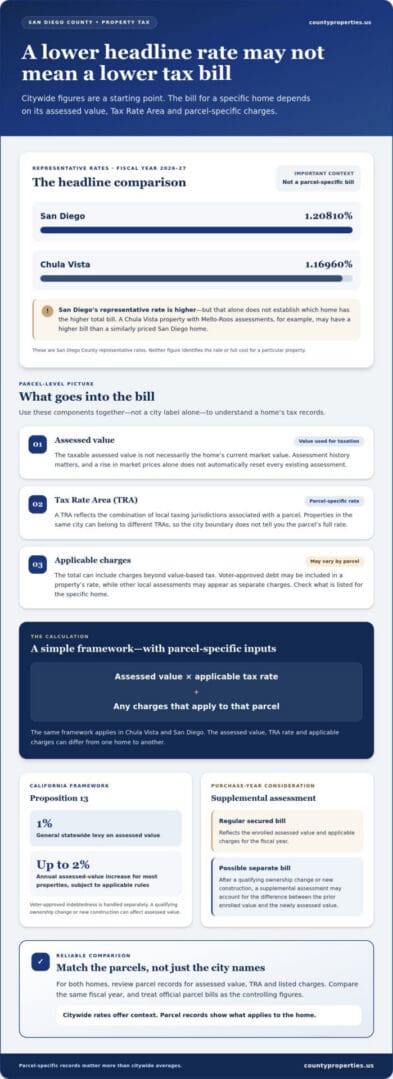
That’s why comparing property tax rates in Chula Vista vs San Diego by headline figures alone can mislead. Each parcel belongs to a Tax Rate Area (TRA), and local bonds or fixed assessments can affect the total bill. San Diego County’s 2026-27 representative rates are 1.20810% for San Diego and 1.16960% for Chula Vista, but neither figure tells you the full cost for a specific home.
This guide explains why nearby properties can have different tax bills, how to look up a parcel’s TRA and assessments, and what to consider before you buy. You’ll also learn why a purchase can reset the assessed value and how to include property taxes in a realistic ownership-cost comparison. A parcel-by-parcel approach helps you compare homes with greater confidence as you weigh your next move in San Diego County.
Key Takeaways
- Compare the property tax rates in Chula Vista vs San Diego using individual parcels, not citywide figures alone.
- Understand how assessed value, the applicable Tax Rate Area, and additional charges contribute to a property’s tax bill.
- Follow a same-fiscal-year process to compare two homes using parcel records and available tax-bill information.
- Use a planning worksheet to estimate costs before buying, while treating official parcel bills as the controlling figures.
- Weigh property taxes alongside purchase price, insurance, maintenance, and location to assess the full cost of ownership.
Why Chula Vista vs. San Diego property tax rates are not one simple number
Neither Chula Vista nor San Diego has one rate that determines every property tax bill. A parcel’s bill depends on its assessed value, the rate for its Tax Rate Area (TRA), and any applicable charges. A TRA represents the combination of local taxing jurisdictions associated with a parcel, such as districts that levy taxes in that area. Properties in the same city can belong to different TRAs.
That’s why the property tax rates in Chula Vista vs San Diego can’t be compared reliably using a single citywide figure. A published average or median can provide context, but it won’t identify the rate or total bill for the home you’re considering.
What does a property tax rate represent?
A tax rate is applied to a property’s assessed value to calculate value-based tax. Assessed value is the figure used for taxation, not necessarily the home’s current market value. The final bill can also include applicable charges beyond the value-based amount, so the rate alone doesn’t show the full cost.
An effective rate is a comparison measure that typically expresses taxes paid as a share of home value. It isn’t necessarily the rate applied to a particular parcel. Ownwell reported a 1.19% median effective rate for Chula Vista in April 2026. Treat that as dated, third-party context, not an official citywide rate or a prediction for an individual home. Before comparing it with another estimate, review the source’s methodology, including its data period, home-value measure, and whether the calculation includes non-value-based charges. These details affect what the figure represents.
California’s Proposition 13 sets the general property tax framework, including a 1% statewide general levy and limits on annual increases to assessed value, subject to applicable rules and exceptions. The California’s Proposition 13 overview provides background, but parcel records are needed to understand a specific property’s assessment and applied charges.
Why can nearby homes have different tax bills?
Two neighboring homes can have different assessed values, belong to different TRAs, or carry different local charges. Their tax bills can therefore differ even if the homes appear similar and share the same city address. City boundaries alone don’t explain every variation.
For example, imagine two neighboring homes with similar features. One may have a different assessed value because of its assessment history, while the other may belong to another TRA or have an additional local charge. You can’t tell which bill is higher from the city name or a published median. You need parcel-specific information.
For a useful comparison, match the parcels, not just the city labels. Use each property’s tax records to identify its assessed value, TRA, and listed charges. That gives you a more dependable starting point for comparing ownership costs before making a decision.
How San Diego County calculates property taxes in Chula Vista and San Diego
The basic calculation is straightforward: multiply a property’s assessed value by the applicable tax rate, then add any charges that apply to that parcel. The same framework applies in Chula Vista and San Diego. From one home to another, the assessed value, parcel rate, and applicable local charges can vary.
The base levy is only part of the picture; parcel-specific charges can increase the total bill. Voter-approved debt may be included in a property’s rate, and other local assessments may appear as separate charges. These items don’t apply uniformly to every property, so don’t assume a charge affects a home just because it’s nearby. Review the parcel records and tax bill to see what applies.
Assessed value, Proposition 13, and a change in ownership
Assessed value is the value used to calculate property taxes. It can differ from current market value, which reflects what a property might sell for now. Under California’s Proposition 13 framework, the general property tax levy is limited to 1% of assessed value, with voter-approved indebtedness handled separately. For most properties, assessed value is based on the purchase price at a change in ownership and can increase annually by no more than 2%, subject to applicable assessment rules. A rise in market prices alone doesn’t automatically reset every existing assessment.
A qualifying change in ownership can trigger reassessment, and new construction can also affect assessed value. A buyer’s starting assessment may therefore differ from a long-time owner’s, even when both properties are in the same neighborhood. The San Diego County Secured Property Taxes resource explains the county’s secured-tax process and how regular bills fit into property tax obligations.
Local charges and supplemental assessments
To understand a bill, distinguish recurring secured taxes from a possible supplemental assessment. The regular secured bill reflects the property’s enrolled assessed value and applicable charges for the fiscal year. After a qualifying ownership change or new construction, the Assessor may issue a supplemental assessment to account for the difference between the prior enrolled value and the newly assessed value. This is separate from the regular bill, so buyers should include the possibility in their purchase-year planning.
For a property-specific review, compare the parcel’s assessed value and Tax Rate Area with available county tax records, and look for separately listed assessments or supplemental bills. County records show which components apply to that home. As you compare homes, local home-buying guidance can help you keep property taxes in view alongside the other details involved in evaluating a purchase.
How to compare actual property tax rates in Chula Vista vs. San Diego
A fair comparison starts with two specific properties and the same fiscal year. Citywide estimates can help you get oriented, but they don’t show whether one parcel has a different assessed value, Tax Rate Area, or added charge. Use this process to compare the available records, keeping any planning estimate distinct from an official bill.
Use the county Tax Rate Area Search correctly
The San Diego County Tax Rate Area Search lets you look up rate information by fiscal year and fields such as Tax Rate Area, city, and school district. Choose the same fiscal year for both homes. The city and school district fields can help narrow or contextualize results, while the TRA identifies the local taxing-area combination tied to a parcel. A city-level search isn’t a substitute for matching the result to the property you’re evaluating.
- Identify each parcel. Gather the street address and, if available, the Assessor’s Parcel Number (APN) for one Chula Vista property and one San Diego property. An APN helps distinguish the exact parcel from nearby addresses.
- Find assessed values and bill records. Look up each parcel’s assessed value and available tax-bill records for the comparison year. If you’re considering a home for purchase, note that its current assessed value may not match the value used for your planning estimate.
- Match each parcel to its TRA. Use the county search to find the applicable TRA and rate information. Confirm that the result corresponds to the parcel, not simply a city or school district with a similar name.
- Record additional charges. Review available bills for local assessments or other listed charges. If a detail isn’t available, mark it “unknown” rather than substituting a city median or neighborhood average.
- Compare estimated totals. Apply the relevant rate to the assessed value, then account for charges shown in the records. Label your calculation as an estimate; use the official parcel bill as the record of billed amounts.
Build a fair side-by-side comparison
Keep the fiscal year and calculation assumptions consistent. This helps you see whether a difference comes from assessed value, the parcel’s rate, or additional charges, rather than from figures drawn from different periods. Property tax rates in Chula Vista vs San Diego become useful for decision-making only when tied to those parcel-level details.
| Comparison item | Chula Vista property | San Diego property |
|---|---|---|
| Address / APN | [Enter details] | [Enter details] |
| Fiscal year | [Same year] | [Same year] |
| Assessed value | [Enter record] | [Enter record] |
| Tax Rate Area (TRA) | [Enter result] | [Enter result] |
| Applicable rate | [Enter rate] | [Enter rate] |
| Added charges | [Enter or mark unknown] | [Enter or mark unknown] |
| Estimated total / official bill | [Label clearly] | [Label clearly] |
Don’t compare one home’s estimated total with another home’s official bill. Consistent records and clearly labeled unknowns give you a dependable basis for comparing the properties before weighing the rest of the purchase.
Estimate your property tax bill before choosing a Chula Vista or San Diego home
A planning estimate can help you compare homes, but it isn’t a promise of what you’ll owe. Build it from parcel information, a consistent fiscal year, and clearly stated assumptions. Keep a separate note of anything that remains unknown. This makes your comparison useful without presenting a rough calculation as an official tax determination.
What information do you need for a useful estimate?
Gather each home’s address or Assessor’s Parcel Number, current assessed value, fiscal year, and available Tax Rate Area (TRA) and rate information. A recent county tax bill or official parcel record can show applicable charges. Record known local assessments separately rather than folding them into the rate, so you can distinguish documented figures from details that still need review.
Use this worksheet for each property:
- Property address or APN: [Enter parcel identifier]
- Purchase assumption: [Enter the expected purchase scenario]
- Assessed value used: [Enter the current figure or clearly labeled planning assumption]
- Fiscal year and TRA rate: [Enter the matching county record]
- Applicable charges: [List each known charge separately, or mark unknown]
- Planning estimate: [Assessed value multiplied by applicable rate, plus known charges]
For a purchase scenario, don’t assume the seller’s current assessed value will be your long-term tax basis. A change in ownership can lead to reassessment, so use a clearly labeled purchase assumption for planning and distinguish it from the parcel’s current record. When reviewing a property tax estimate, check how assessed value and the applicable rate work together, and keep any additional charges separate.
How should buyers interpret an estimate?
A purchase price by itself doesn’t establish the final bill or when every amount will be due. Fiscal-year timing matters, and a qualifying ownership change may result in a supplemental assessment separate from the regular secured bill. Include the possibility of both in your cash-flow planning, then review county records and notices as they become available. The official parcel bill and assessment records control, not a worksheet or calculator.
Online median-rate calculators can offer rough context, but a median isn’t the rate for your parcel. It may also fail to reflect the property’s TRA or specific local charges. Compare estimates built from the same fiscal year and method, and label every assumption. If information is missing, write “unknown” instead of filling the gap with an average.
As you consider buying a home in Southern California, keep the tax estimate alongside other ownership costs and the features that matter to you. County Properties can help you evaluate homes and navigate purchase steps through buyer representation for your home search. This real estate guidance supports your comparison, while tax determinations remain with the relevant county records and authorities.
Choose between Chula Vista and San Diego with a complete ownership-cost picture
A property tax estimate is one part of a home’s ownership cost, not the final verdict on where to buy. Property tax rates in Chula Vista vs San Diego matter, but they belong in a broader comparison that includes purchase price, insurance, expected maintenance, and the practical value of each location. A lower estimated tax bill may be appealing, but it doesn’t automatically make that property the better fit for your budget or plans.
Compare the home and location, not only the tax estimate
Start by comparing homes that meet similar needs, then identify what differs. A useful decision framework includes:
- Total expected costs: Review the purchase price alongside property taxes, insurance, and anticipated maintenance.
- Property condition: Consider the home’s current state and the upkeep it may require, rather than treating two similar-looking listings as identical.
- Commute and daily routines: Account for how each location fits your regular travel and household needs.
- Neighborhood and long-term plans: Weigh the features that matter to you now and how well each home may support your plans over time.
Where possible, compare matched properties with similar features and purchase assumptions. This helps separate location trade-offs from differences in condition, assessed value, or parcel-specific charges. If one home appears less expensive to own, identify the factors behind the difference before deciding whether the trade-off works for you.
Tax information can also change as purchase details become available. Revisit the official parcel records and applicable bill information when you have a specific property in view. Keep estimates labeled as estimates, and use the county’s parcel-specific information to refine your comparison rather than relying on a broad city figure.
How local buyer representation can help
County Properties helps buyers evaluate homes and navigate purchase steps, including property showings, paperwork, and escrow management. The team serves San Diego County, including South Bay, and brings local knowledge to the home search. Founder Arnie Levine has 36 years of Southern California real estate experience.
The guidance focuses on the real estate decision: comparing properties, understanding purchase steps, and keeping relevant details organized. It isn’t tax preparation or legal advice. For questions about a specific assessment or bill, rely on the appropriate county records and qualified tax resources.
With a clearer view of costs and location priorities, you can make a decision that fits your full ownership picture, not just one estimate. If you’re weighing homes in either city, Talk with County Properties about your home search and take the next step with an experienced local real estate guide.
Take the next step toward a confident home choice
Turn your shortlist into a practical decision by revisiting each home’s parcel information as purchase details become clear. Update your ownership-cost comparison, then weigh the numbers against the routines, priorities, and long-term plans that will shape daily life in the home. Property tax rates in Chula Vista vs San Diego are one part of that decision, not a verdict on which community or property is right for you.
County Properties is a family-owned team serving San Diego County, including South Bay. Founded in 1995, the team brings local perspective to buyer representation and the steps involved in purchasing a home. Parcel tax determinations come from official county records, while an experienced real estate guide can help you keep property considerations organized as you evaluate your options.
When you’re ready to explore homes and plan your next steps, Talk with County Properties about your home search. Take the next step with a clearer picture of what matters most and a trusted local team alongside you.
Frequently Asked Questions
Does buying a home in Chula Vista or San Diego reset its assessed value?
A qualifying change in ownership can trigger reassessment under California rules, but the sale price alone doesn’t determine the final tax bill. The parcel’s Tax Rate Area and applicable charges also matter. Before you budget, review the county’s assessment information and the property’s records, and distinguish the regular secured bill from a possible supplemental bill. Assessment rules can have exceptions, so consult current county guidance for the specific property.
What is a supplemental property tax bill in San Diego County?
A supplemental bill may be issued after a qualifying change in ownership or new construction changes the assessed value. It is separate from the regular annual bill and can cover a period the regular bill doesn’t reflect. The amount and timing depend on the property and assessment. If you buy during a fiscal year, include the possibility of a separate bill in your planning, then use county notices and parcel records for the actual details.
Can two homes on the same street have different property tax bills?
Yes. Two nearby properties may have different assessment histories, assessed values, Tax Rate Areas, or applicable charges. For example, a long-held home and a recently purchased neighboring home may have different assessed values. To compare property tax rates in Chula Vista vs San Diego accurately, use each parcel’s records and the same fiscal year. A neighborhood average can offer context, but it can’t establish either home’s individual bill.
Are property taxes in Chula Vista paid monthly or in installments?
San Diego County bills secured property taxes in two installments, not as monthly county payments. For the current schedule, the first installment is due November 1 and becomes delinquent after December 10; the second is due February 1 and becomes delinquent after April 10. A mortgage servicer may collect monthly escrow payments, but that arrangement is separate from county billing. Follow the due dates and instructions on your parcel’s current bill.
Can I appeal my San Diego County property assessment?
Property owners can review their assessment and follow the county’s assessment appeal process if they believe a correction is warranted. San Diego County’s stated annual filing deadline is November 30, but confirm the deadline, eligibility, and evidence requirements for the relevant assessment year with the county. Keep assessment notices and supporting property information together. This FAQ is general information, not legal or tax advice, and it can’t determine whether a particular appeal will succeed.
Do condos in Chula Vista and San Diego have different property tax rates from houses?
A condo’s property type alone doesn’t determine a different citywide tax rate. Its parcel-specific assessed value, Tax Rate Area, assessment history, and applicable charges shape the county tax bill. Also separate any homeowners association dues from property taxes when comparing monthly ownership costs, since they are different expenses. Check the condo’s own parcel records and bill rather than using a nearby house, city median, or another condo as a substitute.