

With office vacancy rates in Los Angeles hitting 23.4% and California capital gains taxes reaching up to 13.3% in 2026, the margin for error when disposing of commercial assets has never been thinner. You’ve likely spent years building equity in your portfolio, and it’s natural to feel concerned about navigating shifting interest rates or the state’s rigorous environmental regulations. You want a transition that honors your hard work without leaving money on the table or facing an unexpected tax bill.
Understanding how to sell a commercial property in California requires a blend of localized market data and a steady, expert hand to guide you through the complexities. This guide provides the strategic roadmap you need to master high-yield asset disposition, from optimizing your valuation based on Net Operating Income to ensuring legal compliance. We’ll walk you through the nuances of the current Southern California market, including how to manage the latest tiered transfer taxes and integrate a successful 1031 exchange. By the end of this article, you’ll have the clarity and confidence to move forward with a seamless escrow process that protects your financial future.
Key Takeaways
- Learn why the 2026 Southern California market continues to favor industrial and neighborhood retail assets and how to align your disposition strategy with these high-growth sectors.
- Master the technical side of valuation by moving beyond simple price-per-square-foot metrics to focus on Net Operating Income (NOI) and mandatory Environmental Site Assessments.
- Discover the essential steps for how to sell a commercial property in California while maximizing asset value through proactive documentation and specialized Southern California marketing strategies.
- Understand the specific advantages of local, collaborative seller representation when navigating complex transitions, especially for senior-owned businesses or assets requiring repositioning.
The State of Southern California Commercial Real Estate in 2026
Southern California’s economy in 2026 presents a mosaic of challenges and opportunities. While some national outlets focus on broad downturns, our regional landscape is defined by specific growth corridors. If you’re evaluating What is Commercial Property? in the 2026 landscape, it’s defined by utility and location. Industrial spaces remain the crown jewel of the Inland Empire, while multi-family housing in San Diego continues to see strong demand despite interest rate shifts. We see a market that rewards precision and localized knowledge over generic investment strategies.
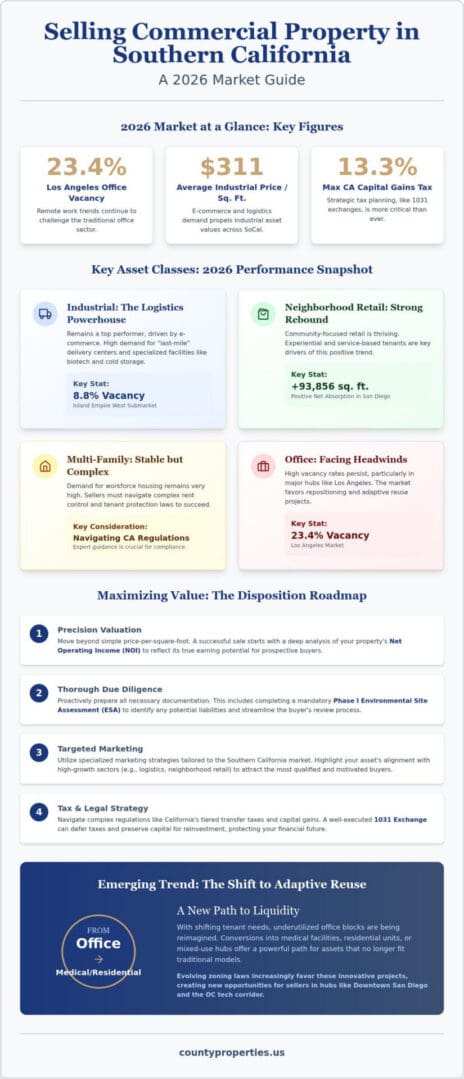
The impact of remote work hasn’t been uniform across all sectors. Los Angeles has seen office vacancy rates climb to 23.4%, but neighborhood-centric retail in San Diego is bouncing back with a positive net absorption of 93,856 square feet. This divergence is critical when you consider how to sell a commercial property in California. Buyers aren’t just looking at square footage; they’re looking at resilience. E-commerce continues to drive industrial prices, which have reached an average of $311 per square foot across Southern California, making these assets highly sought after for disposition.
Post-2025 Economic Drivers in the Region
Interest rates have stabilized after the volatility of previous years, allowing cap rates to find a new equilibrium. Logistics remains a powerhouse. The Port of San Diego acts as a vital artery for regional trade, sustaining high demand for nearby warehouse space. New infrastructure developments, particularly those improving transit between the Inland Empire and coastal hubs, are directly influencing property values in previously overlooked zip codes. These drivers create a sense of security for investors looking for long-term stability.
The Shift Toward Adaptive Reuse Projects
You’re likely seeing underutilized office blocks being reimagined. Because of shifting tenant needs, many owners are exploring conversions into medical facilities or residential units. California’s evolving zoning laws now favor these mixed-use developments, especially in “work-live-play” hubs like Downtown San Diego or the Orange County tech corridor. These projects offer a path to liquidity for assets that no longer fit traditional models. Our team acts as a dependable guide, helping you understand the true potential of your property before it hits the market. This collaborative approach ensures you feel secure during every phase of the transition.
Key Asset Classes: Identifying Opportunity in 2026
Your success in the 2026 market depends on recognizing which asset classes are poised for growth and which face headwinds. While multi-family housing in San Diego remains a favorite for stable cash flow, industrial assets in the Inland Empire are currently experiencing a more complex shift. Understanding these nuances is the first step in learning how to sell a commercial property in California with maximum ROI. We see a distinct resurgence in neighborhood-centric retail spaces, which saw a positive net absorption of 93,856 square feet in San Diego County recently. Medical office buildings also stand out as a recession-proof play, particularly as they cater to an aging demographic. San Diego’s hospitality sector is following suit, with tourism trends driving interest in boutique assets that offer experiential stays.
Industrial Real Estate: The Logistics Powerhouse
Industrial real estate remains a logistics powerhouse, but the Inland Empire West submarket now shows an 8.8% vacancy rate despite high leasing activity. This makes it a double-edged sword for sellers. You’ll find high demand for “last-mile” delivery centers in urban San Diego and specialized biotech facilities, but buyers are more selective than in previous years. Cold storage is another high-growth niche where supply hasn’t yet met demand. When you’re ready to transition out of these assets, our team acts as a dependable guide to help you navigate the specific technical requirements and buyer expectations in these specialized sectors.
Multi-family and Residential Investment
Multi-family investments require a steady hand due to California’s Real Estate Regulations regarding rent control and tenant protections. While these laws add a layer of complexity for owners, the demand for workforce housing in high-growth corridors remains insatiable. If you’re considering diversifying your portfolio into residential assets or selling a complex to reinvest, it’s helpful to review our insights on Buying a Home in Southern California: A Realistic 2026 Guide. We believe in a collaborative approach that ensures you feel secure in your financial decisions. Knowing how to sell a commercial property in California involves more than just a listing; it requires a strategy that accounts for these regulatory shifts. If you’d like to explore your options for a high-yield disposition, you can connect with our team for a professional assessment of your asset’s current market value.
Commercial Property Valuation and Due Diligence
Determining the value of your asset is more than a simple calculation; it’s a strategic positioning. While many sellers focus on the price per square foot, savvy investors in 2026 look deeper into the Net Operating Income (NOI). This figure reflects the true profitability of your property after operating expenses are deducted. A clean rent roll with staggered lease expiration schedules reduces risk for buyers, making your asset more attractive during a shifting interest rate environment. We recommend reviewing these documents early to mitigate any perceived risks before you go to market.
During the due diligence period, which typically lasts 30 to 45 days in California, a Phase I Environmental Site Assessment (ESA) is often the most critical hurdle. Lenders require this to ensure there’s no contamination risk. Additionally, you should proactively address the physical health of the asset. Deferred maintenance, such as a roof near the end of its life or outdated HVAC systems, can lead to significant price re-negotiations. By identifying these issues early, you remain in control of the narrative and protect your asset’s valuation. Knowing how to sell a commercial property in California means being prepared for this level of scrutiny.
The Role of Professional Valuation
Market value in California often sits significantly higher than the assessed value shown on tax records. This discrepancy occurs because property taxes are often influenced by historical caps, while market demand in San Diego and the Inland Empire continues to fluctuate. For more context on regional pricing, see our analysis of the Southern California Housing Market: Forecast & Trends for 2026. In the 2026 SoCal market, the Cap Rate represents the expected rate of return based on the Net Operating Income the property is currently generating. Our team acts as a dependable guide, ensuring your valuation reflects current buyer sentiment rather than outdated data.
Navigating California Zoning and Regulations
Compliance is a cornerstone of a successful closing. The California Environmental Quality Act (CEQA) can impact how a buyer views the long-term potential of your site, especially if they plan for adaptive reuse or expansion. You also need to account for localized San Diego municipal codes, such as specific parking ratios that vary by neighborhood. ADA compliance remains a high priority; properties that aren’t up to code may face scrutiny during the inspection phase. We take a collaborative approach, helping you gather the necessary building information and disclosures to ensure every client feels secure. Mastering how to sell a commercial property in California means anticipating these regulatory requirements before they become obstacles. Our seasoned team helps you prepare a comprehensive package, so you don’t leave your disposition to chance.
Strategic Acquisition and Disposition: The Selling Process
The actual sale of your asset begins long before the first tour. To maximize your return, you must present a property that is physically and administratively ready. Curb appeal matters even in industrial sectors; a clean, well-maintained exterior suggests a well-managed investment. Simultaneously, your documentation package must be airtight. Providing prospective buyers with organized leases, three years of operating statements, and building permits up front creates a sense of transparency. This preparation is a fundamental part of learning how to sell a commercial property in California effectively. When your information is ready, we deploy targeted marketing strategies that reach beyond local listings to engage institutional investors and private equity groups looking for Southern California opportunities.
Negotiations in the commercial sector involve balancing the final sale price with the length of the contingency period. While a high offer is attractive, an offer with fewer contingencies or a shorter due diligence window often provides more security. Once you reach an agreement, the deal moves into escrow. This phase typically lasts between 60 and 90 days. During this time, the title company ensures the property is free of liens while the buyer completes their final walkthrough. Our team acts as a steady, guiding presence throughout this progression, ensuring you feel supported from the initial letter of intent to the final recording of the deed.
Selling Your Commercial Property Fast
Speed is often a priority for owners looking to retire or reposition their wealth. We leverage deep-rooted professional networks to provide access to off-market buyers who are ready to move quickly without the public scrutiny of a traditional listing. While the commercial process differs from residential, our experience in Selling a Home in Southern California: The Ultimate Guide allows us to apply a holistic approach to your entire real estate portfolio. Expert seller representation is vital here. We handle the high-pressure negotiations so you don’t have to, maintaining a collaborative environment that keeps the deal on track. This method ensures you understand how to sell a commercial property in California without the typical stress of a public market cycle.
1031 Exchanges and Tax Strategies
Managing the tax hit from capital gains is a primary concern for California investors. A 1031 exchange allows you to defer these taxes by reinvesting your proceeds into a like-kind property. This process is time-sensitive. You must identify a replacement property within 45 days of your sale and close on that new asset within 180 days. Because California treats capital gains as ordinary income, the stakes are high. We work alongside your tax professionals to ensure every step complies with IRS regulations, providing the methodical assistance you need to protect your wealth. If you’re ready to start your transition, contact our team for a strategic consultation on your asset disposition.
The County Properties Advantage: Local Advocacy Over National Volume
National firms often treat commercial transactions as pure volume, but County Properties prioritizes advocacy and localized insight. Led by Arnie Levine, our agency operates with a service-centric philosophy that places your financial safety at the forefront of every decision. We understand that a commercial asset often represents a lifetime of work, and we treat your disposition with the respect it deserves. Our deep San Diego roots provide access to “hidden” market insights that national brands often overlook, such as specific neighborhood zoning shifts or off-market buyer pools. This community-focused knowledge allows us to position your asset more effectively than a generic, volume-based brokerage.
Our “Experienced Veteran” persona is particularly valuable when you face distressed property situations or complex legal challenges. We act as a dependable guide, using a collaborative team approach to ensure you feel secure throughout the process. This localized focus is essential for anyone researching how to sell a commercial property in California while maintaining a sense of personal connection and professional mastery. We don’t just list your property; we become your steadfast partner during a significant life transition.
Senior Real Estate Specialization in the Commercial Sector
We offer specialized support for business owners transitioning into retirement. Asset liquidation is a significant life milestone, and it requires more than just technical expertise; it requires empathy. For family-owned commercial portfolios, the transition is often emotional as much as it is financial. You might benefit from understanding What is a Senior Real Estate Specialist (SRES®) and Why Do You Need One? and how these specialized insights apply to your commercial assets. We provide methodical assistance to ensure your legacy is protected during the liquidation process, helping you fulfill your long-term personal goals with optimism and achievement.
Your Partner for Southern California Success
Choosing a long-term professional ally is the most important decision you’ll make in your selling journey. We don’t just facilitate a transaction; we help you navigate the complexities of the Southern California market with certainty. If you’re ready to move forward, you can request a personalized commercial market analysis that accounts for the specific nuances of your property’s location and asset class. This tailored approach is the cornerstone of how to sell a commercial property in California with confidence. We invite you to Contact County Properties for a Commercial Consultation to begin your next chapter with a trusted, seasoned mentor by your side.
Securing Your Financial Legacy in the 2026 Market
Success in the Southern California commercial landscape requires a strategic blend of institutional data and boutique advocacy. You now have the roadmap for maximizing valuation through Net Operating Income and managing the technical hurdles of CEQA and 1031 exchanges. Understanding how to sell a commercial property in California is about more than a transaction; it’s about securing your long-term goals through expert guidance. You’ve worked hard to build your portfolio, and you deserve a partner who values your legacy as much as you do.
Led by Arnie Levine, a seasoned veteran in SoCal real estate, County Properties provides the deeply localized San Diego market knowledge you need to thrive. We specialize in senior real estate transitions and distressed assets, offering the methodical assistance required for complex dispositions. You don’t have to face these market shifts alone. Partner with SoCal’s trusted commercial real estate experts at County Properties today to begin your personalized asset analysis. We’re ready to act as your dependable guide, ensuring your next professional milestone is met with optimism and financial security.
Frequently Asked Questions
What is the outlook for commercial real estate in Southern California for 2026?
The outlook for 2026 is defined by a sharp divergence between asset classes. While the Los Angeles office market struggles with a 23.4% vacancy rate, San Diego County retail has seen a positive net absorption of 93,856 square feet. Industrial assets continue to lead the region with average sold prices reaching approximately $311 per square foot. Success depends on targeting resilient sectors like life sciences and logistics hubs.
How do I find off-market commercial properties in San Diego?
Finding off-market opportunities in San Diego requires access to deeply localized professional networks. National aggregators often miss these hidden listings because they focus on high-volume public data. Our team leverages long-standing regional relationships to connect sellers with qualified buyers before a property ever hits the public market. This collaborative approach ensures a more secure and private transaction for owners of high-value portfolios.
What are the typical cap rates for industrial property in SoCal right now?
Industrial cap rates in Southern California have found a new equilibrium following interest rate stabilization. While the Inland Empire West submarket shows an 8.8% vacancy rate, demand for last-mile delivery centers remains high. Investors are currently prioritizing assets with strong Net Operating Income (NOI) over speculative growth. We provide a personalized market analysis to help you understand how these regional shifts impact your specific asset’s valuation.
Can a Senior Real Estate Specialist (SRES®) help with commercial property?
A Senior Real Estate Specialist (SRES®) provides invaluable guidance for business owners looking to transition into retirement. At County Properties, we apply these specialized insights to commercial assets to help seniors liquidate or reposition their portfolios. This empathetic, methodical assistance is designed to make the process seamless. We act as a dependable guide during these significant life transitions, ensuring your financial legacy remains protected.
What is a 1031 exchange and how does it benefit California sellers?
A 1031 exchange allows you to defer capital gains taxes by reinvesting sale proceeds into a like-kind property. This is a critical strategy for learning how to sell a commercial property in California, where state capital gains are taxed as ordinary income at rates up to 13.3%. You must identify a replacement property within 45 days and close within 180 days to maintain compliance with IRS regulations.
How does the California Environmental Quality Act (CEQA) affect commercial sales?
The California Environmental Quality Act (CEQA) influences commercial sales by adding layers of scrutiny to property development and adaptive reuse projects. Buyers often require thorough environmental site assessments to mitigate risks associated with these regulations. We help you prepare a comprehensive documentation package, including building information and disclosures, to navigate these hurdles. This proactive approach ensures every client feels secure during the due diligence period.
What are the most profitable commercial asset classes in Southern California?
Industrial and neighborhood-centric retail are currently the most resilient asset classes in Southern California. Logistics, cold storage, and specialized biotech facilities in San Diego are seeing the strongest demand from institutional buyers. Conversely, neighborhood retail centers are rebounding as residents prioritize local services. Understanding these trends is vital when determining how to sell a commercial property in California for the highest possible yield in today’s shifting environment.
How do I choose between a boutique agency and a national firm for commercial real estate?
Choosing between a boutique agency and a national firm comes down to a choice between personalized advocacy and sheer volume. National firms often prioritize transactional speed over client-centric outcomes. In contrast, a boutique agency like County Properties offers a collaborative team approach and deeply localized knowledge. We act as a seasoned mentor, focusing on your long-term goals rather than just another closing on a spreadsheet.