

Managing the process of selling a house in a trust California in 2026 is a high-stakes financial maneuver where a single oversight in Proposition 19 compliance can cost your family hundreds of thousands of dollars in property tax reassessments. You likely feel the weight of this responsibility as you balance the technical demands of the California Probate Code with the emotional expectations of your beneficiaries. It is natural to feel a sense of urgency when navigating this shifting legal landscape, especially with the 2026 federal estate tax exemption scheduled to revert to approximately $7 million for individuals.
This guide ensures you move forward with absolute confidence by mastering the specific requirements of the current Southern California market. You deserve a smooth transition that honors your loved one’s legacy while protecting the financial interests of everyone involved. We will explore how to leverage the step-up in basis to minimize capital gains, navigate the new March 2026 FinCEN reporting rules for cash purchases, and implement a strategic sale process that maximizes the final inheritance for your family.
Key Takeaways
- Understand how a trust sale allows you to bypass the costly 2026 California probate process for estates exceeding the $208,850 threshold.
- Learn to maximize the final inheritance for beneficiaries by correctly applying the step-up in basis and navigating Proposition 19 tax exclusion caps.
- Follow a proven five-step professional framework for selling a house in a trust California to ensure legal compliance and a smooth market transition.
- Clarify your specific authority and responsibilities as a successor trustee for both revocable living trusts and complex irrevocable structures.
- Discover the value of a collaborative approach where specialized real estate experts work alongside your legal and financial advisors for a seamless sale.
Understanding the California Trust Sale Landscape in 2026
Selling a house in a trust California represents a specialized real estate transaction that bypasses the often-exhausting probate court system. In 2026, the California probate threshold remains $208,850; this means almost any single-family home in the state would be forced into probate without a trust. If you discover that property was intended for the trust but never formally transferred, you can discover HEGGSTAD HELP for specialized assistance with Heggstad petitions to avoid full probate. By utilizing a trust, you provide your family with a faster, more private way to transition property. You aren’t just selling a building. You’re fulfilling a final wish and protecting a legacy. Your primary guide in this journey is the trust document itself, supported by the California Probate Code, which ensures you have the legal framework to act decisively.
The current Southern California housing market requires a strategic approach to timing and transparency. With the statewide median price forecasted at $905,000 and average 30-year fixed mortgage rates at 6.54%, buyers are discerning. You must keep beneficiaries informed about every milestone, from the initial valuation to the final closing. This open communication prevents the anxiety and family friction that often arise during high-stakes transitions. Several factors currently influence trust sales in our region:
- A modest 2% increase in existing home sales volume compared to 2025.
- New March 2026 FinCEN reporting requirements for all-cash trust purchases.
- Strict disclosure rules regarding AI-edited marketing photos and residue from smoking or vaping.
Trust Sale vs. Probate Sale: Key Differences
When you’re selling a house in a trust California, the most significant advantage is the absence of constant court supervision. While a probate sale often requires a judge’s approval and a public bidding process at the courthouse, a trust sale is typically private. You rely on the “Power of Sale” clause found in the trust document. This clause gives you the authority to list the property, accept offers, and close escrow without waiting for a court date. This autonomy allows you to move at the speed of the market, which is essential when the Los Angeles Metro median price sits at $860,000 as of April 2026.
The Successor Trustee’s Fiduciary Responsibility
As a successor trustee, you hold a fiduciary duty, which is the highest standard of care under U.S. Trust Law. You must put the beneficiaries’ interests above your own at all times. This means you must avoid self-dealing, such as selling the property to yourself or a friend at a discount. It’s your job to maintain the property, keep it insured, and ensure it’s sold for fair market value. Detailed record-keeping is your best defense. You’ll need to provide a clear accounting of all expenses, from minor repairs to utility bills, to satisfy both legal requirements and family expectations.
Legal Authority: Revocable vs. Irrevocable Trusts in CA
Establishing your legal authority is the first hurdle when selling a house in a trust California. Most homeowners utilize a Revocable Living Trust, which offers maximum flexibility during the grantor’s lifetime. You can change the terms, add assets, or even dissolve the trust entirely if your goals shift. However, irrevocable trusts operate under much stricter guidelines. These are often designed for permanent asset protection or complex tax strategies. In an irrevocable setup, you typically cannot sell the property without the explicit, written consent of all named beneficiaries, making the process more rigid than a standard sale.
The transition of authority often happens overnight. When a grantor passes away, a revocable trust automatically becomes irrevocable. As the successor trustee, you now step into a role governed strictly by the California Probate Code, which outlines your specific powers to manage and dispose of trust property. Title companies in Southern California won’t ask to see your entire private trust document. Instead, they require a “Certification of Trust.” This condensed document proves your identity, confirms the trust’s existence, and verifies that you have the specific “Power of Sale” needed to transfer the deed to a new buyer.
Selling Property as the Grantor
If you’re the original creator of the trust, you maintain full control over the transaction. You don’t need anyone’s permission to sell your home, but you must ensure the title is handled correctly. The property must be sold in the name of the trust, not your individual name. This is a common step for those transitioning to a senior living community, where the sale proceeds can be used to fund a high-quality next chapter of life. Ensuring your deed is correctly recorded in the trust name before listing is vital for a smooth escrow.
Selling Property as the Successor Trustee
Your journey begins with validating your authority through the “Affidavit of Death of Trustee.” This document, when recorded with the county, officially notifies the state that you’re now the person in charge of the property. You must carefully review the trust for any specific instructions. Some grantors leave requests for the property to be sold only after a certain date or to a specific person. Working with a real estate agent near me who is experienced in trust documentation will help you avoid common title delays. Finding a partner who understands these legal nuances ensures your fiduciary duties are met without unnecessary stress. If you feel overwhelmed by these requirements, connecting with a dependable guide can provide the clarity you need to move forward confidently.
Tax Advantages and Financial Implications of Trust Sales
Selling a house in a trust California offers unique financial benefits that are often unavailable in standard real estate transactions. Your primary tool for protecting the estate’s value is the “step-up in basis,” which can virtually eliminate federal capital gains taxes for beneficiaries. Instead of calculating profit based on what the original owner paid decades ago, the IRS looks at the value on the date of the owner’s death. This reset is a powerful way to maximize the inheritance you distribute to your family. Since California taxes capital gains as ordinary income at rates up to 13.3%, utilizing this strategy correctly is essential for financial safety.
You might wonder if the standard $250,000 or $500,000 primary residence exclusion applies here. If the grantor lived in the home as their primary residence before they passed, the estate might still qualify for these benefits under specific conditions. However, the step-up in basis usually provides a much larger shield. When it comes to reporting, the trust typically files IRS Form 1041 to report any income or losses. If the property is sold quickly for the appraised value, there may be little to no taxable gain to pass on to the beneficiaries’ individual tax returns.
Navigating Proposition 19 in 2026
Proposition 19 has fundamentally changed how we handle inherited property in Southern California. For transfers occurring between February 16, 2025, and February 15, 2027, the exclusion from property tax reassessment is capped at the parent’s factored base year value plus $1,044,586. To keep the original tax base, a child must move into the home as their primary residence within one year. If the market value exceeds this threshold, a partial reassessment will occur, which can significantly increase the annual tax bill for the heirs. We help you calculate these specific impacts so your family can make an informed decision about keeping or selling the asset.
Maximizing the Step-Up in Basis
Securing a professional date-of-death appraisal is your most important task during the first few weeks of administration. This document establishes the new tax cost-basis for the property. Selling the home shortly after the grantor’s death often results in a “zero-gain” sale, as the sale price typically matches the recent appraisal. The step-up in basis resets the property value to the current market rate at the time of death. By acting methodically and securing this valuation early, you protect the beneficiaries from unnecessary tax liabilities and ensure a smooth distribution of the estate’s wealth.
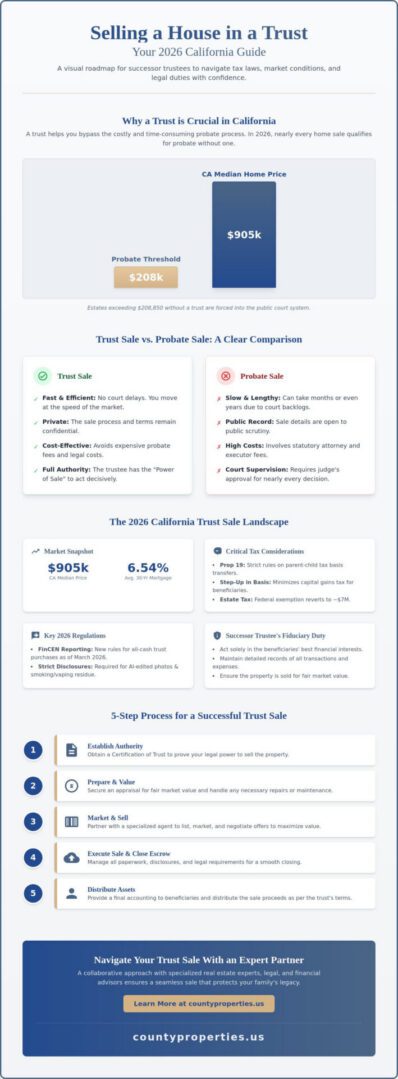
The 5-Step Process to Selling Trust Property in Southern California
Executing the sale of trust-held property requires a methodical approach that balances legal precision with market savvy. In Southern California, where the median home price in Los Angeles reached $860,000 in early 2026, the stakes for your beneficiaries are high. You need a structured roadmap to move from initial verification to the final distribution of assets. Selling a house in a trust California involves these five essential steps:
- Step 1: Document Verification. Confirm your legal standing. The Certification of Trust and Affidavit of Death are your primary tools to prove authority to title companies and escrow officers.
- Step 2: Valuation. Obtain a professional market analysis. In the current San Diego climate, where inventory levels remain tight and the average mortgage rate sits at 6.54%, an accurate valuation ensures you don’t leave beneficiary money on the table.
- Step 3: Disclosures. Identify what must be shared. While you have certain exemptions, California law still requires transparency regarding the property’s condition and history.
- Step 4: Marketing. Position the home strategically. Use professional photography and staging to stand out in a competitive market while adhering to new 2026 digital disclosure laws.
- Step 5: Distribution. Once escrow closes, the proceeds are moved into the trust account for distribution according to the grantor’s specific plan.
California Disclosure Exemptions for Trustees
Successor trustees are often exempt from the standard Transfer Disclosure Statement (TDS) because they typically haven’t lived in the property. However, this isn’t a “get out of jail free” card. You must still disclose any “Known Material Facts” that could affect the property’s value or desirability. For instance, effective in 2026, home sellers must disclose any known residue or history of smoking or vaping inside the property under AB 455. Additionally, a Natural Hazard Disclosure (NHD) report is a non-negotiable requirement for every sale in the state to inform buyers about wildfire or seismic risks.
Strategic Marketing for Trust Assets
Deciding whether to sell “as-is” or invest in minor renovations is a key fiduciary decision. In the 2026 market, high-value buyers expect transparency. If you use AI-edited photos for marketing, AB 723 requires a clear disclosure and a link or QR code to the original, unedited image. Leveraging professional seller representation helps you navigate these complex buyer negotiations while protecting the estate’s bottom line. Professional staging can often yield a higher return than major construction, especially in high-demand Southern California neighborhoods. If you’re ready to begin this process, request a professional trust property evaluation to see how we can maximize your beneficiaries’ inheritance.
Partnering with a Specialized Southern California Real Estate Team
Success in selling a house in a trust California requires more than just a standard real estate license. You need a partner who understands the high-stakes nature of fiduciary responsibility and the emotional complexities of family transitions. A Senior Real Estate Specialist (SRES®) is vital for these transitions because they’re specifically trained to handle the unique financial and legal needs of seniors and their heirs. This expertise ensures that your loved one’s legacy is handled with the dignity and professional mastery it deserves.
Our collaborative approach at County Properties is built on the belief that a trustee shouldn’t have to manage this process alone. We work directly with your attorney and CPA to ensure every decision aligns with your legal obligations and tax strategies. Whether you’re managing property in San Diego or across the broader Southern California region, our localized knowledge provides a significant advantage. We offer turn-key solutions that address every logistical hurdle, including:
- Professional estate clean-outs and item donation coordination.
- Subtle home preparations designed to maximize beneficiary payouts.
- Comprehensive seller representation to manage complex buyer negotiations.
- Final closing coordination that respects the trust’s distribution timeline.
The County Properties Advantage
Arnie Levine founded County Properties with a service-centric philosophy designed to support families through difficult life milestones. We understand that many successor trustees live out-of-state. This makes the logistical burden of property management feel overwhelming. We act as your steady, guiding presence on the ground, handling the heavy lifting so you can focus on your family. Our team provides the security of a long-term professional ally. We ensure your transition is both legally compliant and personally fulfilling.
Next Steps for Successor Trustees
Your journey toward a successful trust liquidation begins with clear information. We invite you to request a complimentary trust property valuation to establish an accurate date-of-death basis or current market value. Following this, we can schedule a strategy session to align our efforts with the specific goals of your trust document. Taking these methodical steps now ensures you fulfill your duties with confidence and peace of mind. Let County Properties guide you through your California trust sale.
Securing Your Family’s Financial Legacy in 2026
You now possess the strategic framework required to manage your role as a successor trustee with professional mastery and care. By focusing on the date-of-death step-up in basis and navigating the specific inflation-adjusted Proposition 19 exclusion caps, you protect the estate’s value for all beneficiaries. Selling a house in a trust California in 2026 requires attention to new transparency laws, such as smoking residue disclosures and FinCEN reporting, but it also offers a unique opportunity to honor a loved one’s wishes without the public burden of probate.
County Properties provides the seasoned guidance you need during this high-stakes transition. With our Senior Real Estate Specialist (SRES®) certification and decades of experience in San Diego trust sales, we act as your dependable ally. We collaborate directly with your legal and tax professionals to ensure a seamless, turn-key experience from the initial valuation to the final closing. You deserve a partner who values your family’s goals as much as you do.
Schedule a Consultation with our Southern California Trust Sale Experts
You have taken the first step toward a successful transition by educating yourself on these complex requirements. We’re here to help you move forward with absolute confidence and achieve a positive outcome for your family’s future.
Frequently Asked Questions
Can a trustee sell a house without all beneficiaries agreeing in California?
Yes, a trustee generally has the authority to sell property without unanimous consent if the trust document grants a “Power of Sale.” You must act in the best interests of all beneficiaries as a fiduciary. While you don’t need a vote for every decision, keeping everyone informed prevents legal challenges and maintains family harmony during the transition.
Do I need a lawyer to sell a house in a trust in California?
You aren’t legally required to hire a lawyer to sell a house in a trust California, but many trustees find their guidance invaluable. While a real estate team handles the market transaction, an attorney can help interpret complex trust language. We recommend checking with your legal advisor to ensure you’re fully protected against personal liability during the sale.
What is the “step-up in basis” and how does it work for a trust sale?
The step-up in basis adjusts the property’s taxable value to its fair market value on the date of the grantor’s death. This reset is a vital tool for financial safety because it can eliminate capital gains tax on decades of appreciation. You’ll need a professional appraisal from that specific date to document this new cost basis for the IRS.
How long does it take to sell a house held in a trust?
Selling trust property typically takes 30 to 60 days once the home is listed on the market. Because you bypass the court-heavy probate process, your timeline mirrors a traditional residential sale. Factors like the current 6.54% mortgage rates and San Diego’s inventory levels will influence how quickly a qualified buyer submits an acceptable offer.
Is a trustee exempt from standard California real estate disclosures?
Trustees are frequently exempt from the Transfer Disclosure Statement (TDS) if they haven’t lived in the home. However, you must still disclose all “known material facts” about the property’s condition. This includes 2026 requirements like the thirdhand smoke disclosure. You cannot withhold information you actually possess simply because you are a trustee.
What happens to the proceeds after selling a house in a trust?
Sale proceeds are paid directly to the trust’s bank account rather than to you personally or the beneficiaries. Once escrow closes and all debts or taxes are settled, you distribute the remaining funds according to the specific instructions in the trust document. Accurate accounting during this phase is essential for satisfying your legal obligations to the heirs.
Can I sell my parents’ house if it is in a living trust while they are still alive?
You can only sell your parents’ house while they’re alive if you’re named as a co-trustee or successor trustee with immediate authority. If your parents are the current trustees, they must sign the listing agreement themselves. If they’ve become incapacitated, you’ll need a “Certification of Trust” to prove your authority to act on their behalf.
How does Proposition 19 affect the sale of an inherited trust property?
Proposition 19 triggers a property tax reassessment if the beneficiaries don’t move into the home as their primary residence. For 2026, the exclusion for a child’s primary residence is capped at the original tax base plus $1,044,586. If you plan on selling a house in a trust California to distribute cash, the buyer will pay taxes based on the new purchase price.