

Is the 2026 “Capital Thaw” the ultimate window to liquidate your portfolio, or will the state’s 13.3% top tax rate turn your exit into a liability? With the California median home price reaching $905,000 this year, you’ve likely felt the pull to capitalize on these historic valuations. It’s natural to worry about how 6.50% mortgage rates affect your buyer pool or how to manage the strict tenant protections that make a sale feel like a legal minefield.
We’re here to help you turn that uncertainty into a calculated win. This guide provides the roadmap for selling investment property in Southern California 2026 with a focus on maximizing your equity and minimizing your tax exposure. You’ll learn how to navigate the new FinCEN reporting rules for all-cash transactions that launched March 1, 2026, and discover why a strategic 1031 exchange is more vital than ever in a market where active listings have climbed 18% year-over-year.
Key Takeaways
- Capitalize on the 2026 “Capital Thaw” by understanding how record-high median prices and stabilizing interest rates create a unique window for portfolio liquidation.
- Master the strategic steps for selling investment property in Southern California 2026 to maximize your equity through 1031 exchanges and advanced tax mitigation.
- Navigate shifting policy risks, including updated ULA tax impacts and California rent control laws, to ensure a compliant and profitable transition.
- Leverage a collaborative team approach to determine your property’s true market value and avoid the pitfalls of rising inventory projected for 2027.
The 2026 Southern California Investment Market: A ‘Capital Thaw’ for Sellers
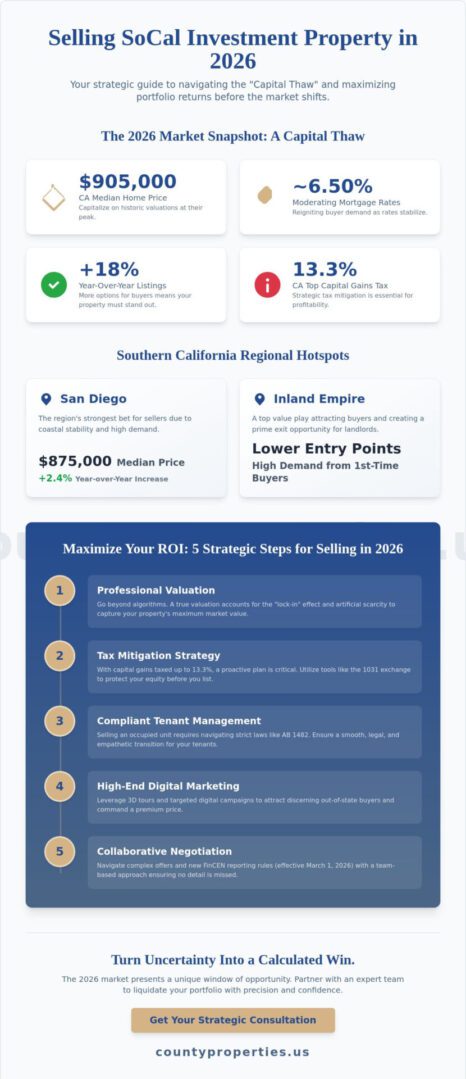
The 2026 market is defined by a “Capital Thaw.” This term describes the release of pent-up buyer demand as mortgage rates finally moderate toward the 6.0% threshold. After years of gridlock, buyers are returning to the table, yet they’re more discerning than ever before. While the average 30-year fixed rate sits around 6.50%, the psychological shift toward lower borrowing costs has reignited interest in residential acquisitions.
California’s statewide median home price is projected to reach $905,000 this year. This record high persists largely because of California’s ongoing housing shortage, which continues to prop up valuations even as more properties enter the market. You’re looking at a landscape where demand still outstrips supply, but the gap is closing just enough to allow for smoother transactions.
Inventory dynamics are shifting. While active listings have seen a 10% increase, this isn’t a sign of a market crash; it’s a sign of a market finding its equilibrium. For you, this means selling investment property in Southern California 2026 requires superior presentation and expert marketing rather than aggressive price drops. Buyers have more options now, so your property must stand out as a high-quality asset to command top dollar.
We’re also seeing a clear “bifurcation effect” across the region. Class A luxury rentals in coastal Orange County and San Diego are significantly outperforming Class C properties. Investors are currently favoring quality and resilience, seeking assets that can weather shifting regulations and economic cycles. If you own a well-maintained property in a prime zip code, you hold significant leverage in today’s negotiations.
Why 2026 is the Year of the Strategic Exit
Buyers have a psychological “Magic 5.9%” mortgage rate threshold. When rates dip toward this number, demand spikes instantly, often leading to multiple-offer scenarios. With a 3.6% price increase projected over 2025 levels, your equity position is likely at an all-time peak. 2026 represents a unique window for Southern California investors to cash out before potential inventory surges in 2027 create stiffer competition. Selling investment property in Southern California 2026 allows you to capture these gains while the “Capital Thaw” is at its most active point.
Southern California Regional Hotspots for Sellers
San Diego remains the region’s strongest bet for sellers due to its coastal stability and high demand from the biotech and defense sectors. Median prices there have reached $875,000 as of May 2026, showing a 2.4% year-over-year increase. Meanwhile, the Inland Empire serves as a top value play for buyers. Lower entry points in Riverside and San Bernardino are attracting first-time buyers and institutional investors alike, creating a perfect exit opportunity for landlords looking to liquidate. To stay ahead of these regional shifts, you should monitor the Southern California housing market trends closely as you plan your timing.
Maximizing Your ROI: 5 Strategic Steps for Selling in 2026
Individual investors, especially those navigating a senior real estate transition, face pressures that large institutions don’t. You aren’t just moving a line item on a spreadsheet; you’re liquidating a lifetime of equity. Selling investment property in Southern California 2026 requires a surgical approach to protect that wealth from high capital gains exposure and shifting buyer expectations.
Step 1 involves a professional valuation that looks past basic online estimates. Most algorithms fail to account for the “lock-in” effect described in a recent Legislative Analyst’s Office report, where current owners hesitate to sell due to low historical mortgage rates. This creates artificial scarcity that your valuation must reflect to capture the property’s true market value.
Step 2 focuses on tax mitigation. With California treating capital gains as ordinary income up to 13.3%, you need a plan before the first offer arrives. Step 3 is tenant management. Selling an occupied unit in 2026 means adhering to AB 1482 and ensuring your residents are handled with empathy and legal precision. Step 4 utilizes high-end tech like 3D tours to attract out-of-state 1031 exchange buyers who are often selling investment property in Southern California 2026 themselves and looking for a replacement asset.
Finally, Step 5 is collaborative negotiation. Our team-based model ensures that while one expert handles the complex FinCEN reporting rules for LLC buyers that took effect March 1, 2026, another is focused entirely on keeping your buyer committed through the inspection period. If you’re feeling overwhelmed by these moving parts, you can request a personalized equity analysis to see exactly where your portfolio stands today.
The 1031 Exchange: Your Secret Weapon Against Capital Gains
Avoiding a massive tax bill in 2026 requires identifying “Like-Kind” properties within strict federal timelines. You have exactly 45 days to identify and 180 days to close on your new asset. A Qualified Intermediary (QI) is mandatory to hold your funds; touching the cash yourself triggers an immediate taxable event. Many investors are currently looking at commercial real estate Southern California as a target for these exchanges to diversify away from the hands-on management of residential units.
Preparing the Property for a High-Value Exit
Don’t fall into the “Deferred Maintenance” trap. In 2026, buyers are wary of high renovation costs and will use minor issues to negotiate major price drops. Focus on high-ROI repairs like HVAC certification and roof maintenance rather than purely cosmetic upgrades. While staging for an owner-occupant highlights lifestyle, staging for an investor should emphasize “rent-readiness” and income potential. A pre-listing inspection is the best way to identify deal-killer issues early and prevent your escrow from falling out during the buyer’s contingency period.
Navigating Policy Risks and Regulatory Hurdles in SoCal
Policy risks in California are no longer just background noise; they’re the primary drivers of deal structure. In 2026, smart sellers are using “policy arbitrage” to move equity from highly regulated coastal pockets into more investor-friendly inland zones. While the 2026 California Housing Market Forecast predicts a stabilization in sales volume, your specific exit price depends on how you navigate local mandates. These include the ULA tax in Los Angeles and the newest appliance maintenance requirements that took effect January 1, 2026, requiring landlords to provide and maintain working stoves and refrigerators.
The ULA Tax, often called the Mansion Tax, continues to influence high-end investment sentiment across the region. Even if your property falls below the luxury threshold, the tax has shifted institutional capital away from certain zip codes, changing the buyer pool for mid-market assets. Additionally, Prop 13 remains the bedrock of your investment gains. Protecting your “American Dream” of homeownership means understanding how to transfer your tax base or time your sale to capture maximum appreciation before local municipalities introduce new transfer fees.
When selling investment property in Southern California 2026, you’re also operating under the expanded reach of AB 1482. This statewide rent control law governs how you handle “just cause” evictions and relocation assistance. Sellers who don’t have a clear legal strategy for tenant-occupied units often find themselves stuck in extended escrow periods or facing steep price concessions during the inspection phase.
San Diego Specific Regulations Every Seller Must Know
San Diego has implemented some of the state’s most rigorous tenant protection ordinances, particularly regarding “Cash for Keys” agreements. You can’t simply offer a tenant a payout to vacate; the process must be documented with specific disclosures to remain valid. Updates to Short-Term Rental (STR) regulations have also impacted property values in coastal communities. If you’re navigating these legislative shifts, our guide on selling a home in Southern California provides the specific checklists you need to stay compliant while listing your asset.
Mitigating the Impact of Rent Control on Sale Price
Marketing a tenant-occupied property to other investors requires a focus on transparency. High rental yields can often offset a buyer’s rent control concerns, provided you can prove the income is stable. Estoppel certificates have become a mandatory part of the 2026 due diligence process. These documents, signed by your tenants, verify the current rent and lease terms, preventing future disputes that could derail your sale. By securing these early, you show buyers that selling investment property in Southern California 2026 can still be a seamless, professional transaction.
Overcoming the ‘Wait and See’ Objection: Why Timing Matters
Many owners are tempted to pause, hoping for the 5.7% rates some analysts predict for late 2027. This “wait and see” approach carries a hidden price tag that could cost you thousands in net equity. While rates might drift slightly lower in the future, waiting likely means competing with 20% more listings by next year as the “lock-in” effect fully dissolves and more sellers enter the fray. Selling investment property in Southern California 2026 allows you to move while inventory is still relatively tight and demand is surging.
We also have to look at the Affordability Index. Currently, only 18% of California households can afford a median-priced home. This creates a hard ceiling on how much further prices can climb before the market simply runs out of qualified buyers. If you’re tracking the 18-year real estate cycle, you’ll recognize we’re in a mature phase where cashing out at a known peak is often wiser than gambling on the final few months of an upswing. The 6.0% rate environment of mid-2026 is a rare sweet spot where buyers feel significant relief but haven’t yet been overwhelmed by a flood of competing properties.
The Opportunity Cost of Hesitation
Holding a rental property isn’t free. Between the new 2026 appliance maintenance laws and the rising costs of disaster remediation for smoke and ash, the “cost of carry” is eating into your monthly cash flow. For many, especially those looking at a lifestyle transition, cashing out at peak equity is more logical than chasing a final 1% of appreciation that might never materialize. If you’re a downsizing investor, working with a senior real estate specialist can help you navigate the emotional and financial complexities of this shift without the stress of a solo transaction.
Buyer Psychology in 2026
The buyers in today’s market have spent the last three years on the sidelines. They’re eager to lock in what they perceive as a “safe haven” asset in a volatile economy. You’re tapping into a massive surge of pent-up demand from the 2023 through 2025 period. The psychological impact of mortgage rates hitting the “Magic 6%” mark has created an intense sense of urgency among buyers who fear missing this window before rates potentially bounce back. If you’re unsure if now is your moment, schedule a 15-minute strategy call to review your specific neighborhood data and see how selling investment property in Southern California 2026 fits your long-term goals.
The County Properties Advantage: Collaborative Excellence
A successful exit in 2026 isn’t a solo achievement. While many corporate firms treat you as a transaction number, Arnie Levine envisioned a different model when he founded County Properties. He explicitly rejected the traditional “Lone Wolf” agent protocol in favor of a collaborative team concept. This ensures that when you’re selling investment property in Southern California 2026, you have a specialized family of friends working toward your financial security rather than a single agent trying to juggle every detail alone.
Our team has navigated every market cycle since 1995. With 36 years of experience, we’ve guided clients through the interest rate spikes of the late 90s and the housing crash of 2008. This historical perspective allows us to advise you through the current “Capital Thaw” with a steady hand. We prioritize your specific goals over a quick commission, ensuring your financial legacy is protected against the volatility of the 2026 market. In a traditional office, agents often compete against each other. At County Properties, we work as a unified force. One specialist might focus on the complex FinCEN reporting for your LLC sale while another manages the tenant-occupied disclosures required by AB 1482. This multi-layered strategy is essential for selling investment property in Southern California 2026 without leaving money on the table.
Beyond Conventional Practices
Our holistic approach goes beyond conventional practices. We provide 24/7 coverage and connect you with vital resources for 1031 exchanges or cash offer facilitation. We specifically address the gap left by corporate firms that ignore the unique needs of individual senior owners. As Senior Real Estate Specialists (SRES), we tailor exit strategies for those downsizing or relocating. We understand that your property isn’t just an asset; it’s the engine for your next life stage. If you’ve been searching for a real estate agent near me in the San Diego area, you’ll find that our structured, service-centric philosophy stands apart from impersonal, corporate competitors.
Your Path to a Successful 2026 Exit
Your path to a successful 2026 exit starts with personalized guidance. We empower you through every phase, from the initial valuation to the final wire transfer. We don’t just list your home; we advise on the timing and tax implications of every offer. Our goal is a seamless transition that leaves you empowered, not exhausted. Whether you’re dealing with a short sale scenario or a straightforward high-value liquidation, our team handles the heavy lifting so you don’t have to. It’s time to take the next step in your journey with a partner you can trust. Contact County Properties for a Personalized 2026 Investment Strategy to secure your financial future today.
Secure Your Financial Legacy in the 2026 Market
The 2026 “Capital Thaw” offers a unique window to liquidate your portfolio at peak valuations before projected inventory increases arrive in 2027. Successfully selling investment property in Southern California 2026 requires more than just a listing; it demands a surgical approach to tax mitigation and tenant management. By leveraging a 1031 exchange and understanding the latest regulatory shifts, you can protect your hard-earned equity from heavy tax liabilities. You’ve worked hard to build your portfolio, and now is the time to ensure those gains are preserved.
Our team at County Properties brings 36 years of Southern California expertise to your side. As SRES® Certified Senior Specialists, we prioritize your long-term security over a simple transaction. Our collaborative model ensures you have a dedicated family of friends navigating every complex legal disclosure and negotiation hurdle. You don’t have to manage this transition alone. It’s about finding the right path for your specific journey.
Get Your Free 2026 Property Value Report & Investment Exit Strategy
Take the next step in your journey with confidence. We’re here to help you turn your investment success into a lasting financial legacy. Your future security is our greatest commitment.
Frequently Asked Questions
Is 2026 a good year to sell investment property in Southern California?
Yes, 2026 is a prime year for selling investment property in Southern California 2026 due to the stabilization of mortgage rates near 6.3%. With the statewide median price hitting $905,000, you’re cashing out at a historical peak. Buyers are returning to the market after years of hesitation, creating a competitive environment that favors high-quality rental assets before inventory potentially surges in 2027.
What is the projected median home price in California for 2026?
The projected statewide median home price in California is $905,000 for 2026. Regional markets show even higher valuations; Orange County reached a median of $1,467,500 in March 2026, while San Diego County hit $1,050,500. These record prices reflect the persistent housing shortage that supports high valuations even as active listings grow by 18% year-over-year in certain coastal pockets.
How do I avoid capital gains tax when selling my rental property?
You can defer capital gains tax by executing a 1031 Exchange into a “like-kind” property. This strategy is vital in California, where gains are taxed as ordinary income at rates up to 13.3%. You must identify a replacement property within 45 days of your sale and close within 180 days. Using a Qualified Intermediary is mandatory to ensure you don’t take constructive receipt of the funds.
What are the current mortgage rate forecasts for Southern California in 2026?
As of May 8, 2026, the average 30-year fixed mortgage rate in California is approximately 6.50%. The 15-year fixed rate is currently 5.88%. These figures represent a significant moderation from previous peaks, fueling the current “Capital Thaw.” While some investors hope for lower figures, the current environment has already unlocked substantial pent-up demand from buyers who were sidelined during 2024 and 2025.
Can I sell my investment property if I have tenants with a long-term lease?
You can sell a property with active leases, but you must comply with California’s strict tenant protections. The buyer typically inherits the lease and becomes the new landlord. Under AB 1482, you must provide proper disclosures and may need to offer relocation assistance if the buyer intends to occupy the unit. Securing estoppel certificates from your tenants is a critical step to verify lease terms for the buyer.
What is the ‘Mansion Tax’ and does it apply to my Southern California sale?
The “Mansion Tax” refers specifically to the Los Angeles ULA Tax, which applies to high-value real estate transfers within the city of Los Angeles. It doesn’t apply to properties in San Diego, Riverside, or San Bernardino counties. If you’re selling in LA, this tax adds a significant percentage to your closing costs, making a tax-efficient exit strategy even more critical for protecting your net proceeds.
How long does it typically take to sell an investment property in San Diego right now?
Homes in Southern California are spending a median of 26 days on the market as of March 2026. While this is a brisk pace, it’s a slight deceleration compared to previous cycles. This pace gives buyers more negotiating power, which is why professional staging and accurate pricing are essential to ensure your property doesn’t linger and become “stale” in the eyes of increasingly discerning investors.
Why should I use a Senior Real Estate Specialist (SRES) to sell my portfolio?
An SRES professional understands the unique financial legacy goals of investors over age 50. When selling investment property in Southern California 2026, these specialists help you navigate the transition from active management to passive income or liquidation. They focus on your long-term security, helping you coordinate with tax professionals to ensure your exit supports your lifestyle goals and minimizes the future burden on your heirs.