

Is a 5% yield actually worth the risk when property prices continue to squeeze your margins? In a market as competitive as San Diego, asking what is a good cap rate in Southern California often leads to conflicting answers. You might feel like you’re chasing moving targets, especially with the Los Angeles multifamily average hitting 5.7% in early 2026 while coastal La Jolla assets trade as low as 3.5%. It’s difficult to hunt for yield when interest rates remain elevated and reliable local benchmarks are hard to find.
We believe you deserve clarity to protect your financial security. This guide provides the specific 2026 benchmarks you need to make confident decisions, from San Diego’s 5.16% cross-sector average to the Inland Empire’s 6.0% value-add opportunities. You’ll discover how to balance immediate cash flow against high-appreciation potential while staying compliant with new 2026 regulations, including the FinCEN all-cash reporting requirements and updated landlord appliance mandates. We will break down exactly where the sweet spot lies for your next Southern California investment.
Key Takeaways
- Understand why cap rate is the essential unleveraged metric for comparing Southern California properties against national averages.
- Learn exactly what is a good cap rate in Southern California for 2026, where the current benchmark typically ranges between 4.5% and 6.5% for multifamily assets.
- Compare regional ROI shifts across San Diego, Los Angeles, and the Inland Empire to identify where lifestyle premiums or rent controls impact your calculations.
- Discover why a lower initial yield in a coastal market often outperforms high-yield bargain states through superior long-term appreciation and equity growth.
- Explore how personalized guidance from County Properties helps you transition family assets into high-performing rental portfolios or navigate senior real estate moves.
What is a Cap Rate and Why It Matters in Southern California?
Understanding the Capitalization rate (or ‘cap rate’) is the first step for any serious investor looking to grow their portfolio. It’s the primary tool for comparing the relative value of similar real estate investments without the distortion of debt. At its core, the cap rate is your Net Operating Income (NOI) divided by the current market value. This figure represents the “unleveraged” return on an investment, showing you how a property performs on its own merits before financing enters the picture.
When you ask what is a good cap rate in Southern California, you have to look at the region’s unique economic pressures. Our market is defined by high demand and a chronic shortage of housing supply. These factors lead to “cap rate compression,” a situation where yields are lower because the asset’s safety and appreciation potential are so high. In a market like San Diego, a lower yield isn’t necessarily a warning sign; it’s often a reflection of the property’s stability and the desirability of the location.
The 2026 Cap Rate Formula for San Diego Investors
To find an accurate cap rate for 2026, you must start with a realistic Net Operating Income. This isn’t just your rent roll. You need to calculate your gross income and subtract all essential operating expenses. These typically include:
- Property taxes and special assessments.
- Insurance premiums for 2026 coverage.
- Maintenance and repair reserves.
- Utilities not paid by tenants.
One common mistake we see is using the original purchase price for this calculation. In 2026, you should always use the “Current Market Value” to get an honest reading of your investment’s health. Additionally, don’t forget to include a vacancy factor. Even with San Diego’s tight rental market, applying a 3% to 5% vacancy allowance ensures your projections are grounded in reality rather than optimism.
Cap Rate vs. Cash-on-Cash Return
While cap rate measures property performance, cash-on-cash return measures how your actual cash is working for you. This distinction is critical in 2026 because of the current interest rate environment. A property might have a healthy 5.5% cap rate, but if your financing costs are 6.5%, your cash-on-cash return will be significantly lower.
You should prioritize the cap rate if your goal is long-term wealth preservation and identifying high-quality assets. If you’re a retiree or an investor who relies on monthly distributions for living expenses, the cash-on-cash return becomes the more vital metric. Balancing these two numbers is how we help our clients ensure their financial security for the long haul.
Defining a ‘Good’ Cap Rate: Southern California Benchmarks for 2026
Determining what is a good cap rate in Southern California requires a shift in perspective if you’re used to Midwest or Sunbelt yields. In early 2026, a “good” baseline for Southern California multifamily property typically sits between 4.5% and 6.5%. While investors in other states might scoff at anything below 7%, the local market rewards those who prioritize stability and long-term equity. According to the California Housing Affordability Tracker, the persistent shortage of inventory keeps demand high, which naturally compresses yields but protects against vacancy.
Comparing these rates to the “risk-free rate” of 10-year Treasury yields is essential for your 2026 strategy. If a Treasury bond offers a 4.3% return, a 4.8% cap rate on a coastal apartment complex might seem thin. However, real estate offers a hedge against inflation and significant tax advantages that fixed-income assets simply can’t match. A 4% cap rate in a premium area like La Jolla is often a superior investment to a 7% yield in a high-crime neighborhood where turnover and maintenance costs eat your profit. You’re trading immediate cash flow for high-security, high-appreciation potential.
Benchmarking by Property Class
Your expected return should align with the quality of the asset. In 2026, Class A luxury properties trade between 4.2% and 5.0%. These assets provide the highest stability but the lowest immediate cash flow. Class B properties, often the favorite for San Diego investors, range from 5.1% to 5.8%. These well-maintained, older buildings offer a balanced mix of yield and growth. Class C value-add assets usually target 6.0% to 7.0% or higher. These require active management and a higher risk tolerance to navigate deferred maintenance and tenant turnover.
Sector Variations: Multifamily vs. Commercial
Multifamily remains the gold standard in 2026. The housing crisis ensures that occupancy stays high, keeping cap rates for apartments tighter than other sectors. Conversely, retail and office spaces are trending higher, often between 7% and 9%. This reflects the increased risk associated with changing work habits and e-commerce growth. Industrial properties in San Diego tell a different story. Proximity to the border and logistics hubs keeps industrial cap rates incredibly tight, often rivaling Class A multifamily. If you’re unsure which class fits your goals, our team can provide personalized San Diego investment guidance to help you choose wisely.
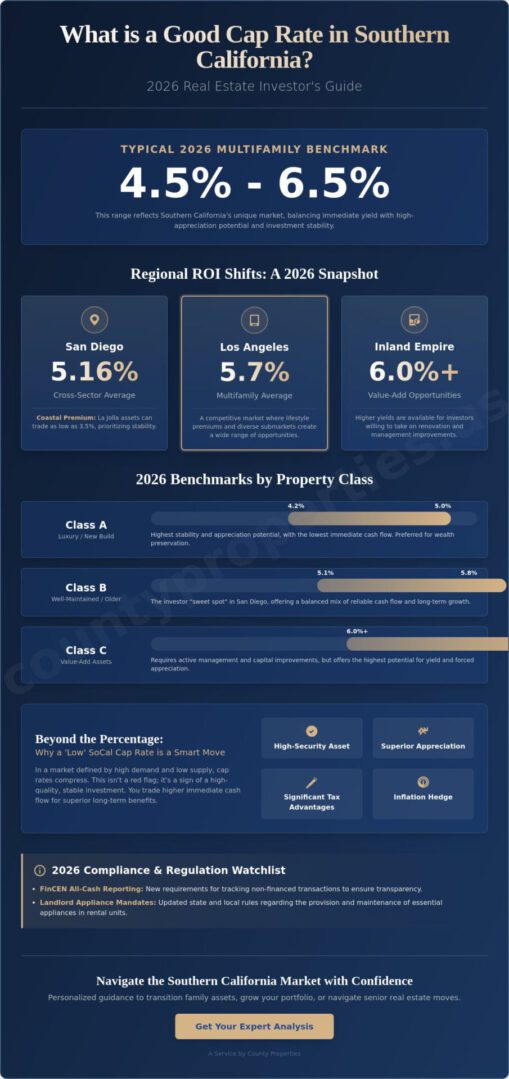
San Diego vs. LA vs. Inland Empire: Regional ROI Shifts
Location dictates your return more than any other variable. When you’re trying to determine what is a good cap rate in Southern California, you have to realize that a “good” number in Riverside is a “great” number in San Diego. San Diego County commands a unique premium. This is driven by our massive military presence, a world-class biotech hub, and a lifestyle that keeps vacancy rates among the lowest in the nation. Investors here often accept tighter yields because the downside risk is significantly lower than in less diversified markets.
Los Angeles County presents a more complex landscape. Investors there must navigate a patchwork of local rent control ordinances that can cap annual increases at 3% or less, making your Net Operating Income (NOI) calculations much more sensitive to tenant turnover. In contrast, the Inland Empire offers the most aggressive initial yields in the region, frequently exceeding 6% for stabilized assets. The trade-off is a higher vacancy risk. The logistics-heavy economy of San Bernardino and Riverside can be more volatile than the coastal hubs, meaning your 2026 projections need a larger cushion for potential downtime.
Recent data from Southern California Commercial Real Estate Cap Rates highlights how these regional shifts create distinct opportunities for different investor profiles. These trends are explored further in our comprehensive guide to the Southern California Housing Market: Forecast & Trends for 2026, which tracks the ongoing migration patterns across the Southland.
San Diego Neighborhood Deep Dive
Rancho Santa Fe is the ultimate example of the equity-over-yield strategy. You might see cap rates as low as 2.5% or 3% there. While the monthly cash flow is thin, the massive equity growth and asset security are unparalleled. If you’re looking for consistent Class B performance, neighborhoods like Hillcrest and City Heights are the workhorses of the San Diego market. High rental demand in these urban pockets keeps units full and yields steady. We also use the “10-mile rule” as a benchmark. For every 10 miles you move inland from the San Diego coast, you can generally expect your cap rate to increase by 0.25% to 0.50% as the “coastal premium” for appreciation begins to soften.
The Impact of Local Regulations
San Diego’s specific Accessory Dwelling Unit (ADU) laws have changed the game for 2026. These regulations allow you to add density to existing lots with fewer hurdles than traditional development, which can dramatically boost your property’s NOI. However, you must still factor in California’s statewide rent control, AB 1482. For non-RSO units built before January 1, 2011, rent increases are generally capped at 5% plus the local CPI. Without local expertise, it’s easy to miss hidden municipal expenses like specific trash hauling mandates or utility pass-through restrictions that vary by city council district.
Beyond the Percentage: Why a ‘Low’ Cap Rate Can Be a Smart Move
Many investors get stuck on a single number. They see an 8% yield in a Rust Belt city and compare it to a 5% yield in Coastal San Diego. This leads them to ask: what is a good cap rate in Southern California if the number looks so low on paper? The answer lies in the total return. In supply-constrained markets like Southern California, cap rate measures current yield while ignoring the massive historical wealth generated through equity growth.
When assessing what is a good cap rate in Southern California, you have to look past the immediate check. Over the last 30 years, Southern California has consistently outperformed high-yield markets in terms of equity. A property bought at a 5% cap rate that appreciates by 6% annually creates far more wealth than a stagnant 8% yield in a market with no growth. You’re trading a few points of current cash flow for millions in long-term net worth.
Prop 13 serves as a hidden hero for local investors. It limits annual property tax increases to a maximum of 2% per year, which protects your Net Operating Income from the sudden tax spikes common in states like Texas or Florida. This predictability is a cornerstone of financial security. While your rents rise with the market, your largest fixed expense stays remarkably stable, effectively “growing” your cap rate every year you hold the asset.
The “Safety Premium” of Southern California
Institutional players and Real Estate Investment Trusts (REITs) flock to San Diego because of the “Safety Premium.” The region’s economic diversity, powered by the military, biotech, and tourism, ensures high tenant quality. These assets act as a powerful hedge against 2026 inflation concerns. Because rental demand remains so high, you can adjust rates more effectively than investors in markets with high vacancy. You aren’t just buying a building; you’re buying a spot in one of the world’s most desirable economies.
Value-Add Strategies to “Force” a Better Cap Rate
You can also “force” a better return through active management. Renovations allow for higher rents, while a Ratio Utility Billing System (RUBS) shifts utility costs back to tenants without the need for expensive sub-metering. This immediately boosts your NOI. Converting garages or underutilized land into Accessory Dwelling Units (ADUs) is another way to jumpstart your yield in 2026. For more tactical advice on these methods, see our Commercial Real Estate Southern California: An Investor’s Guide.
If you want to see how these strategies apply to your specific portfolio, reach out to us for expert San Diego investment consulting.
Maximizing Your Investment Strategy with County Properties
Understanding what is a good cap rate in Southern California is an essential starting point, but turning that data into a successful portfolio requires a seasoned hand. Arnie Levine and the team at County Properties bring 36 years of experience to the table, providing the personalized guidance you need to navigate the San Diego market. We don’t just look at numbers; we look at your life’s journey. Our collaborative team approach prioritizes your financial security over simple transactions. We operate as a family of friends committed to service excellence, ensuring every move you make aligns with your long-term goals.
Senior Real Estate & Lifestyle Transitions
One of our core specializations is helping families navigate the transition from a large family home into a high-performing rental portfolio or a more manageable lifestyle. Downsizing with dignity is a complex process that involves both emotional and financial hurdles. As a Senior Real Estate Specialist (SRES®), Arnie Levine understands these unique challenges. We help you evaluate if your current equity could be better served in a property with a higher yield, effectively turning a house full of memories into a source of reliable retirement income. We provide the step-by-step support needed to make these late-stage moves seamless and stress-free.
Seller Representation for Investment Assets
If you’re ready to exit a position, our seller representation services are designed to highlight your property’s specific cap rate potential to the most qualified buyers. In a market where buyers are constantly asking what is a good cap rate in Southern California, having a partner who can articulate the value of your Net Operating Income is vital. We use comprehensive 2026 market data to justify a premium sales price, ensuring you don’t leave money on the table. Whether you’re selling a Class B apartment in Hillcrest or a retail space in North County, we provide the data-driven marketing and expert negotiation required for success.
Don’t leave your next move to chance. We provide the clarity you need to make informed decisions in an ever-changing market. Whether you are curious about your home’s current market value or need a deep dive into specific local benchmarks, we’re here to serve as your steady hand. Contact County Properties for a Free Market Report and take the next step in your investment journey with a team you can count on.
Securing Your Financial Future in the 2026 Southern California Market
Determining what is a good cap rate in Southern California is just the first step toward building a resilient portfolio. While the 2026 benchmarks provide a useful baseline, your success depends on choosing assets that align with your specific lifestyle and retirement goals. We’ve explored how regional shifts and property classes impact your bottom line. Now, it’s time to apply those insights to your own holdings to ensure your long term security.
County Properties has served as a trusted real estate partner since 1995. Our team brings 36 years of seasoned professional experience to every transaction, specializing in complex Senior Real Estate Transitions and investment sales. We prioritize your financial security by providing the holistic guidance necessary for long term equity growth. Whether you’re downsizing a family estate or expanding a commercial portfolio, our expertise ensures a seamless transition for you and your family.
Let us help you make your dream of secure homeownership and passive income come true. Get Your Free Southern California Property Valuation Report today to see exactly where your assets stand in the current market. Your journey toward a more profitable 2026 starts with reliable data and a partner you can trust. We look forward to helping you take the next step.
Frequently Asked Questions
What is the average cap rate in San Diego for 2026?
The average cap rate across all asset types in San Diego is 5.16% as of April 2026. For multifamily properties specifically, the average typically ranges between 4.8% and 5.1%. These figures reflect the high demand for local inventory and the premium investors are willing to pay for San Diego’s economic stability and diversified job market.
Is a 4% cap rate too low for a Southern California investment?
A 4% yield isn’t necessarily too low if the property is located in a high-appreciation coastal area. When asking what is a good cap rate in Southern California, you have to consider that premium markets like La Jolla often trade between 3.5% and 4.25%. These assets prioritize long-term equity growth and wealth preservation over immediate monthly cash flow.
How do interest rates affect cap rates in the current market?
Interest rates exert upward pressure on cap rates because investors require a spread over the return of risk-free assets like Treasury bonds. In early 2026, we’ve seen cap rates expand by approximately 60 basis points in some sectors to compensate for higher borrowing costs. If financing remains expensive, property values often adjust downward to keep yields competitive for new buyers.
Should I prioritize cap rate or cash flow when buying in San Diego?
You should prioritize cap rate if your goal is long-term wealth building, but focus on cash flow if you need immediate income to cover debt or living expenses. San Diego is historically an appreciation-heavy market where properties often have lower initial yields but higher total returns over a ten-year hold. We help our clients balance these metrics based on their specific financial security needs and retirement timelines.
What is the difference between a cap rate and a GRM (Gross Rent Multiplier)?
Cap rate accounts for all operating expenses, whereas the Gross Rent Multiplier (GRM) only looks at the relationship between the purchase price and gross rental income. GRM is a useful quick screening tool, but it’s often misleading because it ignores taxes, insurance, and maintenance costs. Cap rate remains the more accurate metric for determining the true profitability of a Southern California investment asset.
Can I increase the cap rate of a property I already own?
You can increase your cap rate by either raising your Net Operating Income (NOI) or reducing your annual operating expenses. Implementing a Ratio Utility Billing System (RUBS) to pass utility costs to tenants or adding an Accessory Dwelling Unit (ADU) are two effective ways to boost income in 2026. Even small efficiency improvements, like upgrading to low-flow plumbing, can reduce expenses and improve your overall yield.
Why do commercial properties have higher cap rates than residential ones?
Commercial properties generally carry higher cap rates because they involve more significant risks, such as longer vacancy periods and higher tenant improvement costs. While a San Diego retail center might offer a 6.75% to 7.65% yield in 2026, it requires more specialized management than a standard apartment building. Residential assets are seen as “necessity” housing, which naturally compresses their yields due to lower perceived risk.
What happens to the cap rate if property taxes increase in California?
An increase in property taxes directly reduces your Net Operating Income, which causes the cap rate to drop if the property value remains the same. Fortunately, Prop 13 limits most annual tax increases to 2% unless the property is sold or significantly renovated. If you’re evaluating a new acquisition in 2026, always calculate the cap rate based on the reassessed tax value rather than the seller’s current tax bill.