

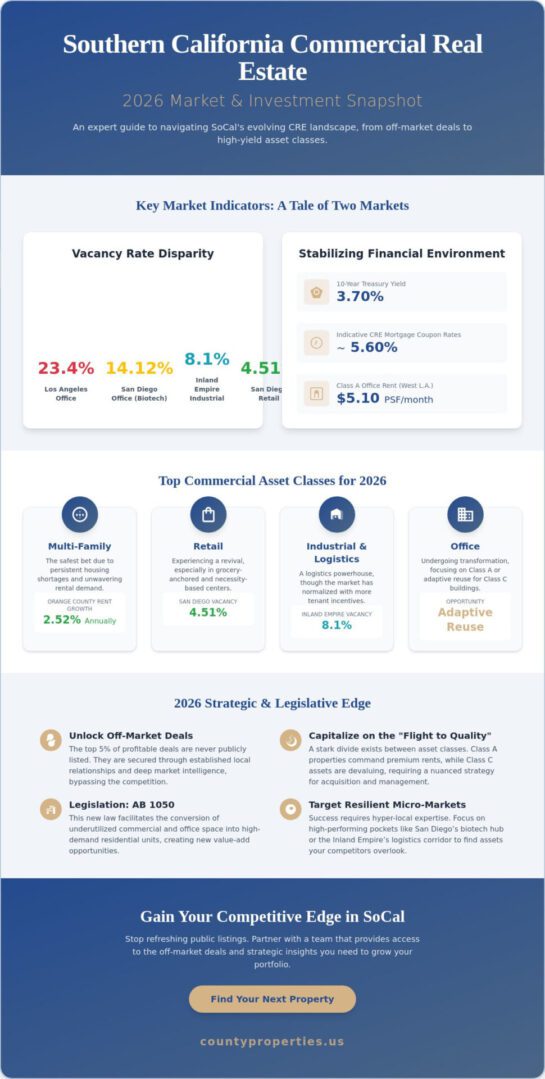
The most profitable commercial real estate for sale Southern California currently offers will never appear on a public listing portal or a digital scraper. While many investors spend hours refreshing websites, the top 5% of deals are secured through established local relationships and off-market intelligence. You’ve likely felt the frustration of losing out to institutional REITs or hitting a wall with California’s dense environmental regulations. It’s a competitive market where the “flight to quality” is real; Los Angeles office vacancies sit at 23.4% while San Diego retail remains remarkably tight at 4.51%.
We understand that you’re looking for more than just a transaction. You want a seasoned partner to help grow your portfolio with confidence. This guide promises to demystify the 2026 market by providing expert insights into asset classes and regional trends. You’ll learn how to capitalize on commercial mortgage rates as low as 5.30% and navigate new laws like AB 1050 that facilitate residential conversions on commercial land. We’ll explore the shift toward transit oriented development and provide a roadmap for identifying high-yield assets that your competitors are overlooking.
Key Takeaways
- Discover how new 2026 legislation like AB 1050 streamlines the conversion of underutilized office space into high-demand residential units.
- Identify resilient, high-performing assets by targeting specific micro-markets like San Diego’s biotech hub or the Inland Empire’s logistics corridor.
- Master the strategic acquisition process to uncover off-market commercial real estate for sale Southern California before it reaches public listing sites.
- Navigate complex 2026 regulations, including new FinCEN reporting requirements and expedited permit timelines, with confidence.
- Learn why a collaborative “team concept” provides a competitive advantage over traditional, commission-driven brokerage models.
The Southern California Commercial Real Estate Market in 2026
The 2026 landscape for commercial real estate for sale Southern California has moved past post-pandemic volatility into a period of calculated adaptation. We’ve observed a massive pivot toward adaptive reuse as developers convert underutilized office space into high-density housing or specialized medical facilities. This shift is fueled by legislative support and a stabilizing financial environment. With the 10-year Treasury at 3.70% as of March 31, 2026, indicative coupon rates for commercial mortgages in California have settled around 5.60%. This predictability has allowed property valuations to find a new floor, ending the “wait-and-see” approach that defined previous years.
Investors are now engaged in a “flight to quality” that creates a stark divide in the market. Class A properties with modern amenities and high environmental ratings command premium rents, while Class C assets face significant devaluation. In West Los Angeles, Class A office space still commands $5.10 PSF per month, even as market-wide averages sit lower at $3.59 PSF. Achieving success in this environment requires a deep understanding of micro-neighborhood shifts. A single zoning change or transit project can radically alter a block’s potential overnight, making local expertise your most valuable asset.
Economic Drivers Shaping SoCal CRE
The Southern California economy remains anchored by diverse sectors that are currently in a state of recovery or expansion. In San Diego, the biotech and life sciences sectors are stabilizing the office market, maintaining a vacancy rate of 14.12% compared to the much higher 23.4% seen in Los Angeles. Meanwhile, the Inland Empire continues its reign as a logistics powerhouse, though industrial vacancy has normalized to 8.1% as of Q4 2025. Landlords here are now offering more aggressive tenant incentives to maintain occupancy levels. All new commercial developments over 50,000 square feet must now adhere to the 2026 CALGreen embodied carbon reduction standards and expanded EV infrastructure requirements.
Investor Sentiment and Market Liquidity
We’ve noticed a distinct change in who is buying. While institutional private equity remains selective, individual family offices are increasingly active, seeking long-term wealth preservation over quick flips. Coastal communities are seeing a rise in “lifestyle commercial” properties that blend high-end retail with wellness and social spaces. Retail is proving surprisingly resilient; San Diego’s retail vacancy was just 4.51% at the end of 2025. Investors are aggressively targeting grocery-anchored centers and necessity-based hubs that offer consistent cash flow. Finding the right commercial real estate for sale Southern California now depends on identifying these high-yield, resilient pockets before the broader market catches on.
Top Commercial Asset Classes for Sale in Southern California
Selecting the right asset class is the first step toward long-term portfolio growth. In 2026, the spectrum of commercial real estate for sale Southern California offers ranges from high-risk office redevelopments to ultra-stable multi-family complexes. According to recent Southern California commercial market data, the region is seeing a stabilization in vacancy rates across industrial and retail sectors, while multi-family remains the most resilient against economic headwinds. Success here isn’t about buying any property; it’s about matching the asset type to the specific economic cycle of the neighborhood.
Multi-family assets continue to be the safest bet because of the persistent housing shortage. With Orange County multifamily rents predicted to grow by 2.52% annually through 2027, the demand for residential rentals is unwavering. Retail is also seeing a revival, particularly in experiential centers where vacancy rates in San Diego County dipped to 4.51% at the end of 2025. Office space is undergoing a transformation. Investors are focusing on Class A suburban satellites that support hybrid work models, while Class C buildings are being eyed for adaptive reuse projects. These shifts require a steady hand and decades of local insight to navigate correctly.
Multi-family Investment Dynamics
Investing in multi-family units requires a sophisticated understanding of local rent control ordinances. These rules vary significantly between Los Angeles and Orange Counties, affecting your long-term yield. The current opportunity lies in “missing middle” housing, which includes mid-density developments that cater to the local workforce. This sector benefits from the same supply-demand imbalance that makes Buying a home in Southern California such a challenge for individuals. By focusing on these properties, you can secure reliable cash flow while providing essential housing solutions to the community.
The Industrial Boom: Inland Empire and Beyond
Industrial and flex spaces remain the backbone of the region’s e-commerce economy. The Inland Empire, despite a rise in vacancy to 8.1% in Q4 2025, still offers the highest concentration of warehousing capacity in the West. Land availability is becoming critically limited, which has pushed the rise of “Last Mile” delivery hubs closer to San Diego and LA. Buyers must be wary of environmental compliance under the California Environmental Quality Act (CEQA). These regulations add layers of complexity to industrial acquisitions that can stall a project for months. If you want to see how these trends affect your specific goals, you can connect with our team for a detailed analysis of available inventory.
Navigating Southern California Micro-Markets
Southern California is not a single, monolithic market. It’s a complex collection of distinct economies, each with its own risk profile and growth trajectory. Successfully identifying commercial real estate for sale Southern California offers requires a lens that zooms into these specific county dynamics. While Los Angeles offers scale and diversity, the Inland Empire provides the higher cap rates sought by yield-hungry investors. Understanding these micro-market shifts is the difference between a stagnant asset and a high-performing portfolio addition.
Los Angeles County remains the epicenter of creative industry and high-density multi-family opportunities. With average office rents at $3.59 PSF, it’s a market defined by neighborhood-level revitalization. Conversely, Orange County presents a more stable environment with premium pricing. It’s a hub for high-income retail and Class A office space, where rents average $2.88 PSF per month. For those seeking logistics dominance, the Inland Empire is the undisputed capital. Despite an industrial vacancy rate of 8.1% in late 2025, it continues to offer better entry points for investors who prioritize cash flow over immediate coastal appreciation.
San Diego: The Jewel of SoCal CRE
San Diego County has carved out a unique niche as a global leader in biotech and military-related assets. The office vacancy rate here sits at a relatively healthy 14.12%, buoyed by a consistent demand for specialized lab space. Urban redevelopment is currently centered in neighborhoods like Hillcrest and North Park, where walkability and density are driving new mixed-use projects. The Port of San Diego also acts as a powerful economic engine, sustaining a robust maritime-industrial sector that is rarely available on the open market. To understand how these commercial shifts mirror residential demand, you can review our latest report on Southern California housing market trends.
Emerging High-Growth Corridors
The most significant growth in 2026 is occurring along the I-15 and I-5 corridors. These secondary markets are becoming primary targets as businesses migrate away from hyper-expensive coastal cores. Infrastructure projects are the main catalyst here. The “Abundant & Affordable Homes Near Transit Act” (SB 79), which takes effect July 1, 2026, is a game changer. It allows local governments to override traditional zoning near major transit stops. This legislation is creating new “hot zones” for transit-oriented development, offering savvy buyers a chance to secure land that will soon support significantly higher density. These corridors represent the next frontier for investors looking for long-term equity growth without the coastal price tag.
The Strategic Acquisition Process: Due Diligence and Financing
Securing a piece of commercial real estate for sale Southern California offers requires more than just capital; it demands a rigorous, step by step strategy to mitigate risk. Most high value deals in 2026 happen behind closed doors through pocket listings and established industry networks. Once you’ve identified a target, your financial modeling must account for the current 5.60% indicative coupon rates. You’re not just looking at today’s yield; you’re projecting how the 2026 legislative shifts will impact your ten year exit. The closing process is a gauntlet of contingencies that requires expert representation to navigate without losing your earnest money deposit.
- Step 1: Asset Identification. Focus on off-market opportunities to avoid the bidding wars common on public portals.
- Step 2: Financial Modeling. Run sensitivity analyses on cap rates to ensure the property remains viable if market conditions shift.
- Step 3: Due Diligence. Investigate zoning, environmental history, and physical building integrity.
- Step 4: Capital Stack Assembly. Secure financing that balances leverage with cash flow safety.
- Step 5: Closing and Reporting. Finalize the transfer while complying with new March 1, 2026, FinCEN reporting requirements for legal entities.
Environmental and Zoning Hurdles
California’s regulatory environment is notoriously complex. You’ll need to start with a Phase I Environmental Site Assessment (ESA) to uncover any history of hazardous materials. If the Phase I raises red flags, a Phase II ESA involving soil or groundwater sampling becomes mandatory. Don’t skip the ALTA survey; it provides a detailed map of property lines, easements, and improvements that standard surveys miss. Title insurance acts as a vital shield for your investment, ensuring that undisclosed liens or ownership disputes don’t compromise your commercial equity. You should also verify that all listing materials comply with the January 1, 2026, law requiring disclosure of AI-generated property photos.
Creative Financing Solutions for 2026
While interest rates have stabilized, credit remains tight. Owner-users should look closely at SBA 504 loans, which offer long term, fixed rate financing with as little as 10% down. We’re also seeing a resurgence in seller carry-back financing, where the seller acts as the lender to bridge the gap between your down payment and a traditional bank loan. If you’re selling an existing asset, a 1031 exchange remains the most powerful tool to defer capital gains tax and roll your equity into a larger Southern California property. To navigate these financial complexities with a partner who has seen every market cycle since 1995, you can schedule a strategic acquisition consultation with our team today.
Why Partner with County Properties for Your CRE Search?
Finding the right property is only half the battle. You need a partner who understands that your financial security is the ultimate goal. Arnie Levine founded County Properties with a vision to revolutionize traditional real estate protocols. He rejected the individualistic, commission-driven model in favor of a “Team Concept.” This means when you search for commercial real estate for sale Southern California, you aren’t just hiring an agent. You’re gaining a family of friends committed to your success. It’s not just a slogan; it’s a commitment we’ve upheld for decades.
Our history in the region dates back to 1995. With 36 years of experience, we’ve navigated every market cycle from the dot-com bubble to the stabilization we’re seeing in 2026. We provide a holistic approach that goes beyond simply closing a deal. We act as your seasoned mentors, guiding you through the complexities of a market where high-quality Class A assets are increasingly rare. We know that every acquisition is a step in your life’s journey, and we treat your portfolio growth with the care it deserves.
Boutique Service, Institutional Results
While large brokerages focus on volume, we focus on precision. Our deep local network allows us to uncover off-market opportunities that never reach public portals. This is critical in a 2026 market defined by tight inventory and opaque pricing. We also offer specialized expertise in areas many firms overlook, such as senior real estate needs and distressed property solutions. We understand the nuances of the “flight to quality” and can help you identify assets that provide resilient yields. For a deeper dive into the specific metrics driving current valuations, read our Commercial Real Estate Southern California: An Investor’s Guide.
Taking the Next Step in Your Journey
We believe in the American Dream of ownership and wealth building. Whether you’re a first-time investor or a seasoned family office, we provide personalized, step-by-step guidance tailored to your specific goals. Our commitment is to empower you with the data and local intelligence needed to build long-term wealth in an environment of shifting regulations and interest rates. We don’t just provide market reports; we provide a roadmap to success in the most competitive real estate environment in the country. Your goals deserve more than a generic search engine. They deserve a trusted partner who prioritizes your service over individual marketing. Contact us today for a curated list of Southern California commercial properties and let’s begin your next chapter together.
Mastering the 2026 Southern California Commercial Landscape
Success in this evolving market requires more than just capital; it demands a deep understanding of the “flight to quality” that currently defines the region. You’ve seen how high quality Class A assets in West LA command $5.10 PSF, while new laws like SB 79 are radically reshaping transit oriented development zones. Industrial vacancy in the Inland Empire has normalized to 8.1% as of late 2025, creating a more balanced environment for savvy buyers. Finding the right commercial real estate for sale Southern California offers depends on acting on these precise trends before they become common knowledge across the public portals.
You don’t have to navigate these regulatory and financial complexities alone. With 36 years of Southern California market experience dating back to 1995, our founder led team is here to provide the steady hand you need. We prioritize your long term financial security over individual agent ego, offering specialized expertise in the San Diego and Inland Empire micro markets. Whether you’re managing Phase I environmental assessments or securing 5.30% mortgage rates, we are ready to serve as your dependable mentor. Let County Properties guide your next commercial investment and help you turn these strategic insights into lasting wealth. Your journey toward a high performing portfolio starts with a single, expert conversation.
Frequently Asked Questions
What is the average cap rate for commercial real estate in Southern California in 2026?
Average cap rates for commercial real estate for sale Southern California typically range between 5.5% and 7.0% as of mid 2026. These yields are closely indexed to the 10 year Treasury rate, which was 3.70% on March 31, 2026. While industrial assets in the Inland Empire often sit at the lower end of this range due to high demand, Class B office properties may offer yields above 7.5% to attract investors.
How do I find off-market commercial listings in San Diego?
Securing off-market listings in San Diego requires a relationship heavy approach rather than refreshing public listing portals. Our team identifies these “pocket listings” through a local network built over 36 years of experience. In the current 2026 market, approximately 30% of high quality commercial deals are completed privately. This allows buyers to avoid the aggressive bidding wars often seen with institutional REITs on the open market.
What are the main differences between buying residential vs. commercial property in California?
The primary differences lie in the valuation methods and the depth of due diligence required. Commercial properties are valued based on their Net Operating Income (NOI) and cap rates, while residential assets rely on comparable sales data. Commercial buyers must also navigate complex environmental hurdles like Phase I ESAs and ALTA surveys. Financing is equally distinct, as commercial loans often feature shorter terms and are based on the property’s ability to service debt.
Can a Senior Real Estate Specialist (SRES) help with commercial property transitions?
Yes, an SRES can be a vital partner when transitioning out of a legacy commercial investment into a retirement strategy. These specialists understand the tax implications and estate planning needs unique to senior investors. They often assist in liquidating commercial real estate for sale Southern California owners have held for decades. This guidance ensures a seamless transition into passive income vehicles like Delaware Statutory Trusts or simplified residential portfolios.
What is a 1031 exchange and how does it apply to SoCal commercial sales?
A 1031 exchange allows you to defer capital gains taxes by reinvesting the proceeds from a sold property into a like kind replacement. In the high value Southern California market, this strategy is essential for preserving equity during a portfolio upgrade. You must identify a new property within 45 days of your sale and complete the purchase within 180 days. This process allows investors to roll 100% of their proceeds into larger, more profitable assets.
How much down payment is typically required for a commercial loan in Southern California?
Most traditional commercial lenders in Southern California require a down payment between 20% and 35% of the purchase price. However, owner users can often qualify for SBA 504 loans which require only 10% down. Lenders in 2026 are strictly evaluating the Debt Service Coverage Ratio (DSCR). You will generally need a DSCR of 1.25 or higher to secure the most competitive rates, which currently hover around 5.60% for many Class A assets.
What are the current zoning challenges for mixed-use developments in San Diego?
The biggest challenge in San Diego involves aligning new projects with the “Abundant & Affordable Homes Near Transit Act” (SB 79), which became effective July 1, 2026. While this law allows for increased density near transit hubs, developers still face local hurdles regarding parking minimums and environmental impact reports. Navigating these conflicting state and local regulations requires a partner who understands the specific micro neighborhood shifts currently occurring across San Diego County.