

What if you finally found your perfect home in North County, only to realize at the very last minute that you’re $18,000 short because of overlooked fees? It’s a common fear for many house hunters in Southern California. You’ve likely spent months saving for a down payment, but the reality of San Diego buyer closing costs can feel like a moving target when you’re already dealing with the stress of a move. We understand that the complex language used by lenders and escrow companies is often confusing, especially when you’re trying to calculate local tax rates on a tight deadline.
You deserve a smooth journey to homeownership without any expensive surprises. This guide will help you master the financial details of your purchase with an expert breakdown of exactly what to expect in 2026. We’ll show you how to build a reliable budget based on the standard 2% to 3% of the purchase price. You’ll also get a complete checklist of every potential fee and proven strategies to negotiate seller concessions. Our goal is to provide the clear guidance you need to ensure your financial security as you make your American dream come true.
Key Takeaways
- Learn the “Golden Rule” for budgeting to ensure you have enough cash on hand before you even start your home search.
- Discover the specific breakdown of lender and property fees to avoid being blindsided by hidden expenses at the finish line.
- Understand how San Diego buyer closing costs are typically split between you and the seller based on local Southern California customs.
- Master strategic ways to lower your out-of-pocket expenses, from shopping for third-party services to evaluating no-closing-cost mortgage options.
- See how a collaborative “Team Concept” and decades of local expertise can prevent last-minute financial surprises during your closing journey.
Understanding San Diego Buyer Closing Costs in 2026
Buying a home in America’s Finest City involves more than just your down payment. Before you receive the keys, you’ll encounter a final bundle of fees due at the end of your real estate transaction. Understanding Closing Costs helps you prepare for the various administrative, legal, and tax related expenses that finalize your mortgage and title transfer. At County Properties, we believe that clear guidance on these figures is the first step toward a successful homeownership journey.
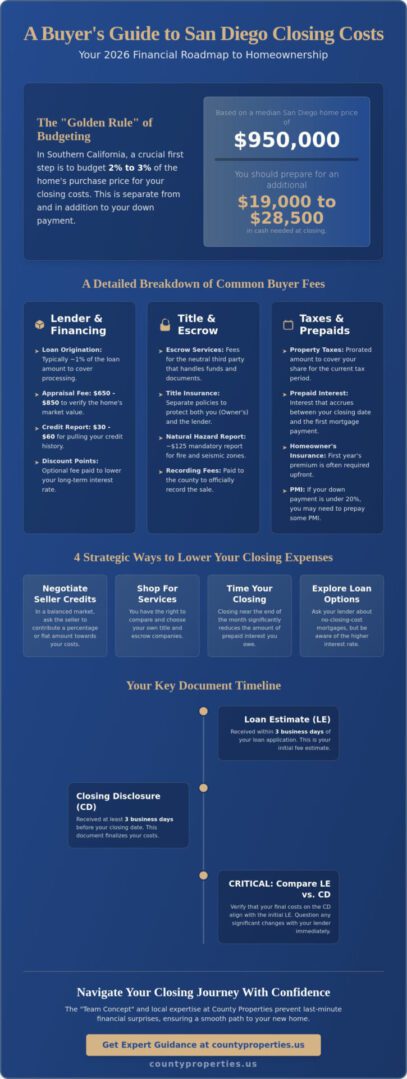
The standard “Golden Rule” for budgeting in Southern California is to set aside 2% to 3% of the home’s purchase price. In a city where the median home price often exceeds $950,000, this means you should prepare for an additional $19,000 to $28,500 in liquid capital. San Diego buyer closing costs often vary from other California regions because of specific local tax assessments. Many neighborhoods in North County or Chula Vista include Mello-Roos districts or special assessment bonds that impact your prorated tax obligations at the closing table.
Two critical documents provide the transparency you need. Your lender will issue a Loan Estimate (LE) within three business days of your application. Later, you’ll receive the Closing Disclosure (CD) at least three business days before settlement. Comparing these documents is vital. It allows you to verify that your final San Diego buyer closing costs align with the initial quotes provided by your loan officer.
Why Closing Costs Matter for Your Budget
You can’t usually finance these fees into your mortgage. They require upfront cash. Cash to Close is the total sum of your down payment plus all closing fees. Your closing date also plays a significant role in your final total. If you close on the 5th of the month, you’ll pay 25 or 26 days of prepaid interest. Closing on the 30th can significantly reduce this specific line item, though it may make for a more hectic moving day.
The 2026 San Diego Real Estate Climate
In the 2026 market, interest rates continue to dictate how buyers approach loan origination. Some buyers choose to pay “points” or discount fees to lower their long-term interest rate, which increases upfront costs. However, current data suggests a more balanced market than in previous years. This shift gives you more leverage to ask for seller credits. A motivated seller might agree to pay a portion of your recurring or non-recurring costs, directly lowering your out-of-pocket requirements at the finish line.
A Detailed Breakdown of Common Buyer Fees
Lender-related expenses often represent the largest portion of your upfront San Diego buyer closing costs. You’ll typically see loan origination fees hovering around 1% of the total loan amount. In the 2026 real estate market, many buyers are choosing to pay for “discount points” to buy down their interest rates. This strategy makes sense if you plan to keep the home for more than seven years, as the long-term interest savings will eventually outweigh the initial cost. If your down payment is less than 20%, lenders will also require Private Mortgage Insurance (PMI), which adds to your monthly carrying costs.
Lender and Financing Fees
- Appraisal Costs: Professional appraisals in San Diego County currently average between $650 and $850 for standard single-family homes.
- Credit Report Fees: Expect to pay $30 to $60 for a tri-merge credit report required by your mortgage company.
- Origination Charges: These cover the administrative costs of processing your loan application and are usually a percentage of the loan.
Title Insurance and Escrow Services
San Diego real estate transactions utilize independent escrow companies rather than attorney-led closings common in other states. This neutral third party manages the funds and ensures all contractual conditions are met before the deed is recorded. You’ll need to budget for both a Lender’s Policy, which protects the bank, and an Owner’s Policy, which protects your equity. This breakdown of California closing costs provides a clear picture of how these insurance premiums are calculated based on your purchase price.
Southern California buyers must also pay for a Natural Hazard Disclosure (NHD) report. These reports, which cost roughly $125, are vital for identifying if a property sits in a high-risk wildfire zone or a seismic fault area. Given the local landscape, this is a non-negotiable step in your due diligence process.
Taxes and Prepaids
Property taxes in San Diego County follow a specific fiscal cycle, with installments due on December 10 and April 10. Depending on your closing date, you’ll likely need to credit the seller for taxes they’ve already paid or set aside funds for the upcoming bill. If you’re looking at newer developments in Chula Vista or Carmel Valley, watch out for Mello-Roos assessments. These special taxes fund local infrastructure and can add $2,000 to $5,000 to your annual tax obligation.
Homeowners Association (HOA) transfer fees are another common expense for condo buyers. These administrative fees usually range from $300 to $600 per transaction. Our experienced team can help you review these line items to ensure your budget stays on track; you can search for homes on our site to identify listings within specific tax districts or HOA communities.
Who Pays for What? San Diego Customary Splits
In San Diego, the division of expenses follows established Southern California protocols. While buyers often focus on their down payment, understanding San Diego buyer closing costs requires a look at the customary splits between parties. These aren’t set in stone by law, but they represent the standard way business is conducted in our local market. According to the California Department of Real Estate guide, total closing costs can range from 3% to 7% of the purchase price, so knowing who handles each piece is vital for your 2026 budget.
The buyer typically takes responsibility for costs related to their specific financing and due diligence. This list includes:
- Loan Fees: Points, origination fees, and credit report charges.
- Inspections: General home inspections, termite reports, and specialized roof or sewer lateral checks.
- Lender’s Title Policy: A requirement from the bank to protect their lien position.
- Appraisal Fees: The cost to verify the home’s value for the lender.
The Seller’s Financial Responsibility
Sellers often shoulder a higher total dollar amount at the closing table. Their primary expenses include real estate commissions and the Owner’s Title Insurance Policy. This policy is a crucial protection for you as the buyer because it ensures you receive a clear title, free of hidden liens or ownership disputes. Sellers also traditionally pay for the Natural Hazard Disclosure (NHD) report. These seller-paid items directly benefit your bottom line by reducing the immediate cash you need to bring to escrow. If you’re also planning to list a property, you can find a deeper breakdown in our guide on Selling a Home in Southern California: The Ultimate Guide.
Negotiating Seller Concessions
Seller credits, also known as concessions, are a powerful tool for managing San Diego buyer closing costs. You can negotiate for the seller to pay a specific dollar amount toward your recurring costs, like property taxes and insurance, or non-recurring costs, like escrow fees. Lenders impose strict limits on these credits. FHA loans generally cap concessions at 6%, while conventional loans for primary residences often limit them to 3% or 6% depending on the size of your down payment. A strategic “buy-down” can be funded by seller credits to lower your interest rate and reduce monthly payments during the initial years of homeownership. This approach is particularly effective in the 2026 market to offset higher entry costs.
Negotiable items also include the County Transfer Tax. In San Diego, this tax is $1.10 per $1,000 of the sale price. While it’s customary for the seller to pay this, it can become a bargaining chip in a competitive multi-offer situation. Our team helps you navigate these nuances to ensure your offer is both competitive and financially sound.
Strategic Ways to Lower Your Closing Expenses
San Diego buyer closing costs often feel like a fixed obstacle, but many of these line items are negotiable or avoidable. You have the right to shop for third-party services rather than accepting your lender’s default suggestions. This includes title insurance, escrow services, and pest inspections. By comparing at least three different providers, you can often save between $500 and $1,500 on administrative fees. Don’t assume the first quote you receive is the final word on what you’ll pay at the finish line.
Another option is the “no-closing-cost” mortgage. In this scenario, the lender pays your upfront fees in exchange for a slightly higher interest rate. While this reduces your immediate cash burden, it increases your monthly payment over the life of the loan. It’s a strategic move if you plan to refinance or sell within five years. Additionally, timing your closing for the end of the month is a simple way to save. Because you pay per-diem interest from the day you close until the first of the next month, closing on the 28th instead of the 5th can save you hundreds of dollars in prepaid interest charges.
Comparing Lender Estimates
Review Page 2 of your Loan Estimate carefully. Focus on the section titled “Services You Can Shop For.” You should also scrutinize Section A for “junk fees” like excessive document preparation or delivery charges. If the property changed hands within the last five years, ask the title company for a “re-issue rate.” This discounted rate can lower title insurance premiums by 10% to 25% because the title search was recently completed and requires less labor to update.
Programs for First-Time and Senior Buyers
San Diego offers several assistance programs, such as those through the San Diego Housing Commission, which provide deferred-payment loans to cover both down payments and closing costs for eligible buyers. For older adults, working with a senior real estate specialist is vital. These experts understand how to leverage home equity from a previous sale to offset transaction fees during a downsize. They ensure you don’t overpay for services that don’t fit your specific transition needs. To see how these costs fit into the broader market, read our Buying a Home in Southern California: A Realistic 2026 Guide.
Every dollar saved during the closing process is a dollar you can put toward your new home’s upgrades or maintenance. If you’re ready to find a home that fits your budget and lifestyle, search our latest San Diego listings today to get started on your journey.
Navigating the Closing Journey with County Properties
Buying a home in Southern California involves high financial stakes. With 36 years of local experience, our team identifies potential financial hurdles before they become deal-breakers. We don’t want you facing a $2,000 surprise at the signing table. Our history in the local market allows us to spot inconsistencies in title reports or escrow instructions that less experienced agents often miss. We prioritize your financial security by maintaining transparent lines of communication with lenders and escrow officers throughout the 30-day or 45-day closing period. You’ll receive regular updates so you’re never left wondering about the status of your funds.
Expert Mentorship in a Complex Market
Finding a real estate agent near me who understands the nuances of local contracts is vital for a smooth transaction. The California Residential Purchase Agreement is a complex, 16-page legal document. Missing a single checkbox regarding inspections or credits can lead to unexpected expenses. We meticulously review your Closing Disclosure (CD) three days before you sign to ensure your San Diego buyer closing costs align with the initial Loan Estimate. This level of care stems from the Arnie Levine vision. He founded County Properties in 1995 to revolutionize the industry by choosing a service-centric model that puts the client’s long-term success above a quick commission check.
Our “Team Concept” replaces the traditional, competitive office environment with a collaborative approach. Instead of a single agent working in a vacuum, you have a family of professionals ensuring every credit is applied correctly. This collective wisdom helps us catch errors in tax prorations or HOA transfer fees that could otherwise drain your budget.
Ready to Start Your San Diego Journey?
You don’t have to guess your final numbers or worry about hidden fees. We provide a clear path to homeownership by mapping out your buying power from the very first consultation. Understanding your neighborhood-specific expenses is the only way to shop with confidence. A condo in Little Italy has different fee structures than a single-family home in Carlsbad. We provide personalized estimates so you know exactly how much cash you need for your San Diego buyer closing costs.
We are in the business of helping you take the next step in your life’s journey with clarity and confidence. Our commitment to service excellence ensures that your transition into a new home is as seamless as possible. Contact County Properties today for a guided home buying experience and let us help you secure your future in America’s Finest City.
Master Your 2026 San Diego Home Purchase Strategy
Navigating the financial landscape of a home purchase requires more than just a down payment. You’ve learned that San Diego buyer closing costs in 2026 involve a complex blend of lender fees, escrow charges, and title insurance. Budgeting for these items early ensures you won’t face unexpected hurdles at the finish line. Whether you’re negotiating customary fee splits or seeking strategic ways to reduce your total expenses, having a seasoned professional by your side changes the entire experience.
County Properties brings 36+ years of Southern California expertise to your transaction. Our collaborative team approach means you aren’t just hiring an agent; you’re gaining a full support system focused on your financial security. For those navigating senior transitions, our SRES® certified specialists provide the specific guidance needed for a seamless move into a new chapter. Don’t leave your financial security to chance. We’re here to help you navigate the closing journey with confidence and clarity. It’s time to turn your homeownership goals into a reality.
Contact County Properties for a Personalized San Diego Buyer Strategy
Frequently Asked Questions
How much are closing costs for a buyer in San Diego?
Buyers in San Diego typically pay between 2% and 5% of the home’s purchase price in total settlement fees. On a median-priced home of $950,000, this equates to a range of $19,000 to $47,500. These San Diego buyer closing costs cover essential items like loan origination, title insurance, and government recording fees. Your lender must provide a Loan Estimate within three business days of your application to detail these specific charges.
Can I include my closing costs in my mortgage?
You generally can’t roll closing costs into a purchase mortgage for a primary residence. This practice is common in refinances but rare for new home purchases. Instead, you can negotiate a seller credit where the seller pays a portion of your costs in exchange for a higher offer price. Another option is a lender credit; the bank pays your fees upfront but increases your interest rate by 0.25% or more to compensate.
Is the appraisal fee part of the closing costs?
Yes, the appraisal fee is a standard component of your closing costs and is required by almost all lenders. In San Diego, a professional appraisal typically costs between $500 and $800 for a single-family home. Lenders require this independent valuation to ensure the property’s market value supports the requested loan amount. While you often pay this fee when you apply for the loan, it appears on your final Closing Disclosure statement.
Who pays the escrow fees in San Diego County?
In San Diego County, the buyer and seller traditionally split the escrow fees 50/50. This local custom differs from Northern California, where the buyer often pays the entire amount. Each party also pays for their own portion of the title insurance policy. These costs remain negotiable, so you can ask the seller to cover your half if the market conditions allow for such concessions during the offer stage.
What are Mello-Roos and do they affect my closing costs?
Mello-Roos are special tax districts created under the Community Facilities Act of 1982 to fund local infrastructure like schools and parks. While they don’t increase your one-time San Diego buyer closing costs directly, they do impact your initial escrow impound account. Lenders often require you to prepay several months of these taxes at the time of closing. This ensures future payments are covered, which increases the total cash you need at settlement.
What happens if I don’t have enough money for closing costs on the day of?
If you lack the necessary funds on closing day, the escrow company cannot record the deed and your loan won’t fund. This delay could result in a breach of contract or daily “per diem” interest charges from the seller. You should review your Closing Disclosure three business days before signing to catch any shortfalls. If you’re short, you might explore down payment assistance programs or request a gift from a family member.
Are closing costs tax-deductible in California?
Most closing costs aren’t immediately deductible, but mortgage interest and “points” paid to lower your rate usually are. You can also deduct pro-rated property taxes paid at the time of settlement. Other costs, like title insurance and recording fees, are added to your home’s “cost basis.” This reduces your taxable capital gains when you eventually sell the property, according to IRS Publication 523 guidelines. You should consult a tax professional for your specific situation.
Does the buyer pay the real estate agent commission in San Diego?
Following the National Association of Realtors settlement in August 2024, buyers now negotiate their agent’s compensation directly. Previously, sellers covered both agents’ fees, but you may now be responsible for paying your broker if the seller doesn’t offer a concession. You’ll sign a representation agreement upfront that clearly defines this fee. This ensures there are no surprises regarding professional fees when you finally reach the closing table to sign your documents.