

Stepping into the world of real estate investing can feel like learning a new language. You’re looking at two promising properties, but how do you fairly compare their potential returns? It’s easy to feel overwhelmed by spreadsheets and financial jargon, afraid of making a costly miscalculation. This is where one powerful metric can cut through the noise, providing a clear, apples-to-apples comparison to guide your decision-making journey. That metric is the capitalization rate, but what is cap rate, and how can you use it to your advantage?
Consider us your trusted partner in demystifying this essential tool. In this simple guide, we will walk you through everything you need to know. We’ll break down the cap rate formula in plain English, show you exactly how to calculate it for any property, and help you understand what the result truly tells you about an investment’s potential. By the end, you’ll have the knowledge and confidence to analyze deals like a seasoned professional and identify what a truly “good” investment looks like on paper.
Key Takeaways
- Quickly compare investment properties by mastering the straightforward formula for calculating a property’s potential rate of return.
- Move beyond the basic definition of “what is cap rate” to understand how it reveals the crucial link between a property’s risk and its value.
- Discover why there is no single “good” cap rate and learn how to identify the right target for your specific market and investment goals.
- Invest with greater confidence by learning what cap rate doesn’t tell you and which other metrics you need for a complete analysis.
What is Capitalization Rate (Cap Rate) in Plain English?
Navigating the world of real estate investing can feel like learning a new language. One of the first and most important terms you’ll encounter is the capitalization rate, or “cap rate.” Think of it as a quick snapshot of a property’s potential annual return, assuming you paid for it in all cash. Its core purpose is to provide a straightforward way to compare the profitability and risk of different investment properties, regardless of their price.
At its heart, the Capitalization rate is a simple calculation that helps answer the fundamental question: what is cap rate showing me about this investment? It boils the complex performance of a property down to a single percentage, based on two key ingredients: its income and its current value. Crucially, it measures this return before accounting for any mortgage payments. This allows you to compare properties on an apples-to-apples basis, focusing purely on their operational performance.
The Cap Rate Formula Explained
To calculate the cap rate, you use a clear and direct formula that serves as a cornerstone for property valuation. It provides a direct link between the income a property generates and its market value.
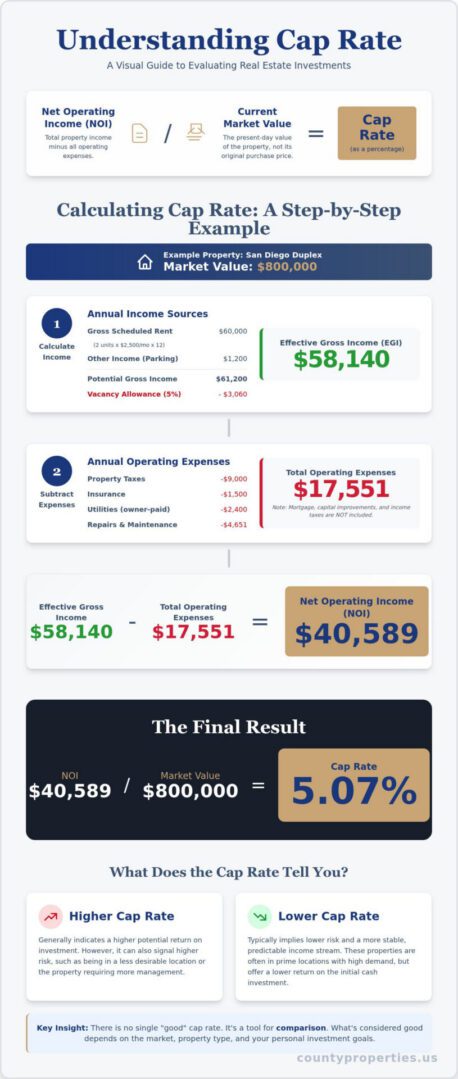
Cap Rate = Net Operating Income (NOI) / Current Market Value
Net Operating Income (NOI) is the total income the property generates over one year, minus all necessary operating expenses. Current Market Value is not what the owner originally paid, but what the property is worth in today’s market.
Why NOI is the Most Important Number
The accuracy of your cap rate calculation depends entirely on getting the Net Operating Income (NOI) right. This figure represents the true profitability of a property’s day-to-day operations. To find it, you must first calculate all income sources and then subtract all operating expenses.
- Sources of Income Include: Gross rental income, parking fees, laundry machine revenue, pet fees, and any other income generated by the property.
- Common Operating Expenses Include: Property taxes, insurance, property management fees, utilities, repairs and maintenance, and landscaping.
It’s equally important to know what is not included in operating expenses. These are costs related to financing and ownership, not operations. This includes your mortgage payments (principal and interest), major capital improvements (like a new roof or HVAC system), and income taxes.
How to Calculate Cap Rate: A Step-by-Step Example
Theory is one thing, but the best way to understand a financial concept is to see it in action. Let’s demystify the formula with a practical, real-world example. Imagine you’re a savvy investor considering a duplex in a desirable San Diego suburb, with an asking price of $800,000. By walking through this calculation, you’ll gain the confidence to analyze any potential investment property on your journey to financial success.
Step 1: Calculate the Annual Gross Income
First, we need to determine the property’s total potential income before any expenses. Let’s assume each of the two units rents for $2,500 per month. We also need to account for potential vacancies, as no property stays 100% occupied forever. A 5% vacancy rate is a common and conservative estimate.
- Gross Scheduled Rent: (2 units x $2,500/month) x 12 months = $60,000
- Other Income (e.g., parking fees): $1,200 per year
- Potential Gross Income (PGI): $60,000 + $1,200 = $61,200
- Vacancy Allowance (5% of PGI): $61,200 x 0.05 = -$3,060
- Effective Gross Income (EGI): $61,200 – $3,060 = $58,140
Step 2: List and Subtract Annual Operating Expenses
Next, we tally all the costs required to run the property, excluding mortgage payments. These operating expenses are essential for finding your Net Operating Income (NOI). For our San Diego duplex, we’ll use realistic annual estimates:
- Property Taxes: $9,000
- Insurance: $1,500
- Utilities (owner-paid): $2,400
- Repairs & Maintenance (8% of EGI): $4,651
- Total Operating Expenses: $17,551
Now, we subtract these expenses from our EGI to find the all-important NOI: $58,140 – $17,551 = $40,589 (NOI).
- Effective Gross Income: $58,140
- Less: Total Operating Expenses: -$17,551
- Net Operating Income (NOI): $40,589
Step 3: Divide NOI by Property Value
This is the final step in answering what is cap rate for this specific property. We simply plug our numbers into the core formula:
Cap Rate = Net Operating Income (NOI) / Property Value
$40,589 / $800,000 = 0.0507
To express this as the familiar percentage, multiply by 100. The cap rate for this duplex is 5.07%. This single figure represents the property’s potential unleveraged annual return. A clear grasp of the importance of cap rates empowers you to quickly compare this duplex against other investment opportunities and gauge whether it aligns with market expectations and your financial goals.
What a Cap Rate Tells You About an Investment
Once you understand the basic formula, the real power of the cap rate comes from what it tells you about a property’s performance and risk profile. Think of it as a trusted diagnostic tool that helps you look beyond the surface-level details of a listing. It provides clear guidance by standardizing the potential return of an investment, allowing you to make confident, apples-to-apples comparisons.
At its core, the capitalization rate reveals the unleveraged rate of return you can expect from an investment property. This metric is crucial because it shows the inverse relationship between a property’s price and its cap rate: as the value of a property goes up, its cap rate goes down, and vice versa. Understanding this relationship is the first step in using this metric to empower your investment journey.
Using Cap Rate to Compare Properties
Imagine you are evaluating two different multifamily properties:
- Property A: Purchase price of $1,000,000 with a Net Operating Income (NOI) of $60,000.
- Property B: Purchase price of $850,000 with an NOI of $46,750.
Property B is less expensive, which might seem more attractive initially. However, by applying the simple formula for how to calculate cap rate, you uncover a clearer picture. Property A has a 6.0% cap rate ($60,000 / $1,000,000), while Property B has a 5.5% cap rate ($46,750 / $850,000). This calculation instantly shows that Property A offers a better potential return on your investment capital.
Understanding Risk Through Cap Rate
Beyond simple returns, a cap rate is a powerful indicator of investment risk. The rate often reflects the perceived stability and desirability of an asset. A very high cap rate, such as 12%, might be a red flag. It could indicate the property is in a high-crime area, is in poor condition requiring significant capital, or has unstable tenancy. The high return is meant to compensate for this elevated risk.
Conversely, a low cap rate, like 4%, often signifies a secure, low-risk asset in a prime location with strong, consistent demand. This property is more expensive relative to its income, but it provides peace of mind and predictable cash flow. Ultimately, deciding between a high or low cap rate depends on your personal financial goals and tolerance for risk.
What Is a ‘Good’ Cap Rate? (The Answer May Surprise You)
After learning the formula, most investors immediately ask, “So, what is a good cap rate?” The honest answer is that there’s no universal number that is inherently “good” or “bad.” A cap rate is simply a measure of potential return relative to risk, and what’s considered good is entirely dependent on your investment strategy, the market, and the specific property.
Instead of searching for a single magic number, a seasoned investor learns to evaluate a cap rate within its proper context. A 4% cap rate might be an excellent deal for a brand-new apartment building in a prime San Diego neighborhood, while an 8% cap rate on a similar property in a less stable market could be a red flag.
Factors That Influence Cap Rates
A property’s cap rate is a direct reflection of its perceived risk and potential for growth. Several key factors create this dynamic:
- Location: A property in a high-demand, economically vibrant area like La Jolla will command a lower cap rate than one in a small, rural town due to lower perceived risk and higher appreciation potential.
- Asset Type & Class: A new, Class A multifamily building has a different risk profile than an older, Class C industrial warehouse. The stability and demand for the asset type significantly impact the cap rate.
- Market Conditions: Broader economic health, interest rates, and local rental demand all play a huge role. In a strong economy with low interest rates, cap rates tend to compress (go down) as property values rise.
Typical Cap Rate Ranges by Property Type
While context is everything, it helps to have a general benchmark. In commercial real estate, properties are often graded into classes that signal their quality and location, which directly correlates with typical cap rates:
- Class A Properties: Prime locations, new construction, high-quality tenants. Typically have lower cap rates (e.g., 4% – 5.5%) due to lower risk and strong appreciation prospects.
- Class B Properties: Good locations, slightly older but well-maintained. They offer a balance of stability and return, with mid-range cap rates (e.g., 5.5% – 7%).
- Class C Properties: Older properties in less desirable locations, often needing renovations. They carry higher risk but offer higher cap rates (e.g., 7%+) to compensate.
How Your Goals Define a ‘Good’ Rate
Ultimately, understanding what is cap rate is about aligning the metric with your personal financial goals. Are you seeking stable, long-term wealth generation through appreciation? If so, a lower cap rate on a high-quality asset might be perfect. Or do you need strong, immediate cash flow to supplement your income? In that case, you’ll be hunting for properties with higher cap rates, understanding they may require more hands-on management. Your strategy defines what a “good” cap rate looks like for you.
Navigating these variables can be complex, especially in a dynamic market. Need help analyzing deals in Southern California? Talk to an expert.
The Limitations of Cap Rate: What It Doesn’t Tell You
Understanding what is cap rate is a crucial first step for any serious real estate investor. However, relying on it as your only metric is like trying to navigate a new city with just a single landmark. It’s a powerful tool for quick, high-level comparisons, but it’s not a magic bullet. A seasoned professional knows that cap rate is just one piece of a much larger puzzle.
At its core, a cap rate is a snapshot of a property’s performance based on one year’s worth of data. It assumes an all-cash purchase and provides a glimpse into potential returns before financing, taxes, or future growth are considered. Furthermore, the calculation is only as reliable as the numbers used; inaccurate income or expense figures will lead to a misleading cap rate.
It Ignores Financing
The cap rate formula deliberately excludes mortgage payments. This provides a clean way to compare properties apples-to-apples, but it doesn’t reflect your actual, personal return. To understand that, you need the Cash-on-Cash Return metric, which measures the return on your actual down payment. Because of different loan terms, down payments, and interest rates, two investors can buy the exact same property and have vastly different cash flow and returns.
It Doesn’t Account for Appreciation
Cap rate is a measure of income, not growth. It tells you nothing about a property’s potential to increase in value over time. In high-demand markets like many here in Southern California, appreciation is a massive component of an investment’s total return. A property with a lower cap rate might seem less attractive at first glance, but it could be a phenomenal long-term investment if it’s in an area poised for significant value growth.
To make a truly informed decision, you must look beyond this single number. Remember these key limitations:
- It’s a single-year snapshot: It doesn’t project future performance, rent increases, or changes in expenses.
- It excludes financing: It doesn’t show your actual cash flow or return on invested capital.
- It ignores appreciation: It overlooks the potential for the property’s market value to grow.
- It doesn’t factor in taxes or the unique benefits of depreciation.
Putting all these pieces together to build a comprehensive investment strategy is where expert guidance becomes invaluable. If you’re analyzing properties and need help seeing the full picture, our team at County Properties is here to provide the trusted, comprehensive support you need on your journey.
Mastering Cap Rate: Your Next Step in Real Estate Investing
Ultimately, understanding what is cap rate is about more than just a formula; it’s about gaining a powerful first look at a property’s potential return. You now know it’s a vital metric for comparing investments, but also that a single number never tells the whole story. A truly savvy investor uses cap rate as a starting point for deeper analysis, not a final verdict. This foundational knowledge is your first step on a successful investment journey.
When you’re ready to apply this knowledge in the real world, having a trusted partner makes all the difference. With over 36+ years of real estate experience, our team of specialists in the Southern California market provides the personalized, step-by-step guidance you need to confidently evaluate opportunities. Ready to analyze investment properties? Let our Southern California experts guide you. Your goals are within reach, and we’re here to help you achieve them.
Frequently Asked Questions About Cap Rate
Is a higher or lower cap rate better?
Whether a higher or lower cap rate is “better” depends entirely on your investment goals and risk tolerance. A higher cap rate often suggests a higher potential return on investment but may come with greater risk, such as a property in a less stable neighborhood or one needing significant repairs. Conversely, a lower cap rate typically indicates lower risk and a more stable, premium asset, but with a lower initial cash flow. It’s a classic trade-off between risk and reward.
What is the difference between cap rate and ROI (Return on Investment)?
The key difference lies in financing. Cap rate measures a property’s unleveraged rate of return, meaning it assumes an all-cash purchase and does not account for a mortgage. ROI, particularly cash-on-cash return, is a leveraged metric that calculates the return on the actual cash you invested, factoring in debt service. Cap rate is excellent for comparing properties against each other, while ROI tells you how a specific deal performs for you with your unique financing.
Does the cap rate calculation include mortgage payments?
No, the cap rate calculation intentionally excludes mortgage payments. Understanding what is cap rate means recognizing it is based on Net Operating Income (NOI), which is calculated before debt service. This is because cap rate is designed to measure the underlying profitability of the real estate asset itself, independent of how an individual investor chooses to finance it. This makes it a universal metric for comparing the relative value of different investment properties.
How do rising interest rates affect cap rates?
Rising interest rates typically cause cap rates to increase as well. When the cost of borrowing goes up, investors’ potential returns are squeezed. To compensate for the higher financing costs and to remain a competitive investment compared to less risky options like bonds, property prices may need to adjust downward. This inverse relationship between property value and cap rate means that as values decrease to attract buyers, the cap rate for the market effectively rises.
Can I use cap rate for a single-family home or just commercial properties?
While you can technically calculate a cap rate for a single-family rental, it is most effective and commonly used for commercial properties like apartment buildings, office spaces, and retail centers. This is because single-family home values are heavily influenced by comparable sales (“comps”) and emotional buyer appeal, not just their income potential. For multi-unit and commercial properties with more predictable income streams, cap rate serves as a much more reliable valuation tool.
Where can I find reliable data for cap rates in my area?
Reliable cap rate data can be found through several professional sources. Major commercial real estate brokerage firms (like CBRE or Cushman & Wakefield) publish regular market reports. Data subscription services like CoStar and Reonomy provide comprehensive analytics. However, for the most accurate and nuanced data for a specific neighborhood and property type, the best resource is often a seasoned local real estate professional who has direct, on-the-ground knowledge of recent transactions and market trends.