

Facing financial hardship with your home is one of life’s most stressful journeys. When the threat of foreclosure looms, it’s easy to feel overwhelmed by the complex process and worried about your financial future. But you are not alone, and you have options. Understanding what is a short sale is the first critical step toward taking back control. It’s more than just a real estate term; it’s a powerful alternative that can provide a path forward, helping you avoid foreclosure and protect your credit as much as possible.
As your trusted real estate partner, we’re here to provide the clear, step-by-step guidance you need. In this complete guide, we will break down exactly how a short sale works, how it differs from a foreclosure, and what the process looks like for both homeowners and potential buyers. Our goal is to empower you with the knowledge to make the best decision for your unique journey, turning a challenging situation into a manageable one.
Key Takeaways
- Learn the core definition of what is a short sale and how it directly impacts your financial negotiation with the lender.
- Discover the crucial differences between a short sale and a foreclosure to determine which path offers you more control and a better outcome.
- Evaluate the unique opportunities and risks from both the buyer’s and seller’s perspectives to see if this path is right for you.
- Understand why partnering with a certified short sale specialist is the most critical step for successfully navigating this complex process.
Decoding the Short Sale: A Clear Definition
If you’re asking, “what is a short sale,” the simplest answer is this: a short sale is the sale of a home for a price that is less than the amount still owed on the mortgage. With the lender’s approval, the homeowner sells the property, and the proceeds from the sale go directly to the lender. The term “short” refers to the fact that the lender is willingly accepting a payoff that falls short of the total loan balance.
This situation typically arises when a homeowner is “underwater” or “upside down” on their mortgage, meaning they owe more on the loan than the home is currently worth in the open market. Successfully navigating a short sale requires the cooperation of several key parties:
- The Homeowner (Seller): You, the property owner facing financial hardship.
- The Lender(s): The bank or financial institution that holds the mortgage (and sometimes a second mortgage).
- The Buyer: An individual or entity making an offer to purchase the property.
- The Real Estate Agents: Professionals who guide both the seller and buyer through this complex transaction.
Why Would a Lender Agree to Lose Money?
It may seem counterintuitive, but a lender’s motivation is purely financial: to minimize its losses. The foreclosure process is incredibly costly and time-consuming for a bank, involving legal fees, property maintenance, and the expenses of reselling a bank-owned property. A lender often sees a pre-foreclosure short sale as a more predictable and less expensive way to resolve a non-performing loan, saving them from a potentially larger financial hit down the road.
Who Qualifies for a Short Sale?
Lenders don’t approve short sales for everyone. The primary requirement is demonstrating genuine financial hardship-a significant life event that has made it impossible for you to keep up with mortgage payments. This could include job loss, a major medical emergency, or divorce. You will need to provide detailed financial documentation to prove both your hardship and your inability to afford the loan, confirming that you have no other assets to cover the shortfall on your underwater mortgage.
Short Sale vs. Foreclosure: A Critical Comparison for Homeowners
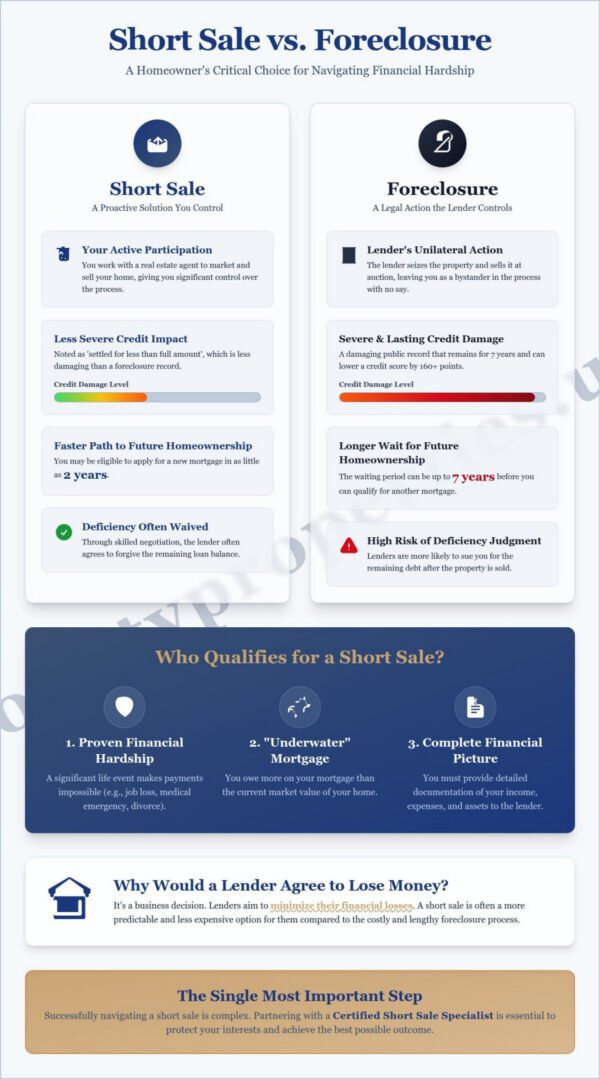
Facing financial hardship is a challenging journey, but understanding your options is the first step toward regaining control. When you can no longer afford your mortgage, the path often narrows to two choices: a short sale or a foreclosure. While neither is an easy decision, a short sale empowers you, the homeowner, to be an active participant in the solution, rather than a bystander to a legal process initiated by the bank. This control is a fundamental difference when you’re trying to understand what is a short sale and how it can provide a better outcome.
The core distinction is simple: a short sale is a real estate transaction you manage with an expert agent, while a foreclosure is a legal action the lender takes against you. This difference in approach has profound impacts on your financial future. As detailed in the NAR’s guide to short sales, having a knowledgeable professional to guide you is critical.
| Feature | Short Sale | Foreclosure |
|---|---|---|
| Homeowner Control | You work with an agent to market and sell your home. | The lender seizes the property and sells it at auction. |
| Credit Impact | Less severe; often noted as ‘settled for less than full amount’. | More severe; a ‘foreclosure’ notation remains for 7 years. |
| Future Mortgage | Shorter waiting period, sometimes as little as 2 years. | Longer waiting period, typically up to 7 years. |
| Deficiency Risk | Can often be waived through skilled negotiation. | High risk of the lender suing for the remaining debt. |
Impact on Your Credit Score
Both events will negatively affect your credit, but the damage from a foreclosure is typically deeper and longer-lasting. A short sale is reported as a debt “settled for less than the full amount,” while a foreclosure is a specific, more damaging public record. According to FICO, a foreclosure can lower a score by 160 points or more. The recovery is also faster with a short sale, allowing you to begin rebuilding your credit sooner.
Future Homeownership Prospects
One of the most significant long-term benefits of a short sale is the quicker path back to homeownership. Fannie Mae guidelines often allow a borrower to be eligible for a new mortgage just two years after a short sale, provided there were extenuating circumstances. In contrast, a foreclosure typically requires a waiting period of up to seven years. This difference can be life-changing for your family’s future stability and financial goals.
The Risk of a Deficiency Judgment
A “deficiency judgment” occurs when a lender sues you for the difference between the home’s sale price and the total mortgage balance you owed. In a foreclosure, this is a common risk. However, a key goal in any short sale negotiation is to secure a waiver of deficiency from the lender, releasing you from this future liability. Here in California, homeowners have additional protections under state law that often prevent deficiency judgments on primary residences in a short sale, providing critical peace of mind.
The Seller’s Journey: A Step-by-Step Guide to the Short Sale Process
Navigating a short sale can feel daunting, but it’s a journey you don’t have to take alone. With a trusted, experienced team guiding you, the process becomes a manageable series of steps designed to help you avoid foreclosure. The key to success is starting early, before the bank’s proceedings become irreversible. Understanding the path ahead provides clarity and empowers you to make the best decisions for your future.
Step 1: Assembling Your Team and Documentation
Your first and most critical action is to partner with a real estate agent who is a certified short sale expert. They will be your primary advocate and guide. Next, you’ll need to gather extensive financial documentation to build your case for the lender. This package typically includes:
- Recent bank statements and pay stubs
- Two years of tax returns
- A detailed list of your assets and liabilities
- A formal hardship letter
The hardship letter is a personal, honest explanation of the circumstances that prevent you from affording your mortgage payments, such as job loss, medical emergency, or divorce. This document is essential for persuading the lender to consider your short sale request.
Step 2: Listing the Property and Receiving an Offer
Once your team is in place, your agent will list your home on the market, much like a traditional sale. However, the listing must include disclosures stating that any offer is contingent upon third-party lender approval. When you receive an offer from a qualified buyer, you will accept it, but this is just the beginning. Your agent then compiles the complete offer package-including the buyer’s offer, their proof of funds or pre-approval, and your entire financial hardship package-and submits it to your mortgage lender for their review.
Step 3: Lender Review and Negotiation
This is typically the longest and most uncertain phase. Your lender will conduct its own due diligence, which includes ordering a Broker Price Opinion (BPO) or an appraisal to determine the home’s current market value. This part of the short sale process can take several months. During this time, your agent will actively communicate and negotiate with the lender on your behalf, advocating for the acceptance of the buyer’s offer. The lender will ultimately respond with one of three outcomes: an approval, a counteroffer with different terms, or a denial of the short sale.
Feeling overwhelmed? The journey is complex, but the right partner makes all the difference. Our short sale specialists can guide you.
The Buyer’s Perspective: Is a Short Sale Property a Good Deal?
For homebuyers, the term “short sale” often brings one thing to mind: a bargain. While it’s true that these properties can present an opportunity to purchase a home below market value, the path to closing is far more complex than a traditional sale. Just as sellers must understand what is a short sale, buyers must weigh the potential rewards against significant risks. Success requires a large measure of patience, flexibility, and expert guidance.
To help you decide if this path is right for your journey, we’ve broken down the key advantages and disadvantages from a buyer’s point of view.
The Pros: Potential for a Discount
The primary attraction of a short sale is, without a doubt, the price. Lenders are often motivated to accept an offer that is less than the mortgage balance to avoid the higher costs of foreclosure. This can lead to several key benefits:
- Below-Market Price: The asking price is often set attractively to entice serious buyers who are willing to navigate the lengthy approval process.
- Access to Better Neighborhoods: A lower price point may allow you to afford a home in a community that would otherwise be outside your budget.
- Less Direct Competition: The long timelines and inherent uncertainty tend to deter many traditional buyers, meaning you may face fewer competing offers.
The Cons: Timelines, Condition, and Uncertainty
The potential for a great deal comes with considerable challenges. These are not transactions for buyers on a tight schedule or those who are faint of heart. Be prepared for:
- Long, Unpredictable Timelines: Your offer must be approved by the seller’s lender(s), a process that can take anywhere from 30 days to over a year. There are no guaranteed timelines.
- ‘As-Is’ Condition: Short sale properties are almost always sold in their current condition. The seller cannot afford repairs, and the lender will not pay for them. All renovation costs fall to you.
- High Risk of Failure: The deal can fall through at any moment for reasons beyond your control. The lender could reject your offer, or the seller could fall into foreclosure before the sale is approved.
Tips for a Successful Short Sale Purchase
If you’re prepared for the journey, a few key strategies can dramatically increase your chances of success. First and foremost, work with a professional who can guide you. An experienced buyer’s agent is your most valuable asset. Additionally, you should:
- Get a Strong Pre-Approval: A solid pre-approval letter shows the lender you are a serious, qualified buyer.
- Make a Clean, Strong Offer: An offer with few contingencies and a fair price is more likely to be accepted by the lender.
- Insist on a Home Inspection: Even though the home is sold ‘as-is’, a thorough inspection is crucial for understanding exactly what repairs and costs you will be taking on.
Why You Need a Short Sale Specialist on Your Side
While any licensed agent can list a home for sale, navigating a short sale is a complex financial negotiation that demands a specialized skill set. A general real estate agent focuses on marketing and showing a property; a Certified Short Sale Specialist acts as your essential advocate, negotiator, and project manager in a transaction where the bank, not the seller, has the final say.
Attempting this process without an expert is one of the most common reasons short sales fail. A specialist has the proven experience to guide you through the turbulence, protecting your interests and working tirelessly toward a successful closing. Understanding what is a short sale is the first step; ensuring it succeeds is the next.
Expert Negotiation with Lenders
Communicating with a lender’s loss mitigation department is nothing like a standard real estate call. These departments are overwhelmed, and your case is just one of thousands. A specialist knows how to craft a compelling short sale package-complete with a persuasive hardship letter, accurate financial statements, and a solid offer-that gets a bank’s attention. They have the experience to anticipate roadblocks, push back against unreasonable demands, and navigate the complex internal bureaucracy of large financial institutions to keep your sale moving forward.
Meticulous Paperwork and Process Management
The application for a short sale involves a mountain of time-sensitive paperwork. A single missed signature, an outdated pay stub, or an incorrectly filled-out form can cause significant delays or even an outright denial, forcing you back to square one. A short sale expert functions as a meticulous manager, ensuring every document is correct, complete, and submitted well before its deadline. This diligence is critical to preventing the common administrative errors that jeopardize a successful outcome.
Your Trusted Guide in a Stressful Time
At County Properties, we understand that facing financial hardship is an emotional and stressful journey. Our specialists provide more than just transactional expertise; they offer empathetic, steady guidance. For homeowners, we provide clarity and support, demystifying the process so you can make empowered decisions. For buyers interested in a short sale property, we manage expectations and provide consistent updates, ensuring you understand the unique timeline and potential hurdles involved.
Don’t navigate this challenging process alone. Partner with a trusted Southern California short sale expert today.
Your Path Forward: Making an Informed Decision
Ultimately, understanding what is a short sale is the first step toward making a sound financial decision. For homeowners, it represents a strategic alternative to foreclosure that can mitigate credit damage, while for buyers, it can be a path to a great deal-if navigated with patience and diligence. The most critical takeaway for both sides is that this complex journey requires an expert guide to protect your interests and ensure a successful outcome.
At County Properties, our service-centric approach is focused on your financial security. With 36+ years of experience in Southern California real estate and our team’s Certified Short Sale and Foreclosure Resource (SFR®) designation, we provide the trusted guidance you deserve. Facing foreclosure? Let our experienced team guide you through your options. You don’t have to navigate this process alone; the right partner can empower you to move toward a brighter financial future.
Frequently Asked Questions About Short Sales
How long does a short sale typically take from offer to closing?
A short sale timeline is significantly longer than a traditional home sale, typically ranging from 90 to 120 days after an offer is accepted. However, complex cases can take longer. This extended period is because your lender’s loss mitigation department must meticulously review the offer, your financial hardship, and all associated documents. Patience and expert guidance are key to navigating this detailed review process and reaching a successful closing.
Do I have to pay taxes on the forgiven debt from a short sale?
Potentially, yes. The IRS may consider the amount of debt forgiven by your lender as taxable income. While laws like the Mortgage Forgiveness Debt Relief Act have offered protection in the past, these regulations can change. It is absolutely essential to consult with a qualified tax advisor or CPA. They can provide personalized guidance based on your specific financial situation and the current tax laws to ensure you understand any potential liability.
As a seller, do I have to pay real estate agent commissions in a short sale?
No, as the seller in a short sale, you typically do not pay for real estate commissions or most closing costs. These expenses are paid by your lender from the proceeds of the sale. The commission structure is negotiated with and approved by the bank as part of the overall agreement. This is a critical benefit for homeowners facing financial hardship, allowing them to secure expert representation without out-of-pocket expenses.
Can I stay in my home during the short sale process?
Yes, you can and should remain in your home throughout the short sale process. You are still the legal owner of the property until the transaction officially closes and the title is transferred to the new buyer. It’s also important to continue maintaining the home’s condition during this time. A well-kept property is crucial for securing a strong offer and ensuring the lender’s final approval of the sale, making the journey smoother for everyone involved.
What is the number one reason a short sale gets denied by the bank?
The most common reason for a short sale denial is an incomplete or incorrect short sale package submitted to the lender. Many people who are just learning what is a short sale underestimate this step. This package must include a detailed hardship letter, financial statements, tax returns, and the buyer’s offer. Any missing document or inconsistency can cause significant delays or an outright rejection, making experienced professional guidance essential for success.
Is it possible to do a short sale if I have a second mortgage or HELOC?
Yes, it is possible, but it adds a layer of complexity to the transaction. A successful short sale requires approval from all lienholders, meaning both your primary mortgage lender and the second mortgage or HELOC holder must agree to the terms. This often involves intricate negotiations, as the second lienholder will receive a much smaller settlement. A seasoned real estate professional can skillfully manage these negotiations to help secure an agreement from all parties involved.