

The journey you’re on is one of the most challenging a family can face, a path heavy with both emotion and responsibility. The decision of selling a home to pay for care is more than just a financial transaction; it’s about safeguarding a legacy while securing the best possible future for someone you love. We understand the weight of this moment-the fear of making a costly mistake, the confusion over legal authority, and the deep desire to honor a lifetime of memories held within those walls. You are not alone, and you don’t have to navigate this complex process without a trusted partner.
In this compassionate guide, we will walk you through every essential step. Our commitment is to provide you with a clear, actionable plan that empowers you to move forward with confidence. You will learn how to manage the legal requirements, maximize your home’s value to ensure long-term financial security, and handle this delicate transition with the dignity and care your loved one deserves. Consider this your roadmap to finding peace of mind.
First Steps: Is Selling the Home the Right Financial Decision?
Deciding to sell a cherished family home to transition into assisted living is more than a financial transaction-it’s a significant life journey. This step involves complex emotions and critical financial planning. Before placing a “For Sale” sign in the yard, the most important action you can take is to create a clear and comprehensive financial picture. The process of selling a home to pay for care requires careful thought and expert guidance to ensure long-term security and peace of mind for everyone involved.
Assess Long-Term Care Costs vs. Home Equity
Before making any moves, it’s essential to balance the numbers. Start by researching the average monthly costs for assisted living, memory care, or in-home services in your specific area. Gaining a clear understanding of what is long-term care and its associated expenses is the foundation of your plan. Next, obtain a professional home valuation from a trusted real estate expert to estimate the net proceeds after closing costs and taxes. This allows you to calculate if the sale will comfortably cover care for the expected duration.
Explore Alternatives to Selling
While selling a home to pay for care is a common and effective strategy, it’s wise to explore all your options to confirm it’s the right one for your family’s unique situation. Consider these potential alternatives:
- Renting the Property: This can generate consistent monthly income to offset care costs but also comes with the responsibilities of being a landlord.
- Reverse Mortgages: Homeowners aged 62 and older can convert a portion of their home equity into cash payments without having to move.
- Home Equity Lines of Credit (HELOC): A HELOC can serve as a valuable short-term solution to cover immediate expenses while you plan your long-term strategy.
Build Your Professional Support Team
Navigating this journey is not something you should do alone. Assembling a team of trusted professionals provides comprehensive guidance and protects your best interests. Your essential team members should include:
- An Elder Law Attorney to handle legal authority, review contracts, and advise on estate planning.
- A Financial Advisor to create a strategy for managing the sale proceeds to ensure they last as long as needed.
- A Senior Real Estate Specialist (SRES®), a REALTOR® with specialized training and experience in helping seniors with major financial and lifestyle transitions.
Critical Financial & Legal Hurdles to Clear Before Listing
The journey of selling a home to pay for care is often filled with complex questions about government benefits, taxes, and legal rights. Navigating these rules can be a significant source of anxiety for families. As your trusted real estate partner, we believe in providing clear guidance. Understanding these critical hurdles upfront is the key to preventing costly mistakes and ensuring a seamless transition for your loved one.
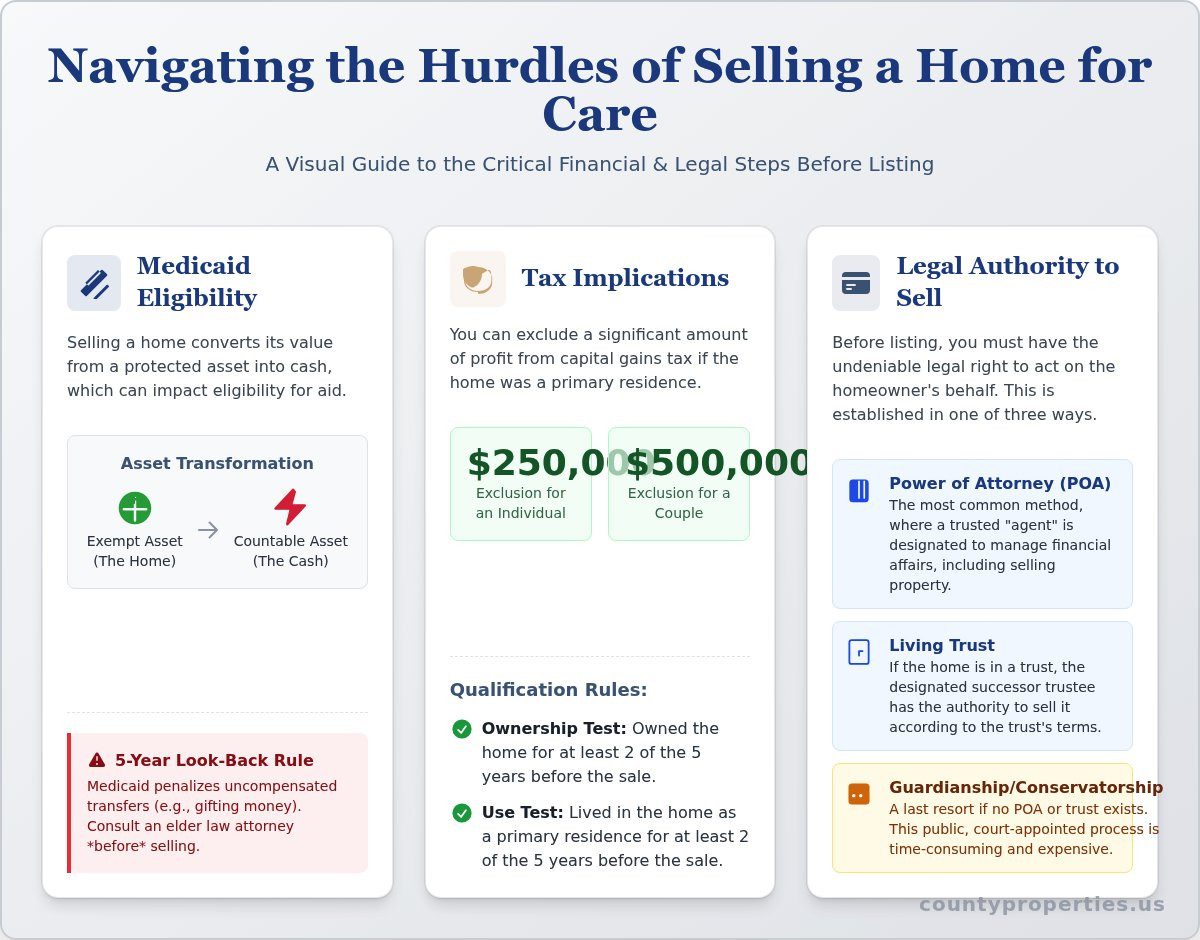
The most important concept to grasp is that selling a home converts what is often an exempt asset (the property itself) into a countable cash asset (the proceeds). This single transaction can have profound effects on financial eligibility for aid and tax liabilities. Furthermore, you must establish who has the non-negotiable legal authority to sign the closing documents before you can even list the property.
Medicaid Eligibility and the 5-Year Look-Back Period
For many individuals applying for long-term care benefits through Medicaid, their primary residence is considered an exempt asset. However, once the home is sold, the cash proceeds become a countable asset, which can immediately disqualify them from receiving aid. It’s a common point of confusion, leading many to ask, Do you have to sell your home to pay for care? The answer depends heavily on your specific circumstances. Critically, you cannot simply give the money away to family members to reduce assets. Medicaid’s 5-year “look-back” rule imposes severe penalties for uncompensated transfers. Consulting an elder law attorney before the sale is essential to create a sound financial strategy.
Tax Implications: Capital Gains Exclusion
A significant financial silver lining when selling a primary residence is the capital gains tax exclusion. An individual can exclude up to $250,000 of profit from the sale, and a married couple can exclude up to $500,000. To qualify, the seller must meet two key tests:
- Ownership Test: They must have owned the home for at least two of the five years leading up to the sale.
- Use Test: They must have lived in the home as their primary residence for at least two of the five years leading up to the sale.
If an heir is selling an inherited property, the rules change to a “step-up in basis,” which often minimizes or eliminates capital gains tax entirely.
Establishing Legal Authority to Sell
Before any real estate transaction can begin, you must have the clear, legal authority to act on the homeowner’s behalf. This is not a step to overlook. The proper documentation must be in place, typically in one of three ways:
- Power of Attorney (POA): This is the most common and effective tool, where the homeowner designates a trusted “agent” to manage their financial affairs, including selling property.
- Living Trust: If the home is owned by a living trust, the designated successor trustee has the authority to sell the property according to the trust’s terms, often bypassing probate court.
- Guardianship/Conservatorship: If no POA or trust exists and the homeowner is incapacitated, a family member must petition the court to be appointed as a guardian or conservator. This process is public, time-consuming, and expensive.
Section 3: A Strategic Approach to the Home Sale
The journey of selling a home to pay for care is more than a simple transaction; it’s a significant life transition that requires extra patience, empathy, and strategic planning. The goal is to prepare and position the property to appeal to the broadest range of buyers, ensuring you maximize its value while minimizing stress for your loved one. This is where the guidance of a trusted real estate partner, especially one with experience in senior transitions, becomes invaluable.
Preparing the Home with Empathy (and for Profit)
A home filled with decades of memories can be emotionally challenging to prepare for sale. The key is to approach downsizing and decluttering with respect and compassion, focusing on one room at a time. Once the home is decluttered, prioritize high-ROI improvements that enhance safety and appeal. Staging the home helps buyers envision their own future there, not the past. Consider these key steps:
- Safety First: Repair uneven walkways, install secure handrails, and ensure all lighting is functional.
- Boost Curb Appeal: A tidy lawn, fresh mulch, and a newly painted front door create a powerful first impression.
- Neutralize and Brighten: A fresh coat of neutral paint can make spaces feel larger, brighter, and more modern.
- Update Key Fixtures: Swapping dated cabinet hardware or light fixtures is a low-cost update with a big impact.
- Deep Clean and Deodorize: Years of life can leave carpets looking tired. To make the entire home feel fresh and well-maintained, you might want to explore Residential Carpet Cleaning services to remove stains and odors.
Pricing Strategy: Beyond Online Estimates
While online valuation tools like Zillow offer a starting point, they often fail to account for a property’s unique characteristics, condition, or recent comparable sales in the neighborhood. A professional Comparative Market Analysis (CMA) provides a far more accurate and defensible price, and for an official property assessment, a chartered firm like South Surveyors can offer an in-depth valuation and condition report. This data-driven approach is crucial for striking the right balance between securing a quick sale and achieving the best possible price. This financial balancing act is especially critical because the proceeds from the process of selling a home to pay for care can have significant implications. Understanding details like Medicaid’s rules on selling a home for long-term care becomes essential for long-term financial planning.
Marketing and Showing the Property
In today’s market, professional presentation is non-negotiable. High-quality photographs and virtual tours are essential to capture the attention of online buyers. Your marketing should highlight features that appeal to modern families, such as potential home office spaces, updated kitchens, or a spacious backyard. If the senior is still living in the home, managing showing schedules requires careful coordination. A seasoned agent can help create a showing plan that minimizes disruption, providing ample notice and grouping viewings together whenever possible to protect your family’s peace and privacy.
Managing the Transition: Logistical and Emotional Support
The process of selling a home to pay for care involves far more than a financial transaction; it’s a profound life transition for the entire family. Successfully navigating this journey requires a plan that addresses both the practical logistics and the significant emotional weight. A compassionate, well-coordinated approach ensures your loved one feels supported, respected, and positive about their next chapter.
Handling the Emotional Weight of Letting Go
A family home is a living archive of memories, and leaving it behind can be difficult. It’s essential to honor these feelings. We encourage families to preserve the home’s legacy by taking photos or videos of each room, creating a scrapbook, and carefully selecting a few cherished items to bring to the new residence. Focusing on the positive aspects of assisted living-such as enhanced safety, daily social engagement, and freedom from home maintenance-can help reframe the move as a step toward a more secure and fulfilling lifestyle.
Solving for Timing: Bridge Loans and Cash Offers
When care is needed immediately, waiting for a traditional home sale to close isn’t always an option. A bridge loan can provide the necessary funds to cover assisted living costs in the interim. For those who prioritize speed and certainty, a direct cash offer is an excellent solution. This allows you to sell the property as-is, bypass showings and repairs, and close in a matter of days. While a cash offer may not yield the absolute maximum market value, its convenience and speed provide invaluable peace of mind during a stressful time. Ask us about flexible selling options for your situation.
Coordinating the Move and Downsizing
The physical task of moving and downsizing can feel overwhelming. Hiring a professional senior move manager can provide expert, hands-on assistance with every step. Creating a detailed checklist for tasks like changing addresses, transferring utilities, and packing is also crucial. When sorting through decades of belongings, a clear plan helps:
- Sell: Use estate sale services or online marketplaces for valuable items.
- Donate: Give furniture, clothing, and household goods to local charities.
- Share: Offer sentimental pieces to family members and friends.
- Store: Rent a small storage unit for items that are hard to part with but won’t fit in the new space.
Why a Senior Real Estate Specialist (SRES®) is Your Most Valuable Partner
The journey of selling a long-term family home to transition into assisted living is profoundly different from a typical real estate transaction. It involves unique emotional, financial, and logistical challenges that not all agents are equipped to handle. The process of selling a home to pay for care requires a partner who offers more than market knowledge; it demands a specialist with proven expertise in guiding seniors and their families.
What is an SRES® Designation?
A Seniors Real Estate Specialist (SRES®) is a REALTOR® who has completed extensive training in serving the distinct needs of the 50+ community. This designation, awarded by the National Association of REALTORS®, signifies a deep understanding of the financial, medical, and housing issues that affect later-in-life transitions. An SRES® is committed to a no-pressure, client-centered approach, ensuring you have the time and information needed to make the best decisions for your future.
The SRES® Difference in Action
Beyond their specialized knowledge, an SRES® acts as your dedicated project manager, coordinating every aspect of the sale with patience and empathy. When selling a home to pay for care, their comprehensive support system becomes a crucial asset. They provide:
- A Trusted Network: An SRES® connects you with a team of vetted professionals, including elder law attorneys, financial planners, specialized movers, and estate sale organizers, ensuring a seamless process from start to finish.
- Empathetic Communication: They are skilled at navigating family dynamics and facilitating productive conversations, ensuring all stakeholders feel heard and respected throughout the journey.
- Specialized Marketing: They know how to effectively market properties with accessibility or aging-in-place features, turning them into valuable assets that attract the right buyers and maximize your home’s value.
Choosing an SRES® provides not only exceptional financial results but also invaluable peace of mind during a significant life change. Their guidance ensures your interests are protected every step of the way. Ready to take the next step with a trusted advisor? Work with a certified Senior Real Estate Specialist in San Diego.
Your Trusted Partner for a Smooth Transition
Navigating the process of selling a home to pay for care is a significant journey, filled with emotional, financial, and logistical considerations. As we’ve explored, success hinges on careful planning, from clearing legal hurdles to managing the personal aspects of the transition. The most critical takeaway is that you do not have to manage this complex process alone; partnering with a compassionate expert is the key to a successful outcome.
Having a dedicated guide makes all the difference. The team at County Properties brings over 36 years of San Diego market experience and the specialized knowledge of a Certified Seniors Real Estate Specialist (SRES®). We provide not just real estate expertise, but also access to our trusted network of elder law attorneys and financial advisors to ensure every detail is handled with care. When you are ready to explore your options, we invite you to schedule a confidential, no-obligation consultation with our Senior Real Estate Specialists.
Let us provide the clarity and support your family deserves, helping you move forward with confidence and peace of mind.
Frequently Asked Questions About Selling a Home for Care
Do we have to sell the house to pay for care or to qualify for Medicaid?
Not always. For Medicaid, a primary residence is often an exempt asset up to a certain value, especially if a spouse still lives there. However, the decision of selling a home to pay for care becomes critical if the funds are needed for private-pay facilities. If the home is sold, the proceeds become a countable asset that must be spent down. We strongly advise consulting an elder law attorney to understand your specific state’s rules and explore all options.
What happens to the money from the house sale? Does it all have to go to the nursing home?
The proceeds from the sale become part of your parent’s assets. These funds are typically used to privately pay for assisted living or nursing home costs until they are “spent down” to the level required to qualify for government aid like Medicaid. The money doesn’t go directly to the facility; you manage it to cover care expenses, outstanding debts, or other approved costs. Proper financial planning is key to making these funds last as long as possible.
How quickly can we sell the house if we need the funds for care immediately?
A traditional home sale can take 30 to 90 days or more, depending on the market and the home’s condition. If you need funds faster, options like selling to a cash home buyer or an iBuyer can often close in as little as 7 to 14 days. While these options offer speed, the offers may be lower than market value. We can guide you through the pros and cons of each path to find the right solution for your family’s timeline.
What are the capital gains tax implications of selling my parent’s home?
If your parent meets the ownership and use tests (living in the home as their primary residence for at least two of the last five years), they can typically exclude up to $250,000 of capital gains from taxes ($500,000 for a married couple). If you inherit the home and then sell it, you receive a “step-up in basis” to the fair market value at the time of their passing, which often minimizes or eliminates capital gains tax.
Can we sell the house if my parent has dementia and can’t sign documents?
Yes, this common challenge can be navigated. If your parent previously granted you a durable Power of Attorney (POA) for financial matters, you can legally sign the documents on their behalf. If no POA exists, you may need to petition the court for a conservatorship or guardianship. This legal process takes time, so it’s crucial to consult with an attorney early when you are planning on selling a home to pay for care and a loved one’s health is declining.
Is it better to sell the house ‘as-is’ or make repairs first?
This depends on your goals for speed versus profit. Selling “as-is” is faster and avoids the stress of managing renovations, which is often ideal when you’re focused on a loved one’s transition to care. Making strategic, high-return repairs (like fresh paint or minor kitchen updates) can increase the final sale price but requires time and upfront investment. We can provide a market analysis to help you decide which approach best fits your family’s unique needs and circumstances.