

The thought of foreclosure can be overwhelming, leaving you feeling stressed, uncertain, and unsure of where to even begin. We understand the weight of this situation-the fear of losing your home, the worry about your credit score, and the desire to find a way forward. But it’s crucial to know you are not out of options. Taking proactive steps is the key to regaining control, and for many California homeowners, the most empowering choice is learning how to sell my house before foreclosure.
This comprehensive guide is designed to be your trusted partner through this challenging journey. We will walk you through the entire process, step by step, providing the clear, expert guidance you need to take back control. You will learn how to navigate the complexities of a pre-foreclosure sale, understand your rights, and work towards the best possible outcome: stopping the bank’s proceedings, protecting your financial future, and potentially walking away with equity from your home. It’s time to turn uncertainty into a clear plan of action.
Understanding the California Foreclosure Timeline: Why You Must Act Fast
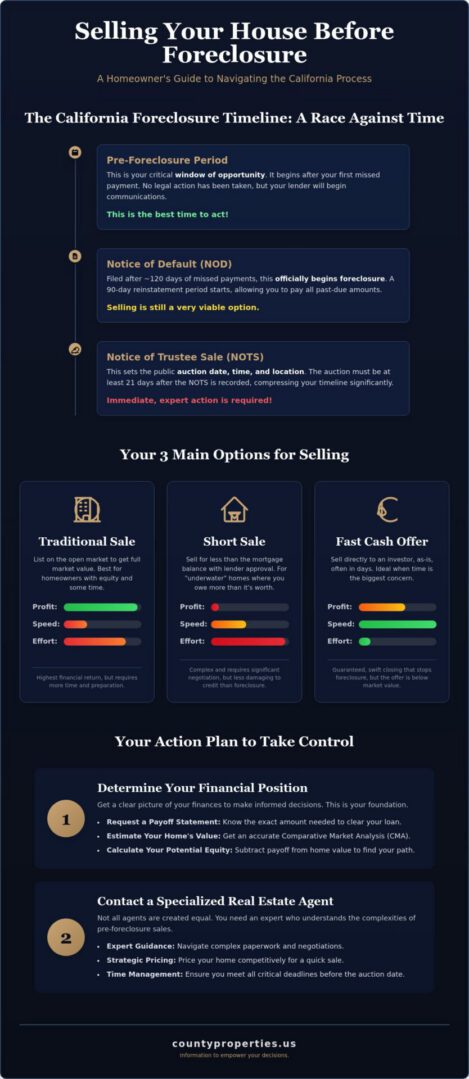
Facing foreclosure can be an incredibly stressful journey, but it’s vital to know that it is a legal process, not a single, sudden event. This timeline provides you with a window of opportunity to take control. Understanding what foreclosure is and its distinct stages is the first step toward a proactive solution. In California, the process is well-defined, and the earlier you act, the more power you have to protect your financial future. The primary goal is to successfully sell my house before foreclosure becomes final at the trustee’s auction, allowing you to walk away with your equity and credit intact.
The Pre-Foreclosure Period: Your Window of Opportunity
This critical period begins the day after your first missed mortgage payment. While no legal action has been taken, your lender will start contacting you through letters and phone calls. This is not a time for panic, but for action. The pre-foreclosure stage is your best opportunity to partner with a trusted real estate expert. Listing your home now gives you the most time to find a qualified buyer and negotiate a sale on your terms, often without the immense pressure of a looming auction date.
Notice of Default (NOD): The Official Start
After approximately 120 days of missed payments, your lender can legally file a Notice of Default (NOD) with the county recorder. This action officially begins the foreclosure process in California. Once the NOD is recorded, a 90-day reinstatement period begins. During this three-month window, you have the right to stop the foreclosure by paying all past-due amounts, including fees. Selling your property is still a very viable option during this crucial phase, as it can provide the funds needed to clear the debt.
Notice of Trustee Sale (NOTS): The Final Countdown
If the loan is not reinstated within the 90-day period, the lender will record a Notice of Trustee Sale (NOTS). This notice sets the specific date, time, and location for the public auction of your home. The auction date must be at least 21 days after the NOTS is recorded. At this point, the timeline becomes extremely compressed. Selling your home is still possible, but it is a race against the clock that requires immediate, expert guidance to complete the sale and close escrow before the scheduled auction.
Your 3 Main Options for Selling a House Before Foreclosure
When facing foreclosure, taking proactive steps is your most powerful tool. Choosing to sell your house before the auction date not only prevents a foreclosure from appearing on your credit record but also gives you control over your financial future. The U.S. Department of Housing and Urban Development (HUD) provides expert guidance on several alternatives to foreclosure, and selling your property is one of the most effective strategies. However, not all sales methods are the same. Each option comes with a different timeline, financial outcome, and set of requirements. The right choice for your journey depends on three key factors: your home’s equity, its physical condition, and how much time you have before the lender takes action. Let’s compare your main options.
Option 1: The Traditional Real Estate Sale
This is often the best path for homeowners who still have equity in their property. A traditional sale on the open market allows you to list your home at its full market value, maximizing your potential profit. While this process requires more time for marketing, showings, and a standard closing period, it offers the highest financial return. A seasoned real estate partner can provide invaluable guidance, helping to price the home competitively for a quicker sale and navigate the process efficiently.
Option 2: A Short Sale
If you owe more on your mortgage than your home is currently worth (known as being “underwater”), a short sale may be your solution. In this scenario, you work with your lender to get their approval to sell the property for less than the total mortgage balance. This is a complex transaction that requires significant negotiation and paperwork, but it is far less damaging to your credit score than a foreclosure. It allows you to walk away from the debt without the severe, long-term consequences of a bank repossession.
Option 3: Selling for a Fast Cash Offer
When time is your biggest concern and you need to sell my house before foreclosure becomes an urgent reality, a fast cash offer is an ideal solution. Real estate investors purchase properties directly from homeowners, often in a matter of days. The primary benefit is speed and convenience-they buy your house as-is, meaning you don’t need to make any repairs or updates. The trade-off is that the offer will be below market value, but it provides a guaranteed, swift closing that stops the foreclosure process in its tracks.
A Step-by-Step Guide to Selling in Pre-Foreclosure
Facing foreclosure can feel overwhelming, but you have options and the power to take control. This step-by-step plan is designed to give you a clear, actionable path forward. The journey to successfully sell my house before foreclosure requires organization, clear communication, and decisive action. By following these steps with a trusted professional partner, you can navigate this challenge and move toward a more secure financial future.
Step 1: Determine Your Financial Position
Before you can create a strategy, you need a clear picture of your finances. This is a critical first step that provides the foundation for all subsequent decisions. Take a deep breath and gather the following information:
- Request a Payoff Statement: Contact your mortgage lender and ask for a formal payoff statement. This document shows the exact amount required to pay off your loan, including any outstanding interest and fees.
- Estimate Your Home’s Value: Get a realistic estimate of your home’s current market value from a qualified real estate professional. An online estimate is a start, but a Comparative Market Analysis (CMA) from an agent is far more accurate.
- Calculate Your Potential Equity: Simply subtract your loan payoff amount from your home’s estimated market value. The result is your equity, which will determine whether a traditional sale or a short sale is the right path for you.
Step 2: Contact a Real Estate Agent Specializing in Foreclosure
Not all real estate agents are equipped to handle the complexities of a pre-foreclosure sale. You need an expert who understands the unique timelines, lender negotiations, and legal nuances involved. A specialist in distressed properties will provide a clear strategy, manage expectations, and serve as your advocate. The right guidance is the most important asset you can have. At County Properties, our team has decades of experience helping homeowners navigate this exact process with compassion and expertise.
Step 3: Notify Your Lender of Your Intent to Sell
Open and honest communication with your lender is crucial. As soon as you decide to sell, you or your agent should inform the lender of your intentions. Providing them with a signed listing agreement can demonstrate your commitment to resolving the debt. In many cases, lenders are willing to postpone foreclosure proceedings if they see you are actively working on a viable solution like a sale. Your agent can handle these critical communications, ensuring everything is documented correctly.
Step 4: Price Your Home to Sell Quickly
When you need to sell your house before foreclosure, time is of the essence. This is not the moment to “test the market” with a high asking price. Your agent will conduct a thorough analysis of comparable recent sales (comps) to set an aggressive, competitive price that will attract immediate buyer interest. A well-priced home generates more showings and is more likely to receive a strong offer quickly, which is your primary goal.
Key Benefits of Selling vs. Allowing a Foreclosure
When facing the possibility of losing your home, it can feel overwhelming to consider your options. However, making the proactive choice to sell your house before foreclosure provides significant long-term advantages that protect your financial future. While letting the bank take over may seem like the simplest path, it is often the most damaging. Selling allows you to manage this difficult journey on your own terms, providing a sense of control when you need it most. As you weigh your options, consider these crucial benefits.
Protecting Your Credit Score
A foreclosure is one of the most severe negative events that can appear on your credit report. It can cause your score to plummet by 100 points or more and remains on your record for seven years, impacting your ability to secure loans for cars, future homes, or even credit cards. In contrast, a traditional or short sale has a much less severe impact, allowing you to begin rebuilding your financial standing far more quickly.
Salvaging Your Home Equity
If you have any equity in your home, a foreclosure auction will almost certainly wipe it out. These sales are designed to recoup the lender’s investment quickly, not to get you the best price. By choosing to sell my house before foreclosure on the open market, you have the opportunity to capture that equity. These funds can be essential, providing the financial cushion needed to land on your feet and start your next chapter.
Avoiding a Deficiency Judgment
In many states, if the foreclosure auction price doesn’t cover the full amount you owe on your mortgage, the lender can sue you for the difference. This is known as a deficiency judgment, and it can follow you for years. When you pursue a pre-foreclosure sale, especially a short sale, your real estate expert can negotiate with the lender to waive their right to seek a deficiency judgment, giving you a truly clean slate.
Regaining Control and Moving Forward with Dignity
Ultimately, a foreclosure is a process that happens to you, leaving you with little to no say in the outcome or timeline. Selling is a decision you make. It empowers you to take control of the situation, manage the sale process, and plan your move on your own schedule. This allows you to close a difficult chapter with your dignity intact and move forward with confidence. When you’re ready, our team is here to provide the expert guidance you deserve. Let us help you take the first step.
Take Control and Secure Your Financial Future
Facing foreclosure in California is a daunting journey, but as we’ve covered, you have more control than you may think. Remember that time is your most valuable asset; acting decisively during the pre-foreclosure period is crucial. Selling your home is a powerful strategy that allows you to protect your credit, regain financial stability, and move forward on your own terms.
If you’re thinking, “I need to sell my house before foreclosure,” you don’t have to navigate this complex process alone. Expert guidance is essential. The team at County Properties brings over 36 years of Southern California real estate experience and a Certified Short Sale and Foreclosure Resource (SFR®) designation to your side. Our empathetic, service-centric approach ensures you receive the compassionate and professional support you deserve.
Take the first step towards a positive resolution. Facing foreclosure? Contact our specialist team for a confidential, no-obligation consultation. Remember, this situation does not define your future. With the right partner, you can move forward with confidence.
Frequently Asked Questions About Selling Your House Before Foreclosure
Can I sell my house if I have no equity or owe more than it’s worth?
Yes, it is possible through a process called a short sale. This is when your lender agrees to accept a sale price that is less than the total amount you owe on the mortgage. Securing lender approval is the most critical step, and it requires a comprehensive package demonstrating your financial hardship. An experienced real estate agent specializing in pre-foreclosure can provide the expert guidance needed to navigate this complex negotiation and successfully sell your home.
How long do I have to sell my house after receiving a Notice of Default in California?
In California, after receiving a Notice of Default, you typically have a 90-day reinstatement period to catch up on payments. If you don’t, the lender can then file a Notice of Trustee Sale, which sets an auction date at least 20 days later. This gives you a minimum of about 110 days from the initial notice to sell your home. Acting quickly with a trusted real estate partner within this window is crucial for a successful outcome.
Will listing my house for sale immediately stop the foreclosure process?
No, simply listing your house for sale does not automatically stop the foreclosure process. Your lender will continue with their legal timeline. However, informing your lender of your intent to sell and providing a signed purchase agreement can often persuade them to postpone the auction date. Consistent communication and demonstrating proactive steps are key to gaining their cooperation while you work with your real estate partner toward a successful sale.
What are the costs associated with selling a home in pre-foreclosure?
The costs are similar to a traditional sale and typically include real estate commissions, escrow fees, and title insurance, all paid from the sale proceeds. You may also need to cover minor repair costs to make the home marketable. In a short sale scenario, we can often negotiate for the lender to cover some or all of these closing costs, which is a significant benefit when your personal funds are limited and you need to protect your financial security.
Can I live in my house while it is on the market?
Absolutely. You are the legal owner of the property until the sale is finalized or the foreclosure auction occurs, so you can continue to live there. Remaining in the home can be beneficial for upkeep and makes it easier to prepare for showings. We will work with you to schedule viewings conveniently. You will just need to be prepared to vacate the property by the closing date agreed upon with the new buyer.
Do I have to pay taxes if my mortgage debt is forgiven in a short sale?
Potentially, yes. Forgiven debt from a short sale can be considered taxable income by the IRS. However, legislation like the Mortgage Forgiveness Debt Relief Act has often provided exemptions for principal residences. Tax laws are complex and change frequently, so it is essential to consult with a qualified tax professional. They can provide personalized guidance based on your specific financial situation and ensure you understand any potential tax liability.
What happens if my house doesn’t sell before the auction date?
If your house doesn’t sell before the auction, the foreclosure will proceed, and the property will be sold to the highest bidder. At that point, you lose ownership and the ability to salvage any equity. Failing to sell my house before foreclosure results in the most significant damage to your credit score. This is why it is so critical to take immediate action and partner with a trusted professional to manage the sale before the final auction date.