

Receiving a notice from your lender can feel like the ground is crumbling beneath you. The fear of losing your home, coupled with confusing legal notices and the overwhelming weight of uncertainty, can be paralyzing. But in this critical moment, it’s important to know you are not alone, and you have options. Taking proactive steps is the key, and understanding how to avoid foreclosure is the first, most empowering step you can take on this journey toward financial security.
That’s why we’ve created this comprehensive, step-by-step guide. As your trusted real estate partner, our commitment is to cut through the jargon and provide the clear, actionable guidance you deserve. We will walk you through every possible option available in California, from loan modifications to short sales, helping you build a solid plan. Our goal is to empower you with the knowledge and confidence needed to navigate this challenge and regain control of your future. Let’s begin.
Understanding the Foreclosure Process in California
Facing the possibility of foreclosure is incredibly stressful, but knowledge is your most powerful tool for overcoming fear and uncertainty. The most important thing to understand is that foreclosure is a legal procedure with a defined timeline-it doesn’t happen overnight. Gaining clarity on these steps is the foundation for learning how to avoid foreclosure. To get a broad overview, you can read about the foreclosure process in general, but California has specific stages you need to know. Time is your most valuable asset, and the earlier you act, the more options you will have.
The Four Main Stages of Foreclosure
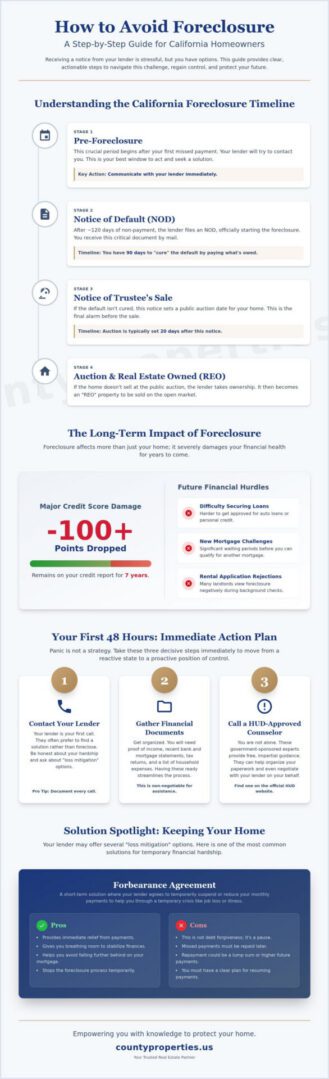
In California, the non-judicial foreclosure process follows a clear path. As your trusted real estate partner, we want to provide you with the guidance to navigate each step:
- 1. Pre-Foreclosure: This period begins after your first missed mortgage payment. Your lender will attempt to contact you to resolve the debt. This is your best window to communicate and seek solutions like loan modification.
- 2. Notice of Default (NOD): After about 120 days of missed payments, your lender can file an NOD. This officially begins the formal foreclosure process and gives you 90 days to “cure” the default by paying what is owed.
- 3. Notice of Trustee’s Sale: If the default isn’t cured, a Notice of Trustee’s Sale is recorded and mailed to you. This sets a public auction date for your home, typically 20 days after the notice is issued.
- 4. Real Estate Owned (REO): If your home doesn’t sell at auction, the lender takes ownership, and it becomes an REO property.
Key Documents You Will Receive
During this journey, you will receive critical legal documents by mail. It is vital that you open and read everything from your lender or their representatives. The Notice of Default is your first formal warning and your cue to take immediate action. The Notice of Trustee’s Sale is the final alarm, informing you of the exact date your property will be sold. Ignoring these notices will not stop the process; it only reduces the time you have to find a solution.
How Foreclosure Impacts Your Credit and Future
The consequences of a foreclosure extend far beyond losing your home. It can cause a significant drop in your credit score-often by 100 points or more-and will remain on your credit report for seven years. This long-term damage makes it extremely difficult to secure future loans for a car, get a new mortgage, or even be approved to rent a home. Understanding these impacts underscores why learning how to avoid foreclosure is absolutely critical for protecting your long-term financial health and stability.
Your Immediate Action Plan: The First 48 Hours
Receiving notice of a potential foreclosure can feel overwhelming, but this is the moment for calm, decisive action, not panic. The steps you take in the next two days can set the foundation for a positive outcome. This is your opportunity to move from a reactive state of worry to a proactive position of control. This guide provides the clear, immediate steps to take as you begin the journey of learning how to avoid foreclosure and protect your home.
Step 1: Contact Your Lender or Servicer
Your first phone call should be to the company you send your mortgage payments to. It’s a common misconception that lenders want to foreclose; in reality, it’s a costly and complicated process they prefer to avoid. They are often willing to work with you. When you call, be prepared with your loan number and a brief, honest explanation of your financial hardship. Ask specifically about their “loss mitigation” or “foreclosure avoidance” options. Document every single conversation: note the date, time, the name of the person you spoke with, and a summary of what was discussed. This log will be an invaluable asset.
Step 2: Gather Your Financial Documents
Your lender and any housing counselor will need a clear picture of your financial situation to help you. Taking the time now to organize these documents will streamline the entire process. This information is non-negotiable for nearly every form of assistance. Start a folder and gather the following essential items:
- Recent mortgage statements
- Proof of income (pay stubs, benefit statements)
- Recent bank statements for all accounts
- A list of your monthly household expenses (utilities, food, insurance, etc.)
- Your most recent tax returns
Step 3: Contact a HUD-Approved Housing Counselor
You do not have to navigate this process alone. The U.S. Department of Housing and Urban Development (HUD) sponsors housing counseling agencies across the country that provide free, expert guidance to homeowners in distress. These counselors are your impartial advocates. They can help you understand the official government tips to avoid foreclosure, organize your financial paperwork, and even negotiate with your lender on your behalf. Finding a trusted expert is a critical step in understanding all the options available to you. You can find a local, approved agency through the official HUD website.
Primary Options to Keep Your Home
When you fall behind on payments, your lender’s primary goal is often to find a way to recover the debt without the costly legal process of foreclosure. This opens the door for collaboration. These solutions, known as “loss mitigation” options, are designed to create a manageable path forward. Understanding these is a critical step in figuring out how to avoid foreclosure. For a comprehensive overview of your legal rights and the foreclosure timeline, the official California Courts Self-Help Guide is an invaluable state-specific resource.
Below are the most common options your lender may offer to help you stay in your home.
Forbearance Agreement
A forbearance agreement is a short-term solution where your lender agrees to temporarily suspend or reduce your monthly mortgage payments. This is designed for homeowners experiencing a temporary financial hardship, such as a sudden job loss, illness, or other unexpected emergency.
- Pros: Provides immediate relief and breathing room to stabilize your finances without falling further behind.
- Cons: This is not debt forgiveness. The missed payments must be repaid later, often through a lump sum, higher payments, or a loan modification.
Loan Modification
A loan modification permanently alters the original terms of your mortgage to make your payments more affordable. This is a long-term solution for homeowners whose financial situation has changed significantly. The lender might lower your interest rate, extend the loan term, or in some cases, reduce the principal balance.
- Pros: Creates a sustainable monthly payment, making it a powerful tool for long-term home retention.
- Cons: The application process can be lengthy and requires significant documentation. It may also have a negative impact on your credit score.
Repayment Plan
If you’ve recovered from a temporary setback but have fallen behind on several payments, a repayment plan allows you to catch up. Under this plan, you pay your regular mortgage amount plus an additional portion of the past-due balance each month over a set period (typically 3-6 months) until you are current.
- Pros: A straightforward way to resolve delinquency if your income has returned to normal.
- Cons: Results in a higher monthly payment during the plan’s duration, which requires a strict budget.
Refinancing
Refinancing involves taking out a new loan to pay off your existing mortgage. Ideally, the new loan would have a lower interest rate or better terms, resulting in a more affordable payment. However, this option is often challenging for those already facing foreclosure.
- Pros: Can lower your monthly payment and interest rate if you qualify.
- Cons: Lenders have strict credit and income requirements. If you have missed payments, it is very difficult to be approved.
Strategic Alternatives When Keeping Your Home Isn’t an Option
Sometimes, the most responsible financial decision involves letting go of your home to protect your future. This is not a sign of failure; it is a strategic choice to take control of the situation and minimize damage to your credit and long-term finances. The goal shifts from saving the house to saving your financial standing. Exploring these paths is a critical part of knowing how to avoid foreclosure, and the guidance of a real estate specialist becomes invaluable during this journey.
These options are proactive measures that allow you to exit homeownership with dignity and on your own terms, rather than waiting for the bank to act.
Short Sale: Selling for Less Than You Owe
A short sale is when your lender gives you permission to sell your home for less than your outstanding mortgage balance. The lender then accepts the sale proceeds as settlement of your debt. While this is a complex negotiation, the benefits are significant:
- Avoids Foreclosure: A short sale is not a foreclosure, and it appears differently on your credit report.
- Less Credit Damage: The impact on your credit score is typically less severe than a foreclosure, allowing you to recover more quickly.
- Provides Closure: You can proactively resolve your mortgage debt and move forward.
Because these transactions require deep expertise and direct lender negotiation, working with a seasoned professional is essential for a successful outcome. Our team are certified short sale specialists. Learn how we can help.
Deed in Lieu of Foreclosure
A deed in lieu of foreclosure is the process of voluntarily transferring ownership of your property to the lender. In exchange, the lender agrees to forgive the mortgage debt and cancel the foreclosure proceedings. While it sounds simple, lenders may reject this option if there are other liens on the property (like a second mortgage or tax lien), as they would have to assume that debt. For the lender, however, it can be a faster and less expensive alternative to a formal foreclosure.
Selling Your Home on the Market
If you have equity in your home-meaning it’s worth more than you owe-selling it on the open market is the best possible course of action. This path provides the most control and the best financial outcome, allowing you to pay off your mortgage and potentially walk away with funds to start fresh. The key is to act quickly and price the home strategically for a fast sale. A trusted real estate partner can provide a market analysis to help you find the right price point to attract serious buyers before the foreclosure process is complete.
Beware of Foreclosure Scams
When you’re facing the stress of a potential foreclosure, your primary focus is on finding a solution-fast. Unfortunately, predatory companies and scammers know this, and they target homeowners in this vulnerable state with fraudulent ‘foreclosure rescue’ offers. Protecting yourself from these schemes is a critical part of successfully navigating this journey and ensuring your financial security.
Common Red Flags to Watch For
True assistance is about guidance, not guarantees. Be extremely wary of any individual or company that makes promises that sound too good to be true. Scammers often use high-pressure tactics to get you to act without thinking. Watch for these warning signs:
- Guarantees to stop foreclosure or demands for large upfront fees. Legitimate, HUD-approved counselors will never guarantee a specific outcome, and many of their services are free or low-cost.
- Instructions to sign over your deed or transfer ownership. This is often part of a ‘lease-back’ scam where you end up as a renter in your own home, only to be evicted later. Never transfer your property title to someone promising to help you.
- Advice to stop paying your lender and pay them instead. You should only ever make your mortgage payments directly to your mortgage servicer or a court-approved entity.
How to Verify Legitimate Help
The key to finding real help is to work with credible, transparent professionals. Before you agree to any service or sign any paperwork, take these essential steps to protect yourself:
- Only work with HUD-approved housing counselors. These professionals are government-certified to provide reliable guidance. You can find a list of approved counselors on the official HUD website.
- Never sign documents you haven’t read or don’t fully understand. If you feel pressured or confused, it’s a major red flag. Always take the time to seek legal advice if necessary.
- Check reviews and professional credentials. A legitimate company or advisor will have a verifiable track record, proper licensing, and a professional online presence.
If you suspect you have encountered a foreclosure scam, report it immediately to the Federal Trade Commission (FTC) and the Consumer Financial Protection Bureau (CFPB). Your report can help protect other homeowners from falling victim to the same scheme.
Ultimately, navigating how to avoid foreclosure is about working with a trusted partner who puts your interests first. A seasoned real estate professional can provide legitimate guidance on options like a short sale or a deed in lieu. At County Properties, we are committed to providing ethical, expert advice to help you explore your options with confidence and clarity.
Your Path Forward: Navigating Foreclosure with Confidence
Facing foreclosure in California can feel overwhelming, but remember that you have options and control. The key is to act swiftly, understand all available paths-from loan modifications to strategic sales-and avoid predatory scams. Knowing how to avoid foreclosure is about making informed, proactive decisions, not reacting out of fear. A clear strategy is your strongest asset in securing a positive outcome for you and your family.
You are not alone in this journey. With 36+ years of experience serving Southern California, our team provides the empathetic, step-by-step guidance you deserve. As a Certified Short Sale and Foreclosure Resource (SFR®), we are uniquely qualified to help you find the best solution for your specific circumstances. You don’t have to navigate this complex process by yourself.
Facing foreclosure? Get a confidential, no-obligation consultation with our specialists.
Taking that first step is the most powerful move you can make toward a brighter financial future.
Frequently Asked Questions About Avoiding Foreclosure
How long do I have to act after receiving a Notice of Default in California?
In California, the foreclosure timeline provides a critical window for action. Once you receive a Notice of Default, a 90-day “reinstatement period” begins. During this time, you can halt the foreclosure by paying the past-due amount plus any accrued fees. It is absolutely essential to use this period to contact your servicer and explore all available options. Acting quickly gives you the best chance to regain control and save your home from a trustee’s sale.
Will avoiding foreclosure through a short sale still hurt my credit score?
Yes, a short sale will negatively impact your credit score, but the damage is typically less severe and prolonged than a foreclosure. A foreclosure can remain on your credit report for seven years, often causing a significant point drop. A short sale, usually noted as “settled for less than the full amount,” may result in a more moderate decrease. It is a strategic alternative that can allow for a faster financial recovery compared to a full foreclosure.
Can I file for bankruptcy to stop a foreclosure?
Filing for bankruptcy can immediately stop a foreclosure proceeding. The moment you file, the court issues an “automatic stay,” which legally prevents your mortgage servicer from moving forward with a sale. This provides you with crucial time to reorganize your finances under a Chapter 13 plan or explore other options. However, bankruptcy is a serious legal step with lasting financial implications, so consulting with a qualified attorney is essential to determine if it is your best course of action.
While you will need a local attorney for specific advice in California, it can be helpful to see how legal professionals operate. For instance, you can check out Matthew Fornaro, P.A. to understand the role a law firm can play in navigating complex financial situations.
What is the difference between a mortgage lender and a mortgage servicer?
Your mortgage lender is the bank or financial institution that originally gave you the loan to buy your home. The mortgage servicer, on the other hand, is the company that manages your loan. They are responsible for collecting your payments, managing your escrow account, and handling customer service. When you are looking for information on how to avoid foreclosure, you will be communicating and negotiating directly with your mortgage servicer, not the original lender.
Do I have to move out immediately if my house is foreclosed on?
No, you are not required to vacate your home on the day of the foreclosure sale. The new owner, whether it’s the bank or a third-party buyer, must follow a formal legal eviction process. In California, this typically starts with a written “3-Day Notice to Quit.” This process provides a clear timeline and cannot be bypassed, giving you a transition period to plan your next steps. It is vital to respond to any legal notices you receive.
Are there any specific foreclosure protections for military servicemembers?
Yes, active-duty military personnel are granted significant protections under the Servicemembers Civil Relief Act (SCRA). This federal law can postpone foreclosure proceedings for the duration of your active service and for up to one year afterward. The SCRA also allows you to request a mortgage interest rate reduction to 6%. If you are a servicemember facing financial difficulty, you must inform your mortgage servicer of your active-duty status to receive these important protections.