

Dreaming of owning a home in the Golden State, but the headlines about soaring prices and complex processes make it feel more like a fantasy? You’re not alone. The journey for a first time home buyer in California can seem daunting, filled with confusing questions about down payments, mortgages, and closing costs. It’s easy to feel overwhelmed and believe that the dream of homeownership is simply out of reach for you.
But what if we told you that your dream is closer than you think? This comprehensive guide is designed to be your trusted partner, providing the clarity and confidence you need to take the next step. We are here to guide you through every stage, from creating a realistic budget and understanding your financing options to uncovering the valuable state and local financial assistance programs you may qualify for. Consider this your personal roadmap to turning the dream of owning a home in California into your reality.
Key Takeaways
- Learn the 7 essential steps of the home-buying journey, a crucial roadmap for any first time home buyer california.
- Uncover the true cost of buying a home by understanding the critical difference between your down payment and closing costs.
- Discover powerful financial assistance programs available to a first time home buyer california that can significantly lower your upfront expenses.
- Understand why a trusted real estate agent is your most important partner for guiding you through loan options and complex negotiations.
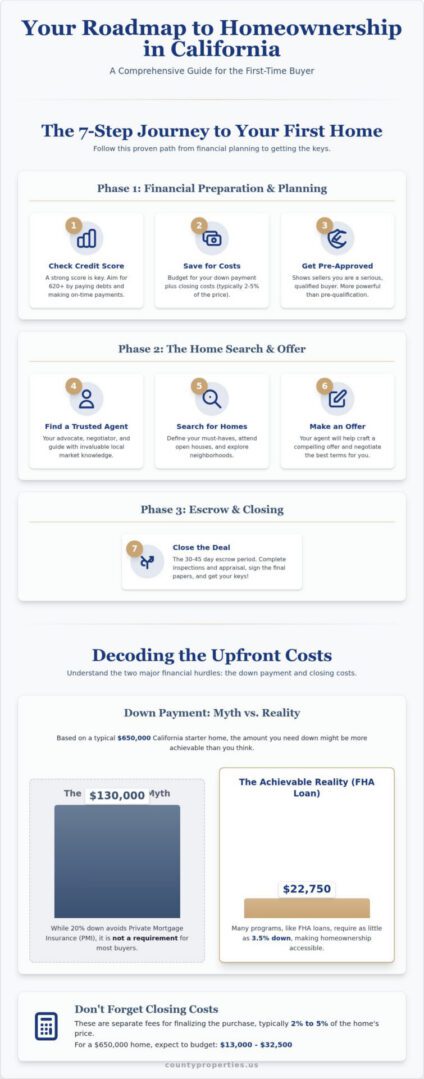
The 7 Steps to Buying Your First Home in California
Welcome to your home-buying journey! Becoming a first time home buyer in California is an exciting milestone, but it’s important to view it as a marathon, not a sprint. The process typically takes several months and involves a team of dedicated professionals-including a real estate agent, a mortgage lender, and a home inspector-who will serve as your expert guides. While the path may seem complex, understanding these key steps will empower you to move forward with confidence and turn your dream of homeownership into a reality.
Phase 1: Financial Preparation & Planning
A strong financial foundation is the bedrock of a successful home purchase. Rushing this phase can lead to stress and disappointment, a lesson learned by many during the turbulent U.S. housing bubble. Taking the time to prepare properly ensures you are in the best possible position to secure a loan and make a competitive offer.
- Step 1: Check and Improve Your Credit Score. Your credit score is a major factor in your mortgage eligibility and interest rate. Aim for a score of 620 or higher, and work on paying down debt and making on-time payments to improve it.
- Step 2: Save for a Down Payment and Closing Costs. While some loans require as little as 3% down, a larger down payment can lower your monthly mortgage. Don’t forget to budget for closing costs, which typically run 2-5% of the home’s purchase price.
- Step 3: Get Pre-Approved for a Mortgage. A pre-approval is a lender’s conditional commitment to loan you a specific amount. It’s far more powerful than a pre-qualification and shows sellers you are a serious, qualified buyer.
Phase 2: The Home Search & Offer
With your finances in order, the exciting search for your perfect home begins. This is where your vision starts to take shape. For any first time home buyer, California‘s competitive market requires a strategic approach, which starts with building the right team.
- Step 4: Find a Trusted Real Estate Agent. A great agent is your advocate, negotiator, and guide. They provide invaluable local market knowledge and help you navigate every step of the process.
- Step 5: Search for Homes and Attend Open Houses. Define your must-haves versus your nice-to-haves. Attend open houses to get a feel for different neighborhoods, layouts, and what your budget can truly afford.
- Step 6: Make an Offer and Negotiate. Once you find “the one,” your agent will help you craft a compelling offer based on market analysis. Be prepared for potential negotiations on price, contingencies, or other terms.
Phase 3: Escrow & Closing
Once your offer is accepted, you enter the final phase known as escrow. This is a 30- to 45-day period where all the final details are handled by a neutral third party to ensure the transaction is completed safely and correctly. This is the home stretch before you officially become a homeowner.
- Step 7: The Escrow Process, Inspections, and Appraisal. During this time, you’ll conduct a home inspection to check for any issues, and your lender will order an appraisal to confirm the home’s value. Once all conditions are met and the final paperwork is signed, the keys are finally yours!
If the path from planning to closing seems daunting, remember you don’t have to walk it alone. A trusted agent can guide you through every step.
Decoding the Costs: Down Payment and Closing Costs Explained
Let’s address the biggest question on every first-time buyer’s mind: “How much money do I actually need?” For most, the financial aspect is the most intimidating part of the journey. The two major hurdles are the down payment and closing costs. Think of it this way: your down payment is your initial investment in the home itself, while closing costs are the fees required to finalize the purchase-like a processing fee for the entire transaction. While the numbers can seem daunting, understanding them is the first step toward creating a manageable plan.
How Much Do You Really Need for a Down Payment?
The myth that you need 20% down is one of the most persistent in real estate. While a 20% down payment helps you avoid Private Mortgage Insurance (PMI), it is not a requirement. Many loan programs are designed for buyers with less to put down. FHA loans require as little as 3.5%, and some conventional loans allow for just 3-5%. If you put down less than 20%, you will likely pay for PMI, which is simply an insurance policy that protects the lender and is added to your monthly payment until you build sufficient equity.
California Example: On a $650,000 starter home, a 3.5% FHA down payment would be $22,750-a far more achievable goal for a first time home buyer California than the $130,000 needed for a 20% down payment.
What Are Closing Costs in California?
Closing costs are the second piece of the puzzle. In California, these typically range from 2% to 5% of the home’s purchase price. For that same $650,000 home, you can expect to pay between $13,000 and $32,500. These fees cover the various services needed to close the deal and can include:
- Lender origination fees
- Appraisal and inspection fees
- Title insurance and escrow fees
- Prepaid property taxes and insurance
Your lender is required to provide a Loan Estimate document, which details these costs. Review it carefully with your agent. In some markets, your agent can negotiate for the seller to cover a portion of these costs, known as “seller concessions,” to reduce your out-of-pocket expenses.
Putting it all together can feel overwhelming, but remember, you don’t have to do it alone. Proper planning and expert guidance make these figures surmountable. Fortunately, California offers numerous assistance programs to help with these upfront costs. Programs like the California Dream For All program can provide significant support, bridging the gap and making your dream of ownership more accessible than you might think.
California’s First-Time Home Buyer Programs: Your Financial Toolkit
For many, the biggest hurdle on the path to homeownership isn’t finding the right house-it’s securing the financing. Fortunately, if you’re a first time home buyer in California, the state offers a powerful financial toolkit designed to turn your dream of owning a home into a reality. These programs, primarily offered through the California Housing Finance Agency (CalHFA), provide the crucial support needed to overcome down payment and closing cost challenges. Think of them as your secret weapon for success.
CalHFA Down Payment and Closing Cost Assistance
CalHFA provides several “silent second” loans, which are junior loans that you don’t have to make monthly payments on. Instead, they are typically repaid when you sell, refinance, or pay off your primary mortgage. This structure significantly lowers your initial cash-to-close requirement. Key programs include:
- MyHome Assistance Program: Provides a deferred-payment loan of up to 3.5% of the purchase price to be used for your down payment or closing costs.
- CalHFA Zero Interest Program (ZIP): Often used in conjunction with a CalPLUS loan, this program offers a no-interest second loan to cover closing costs.
- School Teacher and Employee Assistance Program: Offers additional assistance for eligible teachers, administrators, and staff working in California’s K-12 public schools.
CalHFA First Mortgage Loan Programs
To use the assistance programs above, you must get your primary mortgage through a CalHFA-approved lender. These loans are designed to be stable and reliable, offering 30-year fixed interest rates. Understanding the differences between loan types is a key part of the overall home buying process, and a knowledgeable lender is your best guide. Your main options are the CalHFA Conventional, CalPLUS Conventional, CalHFA FHA, and CalPLUS FHA loans. General eligibility is tied to income limits, meeting credit requirements, and being a U.S. citizen or qualified alien. Let us connect you with a lender who specializes in these programs.
Other Local and City-Specific Programs
Beyond the statewide CalHFA offerings, many municipalities provide their own unique assistance. Major cities like Los Angeles, San Diego, and San Francisco often have dedicated programs with specific funding and requirements. A great starting point is to search online for “[Your City Name] first time home buyer program.” This is where the guidance of a seasoned local real estate expert becomes invaluable; they are often aware of hyper-local opportunities that can provide the final piece of your financial puzzle.
Choosing Your Loan: FHA, VA, and Conventional Options
After exploring assistance programs, the next step is to understand the actual mortgage you’ll receive. It’s a common point of confusion, but programs like CalHFA don’t lend money directly; they work in conjunction with standard loan types. For any first time home buyer california, the journey typically leads to one of three main paths: FHA, VA, or Conventional loans. Your financial profile, credit history, and military service status will guide you to the right choice. Remember, there is no single “best” loan-only the one that best serves your unique situation.
Here’s a high-level comparison to help you see the key differences at a glance:
| Feature | FHA Loan | VA Loan | Conventional Loan |
|---|---|---|---|
| Min. Down Payment | 3.5% | 0% | 3% – 20%+ |
| Typical Credit Score | 580+ | Flexible (lender dependent) | 620+ |
| Mortgage Insurance | MIP (often for life of loan) | No monthly PMI (Funding Fee applies) | PMI (avoidable with 20% down) |
FHA Loans: Flexible and Accessible
Insured by the Federal Housing Administration, FHA loans are a lifeline for buyers with lower credit scores or smaller savings. They require just a 3.5% down payment, making homeownership more attainable. The trade-off is the FHA’s Mortgage Insurance Premium (MIP), which includes an upfront fee and a monthly premium that typically lasts for the entire loan term. This insurance protects the lender, not you, in case of default.
VA Loans: A Powerful Benefit for Veterans
For eligible veterans, active-duty service members, and surviving spouses, the VA loan is an unparalleled benefit. It requires zero down payment and has no monthly mortgage insurance, offering significant savings. Instead of PMI, there is a one-time VA funding fee, which can be financed into the loan. Veterans receiving VA disability compensation are often exempt from this fee, making it an even more powerful tool for homeownership.
Conventional Loans: For Stronger Financial Profiles
Conventional loans are ideal for buyers with strong credit and more substantial savings. The key advantage is avoiding mortgage insurance. If you can make a 20% down payment, you won’t have to pay Private Mortgage Insurance (PMI). For those who can’t, options like the Conventional 97 loan allow for a down payment as low as 3%, with the benefit that PMI can be canceled once you reach 20% equity in your home.
Understanding these nuances is key to securing a loan that empowers your financial future. The right guidance makes all the difference. If you’re ready to explore which loan is the perfect fit for your dream home, the expert team at County Properties is here to help you navigate every step.
Why Your Real Estate Agent Is Your Most Valuable Asset
So far, we’ve covered the crucial steps of getting pre-approved, saving for a down payment, and starting your search. But navigating this complex journey alone, especially as a first time home buyer in California, can feel overwhelming. This is where a professional real estate agent transforms from a helpful resource into your single most valuable asset. Think of them less as a salesperson and more as your dedicated project manager-the trusted guide who orchestrates the entire process and protects your interests from start to finish.
What a Great Buyer’s Agent Does for You
A truly great agent does far more than just unlock doors. They are your strategic partner, providing comprehensive support that simplifies your path to homeownership. Their role includes:
- Deep Local Market Knowledge: Providing invaluable insights into specific Southern California neighborhoods, school districts, local market trends, and realistic property values so you can make a truly informed decision.
- Competitive Offer Strategy: Helping you craft a compelling offer that stands out in a competitive market. They advise on the right price, contingencies, and terms to increase your chances of success.
- Skilled Negotiation: Acting as your steadfast advocate, negotiating the best possible price and terms with the seller’s agent on your behalf, potentially saving you thousands.
- Seamless Coordination: Managing the complex closing process by coordinating with your lender, home inspector, escrow officer, and title company to ensure every deadline is met and the transaction goes smoothly.
Finding the Right Partner for Your Journey
Choosing an agent is about finding a partner you trust. Look for experience, clear and consistent communication, and a philosophy that puts your success above all else. At County Properties, our service-centric approach is built on a unique team concept, ensuring our clients benefit from our collective expertise and unwavering support. We understand the specific challenges and opportunities that a first time home buyer in California faces because we live and work here every day. Your journey to homeownership is a significant life event, and you deserve a dedicated guide. Start your journey with a trusted partner. Contact County Properties today.
Your California Homeownership Journey Starts Now
Embarking on this journey can feel complex, but owning a home in the Golden State is an achievable dream. This guide has shown that success hinges on understanding the process, from decoding costs to choosing the right loan. Most importantly, leveraging the state’s financial programs and partnering with an expert real estate agent are the critical steps that empower every first time home buyer california has the pleasure of welcoming.
You don’t have to navigate this path alone. At County Properties, our service-centric team is dedicated to your success, bringing 36+ years of real estate experience and deep expertise in the Southern California market to your side. We are your trusted partner, committed to providing the personalized guidance you deserve.
Ready to make your dream home a reality? Contact County Properties for personalized guidance. With the right knowledge and a dedicated team, you are closer than ever to unlocking the door to your new home.
Frequently Asked Questions
What is the minimum credit score to buy a house in California?
While there’s no single magic number, lenders generally look for a credit score of 620 or higher for a conventional loan in California. For government-backed loans like FHA, the minimum can be as low as 580 with a 3.5% down payment. A higher score not only increases your approval odds but also helps secure a lower interest rate, saving you thousands over the life of your loan. We can guide you toward lenders who fit your specific credit profile.
How much income do I need to qualify for a home in California?
Lenders focus less on a specific income and more on your debt-to-income (DTI) ratio. This compares your monthly debt payments to your gross monthly income. Ideally, lenders prefer a DTI of 43% or less. For example, if you earn $8,000 per month, your total debt payments, including your future mortgage, should not exceed $3,440. Our team can help you calculate your DTI and understand your purchasing power in today’s market.
Can I buy a house in California with no money down?
While challenging, it is possible. Certain government-backed loans, like VA loans for veterans and USDA loans for eligible rural areas, offer 0% down payment options. Additionally, California offers numerous down payment assistance (DPA) programs that provide grants or silent second mortgages to cover your initial investment. As your trusted partner, we can help you explore these programs to see if you qualify and help make your dream of homeownership a reality with minimal upfront cost.
How long does the home buying process take from start to finish in California?
The timeline can vary, but once you have an accepted offer on a home, the escrow period in California typically takes 30 to 45 days. This is when inspections, appraisals, and final loan approval occur. The initial home search itself can take anywhere from a few weeks to several months, depending on market conditions and your specific needs. We provide step-by-step guidance to ensure your journey from searching to closing is as smooth and efficient as possible.
What happens if I have student loan debt? Can I still buy a house?
Absolutely. Having student loan debt does not automatically disqualify you from buying a home. Lenders will include your monthly student loan payment when calculating your debt-to-income (DTI) ratio. Different loan programs treat this debt differently, so it’s crucial to work with a knowledgeable team. As a first time home buyer in California, we can connect you with lenders who understand how to navigate these guidelines and help you successfully secure a mortgage.
Are there special programs for specific professions, like teachers or firefighters?
Yes, California offers several programs to support community heroes. The CalHFA MyHome Assistance Program and the national Good Neighbor Next Door program can provide significant help to teachers, firefighters, police officers, and EMTs. These programs often include down payment assistance or discounts on certain homes. Our team is experienced in identifying these specialized opportunities to ensure you receive every benefit you’ve earned through your service to the community.
What is the difference between being pre-qualified and pre-approved for a mortgage?
Think of pre-qualification as a quick estimate of what you might be able to borrow, based on information you provide. Pre-approval, however, is a much more powerful step. For this, a lender thoroughly verifies your income, assets, and credit to issue a conditional commitment to lend. For any first time home buyer in California, a pre-approval letter shows sellers you are a serious, financially-vetted buyer, giving your offer a significant competitive advantage.