

You’ve found your dream home in California, navigated the offers, and are nearing the finish line of your homebuying journey. But as you approach the final step, a new wave of questions can arise, often centered around one intimidating topic. The fear of hidden fees and a long list of confusing charges can turn this exciting moment into an overwhelming one. We believe that understanding the closing costs for a buyer in California shouldn’t be a source of stress, but a moment of empowerment.
As your trusted real estate partner, we’ve created this ultimate 2025 guide to provide you with clarity and confidence. We will walk you through every potential fee, from escrow services to title insurance, so you can budget accurately and eliminate last-minute surprises. You’ll learn what’s negotiable, what’s fixed, and discover expert strategies to potentially save thousands on your transaction. Let’s make sure the only thing you feel on closing day is the joy of getting your new keys.
What Exactly Are Buyer Closing Costs in California?
Think of closing costs as the final service fees you pay to complete your home purchase, much like settling a bill at the end of a great meal. In simple terms, these are a collection of expenses for the professional services and administrative tasks required to finalize a real estate transaction and your mortgage. While the specific fees can vary, the fundamental question of what closing costs are is answered by looking at the professionals who guide your journey to the finish line.
It’s crucial to understand that closing costs are completely separate from your down payment. Your down payment is your initial investment in the home itself-it builds your equity from day one. Closing costs, on the other hand, cover the transaction’s logistics. These are paid at the very end of the process when you officially “close” on the property and receive the keys to your new home. Understanding these expenses is the first step to confidently navigating the total closing costs for buyer in California.
Why Do Closing Costs Exist?
These fees aren’t arbitrary; they exist to ensure your home purchase is handled legally, securely, and professionally. They compensate the various independent parties who work behind the scenes to make your homeownership dream a reality. The primary reasons for these costs include:
- Paying Professionals: To compensate third-party providers like your lender, the title company, appraisers, and inspectors for their expert services.
- Covering Paperwork: To handle the significant legal and administrative paperwork required to transfer the property’s title and deed into your name.
- Pre-paying Expenses: To set up escrow accounts for recurring costs you’ll pay as a homeowner, such as property taxes and homeowner’s insurance.
The Key Players You’re Paying
When you review your closing statement, you’ll see fees allocated to several key entities. These are the partners who ensure your transaction is seamless and legitimate. The main recipients of your closing cost funds are:
- Your Mortgage Lender: For underwriting, processing, and funding your home loan. This includes fees for loan origination and application processing.
- The Title & Escrow Company: For conducting a title search to ensure the property is free of liens and for managing the secure transfer of funds between all parties.
- Government Agencies: For officially recording the new deed with the county and, in some areas, for paying local property transfer taxes.
How Much Should You Budget for Closing Costs in California?
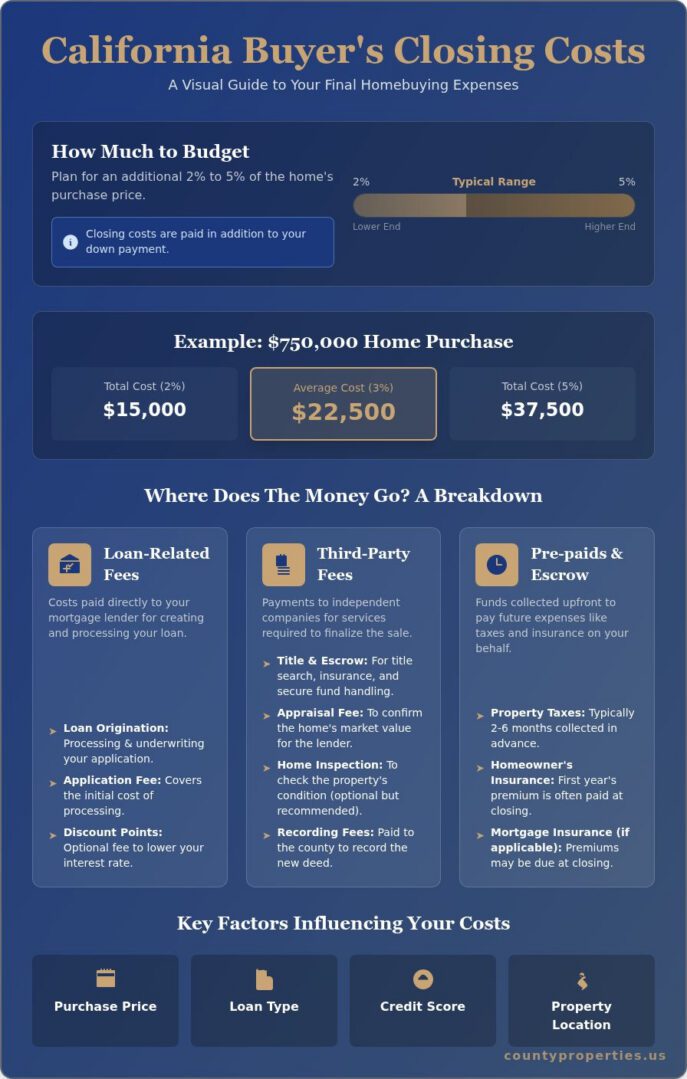
As you embark on your home-buying journey, one of the most critical steps is budgeting for expenses beyond the down payment. As a trusted guideline, you should anticipate that closing costs for a buyer in California will range from 2% to 5% of the home’s final purchase price. This is a significant sum, so planning for it early is essential for a smooth and confident transaction. The range is wide because the final amount depends on your loan type, the property’s location, and terms negotiated in your purchase agreement.
Fortunately, you won’t be left guessing. Within three business days of applying for a mortgage, your lender must provide you with a Loan Estimate (LE). This standardized document offers a detailed, itemized projection of your potential closing costs. While the Loan Estimate provides excellent initial guidance, these figures are finalized in a document you’ll review before closing day called the Closing Disclosure, which you can compare against your original estimate.
A Real-World Example: Closing Costs on a $750,000 Home
To make this tangible, let’s look at a $750,000 home purchase. Using a midrange average of 3%, your estimated closing costs would be $22,500 ($750,000 x 0.03). Based on the full 2% to 5% range, you should prepare to budget anywhere from $15,000 to $37,500. This is the amount of liquid funds you will need to pay on closing day, typically via a cashier’s check or a secure wire transfer.
Factors That Influence Your Total Closing Costs
Several key variables will determine where your final figure falls within that 2-5% range. Understanding these factors will empower you to better anticipate your costs:
- The Purchase Price: Many fees, such as title insurance and certain taxes, are calculated as a percentage of the sale price. A more expensive home will naturally have higher closing costs.
- Your Loan Type: Different mortgage products come with unique fee structures. For example, FHA loans require an Upfront Mortgage Insurance Premium (UFMIP), while VA loans include a funding fee.
- Your Credit Score: A stronger credit profile can help you secure a lower interest rate and may reduce certain lender-origination fees, directly impacting your overall cash-to-close amount.
- Your Specific Location: Property and transfer taxes can vary significantly by county and city in California. Some municipalities have their own local transfer taxes in addition to the county’s.
A Detailed Breakdown of Common Buyer Closing Costs
Navigating the list of fees on your settlement statement can feel overwhelming. To give you clarity and confidence, we’ve organized the typical closing costs for a buyer in California into three logical categories: costs related to your loan, fees for third-party services, and funds set aside for future expenses. Understanding these charges is the first step to managing them effectively. While this list covers the most frequent charges, the Consumer Financial Protection Bureau provides a trustworthy overview of common closing fees you will see on your official loan documents.
Loan-Related Fees (Paid to Your Lender)
These are the direct costs associated with creating, underwriting, and funding your mortgage. While some fees are fixed, the best way to save in this category is by comparing Loan Estimates from multiple lenders.
- Loan Origination Fee: This is what the lender charges for processing and underwriting your loan application. It’s typically calculated as a percentage (e.g., 0.5% to 1%) of the total loan amount.
- Appraisal Fee: An independent, licensed appraiser must verify that the home is worth the price you’re paying. This fee pays for their professional valuation, which protects both you and the lender.
- Credit Report Fee: A small, fixed fee that covers the cost for your lender to pull your credit history and score from the major credit bureaus.
- Discount Points: An optional fee you can pay upfront to “buy down” your interest rate for the life of the loan. One point typically costs 1% of the loan amount.
Title and Escrow Fees (Third-Party Costs)
These fees are paid to neutral third parties who ensure the property title is clear and that the transaction closes correctly. You have the right to shop for title and escrow services to find the best rates.
- Escrow Fee: Paid to the escrow or settlement company for managing the closing process, holding funds, and ensuring all contractual obligations are met before the property changes hands.
- Title Search Fee: This covers the cost of examining public records to ensure the seller has the legal right to sell the property and that there are no outstanding liens or claims against it.
- Lender’s Title Insurance: A required policy that protects your lender’s financial interest in the property against any future title disputes or defects.
- Owner’s Title Insurance: A highly recommended (but often optional) policy that protects you, the buyer, from hidden title issues that could arise after closing.
Prepaid and Prorated Items
These are not fees for services rendered but are your funds set aside to cover property-related expenses that will be due shortly after closing. They ensure a smooth transition of ownership.
- Homeowner’s Insurance: You will likely be required to pay for your first full year’s insurance premium at or before closing.
- Property Taxes: You’ll reimburse the seller for any property taxes they’ve already paid for the time you will own the home. You may also prepay a few months’ worth into an escrow account.
- Prepaid Interest: This covers the mortgage interest that accrues from the date you close until the end of that month. Your first official mortgage payment will then be due on the first of the following month.
- HOA Dues: If your new home is in a homeowners association, you will pay prorated dues for the remainder of the month or quarter.
Strategies to Lower Your Closing Costs as a Buyer
While many closing costs are set by lenders and third parties, you have more power than you might realize to reduce the final amount you bring to the table. Taking a proactive approach can save you thousands of dollars, making your homeownership journey smoother and more affordable. The key is working with a seasoned real estate partner who can provide expert guidance through these negotiations and choices.
It’s important to set realistic expectations: government recording fees and property taxes are generally non-negotiable. However, by focusing on the flexible items, you can significantly lower the overall closing costs for buyer in california.
Negotiate with the Seller for Credits
One of the most effective strategies is negotiating for “seller concessions,” also known as seller credits. This is an agreement where the seller pays for a portion of your closing costs. A skilled agent can strategically build this request into your offer, making it an attractive proposition for a seller who wants a seamless transaction. While more common in a buyer’s market, it’s always a possibility worth exploring.
Shop Around for Key Services
You are not required to use the first provider you’re quoted. Empower yourself by comparison shopping for these critical services:
- Lenders: Obtain a Loan Estimate from at least three different lenders. Compare not just the interest rate, but the specific lender fees in Section A of the estimate, such as origination and underwriting fees.
- Title & Escrow: In California, you have the right to choose your own title insurance and escrow companies. Your agent can provide recommendations for trusted, cost-effective local partners.
Explore Closing Cost Assistance Programs
California offers numerous programs to help make homeownership more accessible. Investigate options like CalHFA loans for first-time buyers or local city and county grants. You can also discuss “lender credits” with your loan officer-this involves accepting a slightly higher interest rate in exchange for the lender covering some of your closing costs. Our team is well-versed in these options. Ask our team about assistance programs in Southern California.
Navigating the Final Steps: The Closing Disclosure and Final Payment
You’ve navigated inspections, appraisals, and negotiations-congratulations, you are on the home stretch of your journey! The final phase involves two critical steps: reviewing your Closing Disclosure (CD) and submitting your final payment. Understanding these elements ensures a smooth and confident closing day.
Your Closing Disclosure is a five-page form that provides the final, official details about your mortgage loan. By law, you must receive this document at least three business days before your scheduled closing. This “3-day rule” is a crucial consumer protection, giving you time to review everything without pressure. This is your last chance to check the numbers and ensure all the final closing costs for buyer in california are accurate. Your real estate agent is your trusted partner in this review, helping you decipher the details and advocate on your behalf.
Reviewing Your Closing Disclosure (CD)
Treat this document as your final financial checklist. Carefully compare it to your initial Loan Estimate to spot any discrepancies. Pay close attention to:
- Loan Terms: Confirm the interest rate, loan type (e.g., 30-year fixed), and total loan amount are correct.
- Projected Payments: Check the breakdown of your estimated monthly payment, including principal, interest, taxes, and insurance (PITI).
- Closing Costs: Scrutinize the itemized list of fees. Some costs, like the appraisal fee, can’t increase, while others have a limited tolerance for change.
If you find an error or have a question, immediately contact your lender and your real estate agent. It is essential to resolve any issues before you reach the signing table.
Making the Final Payment
Your final payment, which includes your down payment and total closing costs, is typically made in one of two ways: a wire transfer or a cashier’s check. The escrow company will provide specific instructions. Be extremely vigilant about wire fraud. Scammers often send fake emails with fraudulent wiring instructions. Always verbally confirm the account details with your escrow officer using a phone number you know to be correct.
At your final signing appointment, a notary will guide you through signing a stack of legal documents. This process formalizes the transfer of ownership and your mortgage agreement. While it may seem daunting, it’s a straightforward step. With your payment sent and documents signed, you’re ready to receive the keys to your new California home. For guidance on this final step, the team at County Properties is always here to provide expert support.
Your Partner in Navigating California Closing Costs
Navigating the final steps of your home purchase is a significant milestone. Remember that knowledge is your greatest asset: understanding what closing costs are, budgeting approximately 2-5% of the purchase price, and knowing your options for negotiation are the keys to a smooth transaction. By mastering the details of closing costs for buyer in california, you transform a complex process into a clear and manageable part of your homeownership journey.
But you don’t have to navigate it alone. Having a trusted expert on your side makes all the difference. With over 36 years of experience in Southern California real estate, the service-centric team at County Properties specializes in guiding buyers through even the most complex transactions. We are committed to ensuring your success is the top priority.
Ready to take the next step with confidence? Get expert guidance on your home purchase. Contact County Properties today. With the right partner, you aren’t just closing a deal-you’re opening the door to your new California home.
Frequently Asked Questions
Can closing costs be rolled into my mortgage loan?
In some situations, yes. Lenders may offer a “no-closing-cost” loan, where they cover these fees in exchange for a slightly higher interest rate on your mortgage. Alternatively, if the home appraises for more than your purchase price, some lenders might allow you to increase the loan amount to cover the costs. This strategy can reduce your immediate out-of-pocket expenses but will increase your total loan balance and monthly payment, so it’s a decision to weigh carefully.
Are closing costs tax-deductible in California?
While most closing costs are not immediately tax-deductible, some specific items are. You can typically deduct points paid to lower your interest rate and any prorated property taxes paid at closing. Other expenses, like appraisal and title fees, are added to your home’s “cost basis.” This doesn’t provide an immediate write-off but can help reduce your capital gains tax liability when you sell in the future. We always recommend consulting a tax professional for personalized advice.
How are property taxes handled in California closing costs?
At closing, property taxes are prorated between the buyer and seller. This means you will be responsible for the taxes covering the portion of the year you will own the home. You may need to reimburse the seller for any taxes they have prepaid beyond the closing date. Your lender will also typically set up an impound (or escrow) account to collect funds for future property taxes as part of your monthly mortgage payment, ensuring they are paid on time.
What is the difference between prepaid costs and closing costs?
It’s helpful to think of them in two categories. Closing costs are fees for services rendered to complete the transaction, such as lender origination fees, appraisal fees, and title insurance. Prepaid costs are expenses you pay in advance for recurring items related to homeownership. Common examples include your first year’s homeowner’s insurance premium and property taxes deposited into your impound account. Both are due at the time of closing but cover different types of expenses.
When will I know the exact amount of my closing costs?
You will receive your official Closing Disclosure document at least three business days before your scheduled closing date. This is a federally mandated requirement that gives you time to review the final figures. This document provides a detailed breakdown of all your costs, including loan fees, third-party charges, and prepaid expenses. It will show the precise amount of money you need to bring to the closing table, ensuring there are no last-minute surprises on your journey.
Can I use gift money from a relative to pay for my closing costs?
Yes, using gift funds from a close relative is a common and accepted way to help cover your expenses. To do this, your lender will require a signed “gift letter” from the donor explicitly stating the money is a gift and not a loan that requires repayment. They will also need to verify the source of the funds. This is a great option for many families navigating the total closing costs for buyer in california and making their homeownership dream a reality.