

What if the four walls of your home could actually pay your property taxes and medical bills instead of just adding to them? In 2026, many California homeowners over age 62 find that their home equity is their most valuable asset, yet it remains locked away while inflation and rising maintenance costs eat into their savings. You might feel like your fixed income isn’t keeping pace with the 3.8% annual inflation rate seen in recent years across the Golden State. Exploring the current reverse mortgage options for seniors in California is a proactive way to reclaim your financial independence. At County Properties, we believe you deserve a retirement that feels like a reward, not a struggle to make ends meet.
Deciding whether to tap into equity or list your home is the most critical financial choice you’ll make in your 60s or 70s, and working with a professional team like Integrity Estates Realty can help you weigh both options. You need to look at the hard math behind reverse mortgage options for seniors in California before committing to a path. Staying in a beloved home feels like the path of least resistance, but it often carries hidden financial weights that a sale could lift instantly.
It’s completely normal to feel protective of your home and cautious about aggressive lenders who seem too good to be true. You want to stay in your neighborhood as long as possible while ensuring your family has a clear plan for the estate later on. This guide provides the facts you need to determine if tapping into your equity is the right move for your long-term security. We’ll walk you through the updated 2026 FHA loan limits, show you how to identify legitimate advisors, and explain the specific strategies that help you access cash without losing your peace of mind.
Key Takeaways
- Understand how to transform your home’s equity into a reliable cash flow while eliminating monthly mortgage payments for a more secure retirement.
- Navigate the primary reverse mortgage options for seniors in California, comparing FHA-insured HECMs with proprietary jumbo loans designed for high-value properties.
- Learn about California’s specific legal safeguards, such as the mandatory seven-day cooling-off period, that ensure you have the time and protection to make an informed choice.
- Evaluate whether “staying or going” is your best financial move by analyzing the long-term costs of home maintenance versus the equity gains of downsizing.
- Discover how a collaborative team of experts can guide you through assessing your home’s true market value to maximize your loan potential.
What is a Reverse Mortgage and How Does it Work in California?
A reverse mortgage is a specialized financial tool designed specifically for homeowners aged 62 and older. Unlike a traditional “forward” mortgage where you send a check to the bank every month, this loan allows you to convert a portion of your home’s equity into tax-free cash. You don’t make any monthly mortgage payments during the life of the loan. Instead, the loan balance grows over time and is typically repaid when the last surviving borrower moves out, sells the home, or passes away. To understand the foundational mechanics, many homeowners start by asking, What is a Reverse Mortgage? and how it differs from a standard home equity line of credit.
In the 2026 California market, these loans have evolved into a strategic retirement asset. Because property values in the Golden State remain significantly higher than the national average, your home is likely your largest financial resource. When exploring reverse mortgage options for seniors in California, it’s vital to recognize that you always retain the title to your property. You’re the owner, not the bank. Your only obligations are to live in the home as your primary residence, keep up with basic maintenance, and stay current on property taxes and homeowners insurance.
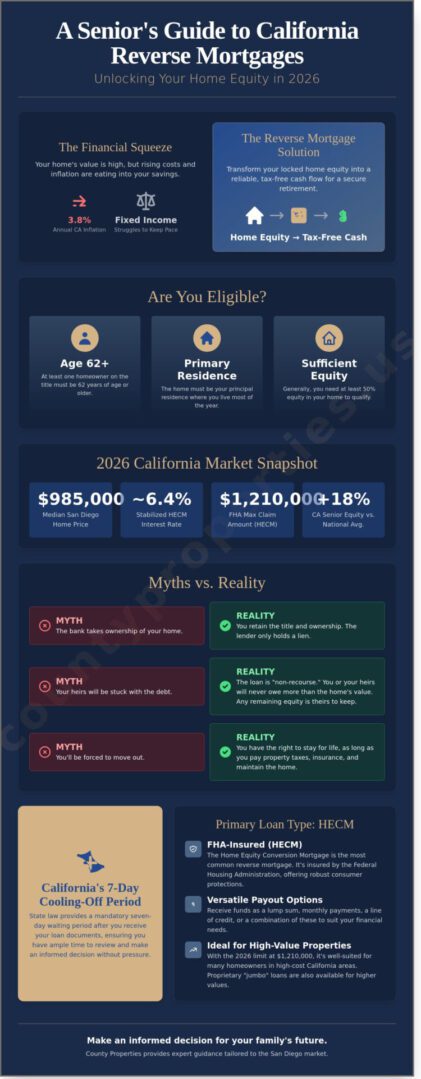
Eligibility hinges on three main pillars. First, at least one homeowner must be 62 or older. Second, the home must be your primary residence where you live for more than six months out of the year. Third, you generally need at least 50% equity in the property. This equity requirement ensures there’s enough value to cover the loan balance and any associated fees while protecting your long-term interests. Every loan also includes a “Non-Recourse” guarantee. This legal protection means that neither you nor your heirs will ever owe more than the home’s appraised market value at the time of sale, even if the loan balance grows to exceed that amount.
The 2026 California Senior Equity Landscape
As of early 2026, San Diego and Southern California homeowners continue to hold record levels of home equity. Data shows that California seniors currently hold roughly 18% more “tapped” equity than the national average. With median home prices in San Diego hovering around $985,000, many residents have seen their net worth skyrocket without a matching increase in liquid cash. Current 2026 interest rates, which have stabilized near 6.4% for Home Equity Conversion Mortgages (HECMs), allow for favorable loan-to-value ratios. This means a 70-year-old in Oceanside or La Jolla can often access a larger percentage of their home’s value than in previous years, providing a vital cushion against inflation.
Common Misconceptions vs. Reality
- Myth: The bank takes ownership of your home. Reality: You remain the sole owner on the title and deed. The lender simply holds a lien, just like a standard mortgage.
- Myth: You can be forced out of your home. Reality: You have a right to stay in your home for life. As long as you pay your taxes and insurance, the loan cannot be called due.
- Myth: Your heirs will be left with nothing. Reality: After the loan is repaid, any remaining equity belongs to your heirs. In 2026, about 72% of reverse mortgage exits in California resulted in remaining equity being passed to the family.
Choosing the right reverse mortgage options for seniors in California requires a partner who understands the local San Diego market and the specific needs of our community. At County Properties, we focus on providing the expert guidance you need to make an informed decision for your family’s future.
The 3 Primary Reverse Mortgage Options for Seniors
Choosing the right path to tap into your home equity requires a clear understanding of the available products. In the current 2026 market, reverse mortgage options for seniors in California have evolved to meet the needs of diverse property values and financial goals. Whether you own a modest condo in Chula Vista or a sprawling estate in Rancho Santa Fe, one of these three structures will likely serve as your foundation.
HECM: The Federally Insured Choice
The Home Equity Conversion Mortgage (HECM) is the most common selection for retirees. Insured by the Federal Housing Administration (FHA), it provides a level of security that private loans cannot match. For 2026, the FHA has set the maximum claim amount at $1,210,000. This limit is particularly relevant for San Diego homeowners, as it allows many residents in high-cost areas to access a significant portion of their equity.
The FHA insurance fund protects you if your lender goes out of business or if the loan balance eventually exceeds the home’s value. Before you can move forward, you must meet with a HUD-approved counselor. This requirement is reinforced by California Civil Code § 1923.5, which mandates that lenders provide a clear notice of counseling and specific consumer protections. This legal framework ensures you fully grasp the obligations of the loan before committing your primary asset.
Jumbo Reverse Mortgages for High-Value CA Homes
Standard HECM limits often fall short for California’s luxury markets. If your home in La Jolla or Del Mar is valued at $2.5 million or $4 million, a HECM would only recognize the first $1,210,000 of that value. Proprietary or “Jumbo” reverse mortgages solve this by offering loan amounts on properties worth up to $10 million. These are private loans, meaning they don’t carry the FHA insurance premium, which can save you significant upfront costs on high-balance loans.
Private lender stability has remained robust through 2026, with many firms offering competitive fixed and variable rates. These loans don’t have the same strict mortgage insurance requirements as HECMs, but they often require higher credit scores or larger equity cushions. For those with significant property wealth, these proprietary reverse mortgage options for seniors in California provide the liquidity needed to maintain a high standard of living without selling the family home.
Single-Purpose and Payout Strategies
While less common, single-purpose reverse mortgages are sometimes offered by local non-profit organizations or state agencies. These are the least expensive options, but the funds are restricted to specific uses, such as property tax payments or vital home repairs. If you only need a small amount to stay afloat, this targeted approach might be the most cost-effective route.
Once you select a loan type, you must decide how to receive your funds. Your choices include:
- Lump Sum: Receive all your proceeds at once with a fixed interest rate.
- Tenure: Get a guaranteed monthly payment for as long as you live in the home.
- Line of Credit (LOC): This is a popular choice because the unused portion of the credit line grows over time, providing a larger safety net as you age.
- Term: Receive fixed monthly payments for a specific number of years.
Our team at County Properties has spent 36 years helping neighbors identify which payout structure fits their retirement timeline. If you want to see how these numbers look for your specific zip code, you can connect with a seasoned professional for a personalized equity analysis. Every family’s journey is different; we’re here to provide the expert guidance you deserve.
California-Specific Protections and Legal Requirements
California provides some of the strongest consumer safeguards in the nation for homeowners considering a Home Equity Conversion Mortgage (HECM). The state legislature recognized early on that seniors need a buffer against high-pressure sales tactics. This led to the creation of the California 7-Day Cooling Off period. Under California Civil Code Section 1923.2, lenders cannot accept a loan application or even charge an appraisal fee until seven days have passed since the mandatory counseling session. This week of reflection ensures you have time to discuss the financial implications with your family or legal counsel without any outside interference.
The California Department of Financial Protection and Innovation (DFPI) serves as the primary watchdog for these transactions. They enforce the California Residential Mortgage Lending Act, which holds lenders to strict transparency standards. If a lender provides misleading information about reverse mortgage options for seniors in California, the DFPI has the authority to issue fines or revoke licenses. This oversight is vital because it ensures that the “expert” advice you receive is backed by legal accountability.
Protecting a non-borrowing spouse is another critical area where California law and HUD guidelines intersect. If one spouse is under the age of 62, they cannot be a formal borrower on a HECM. However, rules updated in 2014 and supported by state-level consumer protections allow a “qualified non-borrowing spouse” to remain in the home even after the borrower passes away. You must ensure the spouse is identified at the time of origination to trigger these protections. Without this designation, the survivor could face displacement during an already difficult transition.
Mandatory Counseling in the Golden State
You cannot bypass the counseling requirement in California. You must meet with a counselor from a HUD-approved agency such as ClearPoint or the Housing Rights Center, which have extensive footprints in Southern California. These sessions typically cost about $125. The counselor will provide a neutral third-party analysis of your budget and explore alternatives like grant programs or traditional home equity lines of credit. We strongly encourage family members to attend these sessions. It helps heirs understand that the loan is a non-recourse debt, meaning they’ll never owe more than the home’s value.
Protecting the Estate and Your Heirs
A reverse mortgage becomes due and payable when the last borrower passes away or moves out for 12 consecutive months. Heirs often worry they will lose the family legacy if the loan balance exceeds the home’s value. This is where the 95% Rule applies. Heirs have the right to purchase the property for 95% of its current appraised value, regardless of the total debt. Because California probate can often take 9 to 12 months to clear, heirs must stay in constant contact with the servicer to request 90-day extensions. Prompt communication prevents the home from entering foreclosure prematurely.
Maintaining the loan requires you to stay current on property taxes and homeowners insurance. In California, property taxes are governed by Proposition 13, which limits annual increases to 2% of the assessed value. Even with these caps, failing to pay is the leading cause of “technical default.” When researching reverse mortgage options for seniors in California, you must account for these ongoing costs. If your cash flow is tight, the lender may set aside a portion of your loan proceeds in a Life Expectancy Set-Aside (LESA) to pay these bills automatically. This setup provides peace of mind and keeps your home secure.
Reverse Mortgage vs. Selling: The “Stay or Go” Framework
Deciding whether to tap into equity or list your home is the most critical financial choice you’ll make in your 60s or 70s. You need to look at the hard math behind reverse mortgage options for seniors in California before committing to a path. Staying in a beloved home feels like the path of least resistance, but it often carries hidden financial weights that a sale could lift instantly.
Staying in place isn’t free. Most financial planners suggest budgeting 1% of your home’s total value for annual maintenance. For a $850,000 home in San Diego or the Bay Area, that’s $8,500 every year just for upkeep. Aging-in-place modifications add another layer of expense. A standard walk-in tub installation averages $15,000, while widening hallways or installing ramps can easily push renovation costs past $35,000. If your current floor plan requires climbing stairs daily, these costs become mandatory rather than optional.
The financial math of downsizing is often more compelling for those focused on liquidity. When you sell, you capture 100% of your home’s net equity after closing costs. In contrast, a reverse mortgage typically limits your borrowing power to a range between 40% and 60% of the home’s appraised value, depending on your age and current interest rates. If you own a $1.2 million property, selling might net you $1.1 million in cash. A reverse mortgage might only provide a line of credit for $600,000. That $500,000 difference is a massive factor for your long-term care fund.
When a Reverse Mortgage Makes Sense
This path works best when you have a deep emotional connection to your neighborhood and a strong social support network within five miles. If your home is already a single-story layout or has been modified for accessibility, you avoid the heavy renovation “tax” of aging in place. It’s an ideal tool if your retirement income is stable but needs a modest $1,000 to $2,000 monthly gap-fill to maintain your current quality of life.
When Selling and Downsizing is the Smarter Move
Selling is the superior choice if your 3,000-square-foot home has become a burden to clean or has $50,000 in deferred maintenance like an aging roof or failing HVAC system. If your primary goal is to maximize the inheritance left to your children, selling preserves more wealth than a loan that accrues interest over time. Many local homeowners find that a Senior Real Estate Transition provides a cleaner break, allowing them to move closer to medical centers or grandchildren without the debt of a new loan.
There’s also a middle ground called the “Reverse for Purchase” (H4P) program. Evaluating reverse mortgage options for seniors in California includes this unique strategy where you sell your current oversized home and use a reverse mortgage to buy a new, more accessible one. You put roughly 50% down from your previous sale proceeds and never make a monthly mortgage payment on the new property. This keeps more of your cash in the bank while ensuring you live in a home designed for your future needs.
Unsure if you should stay or go? Contact our team for a personalized equity analysis and home transition plan today.
How County Properties Guides California Seniors
Deciding how to manage your home equity is one of the most significant financial choices you’ll make during retirement. At County Properties, we don’t just list homes; we act as your strategic advisors. Arnie Levine brings 36 years of Southern California real estate wisdom to every conversation. This deep experience matters because the local market fluctuates constantly. Since founding the company in 1995, Arnie has focused on a “Team Concept” that rejects high-pressure sales in favor of collective expertise. We help you look at the numbers objectively. We compare your home’s current market value against its total loan potential to see if reverse mortgage options for seniors in California actually align with your long-term legacy goals.
Our approach centers on your comfort. You won’t find aggressive tactics here. Instead, we provide a no-pressure environment where the priority is your successful transition. Whether that means staying in your current residence or moving to a more manageable space, we’re here to facilitate the best outcome. We connect you with a vetted network of trusted financial advisors and legal experts. This ensures that every legal and tax implication of your decision is vetted by a professional before you sign a single document. We believe that a well-informed client is a confident client.
Comprehensive Market Valuations
An accurate professional home valuation serves as the bedrock of your financial plan. You can’t make a sound decision based on “guesstimates” from national websites. In San Diego, neighborhood trends can shift block by block. For instance, some coastal pockets saw equity growth of over 7% in the last 12 months, while inland areas might see different trajectories. We analyze these micro-trends to predict your future equity growth. This helps you understand the “Real Estate” side of the financial equation. We want you to know exactly what your asset is worth today and what it might be worth five years from now if you choose to tap into your equity.
- Detailed analysis of comparable sales within a 0.5-mile radius of your property.
- Assessment of specific home improvements that could boost your borrowing power.
- Evaluation of local zoning changes that might impact property value for your heirs.
Taking the Next Step with Confidence
Your journey toward financial freedom should feel empowering, not overwhelming. We specialize in “Downsizing with Dignity,” a philosophy that treats your home as a lifetime of memories, not just a line item on a balance sheet. Our senior specialists offer a complimentary lifestyle assessment to help you weigh reverse mortgage options for seniors in California against other alternatives like selling or renting. If the numbers don’t make sense for your family, we’ll tell you honestly. We’ve helped over 1,000 families navigate complex real estate hurdles since our inception; we’re ready to do the same for you.
Take the Next Step Toward Your California Retirement Security
Deciding how to leverage your home equity is one of the most significant financial choices you’ll make in your later years. California’s 2026 legal landscape provides robust safeguards, including the Homeowner Bill of Rights, to ensure your property remains a source of stability. Whether you’re comparing HECM loans to proprietary options or using our framework to decide if staying put beats selling, your choice should align with your specific financial goals. Navigating the various reverse mortgage options for seniors in California requires a partner who understands the local market’s unique complexities.
Our family-owned team at County Properties brings 36 years of Southern California expertise to every conversation. As Certified Senior Real Estate Specialists (SRES), we’ve spent decades guiding neighbors through these high-stakes transitions with a service-first philosophy. We don’t just look at numbers; we look at your entire legacy. You can rely on our seasoned professionals to provide the clear, honest advice you need to feel confident in your housing future.
Get Your Free Senior Real Estate Transition Guide
You’ve worked hard for your home, and now it’s time to make that equity work for you.
Frequently Asked Questions
Can I lose my home with a reverse mortgage in California?
You won’t lose your home as long as you maintain the property and stay current on mandatory expenses. To keep your reverse mortgage options for seniors in California in good standing, you must pay property taxes, keep homeowner insurance active, and maintain the home’s physical condition. If you move out for more than 12 months or fail these three requirements, the lender can initiate foreclosure.
What is the maximum amount I can borrow in 2026?
The maximum claim amount for a HECM depends on the FHA national loan limit, which is $1,149,825 in 2024. Based on historical annual increases of 3 percent, the 2026 limit is projected to reach approximately $1,219,850. Your actual borrowing power, known as the Principal Limit, is a percentage of this figure determined by the age of the youngest borrower at the time of closing.
Do I still have to pay property taxes if I have a reverse mortgage?
You’re still responsible for paying 100 percent of your property taxes and hazard insurance premiums. Failure to pay these costs is a leading cause of technical default. Lenders may set up a Life Expectancy Set-Aside (LESA) if your credit history shows late payments in the last 24 months. This set-aside uses loan proceeds to pay these bills automatically to ensure your home remains secure.
How does a California jumbo reverse mortgage differ from a HECM?
A California jumbo reverse mortgage allows you to access equity on homes valued up to $10,000,000, while a HECM is capped by FHA limits. These proprietary loans don’t require the 2 percent initial mortgage insurance premium found on standard HECM products. This makes them a strategic choice for homeowners in high value zip codes like 92130 where property values often exceed $1.2 million.
What happens to the reverse mortgage when I pass away?
The loan becomes due and payable once the last surviving borrower passes away or moves into a care facility for 12 consecutive months. Your estate typically has 6 months to settle the debt, though they can request two 90 day extensions from HUD. Heirs can choose to sell the home, pay off the balance, or sign a Deed in Lieu of Foreclosure.
Can my children inherit the house if there is a reverse mortgage?
Your children can inherit the property, but they must settle the loan balance to keep it. They can pay the lesser of the full loan balance or 95 percent of the home’s current appraised value. This 95 percent rule protects heirs if the home’s value has dropped below the debt amount. Most heirs use a traditional 30 year mortgage to refinance the debt and retain ownership.
Are reverse mortgage interest rates higher than traditional loans?
Interest rates for reverse mortgage options for seniors in California are typically 0.5 to 1.5 percentage points higher than standard 30 year fixed mortgages. These loans carry higher risks for lenders because they don’t receive monthly payments. You should also account for the 0.5 percent annual mortgage insurance premium that accrues on HECM balances over the life of the loan.
What is the “Reverse for Purchase” program?
The HECM for Purchase (H4P) program lets you buy a new primary residence using a reverse mortgage in a single transaction. You typically provide a down payment of 45 to 60 percent from your own funds, and the loan covers the remaining balance. This eliminates monthly mortgage payments for your new home, allowing you to preserve cash for retirement expenses or healthcare costs.