

Last Tuesday, a family in San Diego stood in their late father’s living room, staring at a 1978 shag carpet and wondering if a $55,000 renovation was the only way to get a fair price. It’s a heavy burden to manage a property from 300 miles away, especially when siblings are already debating repair costs and fearing they might leave money on the table. You want to protect the estate’s value without the soul-crushing stress of a long-distance construction project. You’re likely asking yourself, “should I sell my parents’ house as is” just to find some peace of mind.
At County Properties, we’ve spent 36 years guiding Southern California families through these exact transitions. We understand your goal. You need a seamless process that respects your time and your parents’ legacy. This guide provides the financial clarity required for a confident decision. You’ll discover the local legal factors, such as California tax implications, that determine if an as-is sale is your smartest financial move. We’ll outline a clear path forward so you and your siblings can finally agree on a plan and maximize the estate’s value without the typical stress.
Key Takeaways
- Understand the legal implications of an “as-is” contract and how to determine “should I sell my parents’ house as is” based on your family’s unique financial and emotional goals.
- Avoid the common “renovation trap” by learning which low-cost updates actually move the needle in the Southern California market versus repairs that rarely pay back their initial cost.
- Protect your inheritance by mastering local financial realities, including how Proposition 19 and the “step-up in basis” rules affect your capital gains and property tax burdens.
- Identify the escalating costs of holding onto a vacant family property, from specialized “vacant home” insurance premiums to time-sensitive California tax assessments.
- Discover a compassionate, turn-key approach to estate transitions that manages everything from estate sales and clean-outs to a final, successful closing.
The As-Is Dilemma: Understanding Your Options When Selling a Parent’s Home
Losing a parent is one of life’s most taxing experiences. Dealing with a lifetime of belongings and a physical structure while grieving adds a layer of complexity most people aren’t prepared for. You’re likely asking yourself, “should I sell my parents’ house as is or spend months on renovations?” Since 1995, County Properties has guided families through this exact transition, prioritizing your financial security and emotional peace. We understand that clearing out a family home isn’t just a real estate transaction; it’s a final goodbye to a space filled with decades of memories. The weight of deciding which furniture to keep and which to donate can be paralyzing, making a quick, simple sale highly attractive.
In California, selling “as-is” is a specific legal designation within the standard California Association of Realtors (C.A.R.) Residential Purchase Agreement. It signals to buyers that you won’t perform repairs or offer credits for defects discovered during inspections. However, it doesn’t grant a “get out of jail free” card regarding honesty. Understanding the legal framework of inheritance is vital, as it governs how the property title transfers to you before you can legally sign a deed. Our team has 36 years of experience ensuring these titles are clear and the transition is seamless for the heirs involved.
You generally have three paths to consider for the estate:
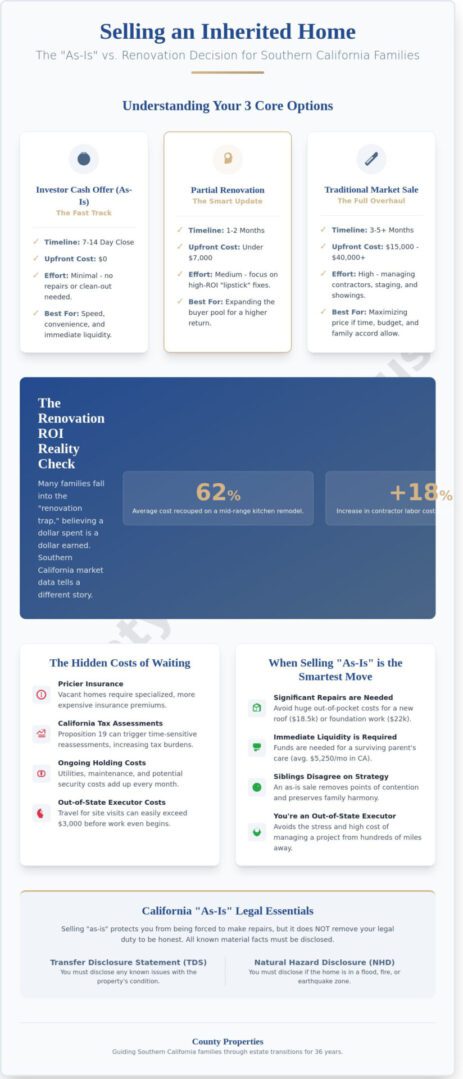
- Traditional Market Sale: This involves listing on the MLS after deep cleaning, staging, and potentially upgrading kitchens or bathrooms to attract retail buyers. It often requires $15,000 to $40,000 in upfront capital.
- Investor Cash Offer: This is a rapid transaction, often closing in 7 to 14 days. A buyer takes the home exactly as it stands, including any unwanted furniture or debris left behind.
- Partial Renovation: This strategy focuses on high-ROI fixes like fresh neutral paint or new flooring. These “lipstick” repairs can cost under $7,000 but significantly expand your pool of potential buyers.
For out-of-state executors, the as-is route often wins by default. Managing a kitchen remodel from 500 miles away is a logistical nightmare. Travel costs for monthly site visits can easily exceed $3,000 before a single contractor is paid. Choosing an as-is sale allows you to focus on your family’s needs rather than managing a construction site from another time zone.
When Selling As-Is Makes the Most Sense
If a 2024 inspection reveals a failing roof costing $18,500 or foundation settling requiring $22,000 in repairs, selling as-is prevents a massive out-of-pocket drain on the estate. It’s also the right move when the estate needs immediate liquidity. With California assisted living costs averaging $5,250 per month, waiting six months for a renovation isn’t always feasible if funds are needed for a surviving parent’s care. Finally, if siblings disagree on paint colors or contractor choices, an as-is sale preserves family harmony by removing those points of contention.
The Legal Reality of As-Is in California
You must still provide a Transfer Disclosure Statement (TDS) even in an as-is sale. If you know the HVAC system failed in 2023, you have to disclose it. You’ll also provide a Natural Hazard Disclosure (NHD) to identify if the home sits in a fire or flood zone. An as-is clause protects you from being forced to fix a leaky faucet, but it doesn’t prevent a buyer from using their inspection contingency to cancel the deal. Deciding “should I sell my parents’ house as is” requires weighing these legal protections against the potentially lower purchase price offered by buyers taking on the risk of unknown repairs.
Calculating the ROI: Does Fixing Up an Older Home Actually Pay Off?
Real estate ROI for inherited homes must account for both the dollar spent and the months of holding time lost. Many families fall into the renovation trap. They believe spending $50,000 on a full kitchen remodel will net an extra $50,000 in profit. Data from 2024 and 2025 shows that major renovations rarely provide a 1:1 return. In fact, most mid-range kitchen projects only recoup about 62 percent of their cost at the time of sale. When weighing if you should I sell my parents’ house as is, current market conditions for contractors are a significant factor. Labor costs have risen 18 percent over the last two years; finding a reliable crew often takes three to five months. Every month the house sits empty, you’re paying property taxes, insurance, and utilities, which eats into your eventual inheritance.
Repairs That Add Value vs. Repairs That Just Cost Money
Focus on mechanical integrity over cosmetic trends. A buyer will likely overlook dated wallpaper, but a leaking 15-year-old water heater can kill a deal during the inspection period. Mechanical upgrades provide peace of mind that justifies a higher asking price. In the San Diego market, curb appeal is a massive driver of first impressions. Spending $1,200 on fresh mulch, drought-tolerant succulents, and a power-washed driveway can increase a home’s perceived value by as much as $7,000. The highest return comes from deep cleaning and decluttering. Removing 40 years of personal belongings allows buyers to see the floor plan clearly. This simple step costs very little but often results in offers that are 3 to 5 percent higher than cluttered homes. It’s also vital to track these expenses for tax purposes. According to IRS Publication 523, certain capital improvements can adjust your cost basis, potentially reducing your tax liability when the property sells.
Hiring Licensed Contractors vs. DIY
DIY projects are risky in a home you don’t live in. If a “handyman” repair fails and causes water damage while the house is vacant, your insurance claim might be denied because the work wasn’t performed by a professional. Licensed and insured contractors provide a paper trail that builds buyer confidence. Most buyers in the current market want a “turn-key” feel, even if the home is older. They’ll pay a premium for work backed by a professional warranty. At County Properties, we’ve spent nearly three decades building a network of vetted vendors. We coordinate minor refreshes like painting and flooring so you don’t have to manage a construction site from miles away. If the math doesn’t support a full renovation, you might find that selling to a specialized partner is the most efficient way to protect your family’s equity without the stress of a long-term project. When you ask should I sell my parents’ house as is, the answer often depends on your ability to manage these logistical hurdles without sacrificing your own peace of mind.
The Hidden Costs of Keeping a Vacant Family Property
Many families struggle with the emotional weight of an estate transition, often asking themselves, “should I sell my parents’ house as is or wait until we can fix it up?” While waiting feels like the conservative choice, an empty property is a depreciating asset that actively drains the estate’s liquidity. In California, the financial bleed begins the moment the home becomes vacant.
Property taxes represent the first major hurdle. In San Diego County, the average effective tax rate is approximately 1.2% of the assessed value. For a home valued at $900,000, the estate is responsible for $10,800 annually. This $900 monthly bill exists regardless of whether the home is occupied. Insurance presents another trap. Most standard homeowners policies include a vacancy clause that triggers after 30 or 60 days. Once this window passes, your coverage may be voided for common issues like pipe bursts or vandalism. Switching to a “Vacant Home” policy typically triples your premiums, often costing between $3,000 and $6,000 per year for a standard suburban lot.
The physical maintenance of a Southern California home is equally expensive. You can’t simply shut the door and walk away. To avoid city code violations and maintain curb appeal, you must continue regular services:
- Landscaping: $150 to $250 per month to prevent fire hazards and “zombie house” appearances.
- Utilities: $200 to $400 per month to keep the HVAC running; this is essential for preventing mold growth in humid coastal air.
- Pool Maintenance: $120 to $180 per month to prevent West Nile virus concerns and costly equipment failure.
- General Repairs: $100 to $300 per month for unexpected issues like pest control or roof leaks.
Security risks provide the most volatile hidden cost. Southern California has seen a rise in professional squatters who target vacant estates. Legal fees to evict an unauthorized occupant in California can exceed $5,000, and the process often takes 180 days or longer. During this time, the property sustains wear and tear that further diminishes its value. Vulture investors also track these properties, often hounding family members with low-ball offers when they see signs of neglect.
The Opportunity Cost of Time
Market volatility is a massive risk when deciding should I sell my parents’ house as is or pursue a long renovation. San Diego home prices shifted by as much as 4% in certain quarters of 2023. A six month renovation might result in a beautifully updated home that hits the market during a downturn, effectively losing the money spent on repairs. Additionally, prolonged estate closures often lead to “sibling friction,” where the emotional toll of managing a vacant property creates rifts between heirs. Fast cash offers can save tens of thousands in holding costs and preserve family harmony.
The Probate and Trust Timeline
Selling a property within a trust or probate requires strict adherence to California’s legal timelines. The length of the sale process directly impacts how quickly heirs receive their distribution. Coordinating with legal counsel is mandatory to ensure every step meets court requirements and protects the executor from personal liability. If you’re managing this process, consult A Guide to Seller Representation to understand how professional guidance can streamline these complex requirements and ensure a seamless transition for your family.
Navigating the Sale: Southern California Legal and Financial Realities
Selling an inherited home in California involves specific tax hurdles that didn’t exist a few years ago. Proposition 19, which took effect on February 16, 2021, fundamentally changed property tax transfers for heirs. Unless you plan to make the home your primary residence within 12 months of the transfer, the property tax base will be reassessed at current market value. This often results in a 300% to 500% increase in annual property taxes for the new owner. When families ask, “should I sell my parents’ house as is,” they must weigh these carrying costs against the potential profit of a long renovation.
The “Step-Up in Basis” remains your most powerful financial tool. If your parents bought their San Diego home in 1988 for $180,000 and it’s worth $1,100,000 at the time of their passing, your tax basis “steps up” to that $1.1 million valuation. This effectively wipes out the capital gains tax you’d owe if you sell the property immediately. This tax break saves families tens of thousands of dollars, making a quick sale highly attractive compared to holding the asset while it accrues new taxes and maintenance fees.
San Diego market trends in 2024 show a distinct split in buyer behavior. While turn-key homes in neighborhoods like Carmel Valley sell in under 14 days, fixer-uppers in areas like North Park or Clairemont are increasingly targeted by developers. These buyers look for “ADU potential” under California’s SB 9 and SB 10 laws. A local expert who understands neighborhood-specific zoning can identify if your lot is worth more to a builder than a traditional family. Often, a developer will pay 90% of the market value for a home in poor condition because they value the land and the ability to build multiple units.
California Disclosure Requirements for Inherited Homes
California law is strict about transparency, even for heirs who never lived in the home. While some trust sales offer exemptions from the standard Transfer Disclosure Statement (TDS), you aren’t exempt from disclosing “material facts” that could affect the property’s value. Per Civil Code 1710.2, if a death occurred on the property within the last 36 months, you must inform the buyer. For homes built before 1978, you’re legally required to provide the federal lead-based paint pamphlet and the California Homeowner’s Guide to Earthquake Safety to protect yourself from future litigation.
Working with a Senior Real Estate Specialist (SRES)
An SRES understands the emotional and logistical weight of a “lifestyle transition” for families. Arnie Levine’s team brings 36 years of experience to these sensitive situations; they handle the heavy lifting that traditional agents often avoid. This includes coordinating estate liquidators, managing junk removal, and communicating with probate attorneys. Whether you decide “should I sell my parents’ house as is” or opt for minor repairs, having a team that manages the physical labor allows your family to focus on the transition rather than the toolbox. They ensure the home is positioned to attract the highest possible offer while minimizing your stress.
Ready to understand the true value of your inherited property in today’s San Diego market? Contact Arnie Levine and the County Properties team for a comprehensive consultation on your best path forward.
How County Properties Simplifies Senior and Estate Transitions
Managing the sale of a family home involves more than just a transaction; it’s an emotional journey through decades of memories. Arnie Levine founded County Properties on a “Family of Friends” philosophy to ensure no client feels like a mere file number during a period of grief. With 36 years of Southern California real estate expertise, our team provides the steady hand needed when you’re asking, “should I sell my parents’ house as is?” We don’t just list properties. We offer a holistic support system that handles the heavy lifting while you focus on your family’s well-being.
Our Hybrid Model represents a significant departure from standard real estate practices. You aren’t locked into a single path. If the property requires extensive repairs or you need to settle an estate quickly to pay for medical bills or taxes, we can provide a rapid cash offer. If the goal is to maximize every dollar of equity, we pivot to a traditional listing strategy. This flexibility ensures you make the decision that fits your specific financial timeline. We’ve helped over 1,000 families in San Diego and surrounding areas find the right balance between speed and profit.
Every estate transition requires different levels of intervention. Our turn-key solutions cover every detail from the initial clean-out to the final closing signature. We coordinate with professional estate sale organizers to monetize personal belongings and manage junk removal for whatever remains. This relieves the physical burden on family members who may live out of state or have demanding schedules. Our goal is a seamless transition that honors the legacy of the home while securing your financial future.
Our Step-by-Step Estate Sale Process
We begin with a dual valuation. You’ll see a side-by-side comparison of the projected market value after repairs versus the immediate as-is price. This transparency helps you decide if “should I sell my parents’ house as is” makes sense for your budget. Once you choose a path, we coordinate everything. This includes professional clean-outs of 40 years of belongings and strategic staging that highlights the home’s potential. Our marketing reaches a database of 5,000 active investors and local families looking for their forever home.
Why Families Trust Arnie Levine and County Properties
Arnie Levine’s commitment to “Client Service over Individual Marketing” has defined our San Diego operations since 1995. One client recently shared how our team stepped in during a probate crisis, managing a full estate sale and closing the deal in under 21 days. We prioritize your peace of mind over our commission. This service-centric approach is why 85% of our business comes from referrals and repeat clients who value honesty over a quick sale. We treat every property as if it were our own family’s home.
Navigate Your Family Estate Sale With Confidence
Deciding how to handle a family home is a major financial and emotional milestone. You’ve seen how holding costs for a vacant property can drain an estate’s value and why some renovations offer a poor return on investment in the current market. When you ask yourself, should I sell my parents’ house as is, the answer depends on your specific financial goals and the property’s condition. Southern California’s complex legal requirements mean you need a strategy that protects your interests while maximizing your inheritance.
County Properties provides the steady hand you need during this transition. With 36 years of Southern California real estate experience, our team understands the local market nuances. We have a Certified Senior Real Estate Specialist (SRES) on staff to guide you through senior-specific hurdles. Our A+ rating for foreclosure and short sale prevention proves our commitment to your financial security. We’re here to simplify the process so you can focus on what matters most. Reach out today to start your journey with a partner you can trust.
Request a Personalized Consultation for Your Parents’ Estate
Your family’s legacy deserves the highest level of care and professional expertise.
Frequently Asked Questions
Do I have to clean out my parents house before selling as is?
You don’t have to clean out the property if you sell to a professional cash buyer, as many investors agree to handle all remaining contents. In 85% of as-is cash transactions, sellers leave behind unwanted furniture, old appliances, or general debris. If you choose to list on the MLS, most traditional buyers expect the home to be “broom clean” before the final walkthrough.
What is the “Step-Up in Basis” and how does it help me sell?
The Step-Up in Basis resets the property’s taxable value to its fair market value on the date of the original owner’s death. If your parents bought a San Diego home for $150,000 in 1990 and it’s worth $950,000 today, your new tax basis is $950,000. This rule helps you decide should I sell my parents’ house as is because it can eliminate 100% of the capital gains tax you’d otherwise owe.
Can I sell my parents house if I have Power of Attorney?
You can sell the property using a Power of Attorney (POA) only if the document specifically grants “Real Property” authority and the principal is still alive. The POA must be recorded with the County Recorder’s Office to validly transfer the title. Once a parent passes away, the POA expires immediately. At that point, you’ll need to obtain “Letters Testamentary” from the probate court to move forward with a sale.
How much less will I get if I sell my house as is?
Selling a home as-is typically results in a sale price 20% to 25% lower than a fully renovated property in the same neighborhood. Investors generally subtract the 10% cost of repairs plus a 15% margin for the risk they’re taking. While the price is lower, you save an average of $45,000 in upfront renovation costs and avoid the 4 to 6 months required for a construction project.
What repairs are absolutely necessary before selling in California?
California law requires three specific safety items to be compliant even in an as-is sale: smoke detectors, carbon monoxide alarms, and double-strapped water heaters. According to the California Health and Safety Code, these must be installed and functional before the close of escrow. While you can negotiate other repairs, these 3 safety standards are mandatory for every residential transfer in the state.
How long does it typically take to sell an estate property in San Diego?
An estate sale in San Diego typically takes 35 days for a cash transaction and 75 days for a traditional MLS listing. If the property must go through the full probate process, the timeline often extends to 6 or 9 months depending on the current court backlog. Our team can often reduce the marketing period to under 12 days by leveraging a private database of local investors.
Is it better to sell to a cash buyer or list it on the MLS as-is?
Choosing between a cash buyer and the MLS depends on whether you prioritize a fast closing or the highest possible net profit. A cash offer can close in as little as 7 days with zero contingencies or inspections. Listing on the MLS as-is exposes the home to more competition, which can drive the final price up by 7% to 12% through multiple offers, though it requires more time.
What happens to the mortgage when a parent passes away?
The mortgage remains attached to the property after a parent passes, and the estate must continue making monthly payments to avoid a default notice. Under the Garn-St. Germain Act of 1982, lenders cannot trigger the “due on sale” clause when a house passes to a relative. This federal law gives you the time to decide should I sell my parents’ house as is without the fear of an immediate foreclosure.