

Last Tuesday, Sarah stood in her parents’ San Diego living room, staring at a wall of family photos and realizing that 42 years of memories couldn’t fit into a two-bedroom assisted living suite. She felt paralyzed, unsure of how to help elderly parents sell their home without it feeling like she was stripping away their identity. You likely feel that same knot in your stomach right now. It’s incredibly difficult to balance the urgent need for professional care with the deep emotional attachment your parents have to a house they’ve called home since 1984.
You can manage this transition with both dignity and financial security. This 2026 guide helps you master the emotional, legal, and financial complexities of the move with expert insights from our Southern California senior real estate specialists. We’ll walk you through securing the proper legal authority, avoiding common 20% capital gains tax traps, and sorting through decades of belongings. By the end of this article, you’ll have a clear, compassionate roadmap to maximize their home’s value and fund the next chapter of their lives.
Key Takeaways
- Reframe the move from a forced sale into a collaborative family project by successfully navigating emotional hurdles like the “Memory Trap.”
- Navigate the 2026 financial landscape with expert insights on Medi-Cal eligibility and the critical tax advantages of a “Stepped-up Basis.”
- Determine the most profitable property strategy by weighing the ROI of specific Southern California renovations against the “Decluttering First” rule.
- Learn the step-by-step process of how to help elderly parents sell their home while protecting their daily routine and peace of mind.
- Partner with seasoned San Diego specialists who provide a compassionate, service-centric roadmap for your family’s unique transition.
The Emotional and Legal Foundation: Starting the Transition
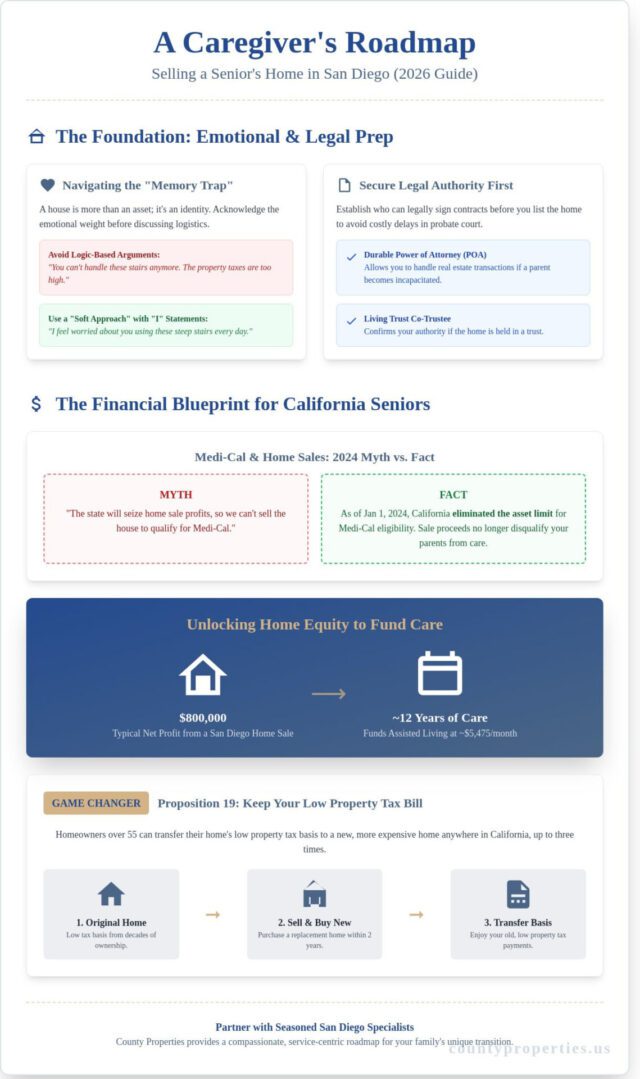
Selling a family home is rarely a simple financial transaction; it’s a profound life shift that requires a delicate balance of empathy and preparation. At County Properties, we’ve spent 36 years guiding families through what we call the “Senior Transition.” This isn’t a forced sale or an eviction. It’s a collaborative family project designed to prioritize the safety and future happiness of your loved ones. Understanding how to help elderly parents sell their home begins with recognizing the “Memory Trap.” This is the emotional weight of decades spent in one place, where every scratch on the floorboards represents a milestone. For many, the house isn’t just real estate; it’s their identity.
While Aging in place is a preference for nearly 90% of seniors according to AARP data, the reality of a multi-story house often creates unnecessary risks. Logic rarely wins these arguments. If you lead with data about property taxes or repair costs, your parents might feel attacked or pressured. A “soft approach” focused on their comfort and legacy beats a “logical data” approach every time. You’re not asking them to give up their past; you’re helping them curate a safer, more manageable future.
The legal side of this transition is just as vital as the emotional one. You must establish whether you’re acting as a Power of Attorney (POA) or a Trustee before any contracts are signed. A Durable Power of Attorney is a specific legal document that allows you to handle real estate transactions on their behalf if they become incapacitated. Without this, or if the home is held in a Living Trust where you aren’t named as a Co-Trustee, the sale can stall for months in probate court. When you’re figuring out how to help elderly parents sell their home, verifying these documents is your first priority.
Navigating the “Right Time” Conversation
Timing the move requires looking for specific physical red flags. Look for maintenance neglect, such as a yard that hasn’t been mowed in 4 weeks or mail piling up on the porch. Isolation is another major indicator; if your parent hasn’t left the house for social activities in 14 days, the home has become a cage rather than a sanctuary. Use “I” statements during these talks. Say, “I feel worried about you using these steep stairs every day,” instead of “You can’t handle these stairs anymore.” This keeps the focus on your care for them, not their declining abilities.
Securing Legal Authority to Act
Legal capacity is a binary line in real estate. If a parent has early-stage dementia, they may still have the “capacity” to sign a listing agreement, but this must be documented clearly. We recommend consulting with a California elder law attorney to review all titles and deeds. A specialized attorney ensures that the Durable Power of Attorney is “durable,” meaning it remains valid even if the parent’s mental health declines. Having these documents sale-ready before the home hits the market prevents 11th-hour legal crises that can scare away qualified buyers.
Financial and Tax Strategy for California Seniors
The most common fear families face is the idea that the government will seize a senior’s home equity to pay for nursing home care. In California, the reality changed significantly on January 1, 2024. The state officially eliminated the asset limit for Medi-Cal eligibility, meaning your parents can now qualify for care regardless of how much money they have in the bank from a home sale. However, the state can still seek “estate recovery” after a person passes away if they received certain services. Understanding these nuances is a vital part of learning how to help elderly parents sell their home while protecting their legacy.
Selling the family home in San Diego requires a clear-eyed look at the numbers. As of 2023, the median cost for assisted living in San Diego is approximately $5,475 per month. If a home sells for a net profit of $800,000, that equity can fund nearly 12 years of professional care. This liquidity often provides more security than keeping the empty house, which continues to accrue property taxes, insurance, and maintenance costs.
Proposition 19 and Property Tax Portability
California’s Proposition 19, which took effect April 1, 2021, is a game-changer for seniors looking to downsize. It allows homeowners over age 55 to transfer the tax basis of their primary residence to a new replacement home anywhere in the state. This can be done up to three times. If your parents bought their San Diego home in 1990 for $200,000, they are likely paying taxes based on that low valuation. Prop 19 lets them buy a new $900,000 condo while keeping a property tax bill similar to their old one. To qualify, they must purchase the new home within two years of selling the original property and file the appropriate forms with the San Diego County Assessor.
Capital Gains and the $250k/$500k Exclusion
Taxes on the profit of a sale can be steep, but the primary residence exclusion offers a significant buffer. Under current IRS rules on capital gains exclusion, an individual can exclude up to $250,000 of profit, while a married couple can exclude $500,000. To qualify, the parents must have lived in the home for at least two of the last five years. If a parent moved into a licensed care facility, this “residency rule” is often relaxed to just one year of physical occupancy.
You can further reduce the tax hit by documenting every major home improvement made over the last 30 years. New roofs, kitchen remodels, or room additions increase the “cost basis” of the home. If your parents spent $150,000 on renovations since 1995, that amount is added to the original purchase price, directly lowering the taxable gain. If you aren’t sure where to start with these calculations, you can request a free equity evaluation to see where your parents stand today.
The Role of the Stepped-up Basis
One difficult strategic choice involves the “stepped-up basis.” When a child inherits a home after a parent passes, the home’s value is “stepped up” to the current market price, potentially eliminating capital gains taxes entirely. However, if your parents need the cash now to afford a high-quality memory care facility, waiting for an inheritance isn’t practical. In these cases, it’s often better to sell and pay the capital gains tax to ensure they have the best possible quality of life. Using a living trust is the most effective way to manage these assets, as it avoids the 12 to 18 month probate process common in California courts. This ensures the how to help elderly parents sell their home process remains a private family matter rather than a public legal one.
Preparing the Property: The “As-Is” vs. “Maximum Value” Debate
Deciding how to help elderly parents sell their home often starts with a difficult financial crossroads. You must choose between selling the property in its current state or investing in renovations to capture top dollar. In Southern California, a home built in 1994 typically requires $45,000 to $75,000 in aesthetic updates to compete with modernized listings. According to the 2023 Cost vs. Value Report, minor kitchen remodels in the Pacific region currently see a 102.8% return on investment. If the home has 30 years of deferred maintenance, the “As-Is” path might be more realistic to avoid the physical and emotional toll of a construction zone.
You have three primary paths to consider. A traditional listing provides the highest price but requires the most preparation. An “As-Is” sale on the open market alerts buyers that no credits will be given for repairs, which usually attracts contractors or “fix-and-flip” investors. Rapid cash offers are the fastest option; these companies can close in as little as 7 days. However, these convenience-based offers often sit 15% to 25% below fair market value. For many families, the middle ground involves professional staging. Spending $3,500 on staging can transform a dated 1990s interior into a “classic” vintage look, often increasing the final sale price by 5% to 7%.
The 48-Hour Decluttering Framework
Seniors often view their possessions as a visual timeline of their lives, making “The Great Purge” emotionally exhausting. Use a strict 48-hour window to categorize every item into five buckets: Keep, Gift, Sell, Donate, or Discard. Data from the National Association of Senior Move Managers shows that 70% of adult children do not want their parents’ heavy heirlooms or china sets. Hiring a certified senior move manager, which typically costs between $1,500 and $5,000, removes the family friction and ensures the home is cleared efficiently without you playing the “bad guy.”
Strategic Repairs That Pay Off
If you choose to renovate, focus only on “escrow killers” and high-impact visuals. A pre-listing home inspection is the best $500 you will spend. It identifies structural, roofing, or plumbing issues that would otherwise derail a sale during the 17-day contingency period. Focus your budget on these three areas:
- Safety and Accessibility: Install high-wattage LED lighting and secure handrails to make the home feel bright and safe.
- Curb Appeal: Fresh mulch and drought-tolerant landscaping can add up to 7% to a home’s perceived value.
- Neutral Paint: A fresh coat of “Swiss Coffee” or similar neutral tones throughout the house provides a 107% ROI and masks decades of wear.
When you learn how to help elderly parents sell their home, you must balance the potential profit against their stress levels. If your parents are already transitioning to a care facility, the “Maximum Value” path might be too disruptive. In these cases, a clean, empty house is better than a cluttered one with expensive new countertops. Buyers in today’s market value transparency. Providing a completed disclosure package and a recent inspection report upfront can build the trust needed to secure a firm offer, even if the wallpaper is still from 1985.
The Step-by-Step Sale Process for Caregivers
Managing a home sale while balancing caregiving duties is a high-wire act. You’re not just moving furniture; you’re relocating a lifetime of memories and emotional anchors. Understanding how to help elderly parents sell their home requires a strategy that prioritizes their daily comfort as much as the final sale price. The process works best when it’s predictable and structured.
Choosing the Right Real Estate Partner
You need more than a generic agent for this transition. A Senior Real Estate Specialist (SRES) carries a specific designation from the National Association of Realtors, meaning they’ve completed 20+ hours of training on senior-specific financial and emotional needs. At County Properties, we’ve spent 36 years refining a “Team Concept” that removes the logistical weight from your shoulders. Our agents act as project managers who oversee a vetted network of painters, deep-cleaners, and landscapers.
This approach is vital for out-of-state children. You shouldn’t have to fly into San Diego every time a contractor needs access to the house. When interviewing agents, ask: “Do you have a dedicated system for communicating with family members in different time zones?” A professional team will provide weekly digital updates so you stay informed without having to relay every stressful detail to your parents. This keeps them calm while you handle the heavy lifting.
The Showing and Escrow Strategy
Traditional selling methods often involve a constant stream of strangers through the front door. For a senior with a set routine or health challenges, this is disruptive and draining. We utilize Matterport 3D tours and high-end video walkthroughs to act as a digital filter. Statistics from the real estate industry show that professional virtual tours can reduce unnecessary physical foot traffic by 40% while attracting more serious, pre-qualified buyers. Only the most motivated prospects will step foot in the home.
- Mega Open Houses: We often schedule one intensive weekend of showings, perhaps Saturday and Sunday from 10:00 AM to 4:00 PM. Your parents only need to leave the house once, rather than dealing with sporadic “pop-up” showings all week.
- Mobile Notary Services: During the 30-day escrow period, paperwork can feel like a mountain. We arrange for mobile notaries to visit your parents at their kitchen table. This eliminates the need for them to navigate San Diego traffic or find parking at a title office.
- Simplified Communication: We use a “need-to-know” approach. You get the full legal breakdown; your parents get the simplified, reassuring version that focuses on their successful move.
The final move is the most physically demanding part of the journey. We recommend hiring professional Senior Move Managers who specialize in “downsizing floor plans.” They measure the new living space and help your parents decide exactly which pieces of furniture will fit. On move day, these specialists can unpack and set up the new home to look familiar, which significantly reduces “transfer trauma” for seniors. Coordinating these logistics 45 days in advance ensures a “Big Move Day” that feels like a fresh start rather than a chaotic exit.
If you’re feeling overwhelmed by the logistics, we can provide a roadmap tailored to your family’s specific needs. Contact our San Diego senior transition experts to discuss a customized plan for your parents’ home.
County Properties: Your Trusted Partner in Senior Transitions
Arnie Levine founded County Properties in 1995 with a vision to revolutionize the San Diego real estate market. With more than 36 years of individual experience, Arnie has guided thousands of families through complex property cycles. He leads a team that operates as a “family of friends,” focusing on collaborative success rather than individual agent egos. When you are researching how to help elderly parents sell their home, you quickly realize that the process requires a level of patience and specialized knowledge that traditional big-box agencies often lack.
Our “Service-Centric” philosophy is the heartbeat of our firm. We don’t view your parents as a transaction; we treat them like our own family members. This means we move at their pace, ensuring they feel empowered and respected throughout the entire transition. We provide turn-key solutions that address the specific hurdles of senior moves. Whether you need a referral for a trusted estate attorney or a team to handle a final estate clean-out, we coordinate every moving part so you don’t have to.
Consider a recent case study involving a San Diego family. Their mother needed to transition into an assisted living facility due to sudden health changes, leaving the family with a house full of 40 years of memories and a tight deadline. We stepped in to manage the repairs, staging, and marketing immediately. We successfully closed the sale and moved their mother into her new community in just 21 days. This rapid turnaround allowed the family to secure the necessary funds for her care without the stress of a lingering vacancy.
A Holistic Approach to Real Estate
We prioritize your parents’ financial security above all else. Our team never pushes for a quick sale just to earn a commission. Instead, we analyze the long-term impact of the sale on their retirement funds and estate plans. We’ve spent decades building a network of San Diego’s most reliable partners, including licensed contractors, professional organizers, and specialized senior movers. The “County Properties Promise” is our commitment to providing personalized, step-by-step guidance. We ensure that every document is explained clearly and every deadline is met with precision.
Next Steps for Your Family
Taking the first step is often the hardest part of the journey. When you learn how to help elderly parents sell their home, having an expert roadmap makes all the difference. We invite you to Schedule your free senior transition consultation today. This no-obligation meeting is designed to give your family clarity and peace of mind.
During our first meeting, our senior specialists will perform a comprehensive assessment of the property. We’ll listen to your family’s specific goals and identify any potential challenges early. You can expect a transparent discussion about market value, suggested improvements, and a realistic timeline for the move. Our goal is to provide a seamless experience that honors your parents’ legacy while preparing them for a comfortable next chapter. We handle the logistics so you can focus on being a supportive son or daughter during this significant life change.
Step Into Your Family’s Next Chapter with Confidence
Navigating a home sale in 2026 requires a blend of emotional patience and strategic financial planning. You’ve discovered that success lies in mastering California’s specific tax strategies and choosing the right property preparation path, whether that’s an “as-is” sale or a value-maximizing renovation. Learning how to help elderly parents sell their home is a significant responsibility, but it’s also a chance to secure their financial future and long-term comfort.
Arnie Levine and the County Properties team bring 36 years of Southern California real estate experience to every transaction. We provide specialized Senior Real Estate Transition services that prioritize your family’s unique needs through a collaborative, team-based approach. We’ve spent over three decades refining a process that handles the legal and logistical heavy lifting so you can focus on what matters most: your parents’ well-being.
Let our Senior Real Estate Specialists guide your family home
Moving forward is a big step, but with the right experts by your side, your family’s transition can be both seamless and rewarding.
Frequently Asked Questions
Do I need Power of Attorney to sell my parents house?
You only need a Durable Power of Attorney (DPOA) if your parents lack the legal capacity to sign contracts themselves. If they’re still mentally competent, they must sign the listing agreement and closing documents. California Probate Code Section 4123 allows a designated agent to handle real estate transactions, which can save a family the 6 to 9 months typically required for a court-ordered conservatorship.
What is a Senior Real Estate Specialist (SRES) and do I need one?
An SRES is a Realtor who has completed specialized training through the National Association of Realtors to serve the needs of homeowners age 50 and older. While you aren’t required to hire one, these specialists understand the unique financial hurdles involved in a late-life move. They’re experts in how to help elderly parents sell their home by coordinating with estate planners and senior moving managers.
How does Proposition 19 help my parents downsize in California?
Proposition 19 allows homeowners over age 55 to transfer the tax basis of their current home to a new primary residence of any value. Since this law took effect on April 1, 2021, eligible seniors can use this tax benefit up to 3 times in their lifetime. This often results in annual property tax savings of $3,000 to $6,000 for parents moving from a long-term family home into a smaller condo.
Should we fix up the house or sell it “as-is” for cash?
You should sell “as-is” if the estimated repair costs exceed 70% of the potential increase in the home’s market value. Cash buyers typically close the transaction in 10 to 14 days, though they often require a 15% to 25% discount for the convenience. A 2023 industry report found that major bathroom remodels only return about 58% of their cost, so deep cleaning and decluttering are usually better investments than renovations.
How will selling the home affect my parents Medi-Cal eligibility?
Selling a home converts an exempt asset into countable cash, but California’s new laws have significantly changed the impact on eligibility. As of January 1, 2024, California eliminated the asset limit for Medi-Cal, meaning the proceeds from a home sale won’t automatically disqualify your parents from coverage. It’s still vital to consult a CELA certified elder law attorney because the interest income from that cash could still affect their specific benefit tier.
What are the tax implications of selling a home that has been in the family for 40 years?
Your parents can likely use the Section 121 exclusion to avoid paying taxes on up to $500,000 of profit if they’re married and filing jointly. This tax rule requires them to have lived in the home for 2 of the last 5 years. If they bought the home for $50,000 in 1984 and sell it for $550,000 today, their entire gain would be tax-free under current IRS guidelines.
How do I handle a parent who refuses to sell their home despite safety concerns?
Start by hiring a neutral third party, such as a geriatric care manager, to conduct a formal 25 point home safety assessment. A 2022 AARP study showed that 77% of seniors want to stay in their homes, so hearing about risks from a professional rather than a child reduces family friction. Understanding how to help elderly parents sell their home often means focusing on their autonomy while presenting data about local assisted living waitlists.
Can I sell my parents house if it is currently in a Living Trust?
Yes, the house can be sold by the person designated as the Trustee or Successor Trustee in the trust documents. Selling through a trust avoids the California probate process, which frequently takes 12 to 18 months to complete. As your trusted real estate partner, we simply need a formal Certification of Trust to provide to the title company to verify your legal authority to sign the deed.