

Last Tuesday, a San Diego daughter stood in her parents’ Clairemont kitchen, staring at a stack of assisted living brochures that each quoted over $75,000 per year. It’s a heavy realization when you find out that your family’s most cherished memories are tied up in the very equity needed to fund a safe future. You aren’t alone in feeling overwhelmed by the sheer volume of “stuff” to declutter or the terrifying possibility that selling a home to pay for assisted living might accidentally disqualify your loved one from essential Medicaid benefits. It’s a high-stakes balancing act that few families feel prepared to handle on their own.
We believe your family deserves a partner who treats you like a friend while providing expert guidance. Our team has spent 36 years helping local families turn real estate assets into long-term financial security. We promise to show you how to maximize your sale price in the 2026 San Diego market while protecting your senior’s eligibility for support. This guide walks through the specific legal hurdles, tax implications, and local decluttering resources you need for a seamless transition into a new chapter of care.
Key Takeaways
- Gain clarity on the 2026 costs of Southern California care and determine whether selling before or after a move maximizes your family’s financial security.
- Protect your assets by understanding the critical impact of California’s Prop 19 and Medi-Cal Homestead Exemption on your property sale.
- Identify high-ROI home updates and sensitive decluttering strategies that honor your loved one’s legacy while attracting the right San Diego buyers.
- Discover how a specialized team approach can streamline selling a home to pay for assisted living by coordinating with legal and care experts for a seamless transition.
The Financial Reality of Senior Care in 2026
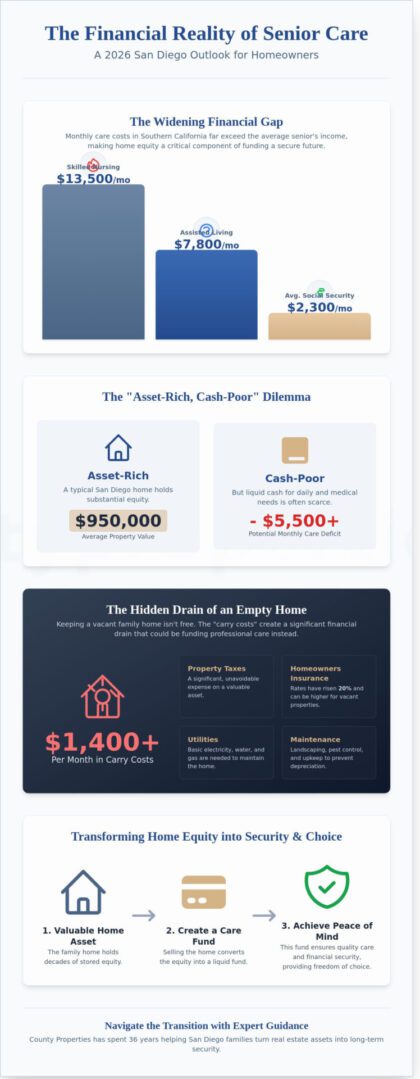
Planning for senior care in 2026 requires a clear look at the rising costs of healthcare in Southern California. For decades, the price of aging has outpaced general inflation, leaving many families to bridge a significant financial gap. In the current market, assisted living facilities in the San Diego region average $7,800 per month, while skilled nursing care often exceeds $13,500 for a semi-private room. These figures represent a 15% increase from just three years ago. Because most seniors rely on Social Security benefits that average $2,300 monthly, a massive deficit exists. This reality makes selling a home to pay for assisted living a logical and often necessary strategy for maintaining a high standard of care.
Your family home is likely your most powerful financial tool. It isn’t just a collection of memories; it’s a concentrated source of equity that can be unlocked to provide a “quality of life” buffer. Without this liquidity, many seniors find themselves restricted to facilities that accept only limited state funding, which may not offer the amenities or specialized attention they deserve. Before making a move, it’s helpful to understand the basics. You can learn more about the fundamental definitions by asking, What is assisted living? and how it differs from clinical nursing care. This distinction is vital because the level of care directly dictates the monthly burn rate of your savings.
Evaluating Care Costs in San Diego
San Diego remains one of the most expensive markets for senior housing in the United States. In 2026, local facilities often charge a base rate that covers housing and meals, but “hidden” costs can add $1,500 to $3,000 to the monthly bill. These add-ons include medication management, assistance with daily activities, and periodic level-of-care increases as health needs evolve. By selling a home to pay for assisted living, families create a dedicated “care fund.” This lump sum acts as a bridge, ensuring the senior can afford the best local options without the constant stress of monthly cash flow shortages. It allows for a seamless transition into a community that offers social engagement and safety.
The Asset-Rich, Cash-Poor Dilemma
Many San Diego homeowners find themselves in a precarious position. They own a property worth $950,000 but struggle to pay for daily help. Keeping a family home vacant while a loved one moves into care is often a massive financial drain. The “carry cost” of an empty house in California is substantial. Between property taxes, homeowners insurance (which has risen 20% in many zip codes), utilities, and basic landscape maintenance, an empty house can cost $1,400 per month or more. That’s money that could be directly funding professional care.
The emotional weight of keeping a property can be heavy, but the financial weight is often heavier. A house that sits empty doesn’t just drain cash; it also risks depreciation if maintenance is deferred. Transitioning that equity into a liquid account provides the freedom to choose a facility based on preference rather than just price. It’s about moving from a place of being “house rich” to being “care secure.” This shift ensures that the senior’s final chapters are defined by comfort and professional support rather than financial anxiety or property management chores.
Timing the Sale: Should You Sell Before or After the Move?
Deciding when to list a long-time family residence is often the most stressful part of the transition to senior care. The strategy you choose impacts both your financial liquidity and the emotional well-being of your loved one. Most families face a difficult choice: do you secure the cash first, or do you prioritize a fast, low-stress relocation? With over 36 years of experience guiding San Diego families through these transitions, we’ve seen that the right answer depends on the senior’s health and the current Southern California inventory levels.
The Benefits of Selling Before the Transition
Listing the home while the senior still resides there allows for immediate access to equity. This is a primary driver for families selling a home to pay for assisted living, as it eliminates the financial strain of “double-paying” for a mortgage and facility fees simultaneously. In California, where the median monthly cost for assisted living reached $5,250 in 2023, avoiding overlapping expenses is a significant relief.
Cash in hand provides a “clean slate” that changes your negotiation position. When you can prove immediate funding, you often gain leverage with facility admissions directors. This approach also forces a necessary decluttering process. Sorting through decades of belongings before the move ensures the senior only takes cherished items to their new suite. It’s a practical way to simplify the logistics of the move day itself. If you’re unsure how to start this process, our team can provide a free home valuation report to help you budget accurately.
The Case for Moving First, Selling Later
Conversely, moving the senior into a facility before listing the home is often the most compassionate choice for those with cognitive decline. According to the National Institute on Aging, routines are vital for seniors with dementia, and the chaos of home showings can trigger significant anxiety. By moving first, the family can focus entirely on the senior’s health during the critical first 30 days of care without the distraction of open houses.
From a real estate perspective, an empty house is significantly easier to stage and show. Professional cleaners can deep-clean the property, and minor repairs can be completed without disrupting anyone’s daily life. In the competitive Southern California market, a well-staged, vacant home often attracts higher offers and closes faster than an occupied one. This strategy works best if the family has enough savings to cover the first few months of care or utilizes a bridge loan.
The Bridge Loan Option and Market Timing
If liquid assets are tied up in the property, a bridge loan acts as a short-term financial gap. These loans typically offer a 6 to 12-month window, providing the funds needed for facility deposits and monthly fees while the house is on the market. While interest rates for these loans are usually 2% to 3% higher than standard mortgages, they offer the flexibility to wait for a better market price.
Local trends in Southern California dictate the pace of your move. As of 2024, San Diego County maintains a lean 2.5 months of inventory, meaning well-priced homes often sell in under 35 days. Families don’t always have the luxury of waiting for the “perfect” spring market. Since assisted living needs are often triggered by a health event, we prioritize a timeline that ensures the senior’s safety above all else. Selling a home to pay for assisted living is a journey, and we’re here to ensure the timing works for your family’s specific financial goals.
Navigating the Legal and Financial Impact of the Sale
Selling a home to pay for assisted living is a major financial pivot that requires a sharp eye on tax codes and state regulations. You aren’t just moving property; you’re liquidating your largest asset to fund years of specialized care. Under Internal Revenue Code Section 121, the IRS allows you to exclude up to $250,000 of capital gains from the sale of your primary residence if you’re single. Married couples filing jointly can exclude up to $500,000. To qualify, you must have lived in the home for two of the last five years. If a senior has already moved into a licensed care facility, the IRS provides a “one-year” exception, requiring them to have lived in the house for at least one year before entering the facility to still claim the full exclusion.
California residents benefit from Proposition 19, which became effective April 1, 2021. This law allows homeowners over age 55 to transfer their original property tax basis to a new primary residence anywhere in the state. This is vital if you plan to purchase a smaller, more accessible condo before eventually transitioning into full-time care. By transferring the tax basis, you avoid a massive spike in property taxes that would otherwise deplete your care budget. Our team has guided many families through these transitions, ensuring they don’t leave money on the table during the escrow process.
Protecting Medicaid (Medi-Cal) Eligibility
When selling a home to pay for assisted living, the timing of the sale affects your eligibility for government assistance. In California, your primary residence is generally an “exempt” asset while you live in it. Once the house sells, the proceeds instantly convert into “countable assets.” As of January 1, 2024, California significantly raised the Medi-Cal asset limit to $240,000 for an individual. If your home sale nets $400,000, you will suddenly exceed this limit and lose your benefits. You can find more details on balancing these assets in this National Institute on Aging guide to paying for long-term care, which helps clarify how personal resources integrate with federal programs.
To remain eligible, you must follow the 30-day “spend-down” or reinvestment rule. This means you have a very narrow window to use the proceeds for exempt purposes, such as paying off existing debt, prepaying for care, or making home modifications. You should never sign a listing agreement without first consulting an elder law attorney. They can help you structure the sale or set up a Pooled Income Trust to protect your eligibility while ensuring the funds remain available for your needs.
Legal Authorizations and Title Issues
Real estate transactions require clear legal capacity, which becomes complicated if a senior is experiencing cognitive decline. A standard Power of Attorney (POA) isn’t always enough for a home sale. Title companies specifically look for a “Durable Power of Attorney” that includes explicit “real estate powers” to sell, convey, or encumber property. If the document doesn’t explicitly mention the power to sell real estate, the transaction can stall in escrow, costing you precious weeks of care funding.
If the home is held in a Living Trust, the Successor Trustee must step in to manage the sale. This requires a formal Certification of Trust and often a physician’s letter if the original trustee is no longer of sound mind. We’ve seen situations where a senior lacks the capacity to sign but never established a POA; in these cases, the family must seek a court-ordered conservatorship. This process can take six months and cost upwards of $5,000 in legal fees, so it’s best to verify all legal documents 90 days before you intend to list the property.
Preparing a Senior’s Home for a Successful San Diego Sale
When you’re selling a home to pay for assisted living, the goal is to maximize equity as quickly as possible. San Diego buyers in 2026 are incredibly discerning. They prioritize updated aesthetics and functional, open spaces. Most homes owned by seniors for 30 or 40 years have “deferred maintenance” that can scare off traditional families looking for a turnkey experience. You don’t need a full, six-figure remodel to get a high price. You need strategic, targeted updates. Focusing on the kitchen and primary bathroom offers the highest return, often seeing a 75% to 85% return on investment in the Southern California market. County Properties uses 36 years of local data to identify exactly which repairs will trigger a bidding war and which ones are a waste of your budget.
Strategic Decluttering and Clean-Out
Clearing out a lifetime of belongings is the most emotionally taxing part of the transition. There’s a vital distinction between a garage sale and a professional estate sale. A garage sale often devalues your treasures. A professional estate sale reaches collectors and specialized buyers, which can increase your total liquidation proceeds by 40% or more.
County Properties streamlines this difficult process by connecting you with a vetted network of local vendors who handle everything from sorting to final haul-away. We help you decide what to keep for the new assisted living suite and what to sell to boost your care fund. It’s about creating “white space” in the home. Buyers need to see the square footage, not the history. Removing heavy drapes, oversized furniture, and personal collections makes rooms feel 20% larger in professional listing photos.
High-Impact, Low-Cost Refresh Strategies
Neutrality is your best friend in a competitive market. While you might love your vintage wallpaper, a 2026 buyer only sees a weekend of hard labor. Fresh paint in a soft, modern white or light greige is the single best investment you can make. It reflects the San Diego sun and makes smaller rooms feel expansive.
Lighting is equally critical for a successful sale. Swapping out 1980s brass fixtures for matte black or brushed nickel alternatives instantly de-ages a property. We recommend using 3000K LED bulbs to provide a warm, inviting glow that doesn’t feel clinical. Accessibility modifications like grab bars or ramps should generally be removed before listing. While they’re essential for seniors, they signal “medical facility” to young families. Removing these items and patching the drywall allows buyers to imagine their own future in the space rather than focusing on the home’s past use.
Don’t ignore the exterior. In our climate, a well-manicured, drought-resistant garden is the gold standard. Replacing a thirsty, brown lawn with succulents and decomposed granite can add 7% to your final sales price while lowering the buyer’s future water bills. Professional staging is the final touch. It’s not just about furniture; it’s about storytelling. We use contemporary pieces that appeal to the 2026 buyer’s desire for a clean, coastal lifestyle. This approach ensures your property stands out among the hundreds of listings in San Diego County.
Ready to maximize your home’s value for the next chapter? Consult with our senior transition experts today for a personalized property assessment.
The Turn-Key Solution: How County Properties Simplifies the Transition
County Properties operates differently than a standard residential brokerage. We hold the Senior Real Estate Specialist (SRES) designation, a credential that requires specific training in the financial and emotional hurdles seniors face. When you’re selling a home to pay for assisted living, you aren’t just looking for a buyer. You’re looking for a strategy that protects your parents’ equity while minimizing their stress. We provide that strategy by integrating with your existing support system. Our team coordinates directly with elder law attorneys and geriatric care managers to ensure every step of the sale aligns with long-term care goals and tax requirements.
Our marketing programs are specifically designed for sensitive family situations. We understand that a home isn’t just an asset; it’s a collection of decades of memories. We avoid high-pressure sales tactics that might overwhelm a senior. Instead, we use a “Family of Friends” approach that prioritizes clear communication and gentle transitions. This commitment to service excellence extends well beyond the closing date. We remain a resource for our clients, helping them settle into their new environment and ensuring the financial proceeds are handled according to their estate plan. Our goal is to make the process as invisible and painless as possible for the person moving.
We’ve spent 36 years refining a collaborative team concept. This means you don’t just get one agent; you get a collective of professionals working toward a seamless move. By managing the logistics, we allow adult children to focus on their parents’ health and well-being rather than worrying about repair addendums or escrow deadlines. We take the burden of the real estate transaction off your shoulders so you can be a supportive family member during this significant life change. We’ve found that this holistic approach reduces family conflict and speeds up the transition by an average of 15 days compared to traditional sales.
Personalized Step-by-Step Guidance
Managing a move from another state is a logistical nightmare for adult children. We act as your dependable guide and local representative in San Diego. Our network includes over 20 trusted local vendors, including professional organizers, estate liquidators, and specialized movers who understand senior transitions. If the timeline is urgent, we offer direct cash options. This allows families selling a home to pay for assisted living to bypass the traditional listing process and access funds in as little as 10 days, providing the liquidity needed for immediate care costs.
Your Trusted Real Estate Partner in Southern California
Since 1995, Arnie Levine has led County Properties with a vision of service-centric real estate. We’ve spent over three decades helping San Diego residents navigate the complexities of property transitions. Our philosophy is simple: we treat your family like our own. We bring 36 years of local market data and a compassionate touch to every consultation. To see how we can help your family transition with dignity and financial security, Schedule a Compassionate Consultation with Arnie Levine today.
Secure Your Senior Care Future in San Diego
Navigating the rising costs of senior care in 2026 requires a proactive and informed strategy. You’ve seen how timing the market correctly can prevent unnecessary debt; while coordinating with elder law professionals protects your family’s long-term interests. selling a home to pay for assisted living is a major life transition that demands more than a standard real estate approach. It requires a partner who understands the emotional and financial weight of this move.
County Properties offers 36 years of Southern California expertise to guide you through every hurdle. Our specialized Senior Real Estate Transition team uses a collaborative approach; working alongside your legal advisors to ensure every step is seamless. We’ve spent over three decades perfecting a turn-key solution that handles the heavy lifting so you can focus on what matters most. You don’t have to manage these complex 2026 market variables alone when you have a seasoned mentor by your side.
Request a Free Senior Transition Consultation
Take the first step toward a secure and comfortable future for your loved ones today. It’s a journey we’re ready to walk with you.
Frequently Asked Questions
Do I need a Power of Attorney to sell my parents house?
You need a valid Durable Power of Attorney (DPOA) if your parents can’t sign legal documents themselves. Without this document, you’d have to petition a California court for a conservatorship, a process that often costs 5,000 dollars or more in legal fees. Ensure the DPOA specifically grants the power to conduct real estate transactions. If they’re still mentally competent, they can sign the listing agreement and closing papers directly.
How does selling a home affect Medicaid (Medi-Cal) eligibility in California?
As of January 1, 2024, California eliminated the asset limit for Medi-Cal eligibility. This means your home equity or cash from a sale won’t disqualify you based on total wealth. However, the income generated from those proceeds still counts toward your monthly share of cost. You should consult a specialist to manage how this 100 percent asset disregard affects your specific long term care plan.
Can I sell my parents home if they have dementia?
You can sell the home if you have a Durable Power of Attorney that was signed before the dementia diagnosis. If your parent is already past the point of legal capacity and no DPOA exists, you must obtain a court-ordered conservatorship. This legal status allows you to manage their estate. In San Diego, this process involves a court investigator and can take 4 to 6 months to finalize.
Are the proceeds from selling a home to pay for assisted living tax-deductible?
While the proceeds from selling a home to pay for assisted living aren’t a tax deduction, the money you spend on care often qualifies as a medical expense. According to IRS Publication 502, you can deduct medical expenses that exceed 7.5 percent of your adjusted gross income. If a doctor certifies the senior is chronically ill, the entire cost of the facility may be deductible on their 2024 federal tax return.
How long does it typically take to sell a senior-owned home in San Diego?
It typically takes 28 to 45 days to find a buyer for a home in San Diego County as of early 2024. Senior-owned homes sometimes require an additional 14 days for clean-outs or estate preparations. Once you’re under contract, the escrow period usually lasts 30 days. Working with a team experienced in senior transitions can help streamline this 60 to 75 day total timeline.
Should I sell the house for cash or list it on the MLS?
You should list on the Multiple Listing Service (MLS) if you want to maximize the equity available for selling a home to pay for assisted living. While cash buyers offer a closing in as little as 7 days, they typically pay 70 percent of the home’s fair market value. Listing on the MLS exposes the property to 100 percent of the buyer pool. This competition often results in a 15 to 20 percent higher net profit.
What is Prop 19 and how does it help seniors moving to assisted living?
Proposition 19 allows homeowners 55 and older to transfer their low property tax base to a new primary residence anywhere in California. This is helpful if you’re selling a large family home to buy a smaller condo near an assisted living facility. You can use this benefit up to 3 times. It prevents a massive spike in property taxes, which can save a San Diego senior 3,000 to 6,000 dollars annually.
Is it better to rent my parents home instead of selling it?
Selling is usually the better option because it provides immediate liquidity for the 5,000 to 8,000 dollar monthly costs of San Diego assisted living. Renting requires you to become a landlord, manage repairs, and deal with vacancies. Most rental incomes in Southern California won’t cover the full cost of high-quality care. Selling allows you to invest the lump sum and draw from it as needed without the 24 hour stress of property management.