

Selling your California investment property is a significant financial milestone, but the looming threat of a massive capital gains tax bill can quickly turn excitement into anxiety. The fear of missing a strict deadline or misunderstanding a complex regulation is real, and it can feel like you’re navigating a minefield alone. This is especially true when trying to decipher the specific 1031 exchange rules california has in place on top of federal guidelines, leaving many investors feeling overwhelmed and uncertain about where to even begin.
As your trusted real estate partner, we believe you deserve a clear path to protecting your hard-earned equity. We created this ultimate 2025 guide to serve as your step-by-step roadmap, empowering you with the confidence to move forward. Inside, we’ll break down the critical 45-day and 180-day deadlines, clarify what “like-kind” property means in the Golden State, and provide a checklist of essential forms and common pitfalls to avoid. Let’s demystify the process together and ensure your next investment journey is a resounding success.
Key Takeaways
- Understand how a 1031 exchange serves as a powerful tool to defer significant capital gains taxes and strategically grow your real estate portfolio.
- Master the strict 45-day identification and 180-day closing deadlines, as these non-negotiable timelines are crucial for a successful exchange.
- Navigate the unique reporting requirements that separate federal guidelines from the specific 1031 exchange rules California imposes on investors.
- Discover a clear, step-by-step process for executing your exchange and learn how to sidestep the most common and costly mistakes.
What is a 1031 Exchange? Core Principles for California Investors
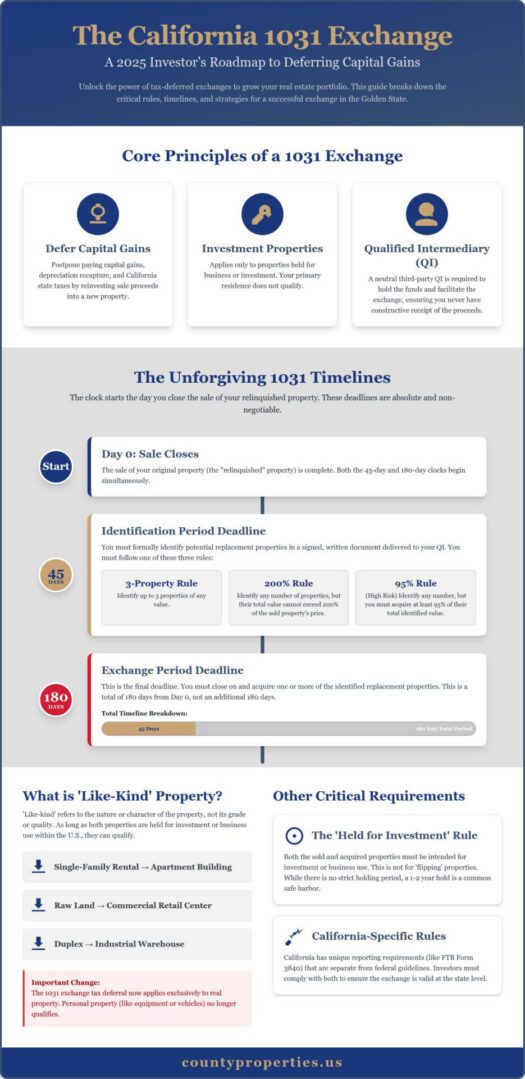
For savvy real estate investors in San Diego, a 1031 exchange is one of the most powerful wealth-building tools available. Named after Internal Revenue Code section 1031, this strategy allows you to defer paying capital gains taxes, depreciation recapture, and California state taxes when you sell an investment property, provided you reinvest the proceeds into a new, similar property. Think of it less like selling and buying, and more like swapping one investment for another without ‘cashing out’ and triggering a taxable event.
It’s crucial to understand that this powerful provision applies only to business or investment properties, not your primary residence. Navigating the strict 1031 exchange rules California requires precision, which is why the process must be facilitated by a neutral third party known as a Qualified Intermediary (QI).
Defining ‘Like-Kind’ Property in California
The term ‘like-kind’ can be misleading, but for real estate investors, it’s interpreted very broadly. You are not required to exchange one type of property for the exact same type. Instead, the rule focuses on the nature of the property, not its grade or quality. As long as both the property you sell and the one you acquire are held for investment within the United States, they can qualify. Common examples include:
- Swapping a single-family rental for a small apartment building.
- Exchanging raw land for a commercial retail center.
- Trading a duplex for an industrial warehouse.
It is important to note that this tax-deferred treatment now applies exclusively to real property; personal property like equipment or vehicles no longer qualifies for a 1031 exchange under federal law.
The ‘Held for Investment’ Requirement
A critical component of the 1031 exchange rules California investors must follow is the ‘held for investment’ requirement. Both the property you are selling (the relinquished property) and the one you are acquiring (the replacement property) must be intended for investment or business use. This distinguishes a 1031 exchange from ‘flipping,’ where a property is bought with the primary intent of reselling it quickly for profit. While the IRS has not set a strict holding period, a common safe harbor is holding the property for at least one to two years. Your intent is paramount, so maintaining records that document your investment purpose, such as rental agreements and financial statements, is a best practice to support your exchange.
The Critical Timelines: Mastering California’s 45-Day and 180-Day Rules
When navigating the 1031 exchange rules California investors must follow, no element is more critical-or unforgiving-than the two mandatory timelines. These deadlines are set by the IRS and are absolute, with no extensions for weekends, holidays, or unforeseen difficulties. Understanding these dates is fundamental; for a deeper dive into all 1031 exchange rules and basics, it’s wise to be well-informed. The clock begins ticking the moment your relinquished property sale closes, setting in motion two concurrent deadlines that demand your immediate attention and expert guidance.
For instance, if you close the sale of your relinquished property on March 1st:
- Your 45-day identification deadline is April 15th.
- Your 180-day exchange period deadline is August 28th.
You do not get 45 days plus 180 days. You get a total of 180 days to complete the entire exchange, with the first 45 of those days dedicated to identification.
The 45-Day Identification Period
Within this first, crucial window, you must formally identify potential replacement properties in a signed, written document delivered to your Qualified Intermediary (QI). You must adhere to one of three strict identification rules:
- The 3-Property Rule: Identify up to three properties of any value. Example: You sell a property for $1M and identify two condos and one duplex as potential replacements.
- The 200% Rule: Identify any number of properties, as long as their combined fair market value does not exceed 200% of your relinquished property’s sale price. Example: You sell for $1M and identify five properties with a total value of $1.9M.
- The 95% Rule: Identify any number of properties, but you must acquire at least 95% of the total value of all properties identified. This rule is less common due to its high risk.
The 180-Day Exchange Period
This is your final deadline to complete the exchange by closing on the purchase of one or more of the properties you formally identified. This period is 180 calendar days from your original sale closing or your tax filing date for that year (including extensions), whichever comes first. This is a vital detail for exchanges closing late in the year. All due diligence, financing, and closing procedures must be finalized within this window, making proactive planning essential for a successful transaction. Waiting until the last minute is the most common and costly mistake an investor can make.
California-Specific 1031 Rules You Must Know
While the 1031 exchange is governed by federal tax code, it’s crucial for investors to understand that California has its own distinct set of regulations. If you are selling an investment property in San Diego or anywhere else in the state, this section is critical. Overlooking these state-level requirements can lead to unexpected tax liabilities down the road, even if your exchange was perfectly executed at the federal level. Navigating the specific 1031 exchange rules California imposes is a key advantage of partnering with a local expert who can provide trusted, step-by-step guidance.
The California ‘Clawback’ Provision Explained
California enforces what is commonly known as a “clawback” provision. This rule gives the state the right to tax the capital gains you deferred, even if you exchange your California property for one in another state. For example, if you exchange a San Diego apartment building for a commercial property in Texas, California will track that transaction. The tax is still deferred, but the moment you sell the Texas property without another exchange, California will “claw back” its portion of the tax on the original gain. This requires diligent, ongoing reporting to the state to remain in compliance.
Reporting Your Exchange: FTB Form 3840
To track these exchanges, the state requires specific paperwork. Anyone who defers a capital gain from the sale of a California property through a 1031 exchange must file FTB Form 3840, titled California Like-Kind Exchanges. This is not a one-time filing. To comply with the California Franchise Tax Board reporting requirements, you must submit this form for the tax year of the exchange and for every year thereafter in which the gain is deferred. Failure to file can result in significant penalties.
- Who Files: Any individual or business deferring a gain from a California property.
- When to File: For the year of the exchange and every subsequent year until the replacement property is sold.
- Why It’s Important: Non-compliance can void your tax deferral at the state level and trigger penalties.
Understanding these unique 1031 exchange rules California has in place is essential for protecting your investment and ensuring a seamless, successful transaction. Our team is here to help you navigate every detail with confidence.
Executing a Flawless 1031 Exchange: A Step-by-Step Walkthrough
Successfully navigating a 1031 exchange can seem daunting, but with a clear roadmap and a trusted team, it becomes a powerful wealth-building strategy. This step-by-step guide is designed to demystify the process, providing a practical framework for your journey. The single most important decision you can make is assembling your expert team-including a CPA, a Qualified Intermediary, and an experienced real estate agent-before you even list your property. Your agent will serve as the crucial coordinator, ensuring every deadline is met for a seamless transaction.
Phase 1: Before the Sale
Proactive planning is the foundation of a successful exchange. Before your property is under contract, you must complete these critical first steps:
- Step 1: Consult Your Team. Discuss your goals with your CPA to confirm a 1031 exchange aligns with your financial strategy. Partner with a real estate agent who has proven experience in investment properties and exchanges.
- Step 2: Add a Cooperation Clause. Your agent will ensure the sales agreement for your relinquished property includes a clause stating the buyer agrees to cooperate with your 1031 exchange at no cost or liability to them.
- Step 3: Engage a Qualified Intermediary (QI). You cannot touch the sales proceeds. You must formally select and engage a reputable QI to hold the funds in escrow between the sale and the purchase.
Phase
Avoiding Costly Mistakes: How a Trusted Partner Protects Your Investment
In our decades of experience guiding San Diego investors, we’ve seen how seemingly small oversights can lead to significant financial consequences. Navigating the intricate 1031 exchange rules California has in place requires more than just good intentions; it demands precision and expertise. A single misstep can disqualify your entire exchange, triggering a massive, unexpected tax bill on your capital gains. The key to protecting your investment is not just knowing the rules, but understanding how to avoid the common pitfalls that trap inexperienced investors.
The Dangers of ‘Boot’ and Constructive Receipt
Two of the most damaging errors involve ‘boot’ and ‘constructive receipt.’ Boot is any non-like-kind property you receive in an exchange, such as cash back, debt relief (mortgage on the new property is less than the old one), or personal property. This portion is immediately taxable. Constructive receipt is even more dangerous; it occurs if you take control of the sale proceeds, even for a moment. To avoid this, your funds must always be held by a neutral third-party Qualified Intermediary (QI) from the moment your relinquished property closes until your replacement property is purchased.
Why Your Real Estate Agent Matters
Your real estate agent is your strategic quarterback in a 1031 exchange. An agent experienced in these transactions does more than just find properties; they are essential for a successful outcome. Their expertise is critical for:
- Drafting Proper Contracts: Ensuring the purchase agreements for both properties contain the necessary 1031 exchange cooperation clauses.
- Meeting Strict Deadlines: Leveraging their network and market knowledge to help you identify suitable replacement properties within the tight 45-day window.
- Seamless Coordination: Acting as the central point of communication between the Qualified Intermediary, title company, and lender to prevent costly delays.
An expert partner ensures every step complies with the complex 1031 exchange rules california requires, safeguarding your tax-deferred status. They are your first line of defense against mistakes that could jeopardize your financial goals.
Ultimately, a successful 1031 exchange is a team effort. Partnering with a trusted real estate professional who lives and breathes these transactions is the most important decision you can make. To ensure your investment journey is protected, contact the seasoned experts at County Properties for guidance you can count on.
Master Your California Investment Strategy
Successfully leveraging a 1031 exchange is a powerful way to build wealth, but it demands precision. As we’ve covered, mastering the critical 45 and 180-day deadlines and understanding unique state-level requirements are non-negotiable. A single misstep can negate the significant tax benefits, making expert partnership essential. Adhering to the complex 1031 exchange rules california is not just about following a checklist; it’s about strategic execution to protect and grow your assets.
Navigating this journey requires a trusted guide. With over 36+ years of real estate experience in Southern California, the team at County Properties provides specialized guidance for complex investment transactions. We are a service-centric team committed to your financial success, ensuring every detail is managed with expertise. Don’t leave your legacy to chance.
Navigating a 1031 exchange requires expert guidance. Contact County Properties to develop your California investment strategy. Let’s confidently secure your financial future together.
Frequently Asked Questions About San Diego 1031 Exchanges
Can I do a 1031 exchange on my primary residence or a vacation home?
Generally, no. IRS regulations specify that both the property you sell and the one you acquire must be held for productive use in a trade, business, or for investment. A primary residence or a personal vacation home does not meet this “held for investment” requirement. To qualify, the property’s primary purpose must be for business or investment, a foundational rule for any investor looking to defer capital gains in San Diego.
What is ‘boot’ in a 1031 exchange, and how is it taxed?
In a 1031 exchange, ‘boot’ refers to any non-like-kind property received during the transaction. This most often includes cash, a reduction in your mortgage debt (debt relief), or other personal property. While receiving boot does not automatically void the exchange, its fair market value is considered a taxable gain. To ensure full tax deferral, your goal should be to acquire a replacement property of equal or greater value and debt.
Can I use 1031 exchange funds for renovations on the new property?
You cannot directly use exchange funds for renovations after acquiring the new property, as the money must be used to purchase the real estate itself. However, it is possible to structure an “improvement” or “construction” exchange from the start. This allows you to use the exchange proceeds to both acquire the property and pay for pre-planned improvements, but it requires careful coordination with your Qualified Intermediary and trusted advisors before closing.
What is the role of a Qualified Intermediary (QI) and why are they required?
A Qualified Intermediary is a mandatory, independent third party whose role is to facilitate the exchange. The QI holds the proceeds from the sale of your property to prevent you from having “constructive receipt” of the funds. This is a critical component of the 1031 exchange rules California investors must follow. The QI then uses these funds to acquire your replacement property, ensuring the transaction qualifies for tax-deferred status under IRC Section 1031.
How many times can I perform a 1031 exchange?
There is no limit on the number of 1031 exchanges you can perform. This powerful strategy allows investors to continuously roll gains from one investment property into another, deferring capital gains taxes indefinitely. By repeatedly exchanging properties, you can significantly grow the value of your real estate portfolio over time without the immediate tax liability that would otherwise diminish your investment capital. It is a cornerstone strategy for long-term wealth building.
What happens if I cannot find a replacement property within 45 days?
The 45-day identification period is a strict and inflexible deadline. If you fail to formally identify potential replacement properties in writing to your Qualified Intermediary within this timeframe, the exchange will fail. Your QI will then be required to return the sale proceeds to you, and the transaction will be treated as a standard taxable sale. You will be liable for all applicable capital gains taxes on the profit from your original property.